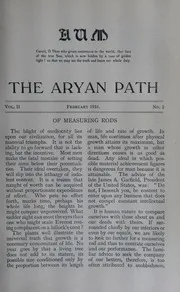
Esoteric Buddhism
 71
71

Esoteric Buddhism
Alfred Percy Sinnett's "Esoteric Buddhism," with contributions from Desmond Gahan, offers a fascinating, if dated, attempt to bridge the gap between Western occultism and Buddhist philosophy as understood by the nascent Theosophical Society. The book’s strength lies in its ambitious synthesis, presenting complex ideas like cyclic evolution and the seven principles of man in a structured, albeit esoteric, framework. However, its primary limitation is the inherent bias of its Theosophical interpretation, which often overlays Buddhist concepts with Western occult terminology and assumptions, potentially obscuring the original teachings. A passage discussing the "man-atom" and its journey through different planes of existence exemplifies this unique, sometimes convoluted, interpretive style. It is a valuable artifact of esoteric history, revealing how Buddhism was refracted through a specific Western spiritual lens in the late 19th century.
📝 Description
71
Alfred Percy Sinnett and Desmond Gahan's 1886 work filters Buddhist doctrine through a Theosophical lens.
Esoteric Buddhism presents a Theosophical interpretation of Buddhist teachings, aiming to align them with Western esoteric thought. The authors discuss concepts like reincarnation, karma, and consciousness, framing them within a model of cosmic evolution. This perspective suggests a hidden meaning in Buddhist philosophy, accessible through spiritual study and personal development.
The book is written for those interested in comparative religion and esotericism, especially individuals curious about the convergence of Eastern philosophies and Western occult traditions. Readers familiar with Helena Blavatsky's work or alternative understandings of Buddhism will find it particularly relevant. It addresses how ancient spiritual systems can be re-examined using modern esoteric frameworks.
Published in 1886, the book appeared during a time of significant Western fascination with Eastern religions and spiritualism. It contributed to the Theosophical movement's efforts to synthesize global religious and philosophical ideas. The text offered interpretations of Buddhism that sometimes differed from traditional monastic viewpoints, shaping its reception in Western esoteric circles.
This book emerged from the Theosophical movement, founded in 1875 by Helena Blavatsky. Theosophy sought to find universal truths within world religions, occult traditions, and ancient philosophies. Esoteric Buddhism applies this synthetic approach to Buddhist concepts, reinterpreting them through a framework that includes spiritual hierarchies, astral bodies, and cosmic cycles. It reflects a late 19th-century Western interest in 'hidden' or 'esoteric' dimensions of Eastern religions, often diverging from orthodox interpretations.
💡 Why Read This Book?
• Understand the Theosophical interpretation of Buddhist concepts, such as the seven principles of man, as presented in the late 19th century, offering a unique historical perspective not found in purely academic Buddhist studies. • Explore the book's framework of cyclic evolution and spiritual progression across lifetimes, providing a metaphysical lens through which to view personal development and cosmic history, distinct from linear Western paradigms. • Examine the concept of 'adepts' and their role in guiding humanity, as detailed in the text, which offers insight into esoteric views of spiritual hierarchy and enlightened beings prevalent in the Theosophical movement.
⭐ Reader Reviews
Honest opinions from readers who have explored this book.
❓ Frequently Asked Questions
When was "Esoteric Buddhism" first published?
Alfred Percy Sinnett's "Esoteric Buddhism" was first published in 1886, a significant year for esoteric literature and the burgeoning Theosophical movement in the late 19th century.
What is the main focus of "Esoteric Buddhism"?
The book focuses on interpreting Buddhist philosophy through the lens of Theosophy, exploring concepts like reincarnation, karma, and spiritual evolution within a Western esoteric framework.
Who was Alfred Percy Sinnett?
Alfred Percy Sinnett was an English journalist and writer, and a prominent member of the Theosophical Society. He was a key figure in popularizing Theosophical ideas, including his interpretation of Buddhism.
Does "Esoteric Buddhism" align with traditional Buddhist teachings?
The work offers an esoteric interpretation that often diverges from traditional monastic Buddhist doctrines, integrating Western occult concepts and Theosophical frameworks.
What esoteric concepts are discussed in the book?
Key concepts include the seven principles of man, cyclic evolution (kalpas), subtle bodies, and the role of spiritual adepts, all presented within a metaphysical and evolutionary context.
Is "Esoteric Buddhism" considered a primary source for Buddhist studies?
While not a primary source for traditional Buddhist studies, it is a significant text for understanding the history of Western esotericism and how Eastern religions were received and reinterpreted in the late 19th century.
🔮 Key Themes & Symbolism
Cyclic Evolution and Karma
The book elaborates on the concept of cyclic evolution, presenting existence not as a linear progression but as a series of grand cycles (kalpas) through which consciousness evolves. Karma is framed as the immutable law governing this progression, dictating the conditions of rebirth and the lessons to be learned across multiple lifetimes. This interpretation links individual moral actions to a vast cosmic unfolding, suggesting a purpose behind suffering and a structured path toward spiritual advancement.
The Seven Principles of Man
A central theme is the dissection of human consciousness into seven distinct principles, a framework integral to Theosophical thought. These principles range from the physical body to the highest spiritual essence, outlining a complex structure of being. The text details how these principles interact and develop throughout an individual's evolutionary journey, suggesting that understanding and refining these components is key to spiritual realization and liberation from the cycle of rebirth.
Spiritual Adepts and Guidance
Esoteric Buddhism introduces the idea of spiritual adepts, highly evolved beings who have transcended ordinary human limitations. These figures are presented as guides and guardians of humanity, subtly influencing its spiritual and intellectual progress. The book suggests that knowledge of esoteric truths is often transmitted through these advanced souls, offering a hierarchical view of spiritual development and the existence of hidden masters who oversee the planet's evolution.
The Nature of Buddhahood
The work offers a unique perspective on the concept of Buddhahood, interpreting it not merely as a historical figure but as a state of being and a potential for all individuals. It discusses the stages of spiritual attainment leading to enlightenment within the context of the seven principles and the grand cycles. This esoteric view of Buddhahood emphasizes inner transformation and the realization of latent spiritual potentials.
💬 Memorable Quotes
Direct passages from the work, attributed to the author.
“The doctrine of Karma is the doctrine of cause and effect, applied to the moral and spiritual world.”
— This highlights the book's focus on karma as a fundamental law governing existence, emphasizing that actions have inevitable consequences that shape future experiences and spiritual progress across lifetimes.
“The universe is governed by great cycles of manifestation and dissolution.”
— This interpretation captures the book's presentation of cosmic time as cyclical, rather than linear, a fundamental aspect of its esoteric cosmology that influences the understanding of evolution and rebirth.
“The ultimate goal is the liberation from the cycle of rebirth, achieved through spiritual knowledge.”
— This captures the book's overarching aim for the spiritual aspirant: to understand the laws of existence and achieve enlightenment, thereby escaping the continuous process of reincarnation.
💡 Key Ideas
Editorial paraphrase of the work's core concepts — not direct quotes.
Man is not a single entity, but a composite being, composed of several distinct principles.
This paraphrase points to the core Theosophical concept of the seven principles of man, which the book uses to explain the complex structure of human consciousness and its journey through evolution.
Evolution proceeds not only on the physical plane, but on spiritual and mental planes as well.
This paraphrased concept underscores the book's emphasis on a multi-dimensional view of evolution, extending beyond biological development to encompass the spiritual and intellectual growth of consciousness.
🌙 Esoteric Significance
Tradition
This work is firmly rooted in the Western Esoteric Tradition, specifically the Theosophical movement established by Helena Blavatsky. It attempts to reconcile and reinterpret Buddhist doctrines within the Theosophical framework, which itself draws from Hermeticism, Neoplatonism, Kabbalah, and Eastern philosophies. It departs from traditional Buddhism by introducing concepts like the seven principles of man and a specific cosmology of cyclic evolution, framing Buddhist ideas as part of a universal, hidden spiritual science.
Symbolism
The book frequently employs the symbolism of the lotus flower, representing spiritual purity and unfolding consciousness amidst the muddy waters of material existence. Another key motif is the wheel of Samsara, symbolizing the continuous cycle of birth, death, and rebirth driven by karma, which the text illustrates as a process of evolutionary learning rather than mere suffering. The concept of 'planes' also functions symbolically, mapping out distinct levels of reality and consciousness that the soul traverses.
Modern Relevance
Contemporary esoteric practitioners and comparative religion scholars still reference "Esoteric Buddhism" for its historical significance in shaping Western perceptions of Buddhism. Thinkers and groups within the broader New Age movement and various neo-Theosophical societies continue to draw upon its synthesis of Eastern and Western spiritual ideas, particularly concerning karma, reincarnation, and consciousness evolution. It serves as a foundational text for understanding the historical development of esoteric interpretations of Buddhism.
👥 Who Should Read This Book
• Students of Theosophy and Western Esotericism: Those interested in the foundational texts and interpretations of the Theosophical movement will find this a crucial, albeit historically situated, read. • Comparative Religion Scholars: Researchers examining how Eastern religions were received and adapted in the West during the late 19th century will gain insight into a specific influential interpretation. • Seekers of Metaphysical Frameworks: Individuals exploring alternative models of consciousness, reincarnation, and spiritual evolution beyond conventional religious or scientific paradigms will find its detailed system compelling.
📜 Historical Context
The publication of "Esoteric Buddhism" in 1886 placed it squarely within the intellectual ferment of the late Victorian era, a period marked by a profound Western fascination with Eastern religions and burgeoning spiritualist movements. Helena Blavatsky's Theosophical Society, founded in 1875, was gaining significant traction, seeking to synthesize ancient wisdom traditions. Sinnett, a prominent Theosophist, contributed significantly to this effort by interpreting Buddhist concepts through a Theosophical lens. This work emerged alongside other popular esoteric texts and engaged with, though often implicitly, the prevailing scientific and religious orthodoxies of the time. Its reception was enthusiastic within esoteric circles, but critical from traditional Buddhist scholars and mainstream religious thinkers who viewed its interpretations as syncretic and potentially misrepresentative of original Buddhist teachings.
📔 Journal Prompts
The manifestation and dissolution cycles of the universe described in the text.
The seven principles of man and their role in spiritual development.
The law of Karma as a mechanism for soul evolution.
The concept of spiritual adepts and their influence on humanity.
The relationship between individual consciousness and cosmic cycles.
🗂️ Glossary
Kalpa
A vast cosmic cycle of time in Hindu and Buddhist cosmology, representing a period of creation and dissolution, which the book uses to frame universal evolution.
Samsara
The cycle of death and rebirth, a fundamental concept in many Indian religions, which the book interprets through the lens of karma and spiritual evolution.
Seven Principles of Man
A Theosophical concept outlining the layered structure of human consciousness, typically including physical, vital, astral, lower and higher mental, psychic, and spiritual bodies.
Karma
The spiritual principle of cause and effect, where intent and actions of an individual influence their future in this life and in subsequent rebirths.
Adepts
Individuals who have achieved a high degree of spiritual development and mastery over their lower nature, often seen as spiritual guides or masters.
Man-atom
A Theosophical term referring to the essential spiritual spark or monadic essence that reincarnates through various human lives and evolutionary stages.
Planes of Existence
Different levels or dimensions of reality, from the physical to the spiritual, through which consciousness and subtle bodies are understood to operate and evolve.
🔮 Readers Also Liked
Browse all →






More by Alfred Percy Sinnett, Desmond Gahan
All books →
More Free Theosophy & Anthroposophy Books
View all →