Elementary Theosophy
 78
78

Elementary Theosophy
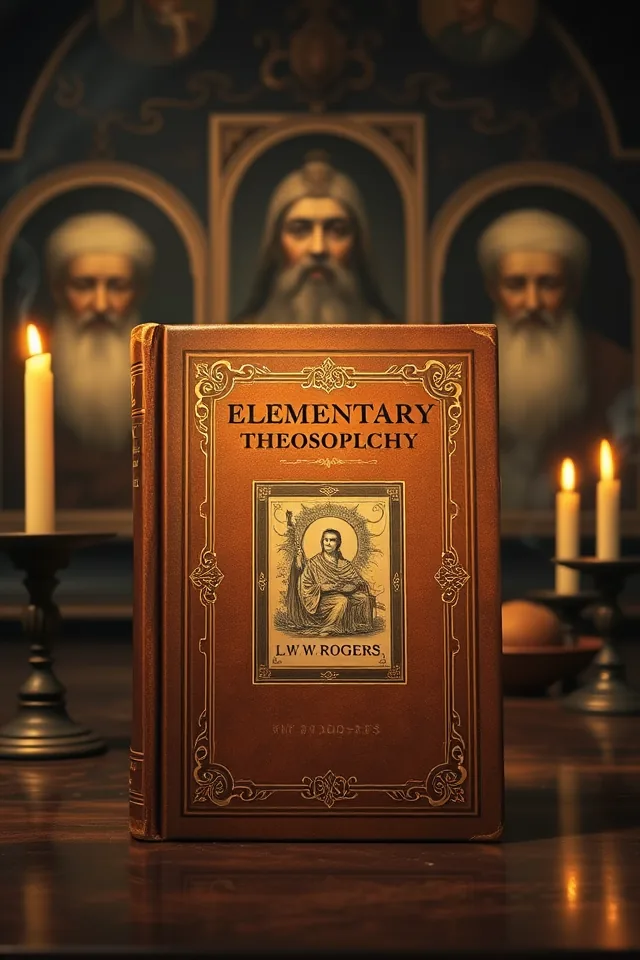
L. W. Rogers' "Elementary Theosophy" offers a commendable effort to distill the often-intimidating principles of Theosophy into digestible prose. Its strength lies in its systematic approach, presenting complex ideas like the seven planes or the man-body constitution with a clarity that genuinely aids beginners. Rogers avoids overly academic jargon, making the esoteric accessible. However, the very act of simplification can sometimes lead to a flattening of the profound paradoxes inherent in Theosophical thought. For instance, the discussion of karma, while clear, might not fully convey the intricate, multi-lifetime karmic entanglements Theosophy often describes. A passage discussing the "lower quaternary" and its relation to the "higher triad" effectively illustrates Rogers' ability to map these abstract principles, but it also highlights the potential for over-schematization. This is a solid primer, but readers should be aware that it is an introduction, not an exhaustive exegesis. It serves its purpose as a gateway text effectively.
📝 Description
78
L. W. Rogers wrote 'Elementary Theosophy' to explain Theosophy's core ideas simply.
Published in 2016, L. W. Rogers' 'Elementary Theosophy' acts as a clear introduction to the main ideas of Theosophy. The book aims to make complex spiritual and philosophical concepts accessible to those new to the subject. Rogers breaks down abstract principles, explaining unseen forces and the governing rules of existence as understood within Theosophical thought. This text is suited for newcomers to Theosophy or anyone wanting a straightforward overview of Helena Blavatsky's work. It appeals to the curious, spiritual seekers, and those interested in comparing religions and philosophies from an esoteric viewpoint.
Readers who find other spiritual writings difficult to approach may appreciate Rogers' direct style. The book is also useful for students of occultism and metaphysics. It helps build a solid understanding of Theosophical basics before tackling more advanced material. Rogers' work synthesizes and simplifies the early foundations of Theosophy, continuing the effort to spread these principles after Blavatsky's era.
Theosophy, originating in the late 19th century with figures like Helena Blavatsky, sought to synthesize Eastern and Western esoteric traditions. Blavatsky's major works, such as 'The Secret Doctrine' (1888), laid out a complex cosmology and philosophy. Rogers' 'Elementary Theosophy,' while published much later, directly engages with these foundational texts. His aim was to distill and simplify these often dense teachings, making them understandable for a wider audience. The book reflects a continuing tradition of making esoteric knowledge accessible, bridging the gap between complex original works and the general reader interested in spiritual philosophy.
💡 Why Read This Book?
• Gain a foundational understanding of the Seven Planes of Existence, a core Theosophical cosmological model, enabling you to grasp how consciousness operates across different dimensions. • Learn about the Law of Karma and Reincarnation as explained by L. W. Rogers, providing a framework for understanding cause and effect in personal development. • Explore the concept of the 'Principles of Man,' a Theosophical model of human constitution, offering a unique perspective on the interplay between spirit, mind, and body.
⭐ Reader Reviews
Honest opinions from readers who have explored this book.
❓ Frequently Asked Questions
What is Theosophy according to L. W. Rogers?
L. W. Rogers defines Theosophy as divine wisdom, an ancient and universal system of thought concerning the fundamental truths of existence, the nature of the universe, and humanity's place within it, accessible through study and inner development.
Who was L. W. Rogers in relation to Theosophy?
L. W. Rogers was an author and proponent of Theosophy who sought to make its teachings accessible. His work, like "Elementary Theosophy," aimed to demystify complex concepts for a wider audience interested in spiritual and esoteric philosophy.
What are the key principles discussed in Elementary Theosophy?
The book covers fundamental Theosophical ideas such as the Monad, the seven planes of existence, the seven principles of man, karma, reincarnation, and the evolutionary journey of consciousness.
Is this book suitable for complete beginners to esotericism?
Yes, "Elementary Theosophy" is specifically designed as an introductory text. Rogers' clear language and systematic presentation make it an excellent starting point for those new to Theosophy or esoteric studies.
When was "Elementary Theosophy" originally published?
While this edition was published in 2016, L. W. Rogers' original writings on Theosophy were produced earlier in the 20th century, contributing to the ongoing dissemination of Theosophical thought.
What is the concept of the 'Monad' in Theosophy as presented by Rogers?
Rogers explains the Monad as the divine spark or individualized consciousness within each being, the ultimate source of existence that journeys through evolution across countless lifetimes and planes.
🔮 Key Themes & Symbolism
The Seven Principles of Man
Rogers elaborates on the Theosophical understanding of human constitution, detailing the seven principles that make up an individual. These range from the physical body to the higher spiritual aspects like Atma and Buddhi. The work emphasizes that true understanding of oneself requires acknowledging and integrating these distinct yet interconnected principles, moving beyond a purely materialist view of humanity. This framework provides a map for inner development and spiritual evolution, suggesting that each principle has its own consciousness and function.
Karma and Reincarnation
Central to Rogers' exposition is the law of Karma, presented not as arbitrary fate but as an impersonal, unerring principle of cause and effect governing all existence. Reincarnation is the mechanism through which karmic lessons are learned and spiritual evolution progresses. The book explains how actions in one life inevitably shape the circumstances of future lives, offering a cosmic justice system that encourages ethical living and personal responsibility. This cyclical view of existence provides a profound context for understanding life's challenges and opportunities.
The Planes of Existence
Rogers systematically outlines the Theosophical cosmology, detailing the seven planes of existence. These include the physical, astral, mental, Buddhic, and Atmic planes, among others. The text explains that consciousness operates on different levels and that human beings are not limited to the physical dimension. This concept provides a framework for understanding subtle energies, psychic phenomena, and the multi-dimensional nature of reality, positing that spiritual growth involves expanding awareness across these planes.
The Evolution of Consciousness
A fundamental theme is the ongoing evolutionary journey of the human Monad. Rogers posits that consciousness, originating from the Divine, undergoes a long process of development through successive incarnations and across various planes. This evolution is driven by experience, learning, and the gradual purification of the lower principles. The work suggests that humanity is part of a grand cosmic unfolding, with the ultimate goal of returning to its divine source with accumulated wisdom and spiritual attainment.
💬 Memorable Quotes
Direct passages from the work, attributed to the author.
“The Monad is the divine spark in each of us.”
— This statement captures the Theosophical concept of the Monad as the essential, eternal spiritual self, the individualised divine essence that undergoes the process of reincarnation and evolution.
“Karma is the law of cause and effect.”
— This succinctly defines karma not as punishment or reward, but as a natural, impersonal law that ensures every action generates a corresponding reaction, shaping future experiences.
“Man has seven principles.”
— This refers to the Theosophical model of human constitution, which posits seven distinct aspects or vehicles of consciousness, from the physical body to the higher spiritual principles.
“The planes are different states of consciousness.”
— This interpretation highlights that the Theosophical 'planes' are not merely physical locations but differing levels or modes of awareness and existence, extending beyond the material realm.
“Evolution is the path of the Monad.”
— This underscores the idea that the primary purpose and process for the divine spark within each being is a gradual, unfolding development through numerous experiences and lifetimes.
🌙 Esoteric Significance
Tradition
This work firmly belongs within the Theosophical tradition, stemming directly from the teachings disseminated by Helena Blavatsky and the Theosophical Society. It adheres to the core tenets of Theosophy, emphasizing universal brotherhood, comparative religion, and the study of latent human powers and the laws governing the universe. Rogers' contribution lies in making these often dense teachings more accessible, acting as a bridge between the foundational esoteric literature and the curious newcomer.
Symbolism
The book often employs symbolic language common in esoteric traditions. The concept of the 'Monad' serves as a primary symbol for the divine spark within, representing ultimate unity and potential. The 'Seven Principles of Man' can be seen as symbolic of a layered reality, illustrating the complex interplay between the material and spiritual aspects of existence. Furthermore, the 'Planes of Existence' function symbolically, representing different states of consciousness and degrees of manifestation rather than literal geographic locations.
Modern Relevance
Contemporary esoteric practitioners, particularly those interested in comparative spirituality, conscious evolution, and the application of ancient wisdom to modern life, still draw upon the foundational concepts presented in works like Rogers'. Modern New Age thought, certain branches of depth psychology exploring archetypes, and self-help movements focused on personal growth and understanding karma often echo Theosophical ideas, sometimes without direct attribution.
👥 Who Should Read This Book
• Beginners exploring Theosophy: Individuals new to the works of Helena Blavatsky or the Theosophical Society will find this a clear and structured starting point. • Students of comparative religion: Those interested in how Eastern philosophies and esoteric traditions explain human nature and the cosmos will gain valuable context. • Seekers of spiritual frameworks: Readers looking for a systematic, philosophical approach to understanding life, death, and the purpose of existence may find resonance.
📜 Historical Context
L. W. Rogers' "Elementary Theosophy," while finding its way into a 2016 edition, engages with ideas deeply rooted in the Theosophical movement that flourished in the late 19th and early 20th centuries. Helena Blavatsky's seminal works, "Isis Unveiled" (1877) and "The Secret Doctrine" (1888), laid the groundwork for this spiritual renaissance, attracting a public eager to explore Eastern philosophies and occult sciences. Rogers' text follows in this tradition, simplifying complex doctrines for a broader readership. This era saw competing interests in spiritualism, Theosophy, and emerging psychological theories. While figures like Annie Besant and C.W. Leadbeater continued Blavatsky's work, Rogers offered a more focused, introductory approach. His writing reflects a sustained effort to make Theosophical concepts, such as karma and reincarnation, palatable and understandable within a Western context, contributing to the ongoing dissemination of these esoteric ideas.
📔 Journal Prompts
The Monad's journey through the planes, as described by Rogers.
Reflecting on the Law of Karma and its manifestation in personal experience.
The seven principles of man: which aspect feels most prominent currently?
Connecting the concept of reincarnation to personal growth and learning.
How the concept of the Seven Planes might inform one's perception of reality.
🗂️ Glossary
Monad
In Theosophy, the divine spark or individualized spiritual essence within each being, the ultimate source of consciousness that undergoes evolution through multiple lives and planes.
Karma
The universal law of cause and effect, where actions (causes) inevitably lead to corresponding results (effects), shaping an individual's present and future experiences.
Reincarnation
The Theosophical doctrine that the essential spiritual self (Monad) is reborn into new physical bodies over successive lifetimes to learn lessons and evolve spiritually.
Planes of Existence
The multiple levels or dimensions of reality described in Theosophy, ranging from the physical to increasingly subtle spiritual realms, each corresponding to different states of consciousness.
Principles of Man
The Theosophical model of human constitution, comprising seven distinct aspects or vehicles of consciousness, from the physical body (Sthula Sharira) to the higher spiritual principles (Atma, Buddhi).
Theosophy
Literally 'divine wisdom,' an esoteric philosophy originating in the late 19th century, seeking to understand the fundamental truths of existence and the laws governing the universe.
Mahatma
A term used in Theosophy to refer to highly evolved spiritual beings or Masters who guide humanity's evolution and have attained profound wisdom and spiritual realization.
🔮 Readers Also Liked
Browse all →








More by L. W. Rogers
All books →




More Free Theosophy & Anthroposophy Books
View all →