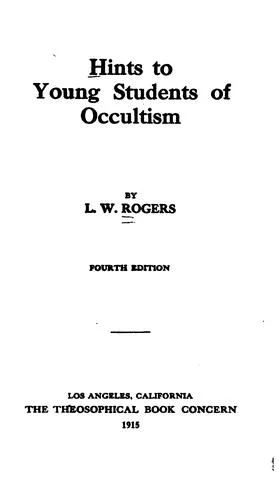
Hints to Young Students of Occultism
 81
81

Hints to Young Students of Occultism
L. W. Rogers’ *Hints to Young Students of Occultism* offers a surprisingly direct and unadorned entry point into esoteric studies, a welcome antidote to the often flowery prose found in similar early 20th-century texts. The strength of this 1909 edition lies in its no-nonsense approach, treating occultism as a serious path requiring discipline rather than mere curiosity. Rogers’ insistence on ethical conduct as paramount is particularly noteworthy, grounding the potential for extraordinary experiences in a firm moral compass. A point of limitation, however, is the relative scarcity of concrete examples; the book speaks of principles but rarely illustrates them with specific anecdotes or detailed symbolic interpretations, leaving some concepts somewhat abstract for the uninitiated. The passage discussing the necessity of a "pure mind" before attempting astral projection, while conceptually sound, could benefit from more practical guidance on achieving such purity.
Ultimately, Rogers provides a clear, albeit brief, primer for the serious aspirant.
📝 Description
81
L. W. Rogers published Hints to Young Students of Occultism in 1909, aiming for clear instruction on esoteric philosophy.
First released in 1909, Hints to Young Students of Occultism offers direct advice for those beginning their study of occultism. Rogers avoids complex language, focusing instead on practical guidance for investigating unseen forces and fundamental principles of existence. He frames occultism not as a casual pursuit but as a serious discipline demanding commitment and moral integrity. This book is for new students of the occult who want a straightforward introduction to its core ideas. It suits individuals drawn to spiritual questions who need a way to frame their experiences. Readers who prefer clear, direct instruction and are ready to consider the ethical aspects of occult study will find it useful. It also serves as a reference for those examining early 20th-century esoteric thought.
Rogers stresses that self-control and ethical behavior are necessary before undertaking occult studies. He discusses the "astral body" as a means of experience and perception beyond the physical. The work also touches upon the nature of thought, the importance of intuition, and the development of inner faculties. It encourages a disciplined approach, cautioning against hasty conclusions or the misuse of occult knowledge. The book's aim is to equip students with a solid, ethical foundation for their path.
Published in 1909, Hints to Young Students of Occultism appeared during a period of heightened interest in spiritualism and occultism, influenced by figures like Helena Blavatsky and the Theosophical Society. Rogers' work functions as a practical guide within this intellectual climate, differentiating itself from more abstract philosophical texts. It predates many later New Age movements, rooting its counsel in existing occult traditions. This era also saw other esoteric writers like Aleister Crowley active, but Rogers' approach seems closer to earlier, perhaps more conventional, understandings of esoteric principles.
💡 Why Read This Book?
• Gain a direct, practical framework for approaching occult studies, as outlined in the book's early chapters, which emphasizes foundational principles over abstract theorizing. • Understand the critical role of ethical development in esoteric progression, a concept Rogers stresses throughout, offering a grounded perspective often overlooked in spiritual literature. • Grasp the initial concepts of subtle bodies, such as the "astral body," and the disciplined approach required for their conscious use, as introduced in the text's guidance.
⭐ Reader Reviews
Honest opinions from readers who have explored this book.
❓ Frequently Asked Questions
What is the primary purpose of L. W. Rogers' 'Hints to Young Students of Occultism'?
The book aims to provide clear, foundational instruction for individuals beginning their study of occultism. It emphasizes discipline, ethical conduct, and the practical aspects of exploring esoteric principles and subtle planes of existence.
When was 'Hints to Young Students of Occultism' originally published?
The original edition of 'Hints to Young Students of Occultism' by L. W. Rogers was published in 1909.
Who is L. W. Rogers and what is his background?
While specific biographical details are scant, L. W. Rogers was an author writing within the esoteric and occult milieu of the early 20th century. His work suggests a practitioner or deep student of these subjects.
What are some key themes covered in the book?
Key themes include the necessity of self-discipline, the importance of ethical conduct, the concept of the astral body for exploration, and the development of inner faculties like intuition and will.
Is this book suitable for complete beginners in occultism?
Yes, the book is specifically designed for 'young students' and aims for clarity. It offers a structured introduction to core concepts and the mindset required for serious occult study.
Where does this book fit within the history of esoteric literature?
Published in 1909, it belongs to the surge of interest in occultism influenced by movements like Theosophy, offering a practical manual amidst more theoretical works of the era.
🔮 Key Themes & Symbolism
Ethical Foundation of Study
Rogers consistently foregrounds the ethical dimension of occultism, positing that moral purity and disciplined intent are not mere suggestions but prerequisites for genuine progress. The book argues that attempting to manipulate unseen forces without a strong ethical framework leads to detrimental consequences for the student's own spiritual evolution. This theme underscores the idea that true occultism is intrinsically linked to self-mastery and responsible action, rather than power acquisition.
The Astral Body and Exploration
A central concept discussed is the astral body, presented as a subtle vehicle capable of traversing non-physical realms. Rogers guides the reader to understand this body not as a mere metaphor, but as an actual component of the human constitution that can be consciously directed. The text implies that developing control over the astral body is key to gaining experiential knowledge of the hidden worlds, moving beyond theoretical understanding.
Cultivating Inner Faculties
The work emphasizes the development of specific inner faculties, such as intuition, imagination, and the will, as essential tools for occult investigation. Rogers suggests that these are not innate gifts but capacities that can be deliberately cultivated through focused practice and mental discipline. By honing these senses, the student is better equipped to perceive the subtler energies and intelligences that populate the unseen dimensions.
The Discipline of Practice
Rogers' approach treats occultism as a rigorous academic or scientific discipline, demanding consistent effort and methodical application. The book advises against superficial engagement, advocating instead for patience, perseverance, and a systematic approach to learning. This theme highlights the commitment required, framing occultism as a path of serious study and dedicated practice rather than fleeting mystical experiences.
💬 Memorable Quotes
Direct passages from the work, attributed to the author.
“The student must learn to govern himself before he can govern anything else.”
— This statement expresses Rogers' core philosophy: true mastery in occultism begins with the mastery of one's own mind, emotions, and impulses. It positions self-control as the fundamental prerequisite for engaging with external or subtle forces.
“Imagination is the eye of the soul.”
— This phrase defines imagination not as mere fantasy, but as a vital spiritual faculty, akin to a sensory organ for perceiving higher realities. It suggests that cultivating a disciplined imagination is crucial for accessing and understanding esoteric truths.
“The astral body is the vehicle of consciousness.”
— This highlights the functional role of the astral body within Rogers' framework. It is presented as the essential medium through which consciousness operates and explores realms beyond the physical body.
“Patience is a virtue that cannot be dispensed with.”
— This emphasizes the necessity of perseverance and long-term commitment in occult studies. Rogers suggests that rapid results are unlikely and that enduring patience is a key trait for successful spiritual development.
💡 Key Ideas
Editorial paraphrase of the work's core concepts — not direct quotes.
Every thought creates a vibration.
This paraphrased concept points to the energetic principle of cause and effect in the mental and astral realms. It implies that thoughts have tangible energetic consequences that can influence the environment and the thinker.
🌙 Esoteric Significance
Tradition
This work aligns with the Western Esoteric Tradition, particularly drawing from Hermeticism and early Theosophical thought. It emphasizes practical application and ethical development, suggesting a lineage that values direct experience and self-transformation. Rogers’ focus on the astral body and inner faculties places it within a broader current of post-Theosophical occult literature seeking to clarify and systematize esoteric knowledge for a wider audience.
Symbolism
While not heavily symbolic in presentation, the concept of the "astral body" functions as a key motif, representing the vehicle for consciousness beyond the physical. The implied symbolism of "vibration" in relation to thought suggests an energetic, interconnected universe governed by laws analogous to physics, but operating on subtler planes. The "eye of the soul" (imagination) symbolizes the faculty needed to perceive these subtler realities.
Modern Relevance
Contemporary spiritual seekers interested in practical magic, consciousness exploration, and ethical self-development can find value in Rogers' directness. Modern esoteric authors and practitioners often echo his emphasis on self-discipline and the foundational importance of ethical grounding, especially within Western Hermetic or magical circles that continue to explore astral projection and subtle energy work.
👥 Who Should Read This Book
• Aspiring students of occultism seeking a foundational text that prioritizes clear instruction and ethical considerations over complex theory. • Individuals interested in the history of esoteric thought in the early 20th century, particularly its practical and less sensationalist branches. • Those who appreciate a direct, disciplined approach to spiritual development and wish to understand concepts like the astral body from an early practitioner's perspective.
📜 Historical Context
L. W. Rogers' *Hints to Young Students of Occultism*, published in 1909, emerged during a fervent period for esoteric thought in the West. This era saw a significant popularization of spiritualism, Theosophy, and various occult revival movements, partly fueled by figures like Helena Blavatsky and her influential society founded in 1875. Rogers' work offered a more direct, practical guide compared to the complex philosophical systems of some contemporaries like Aleister Crowley, who was also actively publishing significant works on the occult during this time. The book taps into a public appetite for understanding unseen realities, providing a structured approach distinct from the more esoteric ceremonial magic or theosophical doctrines. Its reception likely resonated with those seeking a grounded, ethical path amidst the diverse and sometimes sensationalist spiritual explorations of the early 20th century.
📔 Journal Prompts
The necessity of self-governance before external control.
Defining the 'eye of the soul' in personal practice.
Ethical implications of manipulating subtle energies.
Cultivating the astral body through disciplined thought.
The role of patience in long-term spiritual study.
🗂️ Glossary
Occultism
The study and practice of hidden or secret knowledge concerning the nature of reality, often involving supernatural, mystical, or magical forces and phenomena.
Astral Body
In esoteric traditions, a subtle body composed of 'astral' or non-physical matter, considered the vehicle of consciousness, emotion, and desire, capable of functioning independently of the physical body.
Subtle Planes
Non-physical dimensions or levels of reality that exist alongside the physical world, accessible through altered states of consciousness or specific esoteric practices.
Inner Faculties
Mental or spiritual capacities that are not based on the physical senses, such as intuition, clairvoyance, imagination, and willpower, which are cultivated in esoteric training.
Vibration
In an esoteric context, refers to the energetic frequency or oscillation associated with thoughts, emotions, and entities within subtle planes, influencing interactions and manifestations.
Will
The faculty of conscious intention and determination, considered a powerful force in directing energy and shaping reality within occult frameworks.
Discipline
Systematic training and control of oneself or one's behavior, regarded in occultism as essential for spiritual growth and the mastery of subtle forces.