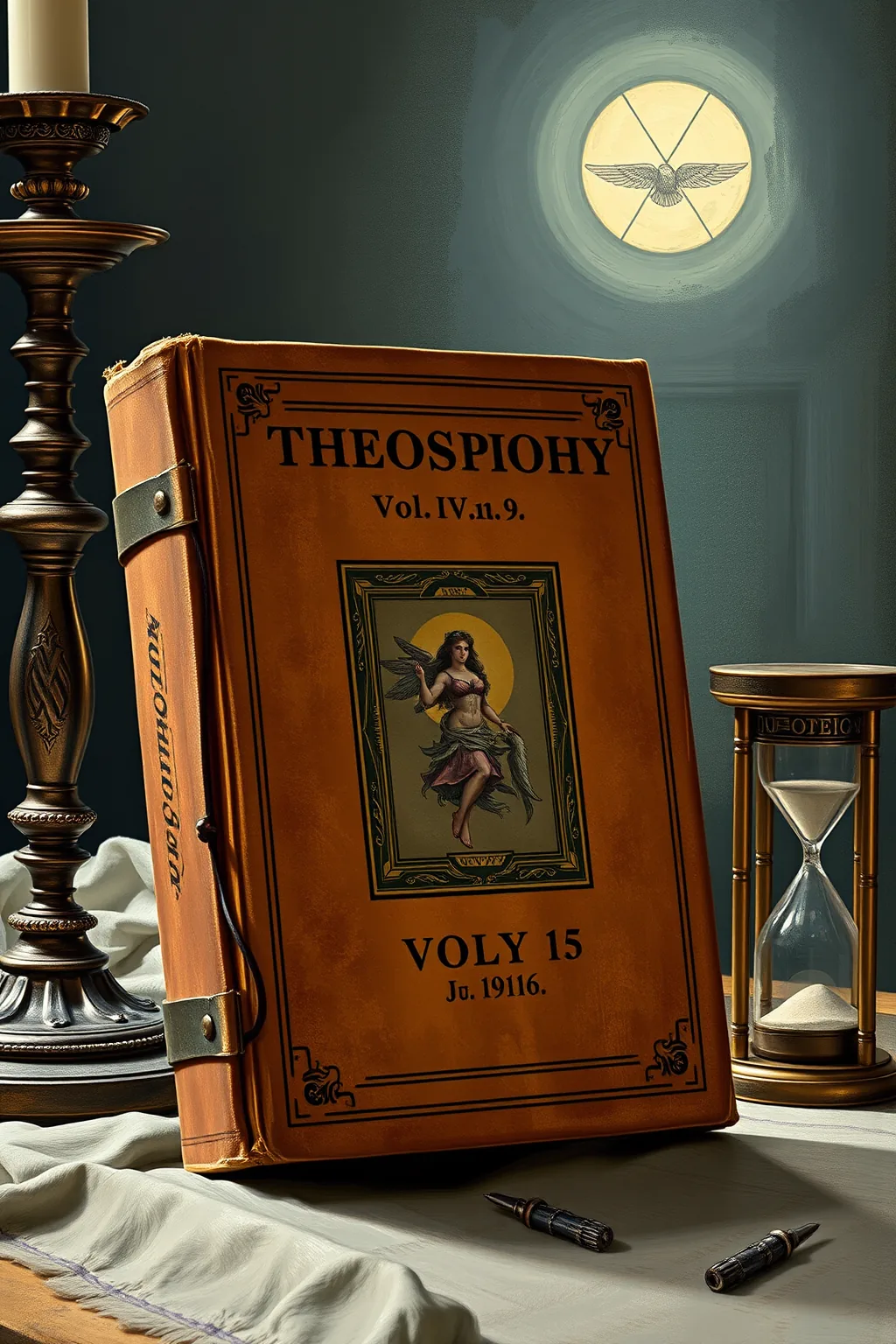
Theosophy Vol-IV,No-9,July 1916
 72
72

Theosophy Vol-IV,No-9,July 1916


Celeste Moreau (Divination & Symbolism Reviewer) — This July 1916 issue of 'Theosophy' is a veritable treasure trove for students of the arcane. It offers profound insights into the cyclical nature of existence and the intricate workings of karma, presented with the clarity characteristic of early Theosophical literature. The essays herein skillfully dissect complex spiritual concepts, making them accessible without sacrificing their esoteric depth. It is particularly valuable for its exploration of subtle energies and the development of inner perception, offering practical guidance for the dedicated practitioner. Its strength lies in its unwavering commitment to unveiling the hidden order of the universe, serving as an indispensable resource for serious seekers and scholars alike who wish to engage with the foundational texts of modern occultism.
📝 Description
72
The July 1916 issue of Theosophy presents essays on unseen forces and spiritual evolution.
This 1916 issue of Theosophy magazine contains essays that discuss metaphysical ideas and the forces influencing existence. It examines spiritual development and the nature of consciousness. The articles aim to transmit ancient knowledge, intended to stimulate the reader's spiritual awareness. The writing creates an atmosphere of reflection, suggesting a connection between the material and spiritual worlds. It touches on the cosmic order and human potential.
The content addresses those interested in life's deeper questions and the application of universal wisdom. It speaks to a search for truth beyond temporary concerns, touching on principles that are meant to endure beyond specific historical periods or beliefs. The essays encourage a thoughtful approach to understanding existence.
Published during a period of significant interest in spiritualism and occultism, this issue of Theosophy aligns with the broader Esoteric movement of the late 19th and early 20th centuries. The Theosophical Society, founded by Helena Blavatsky, sought to synthesize Eastern and Western esoteric traditions, promoting universal brotherhood and the study of comparative religion, philosophy, and science. This journal issue likely reflects those aims, engaging with concepts such as karma, reincarnation, and the development of higher human capacities, as understood within the Theosophical framework.
💡 Why Read This Book?
Unlock ancient secrets and profound spiritual insights within this pivotal 1916 issue of 'Theosophy'. It offers a rare glimpse into the foundational thought of a movement dedicated to Universal Wisdom. Ideal for seekers of truth, students of comparative religion, and practitioners of meditation and esoteric disciplines, this volume provides a rich intellectual and spiritual landscape to explore the deeper meanings of life.
⭐ Reader Reviews
Honest opinions from readers who have explored this book.
❓ Frequently Asked Questions
What is Theosophy?
Theosophy, meaning 'divine wisdom', is a philosophical and religious movement that seeks to understand the underlying unity of all religions and philosophies. It explores esoteric teachings about the nature of the universe, humanity's spiritual evolution, and the existence of hidden spiritual hierarchies.
Who was the author of this issue?
The specific author for each article within this issue is not explicitly stated, a common practice in early Theosophical journals where the collective wisdom and teachings of the movement were emphasized over individual authorship.
What kind of topics are covered?
This issue likely delves into subjects such as the nature of consciousness, reincarnation, karma, the Seven Planes of Existence, the evolution of humanity, and the principles of esoteric science, drawing from ancient wisdom traditions.
Is this book suitable for beginners?
While the topics are profound, the early Theosophical movement aimed to make these teachings accessible. Beginners willing to engage with metaphysical concepts will find it a rewarding introduction to esoteric thought.
When was this publication released?
This particular volume, 'Theosophy Vol-IV, No-9', was published in July of the year 1916, during a period of significant growth and influence for the Theosophical Society.
🔮 Key Themes & Symbolism
The Evolution of Consciousness
This theme explores the intricate journey of human consciousness through various stages of development, both individually and collectively. It posits that consciousness is not static but undergoes a continuous process of unfolding, guided by spiritual laws and the inherent drive towards divine perfection. The essays likely dissect the nature of the ego, the astral body, and the causal body, outlining how their refinement leads to higher states of awareness and a deeper understanding of one's place in the cosmic order. This is a core part of Theosophical thought, offering a framework for comprehending personal growth and the grand spiritual destiny of humankind.
The Law of Karma and Reincarnation
Central to Theosophical teachings, this theme elucidates the profound principle of Karma – the universal law of cause and effect that governs all actions, thoughts, and intentions. It explains how past deeds shape present circumstances and future experiences, emphasizing personal responsibility. Intertwined with Karma is the doctrine of Reincarnation, presenting life as a series of incarnations through which the soul learns and evolves. This cyclical view of existence offers solace and purpose, highlighting that challenges are opportunities for spiritual growth, and that every life contributes to the ultimate liberation and perfection of the spirit.
The Seven Planes of Existence
This theme studies the esoteric understanding of the cosmos as comprising multiple dimensions or planes of reality, often enumerated as seven. These planes range from the physical, tangible world to progressively subtler areas of mind, spirit, and divine consciousness. The essays likely describe the characteristics of each plane, the nature of beings that inhabit them, and the interconnections between them. Understanding these planes is crucial for grasping the Theosophical model of the universe, the journey of the soul after death, and the potential for humanity to ascend to higher states of being through spiritual discipline and knowledge.
💬 Memorable Quotes
Direct passages from the work, attributed to the author.
“As you sow, so shall you reap, not just in this life, but across many.”
— A succinct encapsulation of the Law of Karma and the principle of reincarnation, highlighting the long-term consequences of our actions and the continuous nature of spiritual learning.
“Seek not for truth without, but within.”
— A direct admonition to turn inward for spiritual revelation, suggesting that the answers to life's profound questions reside within the seeker's own consciousness, rather than in external doctrines or authorities.
💡 Key Ideas
Editorial paraphrase of the work's core concepts — not direct quotes.
The outer forms of religion may differ, but the inner truth remains one.
This quote emphasizes the core Theosophical tenet of the unity of all spiritual paths, suggesting that beneath the diverse rituals and dogmas lies a single, universal divine wisdom.
Within the atom lies the echo of the cosmos.
This quote points to the principle of 'as above, so below,' suggesting an inherent interconnectedness and correspondence between the smallest particles of matter and the vastness of the universe.
The path to enlightenment is paved with self-knowledge.
Underscoring the introspective nature of spiritual development, this quote emphasizes that true wisdom and liberation are found through diligent self-examination and understanding of one's own inner nature.
🌙 Esoteric Significance
Tradition
This publication is deeply rooted in the Theosophical tradition, a syncretic spiritual movement founded in the late 19th century. It draws heavily from ancient Eastern philosophies, particularly Hinduism and Buddhism, alongside Hermeticism, Neoplatonism, and Kabbalah. Theosophy aims to reveal the universal spiritual laws and principles underlying all religions and sciences, emphasizing the existence of a divine plan for the evolution of consciousness and the universe.
Symbolism
Theosophy extensively employs symbolism to convey profound spiritual truths that often transcend literal language. Key symbols likely explored in this issue include the Serpent (representing eternal wisdom and cyclical evolution), the Triangle (divine trinity and manifestation), the Lotus (spiritual unfolding and purity), and the Caduceus (healing, balance, and the awakening of Kundalini energy). These symbols act as keys, unlocking deeper levels of understanding for the initiated student of the hidden sciences.
Modern Relevance
The esoteric insights presented in this 1916 issue remain remarkably relevant today. As humanity grapples with complex global challenges and a pervasive sense of existential questioning, Theosophy's emphasis on interconnectedness, spiritual evolution, and the power of consciousness offers a profound perspective. Its teachings on karma, reincarnation, and the unity of all life provide a moral and philosophical compass, guiding individuals towards greater self-awareness, compassion, and a deeper appreciation for the sacred nature of existence.
👥 Who Should Read This Book
This volume is a vital resource for dedicated students of esoteric philosophy, spiritual seekers, and scholars of comparative religion. Beginners intrigued by the foundational texts of modern occultism will find it an clear, albeit dense, introduction. Experienced practitioners of meditation and mindfulness may discover new frameworks for understanding their inner work. Those interested in the historical development of spiritual movements and the intellectual currents of the early 20th century will also find significant value. It speaks to anyone yearning for a deeper, more meaningful understanding of life's mysteries and their own spiritual potential.
📜 Historical Context
Published in July 1916, this issue of 'Theosophy' emerges from an important era for esoteric thought. The early 20th century was a time of immense societal upheaval, marked by World War I, rapid technological advancement, and a growing disillusionment with purely materialistic worldviews. In this milieu, Theosophy, championed by figures like Helena Blavatsky and Annie Besant, offered a compelling alternative, synthesizing ancient Eastern wisdom with Western philosophical and scientific inquiry. It provided a framework for understanding the deeper spiritual underpinnings of existence, attracting intellectuals, artists, and spiritual seekers disillusioned by conventional religious and scientific paradigms. This journal served as a crucial conduit for disseminating these revolutionary ideas, contributing significantly to the burgeoning interest in mysticism, occultism, and alternative spiritualities that characterized the period and laid the groundwork for future esoteric movements.
📔 Journal Prompts
Reflect on a recent challenge: how might the Law of Karma be at play in this situation?
Consider the concept of the 'subtle body' – what are your experiences or intuitive understandings of it?
How does the idea of 'evolution of consciousness' resonate with your personal journey?
Explore a symbol that holds personal meaning for you. What deeper truths might it represent?
In what ways can you apply the principle of 'as above, so below' to your daily life?
🗂️ Glossary
Manvantara
A cosmic cycle of manifestation, a period of immense duration during which a universe or a specific evolutionary chain comes into being and undergoes its development, followed by a period of rest (Pralaya).
Pralaya
A period of cosmic dissolution or rest, occurring between Manvantaras. It is a state of dormancy where the universe withdraws into latency before a new cycle of manifestation begins.
Astral Body
In Theosophy, a subtle, non-physical body composed of finer matter than the physical body. It is considered the vehicle of emotions, desires, and lower consciousness, and it persists after physical death.
Deva
A divine being or elemental spirit in Hindu and Buddhist cosmology. In Theosophy, these are often understood as intelligences that govern natural forces and assist in the evolution of the cosmos.
Monad
The ultimate spiritual principle or divine spark within each being, considered eternal and unchanging. It is the source of consciousness and the driving force behind spiritual evolution.
This book appears in 2 collections
🔮 Readers Also Liked
Browse all →









From the “Theosophy” Collection
View all →




More Free Theosophy & Anthroposophy Books
View all →