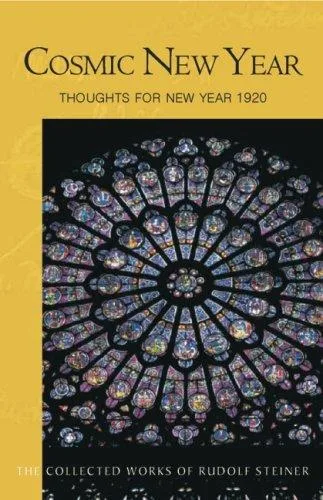
Weltsilvester und Neujahrsgedanken
 73
73

Weltsilvester und Neujahrsgedanken
Steiner's 'Weltsilvester und Neujahrsgedanken' offers a distinct lens through which to view the perennial human contemplation of New Year's. Rather than focusing on resolutions or societal traditions, Steiner redirects attention to the cosmic and spiritual forces he believed are active at this temporal juncture. The strength of the work lies in its unique perspective, presenting the turning of the year not merely as a human construct but as a moment charged with significant spiritual currents. A particular passage discussing the 'guarding spirits' of the year, which he posits prepare the way for future events, illustrates this distinctive approach. However, the density of anthroposophical terminology may present a challenge for newcomers, requiring a degree of familiarity with Steiner's broader philosophical framework. The work ultimately serves as a rich, albeit specialized, contemplation on the spiritual dynamics of time.
📝 Description
73
Rudolf Steiner's 1986 collection, 'Weltsilvester und Neujahrsgedanken,' examines the spiritual meaning of the year's end.
'Weltsilvester und Neujahrsgedanken,' or 'World-New Year's Eve and New Year's Thoughts,' is a compilation of lectures by Rudolf Steiner. Published in 1986, these talks consider the spiritual significance inherent in the transition from one year to the next. Steiner's perspective is rooted in anthroposophy, a spiritual philosophy he developed.
The work addresses individuals who desire a more profound spiritual apprehension of time's passage, the rhythms of nature, and the internal human development that aligns with these cycles. It will resonate with those already acquainted with Steiner's extensive writings or those curious about the esoteric aspects of calendrical observances. Steiner, active in the early 20th century, established anthroposophy during a time of considerable spiritual and philosophical exploration.
Rudolf Steiner formulated anthroposophy in the early 20th century, a movement emerging from the broader theosophical milieu. While contemporary with figures like Annie Besant, Steiner eventually charted his own course, establishing a distinct spiritual science. His work sought to provide a framework for understanding the spiritual realities underlying the physical world and human experience. This collection, 'Weltsilvester und Neujahrsgedanken,' reflects that effort by applying anthroposophical principles to the specific, often overlooked, spiritual dimensions of calendrical events.
💡 Why Read This Book?
• Understand the spiritual significance of the year's end as presented by Rudolf Steiner, moving beyond secular New Year's resolutions to explore cosmic influences. • Gain insight into Steiner's concept of spiritual science and its application to understanding time and human consciousness, particularly through the lens of the 1986 publication date. • Explore specific anthroposophical ideas such as the 'guarding spirits' and their role in the transition from one year to the next, as elaborated in the lectures.
⭐ Reader Reviews
Honest opinions from readers who have explored this book.
❓ Frequently Asked Questions
What is the core message of Rudolf Steiner's Weltsilvester und Neujahrsgedanken?
The core message is that the transition from one year to the next, specifically New Year's Eve and Day, is a potent spiritual threshold. Steiner posits that specific cosmic forces are active, offering opportunities for human consciousness to engage with them for inner development.
When was Weltsilvester und Neujahrsgedanken first published?
The work was first published in 1986, collecting lectures that Rudolf Steiner delivered earlier in his career.
Is this book suitable for someone new to Rudolf Steiner?
It can be challenging for absolute beginners due to its specialized anthroposophical concepts. Familiarity with Steiner's general teachings would be beneficial for a deeper comprehension of the ideas presented.
What esoteric tradition does this book belong to?
This book belongs to the esoteric tradition of Anthroposophy, a spiritual philosophy founded by Rudolf Steiner, which seeks to understand the spiritual nature of reality and humanity's place within it.
How does Steiner view the concept of time in this book?
Steiner views time not merely as a linear progression but as imbued with spiritual forces and rhythms. He sees the annual cycle, and particularly the New Year transition, as significant moments for conscious spiritual engagement.
What are 'Neujahrsgedanken' in the context of this book?
'Neujahrsgedanken' translates to 'New Year's Thoughts.' In this book, it refers to Steiner's contemplative and spiritual reflections on the significance and forces at play during the turn of the calendar year.
🔮 Key Themes & Symbolism
The Spiritual Nature of Time
Steiner posits that time is not simply a neutral progression but carries distinct spiritual qualities and forces, especially at cyclical junctures like the year's end. He suggests that the transition from December 31st to January 1st is a moment when human consciousness can more readily perceive and interact with these subtle energies. The book explores how the 'spirit of the time' influences individual and collective human experience, framing the New Year as a significant portal for spiritual renewal and insight.
Cosmic Influences on Human Consciousness
The work explores the relationship between celestial movements and human inner life, a concept central to many esoteric traditions. Steiner articulates how cosmic rhythms, particularly those culminating at the close of the year, exert a palpable influence on human thought, feeling, and will. He introduces ideas about 'guarding spirits' and the preparation of spiritual forces that shape the coming year, inviting readers to consider a universe interconnected with human spiritual destiny.
Inner Development Through Calendrical Cycles
Weltsilvester und Neujahrsgedanken frames the annual cycle, and specifically the New Year, as an opportunity for intentional inner work. Steiner suggests that by consciously understanding and engaging with the spiritual dynamics of this period, individuals can foster their own spiritual evolution. The lectures encourage a mindful approach to the year's end, viewing it not just as a passage of days but as a potent moment for spiritual awakening and the cultivation of future potential.
The Anthroposophical Worldview
This collection serves as an accessible entry point into core anthroposophical concepts concerning time, spirituality, and human development. Steiner's unique approach, developed in the early 20th century, seeks to bridge the material and spiritual worlds. The book exemplifies his method of spiritual scientific investigation, applying it to a universally recognized human experience – the turning of the year – to reveal deeper metaphysical realities.
💬 Memorable Quotes
Direct passages from the work, attributed to the author.
“We must prepare ourselves spiritually for the forces that will unfold in the coming year.”
— This statement highlights the call to conscious action within Steiner's philosophy. It suggests that human beings have a role in actively engaging with and preparing for the spiritual energies and events that will manifest in the ensuing twelve months.
“The threshold of the New Year allows us to perceive the spiritual realities usually veiled from us.”
— This concept emphasizes the unique access to spiritual perception that Steiner believed is available during the specific temporal window of the year's end. It points to a temporary lifting of ordinary consciousness's limitations.
“The thoughts we hold at New Year's can shape the spiritual substance of the coming time.”
— This interpretation underscores the power of human consciousness and intention. Steiner suggests that our mental and spiritual focus during this key period has a direct, formative effect on the unfolding reality of the new year.
💡 Key Ideas
Editorial paraphrase of the work's core concepts — not direct quotes.
The year is a living being, and the transition from one year to the next is its spiritual heart.
This paraphrase captures Steiner's view of the calendar year not as an abstract construct but as a dynamic entity. The New Year's transition is presented as a crucial moment of spiritual intensity and potential for renewal within this living cycle.
Spirits of the threshold prepare the way for the energies of the new cycle.
This paraphrase refers to Steiner's concept of spiritual beings or forces that actively work to facilitate the transition between temporal cycles. It implies a conscious, ordered process occurring in the spiritual realms that underpins earthly events.
🌙 Esoteric Significance
Tradition
This work is firmly rooted in Anthroposophy, a spiritual tradition founded by Rudolf Steiner. While drawing from broader Western esoteric lineages such as Gnosticism and Hermeticism, Anthroposophy presents a unique, contemporary path focused on the evolution of human consciousness through spiritual perception and scientific investigation of the spiritual world.
Symbolism
The 'Weltsilvester' (World-New Year's Eve) itself acts as a potent symbol of transition, a threshold between the old and the new, the completed and the potential. Steiner also discusses the 'guarding spirits' as symbolic agents of cosmic order and foresight, preparing the spiritual groundwork for future events and influences within the annual cycle.
Modern Relevance
Contemporary practitioners of Anthroposophy, Waldorf education proponents, and biodynamic farmers continue to engage with Steiner's cosmological views. His insights into the spiritual forces influencing time and human development are still studied by individuals seeking alternative frameworks for understanding consciousness and the cycles of nature in the 21st century.
👥 Who Should Read This Book
• Students of Rudolf Steiner's work seeking to understand his perspective on the spiritual dynamics of time and the New Year. • Individuals interested in comparative esotericism looking to explore how different traditions interpret calendrical events and cosmic influences. • Seekers of spiritual growth interested in a non-traditional approach to personal reflection during the annual transition period.
📜 Historical Context
Rudolf Steiner delivered lectures that form the basis of 'Weltsilvester und Neujahrsgedanken' during the early 20th century, a period marked by intense spiritual seeking and the rise of numerous esoteric movements. His work emerged in parallel with, yet distinct from, contemporary spiritual currents like Theosophy, from which he eventually diverged to establish Anthroposophy. While figures like Helena Blavatsky and later Annie Besant were influential, Steiner developed his own specific 'spiritual science.' This era saw a widespread questioning of materialistic worldviews and a search for deeper meaning, making Steiner's lectures on the spiritual significance of time and consciousness particularly relevant. The first publication of these collected thoughts in 1986 placed them within a later context of renewed interest in esoteric studies, long after Steiner's death in 1925.
📔 Journal Prompts
The guarding spirits of the year: What might their role be in shaping the coming months?
Reflecting on the 'spiritual heart' of the year's transition, how does this concept alter your perception of December 31st?
Consider the cosmic forces Steiner suggests are active at year's end; how might they be perceived or engaged with consciously?
The idea of time as a living being: How does this framing influence your daily experience of the calendar?
What personal spiritual preparation is needed to engage with the energies of the new year as described by Steiner?
🗂️ Glossary
Anthroposophy
A spiritual philosophy founded by Rudolf Steiner, seeking to understand the spiritual nature of reality and humanity's place within it through clairvoyant perception and spiritual scientific methods.
Weltsilvester
German for 'World-New Year's Eve,' referring to the transition from one year to the next, viewed here not just as a human event but as a moment of significant cosmic and spiritual activity.
Neujahrsgedanken
German for 'New Year's Thoughts,' indicating the reflective and contemplative nature of the book's content, focusing on spiritual insights related to the turn of the year.
Guarding Spirits
A concept in Steiner's work referring to spiritual beings or forces that oversee and prepare the spiritual environment for the unfolding events and influences of a new temporal period, such as a new year.
Spiritual Science
Steiner's term for his method of investigating the spiritual world, aiming to apply scientific rigor to the study of esoteric and supersensible phenomena.
Cosmic Rhythms
The cyclical patterns and influences originating from celestial bodies and cosmic processes that Steiner believed impact earthly life and human consciousness.
Threshold
In this context, a symbolic and energetic point of transition, particularly the temporal boundary between the end of one year and the beginning of the next, seen as a moment of heightened spiritual potential.
🔮 Readers Also Liked
Browse all →







More by Rudolf Steiner
All books →



More Free Theosophy & Anthroposophy Books
View all →