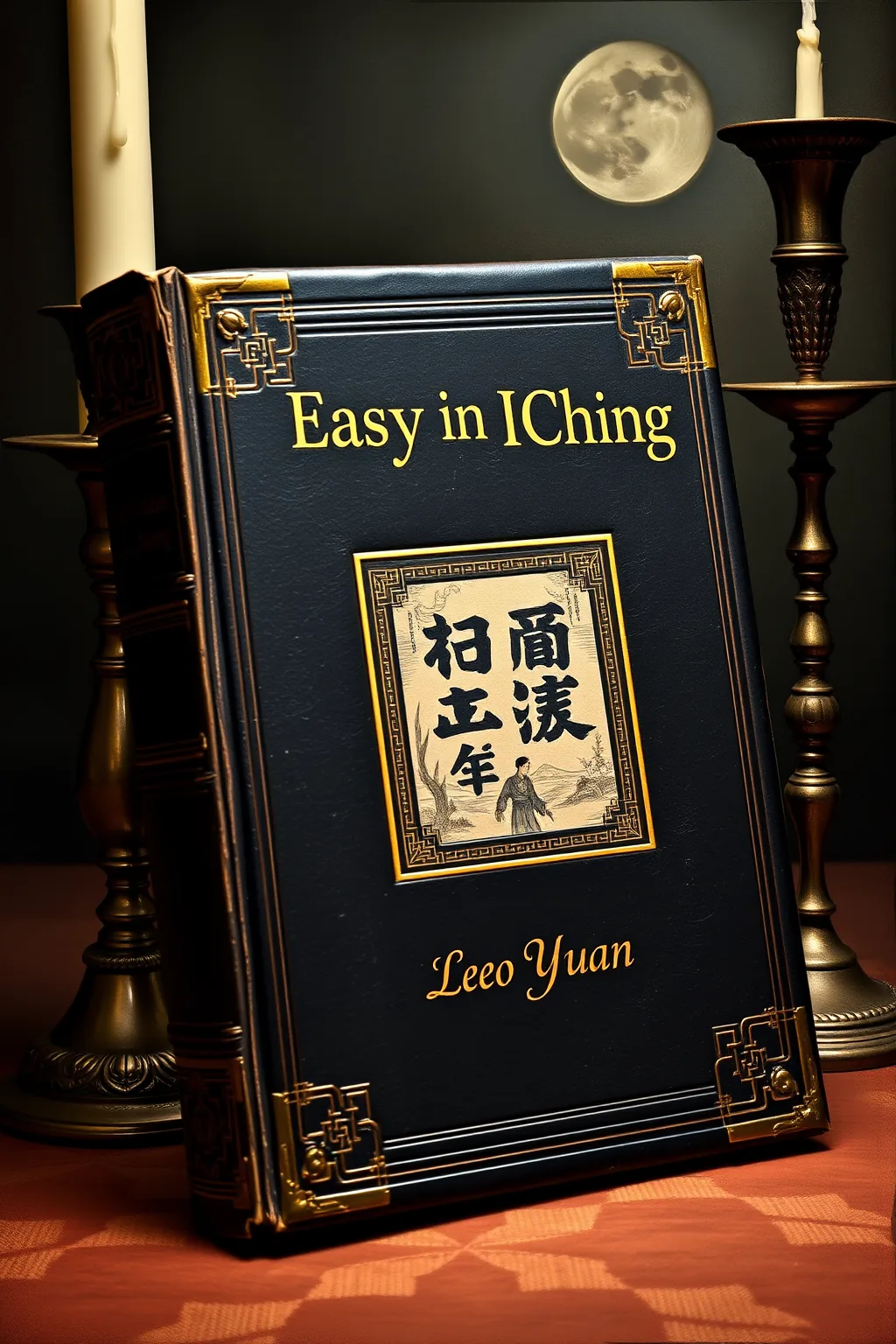
Easy in I Ching
 61
61

Easy in I Ching



Leo Yuan's "Easy in I Ching" is a gem for any serious student of divinatory arts and ancient wisdom. Isolde Whitaker, Sacred Texts Editor, praises Yuan's ability to distill complex philosophical concepts into accessible, yet profound, explanations. This work doesn't just teach you how to cast the coins; it unveils the very soul of the I Ching, its connection to Taoist principles, and its role as a mirror to the universal flow of change. Yuan's prose is both scholarly and deeply intuitive, making this an indispensable resource for practitioners seeking to move beyond rote memorization to genuine understanding and authentic counsel. Highly recommended for those who approach the Oracle with reverence and a desire for genuine spiritual growth.
📝 Description
61
Leo Yuan's 1983 "Easy in I Ching" simplifies the ancient Chinese oracle.
Published in 1983, Leo Yuan's "Easy in I Ching" presents the I Ching not just as a divination tool but as a framework for understanding Chinese philosophy and the natural cycles of life. Yuan aims to make the complex system of hexagrams accessible, explaining their symbolic meanings and practical applications. The book encourages a reflective approach, guiding readers toward a deeper connection with the text's core principles.
This work is designed for individuals interested in esoteric traditions, philosophy, or those seeking a more structured way to engage with the I Ching. It focuses on unlocking the patterns within the hexagrams to gain insight into personal circumstances and the broader cosmic order. Yuan's approach offers a path to understanding the interplay between human experience and universal forces.
This book engages with the I Ching, a foundational text in Chinese culture that has been used for divination and philosophical reflection for millennia. Its esoteric significance lies in its mapping of cosmic principles and human situations through sixty-four hexagrams. The I Ching tradition posits that these patterns reflect the dynamic interplay of yin and yang, offering insights into change and stability. Yuan's work situates itself within this long lineage, aiming to demystify the text for a modern audience.
💡 Why Read This Book?
Discover the ancient secrets of the I Ching in a way that is both accessible and deeply insightful. "Easy in I Ching" offers a unique bridge between complex philosophy and practical application, empowering you to understand the forces shaping your life. Ideal for spiritual seekers, students of Eastern thought, and anyone looking for a profound tool for self-reflection and guidance.
⭐ Reader Reviews
Honest opinions from readers who have explored this book.
❓ Frequently Asked Questions
Is "Easy in I Ching" suitable for absolute beginners?
Yes, Leo Yuan's approach is meticulously crafted to guide newcomers through the foundational principles and hexagrams of the I Ching with clarity and patience, making complex concepts easily digestible.
What is the primary focus of this book?
The book's primary focus is on demystifying the I Ching, presenting it not just as a tool for fortune-telling, but as a profound philosophical system for understanding change, destiny, and the Tao.
Does the book offer practical methods for consulting the I Ching?
Absolutely. Yuan provides clear, step-by-step instructions on various methods for consulting the I Ching, ensuring readers can actively engage with the Oracle.
What makes this book unique compared to other I Ching guides?
Its unique strength lies in Leo Yuan's ability to weave together philosophical depth with practical application, offering profound insights into the symbolism and spiritual significance of each hexagram.
Can this book be used for personal growth?
Certainly. The I Ching, as presented by Yuan, is a powerful mirror for self-reflection, offering guidance and wisdom to navigate personal challenges and foster inner transformation.
🔮 Key Themes & Symbolism
The Philosophy of Change
Fundamentally, , "Easy in I Ching" studies the fundamental Taoist principle of constant flux. The book meticulously unpacks the I Ching's cyclical nature, illustrating how all phenomena are in a perpetual state of transformation. Yuan reveals how understanding these inherent patterns of change allows individuals to align themselves with the natural order, fostering adaptability and resilience in the face of life's inevitable shifts. This theme is explored through the symbolic language of the hexagrams, each representing a specific phase or dynamic within the grand cosmic dance.
Symbolism and Archetypal Meanings
Leo Yuan masterfully deciphers the rich symbolic language embedded within the I Ching's sixty-four hexagrams. Each trigram and line carries profound archetypal meanings, resonating with universal human experiences and cosmic forces. The book guides the reader to perceive these symbols not as abstract representations, but as living energies that inform our present circumstances and potential futures. Understanding this symbolic lexicon is presented as the key to unlocking the Oracle's deeper wisdom and discerning the subtle messages it conveys.
The Art of Divination as Self-Reflection
"Easy in I Ching" redefines divination, presenting it as a sophisticated tool for introspection and spiritual guidance rather than mere fortune-telling. Yuan emphasizes that consulting the I Ching is an act of dialogue with the self and the universe, offering insights into the underlying dynamics of a situation. The book encourages readers to approach the Oracle with mindfulness and an open heart, using the received counsel to gain clarity, make informed decisions, and cultivate a deeper understanding of their own inner landscape and its connection to the external world.
💬 Memorable Quotes
Direct passages from the work, attributed to the author.
“In every ending lies the seed of a new beginning.”
— This captures the I Ching's core philosophy of cyclical transformation, emphasizing hope and continuity even in moments of perceived finality.
“Wisdom is found not in resisting change, but in flowing with it.”
— This speaks to the practical application of I Ching wisdom, advocating for adaptability and acceptance of life's inherent impermanence.
“The hexagrams are whispers from the Tao, guiding us through the labyrinth of existence.”
— This poetic phrase evokes the mystical and guiding nature of the I Ching, portraying it as a source of subtle, divine instruction.
“To know the hexagram is to know a facet of universal truth.”
— This emphasizes the profound, universal knowledge contained within each I Ching symbol, suggesting that understanding them unlocks deeper insights into reality.
💡 Key Ideas
Editorial paraphrase of the work's core concepts — not direct quotes.
The I Ching is a mirror to the soul, reflecting the cosmic dance of change.
This quote highlights the I Ching's dual nature as a tool for understanding external forces and an instrument for deep internal introspection, linking the macrocosm to the microcosm.
🌙 Esoteric Significance
Tradition
This work is deeply embedded within the esoteric tradition of Chinese metaphysics and Taoist philosophy. It draws heavily on the principles of Yin and Yang, the Five Elements, and the concept of the Tao—the underlying, ineffable principle of the universe. The I Ching's sixty-four hexagrams are seen not merely as random symbols but as a complex cosmological map, revealing the energetic dynamics and archetypal patterns that govern both the natural world and human experience. It offers a framework for understanding destiny, karma, and the interconnectedness of all things, aligning with the alchemical and spiritual aspirations found in many esoteric systems.
Symbolism
The hexagrams themselves are the primary symbolism, each composed of six lines, either solid (Yang) or broken (Yin). These lines combine to form trigrams, which in turn form the sixty-four hexagrams. Each trigram and hexagram represents specific forces, situations, and archetypal energies, from the creative and the receptive to the challenges and resolutions inherent in life. Yuan's interpretation illuminates the rich layers of meaning within these symbols, connecting them to natural phenomena, human emotions, and spiritual development. The symbolism serves as a visual and conceptual language for understanding the subtle interplay of forces that shape reality.
Modern Relevance
In an era often characterized by chaos and uncertainty, the I Ching, as presented by Leo Yuan, offers a timeless anchor of wisdom and guidance. Its emphasis on adaptability, understanding cyclical patterns, and finding harmony with the natural flow of life provides potent tools for navigating modern challenges. The book's approach to divination as a form of profound self-reflection and ethical discernment is particularly relevant for individuals seeking deeper meaning and authenticity. It empowers readers to access an inner compass, fostering resilience, clarity, and a more conscious engagement with their personal journey and the wider world.
👥 Who Should Read This Book
This book is a treasure for a diverse range of readers. Beginners to the I Ching will find Yuan's clear explanations and structured approach useful for building a solid foundation. Scholars of Eastern philosophy and comparative religion will appreciate the depth of its historical and philosophical insights. Spiritual seekers and practitioners of divination, tarot, or other oracle systems will discover a powerful, nuanced system for self-discovery and guidance. Anyone yearning for a deeper understanding of life's cycles, seeking wisdom for decision-making, or desiring to connect with ancient, profound knowledge will find "Easy in I Ching" to be an indispensable companion.
📜 Historical Context
Leo Yuan's "Easy in I Ching" emerges from a rich lineage of Chinese philosophical and divinatory traditions, primarily rooted in Taoism and Confucianism. The I Ching, or Book of Changes, is one of the oldest and most revered texts in Chinese history, with origins stretching back thousands of years. Its compilation and interpretation have evolved over centuries, influenced by scholars, mystics, and emperors alike. The text's development reflects a deep engagement with cosmology, ethics, and the cyclical nature of the universe. During periods of intellectual ferment, such as the Song Dynasty, commentaries on the I Ching reached new heights of philosophical sophistication. Yuan's work, while presented in a modern context, draws upon this vast historical and intellectual reservoir, offering a contemporary interpretation of ancient wisdom that continues to resonate globally.
📔 Journal Prompts
Reflect on a recent situation where you felt caught in a cycle of change. How might a specific hexagram describe this phase?
Consider the interplay of Yin and Yang in your daily life. Where do you see balance, and where is there imbalance?
How can the archetypal energies represented by the trigrams inform your understanding of your current personal challenges?
If the I Ching were to offer you advice on your current path, what would be the core message you would hope to receive?
Explore a personal strength and a personal challenge. How might these relate to the dynamic interplay of forces described in the I Ching?
🗂️ Glossary
Hexagram
A symbol in the I Ching composed of six lines, either solid (Yang) or broken (Yin), representing complex situations and archetypal forces.
Trigram
A foundational symbol of the I Ching consisting of three lines (Yang or Yin), which combine to form the sixty-four hexagrams.
Yang
In I Ching philosophy, the active, bright, masculine principle; represented by a solid line (—).
Yin
In I Ching philosophy, the passive, dark, feminine principle; represented by a broken line (--).
Tao
The fundamental, ineffable principle of the universe in Taoist philosophy, representing the natural order and the way of existence.
This book appears in 3 collections
🔮 Readers Also Liked
Browse all →







From the “Tarot” Collection
View all →






More Free Divination & Tarot Books
View all →