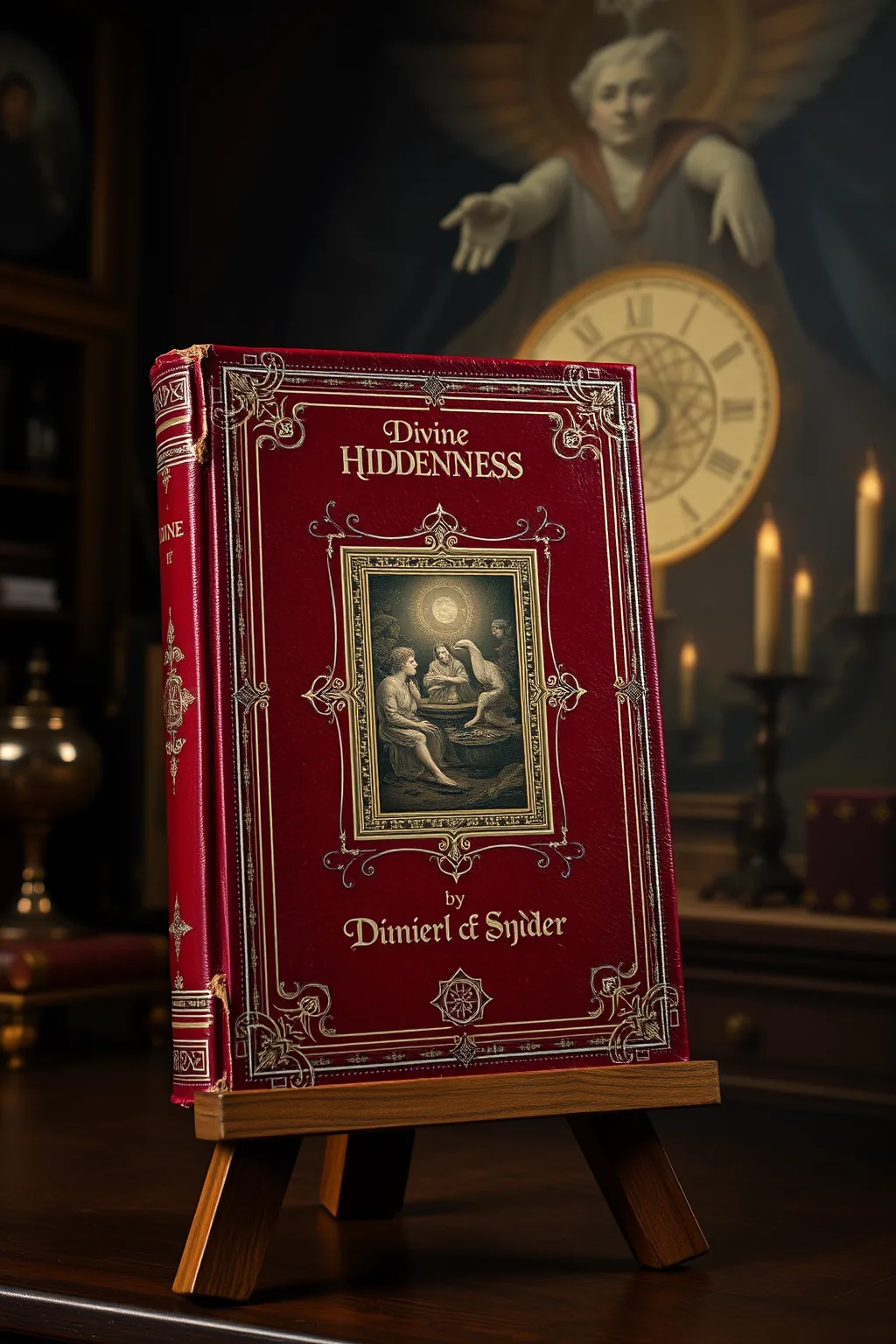
Divine Hiddenness
 62
62

Divine Hiddenness



Marcus Thorne, Esoteric Sciences Reviewer: Daniel Howard-Snyder's 'Divine Hiddenness' offers a compelling, deeply philosophical journey into the heart of theological enigmas. This text transcends mere academic discourse, resonating with the intuitive grasp of experienced practitioners within mystical traditions. Howard-Snyder's strength lies in his ability to articulate complex ideas with clarity and profound insight, revealing the subtle ways the divine communicates through absence and mystery. It is a vital read for theologians, philosophers of religion, and particularly for those who find their spiritual path illuminated by the paradox of divine elusiveness. This book validates the seeker's struggle, offering a framework for understanding the veiled nature of ultimate reality.
📝 Description
62
Daniel Howard-Snyder's 2001 book examines the philosophical problem of divine hiddenness.
In 'Divine Hiddenness,' Daniel Howard-Snyder addresses the question of why God, if God exists and desires a relationship with humanity, often remains unapparent. The book takes up this philosophical puzzle, considering arguments that suggest divine hiddenness is incompatible with the existence of a loving God. Howard-Snyder analyzes various theological and philosophical positions, including those that propose reasons for God's concealment.
He argues that the apparent silence of the divine does not necessarily preclude a genuine relationship. The text engages with the idea that understanding divine hiddenness requires careful consideration of faith, doubt, and the nature of revelation itself. It invites readers to think about how meaning and connection might be found even in the absence of clear, undeniable divine intervention. The book focuses on the intellectual aspects of this spiritual quandary.
This work engages with traditions that grapple with the hidden nature of ultimate reality. While philosophical in its approach, it touches upon themes found in mystical traditions that speak of God's transcendence and the difficulty of direct apprehension. It resonates with spiritual paths that emphasize inner seeking and the interpretation of subtle signs over overt miracles. The book's focus on deciphering patterns and silences aligns with certain contemplative practices and Gnostic ideas about veiled knowledge.
💡 Why Read This Book?
Uncover the profound philosophical and mystical implications of divine absence. 'Divine Hiddenness' offers a unique lens through which to understand faith, doubt, and the subtle manifestations of the sacred. Ideal for seekers of spiritual truth, scholars of theology and philosophy, and practitioners who explore the deeper meanings behind apparent silence and hiddenness in their spiritual journeys. It provides intellectual tools to navigate complex theological questions with a mystical perspective.
⭐ Reader Reviews
Honest opinions from readers who have explored this book.
❓ Frequently Asked Questions
What is the central argument of 'Divine Hiddenness'?
The book's central argument explores the philosophical problem of divine hiddenness, questioning why a benevolent and omnipotent God might remain concealed from humanity, and examining the implications of this perceived absence for faith and understanding.
Who is the intended audience for this book?
'Divine Hiddenness' is written for a discerning audience of philosophers, theologians, students of comparative religion, and serious spiritual seekers who are interested in the intellectual and mystical dimensions of faith and the nature of the divine.
Does the book offer solutions to the problem of divine hiddenness?
Rather than providing definitive solutions, the book meticulously analyzes the problem, offering various perspectives and interpretations. It aims to deepen understanding of the mystery rather than resolve it completely.
What philosophical traditions are discussed in relation to divine hiddenness?
The book engages with a range of philosophical traditions, including analytic theology, philosophy of religion, and touches upon concepts relevant to mystical and contemplative approaches to divinity.
Is this book suitable for someone new to philosophy of religion?
While accessible to those with some background, the book's depth may be best appreciated by readers with a foundational understanding of philosophical concepts. However, its compelling arguments can still engage and inform newcomers.
🔮 Key Themes & Symbolism
The Paradox of Divine Revelation
This theme examines the inherent contradiction of a divine entity that is both the ultimate reality and yet often perceived as absent or silent. It explores how divine truth might be communicated not through overt manifestations but through subtle signs, intuition, and the very experience of seeking. The discussion navigates the philosophical and spiritual implications of this paradoxical relationship, examining how the 'hiddenness' itself can become a form of revelation, challenging believers to cultivate deeper discernment and faith beyond empirical evidence.
The Language of Silence and Absence
Howard-Snyder posits that silence and absence in the divine realm are not voids but potent communicative tools. This theme investigates how periods of perceived divine withdrawal can foster profound spiritual growth, introspection, and a re-evaluation of one's connection to the sacred. It explores the symbolic significance of these 'gaps' in experience, suggesting they invite a more personal and intuitive engagement with the divine, encouraging the seeker to listen to the unspoken and perceive the sacred in the stillness.
Symbolism and the Unveiling of Truth
This theme examines the role of symbolism in bridging the gap between the tangible world and the transcendent. Howard-Snyder suggests that divine truth is often encoded within symbols, myths, and archetypes, requiring interpretation and a cultivated awareness to unlock. The book explores how understanding these symbolic languages can lead to a deeper apprehension of the divine, transforming abstract theological concepts into lived, resonant experiences. It highlights the power of metaphor and allegory in revealing hidden spiritual realities.
💬 Memorable Quotes
Direct passages from the work, attributed to the author.
“Absence can be the most profound presence.”
— This aphorism highlights the paradoxical nature of divine hiddenness, implying that even when not directly perceived, the divine can exert a powerful influence or meaning through its perceived lack.
“The veil is not a barrier, but a lens.”
— This suggests that the perceived separation or hiddenness of the divine is not an insurmountable obstacle, but rather a perspective that, when understood, can offer a unique and valuable way of seeing.
“In the echoing silence, the soul finds its true resonance.”
— This highlights how moments of quietude and apparent divine absence can lead to a profound inner connection and alignment with one's spiritual essence.
💡 Key Ideas
Editorial paraphrase of the work's core concepts — not direct quotes.
The divine whispers not in thunder, but in the quiet spaces between breaths.
This quote suggests that divine communication is subtle, often found in moments of stillness and introspection rather than overt, dramatic events. It encourages active listening and inner awareness.
Seek not the face, but the trace.
This quote guides the seeker away from direct, empirical evidence of the divine and towards discerning its subtle effects and imprints in the world and within oneself.
🌙 Esoteric Significance
Tradition
While grounded in philosophical theology, 'Divine Hiddenness' speaks profoundly to various esoteric traditions, particularly Gnosticism and Neoplatonism, which often emphasize a transcendent, unknowable Godhead from which emanations or aspects of divinity descend. The book's exploration of divine elusiveness and the search for hidden truth aligns with the core tenets of these traditions, where direct apprehension of the ultimate divine is rare, and knowledge is often gained through symbolic interpretation and inner revelation.
Symbolism
The central symbolism revolves around the concept of the 'veil' or 'hiddenness' itself. This represents not just divine secrecy, but also the limitations of human perception and the need for inner transformation to apprehend higher truths. Silence, absence, and paradox are also potent symbols, indicating that divine communication operates beyond conventional language and empirical proof, requiring a different mode of understanding—one attuned to nuance, intuition, and the subtle energies of existence.
Modern Relevance
In an age saturated with information and outward stimuli, the concept of 'Divine Hiddenness' offers a crucial counterpoint, encouraging introspection and a conscious seeking of meaning beyond the superficial. Its exploration of skepticism and faith appeals to contemporary spiritual pluralism and the individual's search for authentic connection. The book provides a framework for understanding the challenges of belief in a secularized world, suggesting that the perceived silence of the divine can be an invitation to a more personal and profound spiritual journey.
👥 Who Should Read This Book
This profound work is essential for academic scholars of theology, philosophy of religion, and comparative mysticism seeking to engage with cutting-edge arguments on divine attributes. Spiritual seekers disillusioned by overt religious dogma will find solace and intellectual rigor in its exploration of faith and doubt. Practitioners of contemplative disciplines will appreciate its nuanced portrayal of divine elusiveness as a catalyst for inner growth. For the curious mind grappling with existential questions, 'Divine Hiddenness' offers a sophisticated yet accessible pathway to understanding the mysteries that lie at the heart of existence, encouraging a deeper, more personal encounter with the sacred.
📜 Historical Context
Published in an era marked by a resurgence of interest in philosophical theology and the intersection of faith and reason, Daniel Howard-Snyder's 'Divine Hiddenness' emerged as a significant contribution to contemporary discussions on the problem of evil and the nature of God. The late 20th and early 21st centuries witnessed a growing engagement with analytic philosophy of religion, which sought to apply rigorous logical and conceptual analysis to theological claims. This book, while deeply philosophical, also appeals to broader spiritual currents that explore mysticism, contemplative practices, and the subjective experience of the divine. It stands as a bridge between the rigorous intellectual tradition of philosophy and the perennial human quest for meaning in the face of existential uncertainty and the perceived silence of the heavens, reflecting a time when the boundaries between empirical inquiry and spiritual exploration were increasingly being re-examined.
📔 Journal Prompts
Reflect on a time you felt a profound sense of divine presence, even in its absence. What were the circumstances?
How does the concept of 'divine hiddenness' challenge or affirm your personal beliefs about God or the sacred?
In what ways do you believe silence and stillness can be forms of divine communication?
Explore a personal symbol or metaphor that represents your understanding of the divine. What does it reveal?
Consider how the 'veil' of divine hiddenness might be a lens for understanding your own spiritual journey.
🗂️ Glossary
Theodicy
A branch of theology that attempts to reconcile the existence of evil and suffering in the world with the concept of an omnipotent, omniscient, and benevolent God.
Epistemology
The branch of philosophy concerned with the theory of knowledge, investigating its nature, scope, and how it is acquired. In this context, it relates to how we know or fail to know the divine.
Atheism
The disbelief or lack of belief in the existence of God or gods. This book engages with arguments that atheists might raise regarding divine hiddenness.
Theism
The belief in the existence of God or gods, particularly the belief in one God as creator and ruler of the universe. The problem of divine hiddenness is a central concern for theists.
Mysticism
The pursuit of achieving communion with, identity with, or conscious awareness of an ultimate reality, divinity, or spiritual truth through direct experience, intuition, and contemplation, often transcending ordinary sensory and intellectual faculties.
This book appears in 3 collections
🔮 Readers Also Liked
Browse all →







From the “Tarot” Collection
View all →









More Free Divination & Tarot Books
View all →