Doubt and certainty
 73
73

Doubt and certainty
Rothman and Sudarshan's 1998 treatise, Doubt and Certainty, performs a valuable, if somewhat dry, dissection of how physicists construct and defend their beliefs. The strength lies in its unflinching look at the human element in science; the authors don't shy away from the psychological underpinnings of scientific conviction. I found their discussion of how intuitive leaps can solidify into dogma, often before rigorous proof, particularly illuminating, especially when considering the reception of quantum mechanics in its early days. However, the prose can be dense, demanding considerable reader attention. A limitation is the relative lack of engagement with explicitly esoteric or metaphysical interpretations of scientific uncertainty, despite its potential audience. The passage exploring the 'certainty' surrounding the discovery of the Higgs boson, viewed retrospectively, exemplifies this tension between established fact and ongoing inquiry. It’s a rigorous philosophical inquiry into scientific belief, best suited for the dedicated scholar.
📝 Description
73
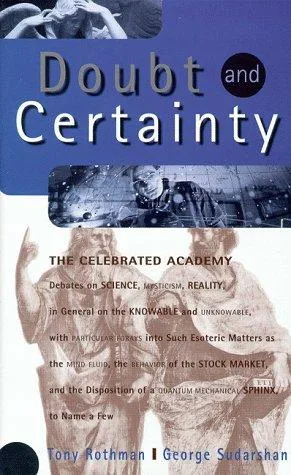
Doubt and Certainty (1998) questions how science establishes and maintains belief.
Published in 1998, Tony Rothman and George Sudarshan's book examines the foundations of scientific knowledge. It scrutinizes how certainty is built and held within scientific discussions, particularly in physics. The authors look at the psychological and knowledge-based factors that lead to both doubt and conviction. They do not provide easy answers but instead offer a careful study of how scientific agreement forms and the persistent uncertainties involved.
The book uses a wide range of scientific concepts as a way to investigate the nature of belief itself. It is written for intellectually curious people who already have a basic grasp of scientific ideas, especially physics. Those interested in the philosophy of science, epistemology, and the history of thought will find much to consider. It is particularly useful for readers who question the idea of absolute scientific truth and want to understand the human aspects—the beliefs, biases, and social forces—that shape scientific advancement.
While not strictly esoteric in the occult sense, this work engages with questions about belief and knowledge that resonate with esoteric traditions. Many esoteric paths concern the nature of inner certainty versus external dogma, and the process of individual discernment. Rothman and Sudarshan's focus on the human elements shaping scientific 'truth'—beliefs, biases, and social dynamics—mirrors esoteric inquiries into the subjective nature of perception and the construction of reality. Their examination of how conviction forms and dissolves within a formal system like physics speaks to broader concerns about the limitations of established doctrines and the individual's quest for authentic understanding.
💡 Why Read This Book?
• Gain a nuanced understanding of how scientific consensus forms, moving beyond a simplistic view of objective truth, by examining the authors' critique of 'certainty' in physics. • Explore the psychological dimensions of scientific belief, learning how factors beyond pure data influence acceptance of theories, as discussed in their analysis of intuition. • Appreciate the philosophical underpinnings of scientific knowledge by engaging with the specific challenges Rothman and Sudarshan raise regarding the acceptance of theories, particularly in the context of 1998's scientific landscape.
⭐ Reader Reviews
Honest opinions from readers who have explored this book.
❓ Frequently Asked Questions
What is the primary philosophical focus of Doubt and Certainty?
The book primarily focuses on epistemology and the philosophy of science, investigating how scientific certainty is established, maintained, and challenged, particularly within the field of physics. It examines the psychological and social factors influencing belief.
Who are the authors of Doubt and Certainty?
The authors are Tony Rothman and George Sudarshan. Sudarshan was a renowned theoretical physicist, known for his work on the tachyon and the V-A theory of weak interactions.
When was Doubt and Certainty first published?
Doubt and Certainty was first published in 1998, a period marked by significant philosophical reflection on scientific knowledge.
Does the book discuss specific scientific theories?
Yes, the book uses specific scientific theories and concepts, particularly from physics, as case studies to explore the broader philosophical themes of doubt and certainty in scientific inquiry.
Is this book suitable for someone without a physics background?
While it uses physics examples, the book's core is philosophical. Readers with a general interest in epistemology and the nature of knowledge might find it accessible, but a basic scientific literacy is beneficial.
What is the main argument regarding 'certainty' in science?
The central argument is that scientific 'certainty' is often a more complex, psychologically and socially constructed phenomenon than a purely objective, irrefutable state, even within the rigorous discipline of physics.
🔮 Key Themes & Symbolism
The Psychology of Scientific Belief
This theme explores how cognitive biases, intuition, and the human need for conviction influence the acceptance and rejection of scientific theories. Rothman and Sudarshan examine the internal mechanisms by which physicists arrive at what they consider 'certainty,' often before empirical evidence is fully conclusive. It studies how psychological comfort derived from established paradigms can create resistance to novel ideas, thereby shaping the trajectory of scientific progress. The work posits that understanding these human factors is crucial for a complete picture of scientific development, moving beyond a purely logical or data-driven model.
Epistemological Limits in Physics
The book critically assesses the boundaries of knowledge within physics, a field often perceived as the most rigorous and objective science. It questions the absolute nature of scientific 'truth,' particularly in areas where theories are abstract or predictive power is not yet fully validated. Rothman and Sudarshan highlight how prevailing theoretical frameworks can create blind spots, leading to a subjective form of certainty. This theme interrogates the very definition of proof and evidence in theoretical physics, suggesting that what is accepted as fact is often a consensus built on interpretation and belief.
Social Construction of Scientific Fact
Doubt and Certainty examines how scientific ideas gain acceptance not solely through empirical validation but also through community consensus and social dynamics. The authors discuss how the opinions and beliefs of influential figures, along with the collective agreement within scientific institutions, contribute to the establishment of 'facts.' This theme suggests that scientific progress is a social process, where ideas are debated, negotiated, and adopted. It scrutinizes how certain theories become dogma, while others, potentially equally valid, are marginalized due to these social mechanisms, particularly relevant in the context of physics in the late 20th century.
The Nature of Doubt in Inquiry
This theme positions doubt not as an obstacle to knowledge, but as an intrinsic and necessary component of scientific progress. Rothman and Sudarshan explore how questioning established beliefs, even those held with strong conviction, is vital for intellectual advancement. They analyze the mechanisms by which doubt can be suppressed by the drive for certainty and how its presence, when properly channeled, can lead to deeper understanding and paradigm shifts. The work implies that a healthy scientific culture embraces, rather than fears, the persistent presence of doubt.
💬 Memorable Quotes
Direct passages from the work, attributed to the author.
“The tendency to arrive at a conclusion, and then to defend it, is a very strong one.”
— This highlights the psychological bias in scientific reasoning, suggesting that researchers may unconsciously seek evidence to confirm pre-existing beliefs rather than objectively evaluating all data.
“Certainty is often a matter of convenience.”
— This interpretation suggests that scientists, like all humans, may find psychological comfort in definitive answers, sometimes prioritizing a sense of closure over the acknowledgment of persistent unknowns or ambiguities.
“We often mistake the limits of our own understanding for the limits of the universe.”
— This concept points to the human tendency to project personal or current scientific limitations onto objective reality, potentially hindering the exploration of phenomena beyond our current conceptual grasp.
“The acceptance of a theory is not solely based on its logical consistency or empirical verification.”
— This implies that factors such as the social standing of proponents, aesthetic appeal of the theory, or prevailing intellectual fashion can play a significant role in its adoption by the scientific community.
“Doubt is not the opposite of knowledge, but a catalyst for its refinement.”
— This interpretation frames doubt as an active and constructive force in scientific discovery, essential for challenging assumptions and driving the evolution of understanding.
🌙 Esoteric Significance
Tradition
While not explicitly an esoteric text, Doubt and Certainty engages with themes that echo within certain esoteric traditions, particularly those concerned with gnosis, subjective experience, and the limitations of materialist paradigms. Its examination of how belief is formed and the potential for 'certainty' to obscure deeper truths aligns with Gnostic concerns about false doctrines and the pursuit of inner knowledge beyond dogma. It departs from traditional esotericism by grounding its analysis firmly within the framework of modern physics and scientific methodology, rather than mystical revelation.
Symbolism
The book doesn't employ overt esoteric symbols but uses scientific concepts as symbolic vehicles. For instance, the 'uncertainty principle' in quantum mechanics can be seen as a symbolic representation of inherent limitations in knowledge and observation. The concept of a 'paradigm' itself functions symbolically, representing a collective belief structure that can both enable and constrain understanding, mirroring how certain established dogmas in esoteric traditions can limit individual spiritual insight.
Modern Relevance
Contemporary discussions in fields like quantum mysticism, consciousness studies, and even certain branches of transhumanism, which explore the intersection of consciousness, reality, and advanced science, can draw upon the foundational questions raised by Rothman and Sudarshan. Their work provides a philosophical framework for understanding how subjective belief systems interact with objective scientific findings, a crucial consideration for those exploring the non-dualistic or participatory aspects of reality suggested by modern physics.
👥 Who Should Read This Book
• Students of the philosophy of science: Gain critical insights into how scientific knowledge is constructed and the role of belief systems, using physics as a primary case study. • Physicists and scientists: Understand the psychological and epistemological underpinnings of your own work, and how 'certainty' is achieved and maintained within your field. • Curious general readers: Explore the nature of knowledge and belief, questioning the absolute certainty often attributed to scientific pronouncements, and appreciating the human element in discovery.
📜 Historical Context
Published in 1998, Doubt and Certainty emerged in an intellectual climate still processing the implications of Thomas Kuhn's 'The Structure of Scientific Revolutions' (1962) and Paul Feyerabend's radical critiques of scientific method. The late 20th century witnessed a flourishing of the sociology and philosophy of science, with debates around the social construction of knowledge gaining prominence. Physicists themselves were increasingly reflecting on the nature of their discipline. George Sudarshan, a highly respected theoretical physicist, brought a practitioner's perspective to these philosophical discussions. While thinkers like Feyerabend often adopted a more overtly anti-establishment stance, Rothman and Sudarshan's work offered a more internal critique, examining the psychological and epistemological mechanisms at play within physics. The book's reception likely resonated with those already questioning the absolute objectivity often ascribed to science, contributing to the ongoing discourse on scientific realism versus anti-realism.
📔 Journal Prompts
The psychological comfort derived from certainty: how does this manifest in your own thinking?
Reflecting on the limits of our understanding: what 'certainties' might be hindering your personal growth?
The role of doubt in scientific progress: identify an area where questioning established norms led to a breakthrough.
Examining the 'paradigm' of your own beliefs: what assumptions might be unquestioned?
The interplay of intuition and evidence: when has your gut feeling led you to a valid conclusion?
🗂️ Glossary
Epistemology
The branch of philosophy concerned with the theory of knowledge, especially with its methods, validity, and scope. It investigates what distinguishes justified belief from opinion.
Paradigm
In the context of science, a widely accepted model or framework of concepts and practices that defines a scientific discipline during a particular period. Coined by Thomas Kuhn.
Underdetermination
The philosophical principle that for any body of empirical evidence, there can be more than one distinct theory that is consistent with that evidence.
Heuristics
Mental shortcuts or rules of thumb that allow individuals to make judgments and solve problems quickly and efficiently. They can be useful but sometimes lead to errors.
Dogma
A principle or set of principles laid down by an authority as incontrovertibly true. In science, it refers to beliefs that are accepted without question.
Tachyon
A hypothetical particle that always travels faster than light. George Sudarshan made significant theoretical contributions related to such concepts.
V-A Theory
Vector minus Axial-vector theory, a fundamental description of weak nuclear interactions, for which George Sudarshan and Robert Marshak proposed the initial formulation.
🔮 Readers Also Liked
Browse all →









More by Tony Rothman, George Sudarshan
All books →
More Free Mysticism & Contemplation Books
View all →