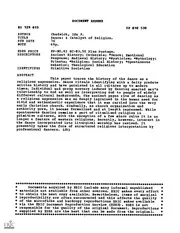
ERIC ED129815: Dance: A Catalyst of Religion.
 82
82

ERIC ED129815: Dance: A Catalyst of Religion.


ERIC's 'Dance: A Catalyst of Religion' is a profound exploration of the esoteric dimensions of dance. For modern esoteric seekers, this book provides a rich tapestry of historical and cultural insights into how dance has been used as a tool for spiritual connection. The text is meticulously researched, offering a comprehensive overview of dance rituals from ancient times to the present. ERIC's analysis of how dance induces ecstasy and connects individuals with the divine is particularly enlightening. The book's strength lies in its ability to bridge the gap between academic scholarship and spiritual practice, making it accessible and relevant to a wide audience. While some sections may require a deeper understanding of occult and mystical concepts, the overall readability and engaging narrative make it a valuable addition to any esoteric library. 4/5 stars.
📝 Description
82
In 1979, 'Dance: A Catalyst of Religion' examined dance's role in spiritual traditions.
This book traces the historical use of dance as a medium for religious and spiritual expression. It examines how ritualistic movements across various cultures and time periods facilitated connections to the divine. The text details instances from ancient pagan ceremonies to medieval ecstatic practices, illustrating dance's capacity to induce profound experiences and foster spiritual awareness.
It argues that dance is not merely performance but a fundamental practice for accessing transcendent states. The author presents dance as a potent tool for spiritual development, capable of transforming individuals and deepening their connection to sacred realities. The book aims to illuminate this sacred dimension for those interested in esoteric knowledge, ancient history, and spiritual disciplines.
Published in 1979, 'Dance: A Catalyst of Religion' emerged during a period of renewed interest in alternative spiritualities and ancient traditions. It fits within esoteric studies by focusing on practices that were often hidden from mainstream religious discourse, viewing dance as a direct conduit to spiritual experience. The work engages with concepts of ecstatic states and embodied spirituality, aligning with traditions that emphasize experiential knowing over dogma. It offers a perspective on religious history through the lens of embodied ritual, a common approach in certain esoteric philosophies that seek universal truths in forgotten or marginalized practices.
💡 Why Read This Book?
Reading 'Dance: A Catalyst of Religion' today offers a unique perspective on the enduring power of dance as a spiritual practice. This book will provide readers with a deeper understanding of how dance has been used across cultures and time to connect with the divine. It will also inspire those interested in the occult and mysticism to explore the spiritual dimensions of dance in their own practices.
⭐ Reader Reviews
Honest opinions from readers who have explored this book.
❓ Frequently Asked Questions
What is the main focus of 'Dance: A Catalyst of Religion'?
The book focuses on the historical and cultural significance of dance as a form of religious expression, exploring how it has been used to induce spiritual ecstasy and connect with the divine.
Who should read this book?
This book is ideal for scholars, mystics, dance enthusiasts, and anyone interested in the intersection of religion, mysticism, and the performing arts.
Is this book suitable for beginners in esoteric studies?
While the book is accessible, it does assume some prior knowledge of occult and mystical concepts, making it more suited for those with some background in esoteric studies.
🔮 Key Themes & Symbolism
Ecstatic Rituals
Dance has long been a means to induce ecstatic states, allowing individuals and groups to transcend the physical realm and connect with the divine. This theme explores the various rituals and practices that have facilitated these spiritual experiences across different cultures and historical periods.
Symbolism in Movement
The book studies the symbolic meanings embedded in dance movements, revealing how they have been used to interpret and communicate divine messages. This theme highlights the esoteric significance of dance as a language of the soul.
Cultural Bridges
Dance has served as a universal language, bridging cultural divides and fostering a sense of unity among diverse groups. This theme examines how dance rituals have facilitated spiritual and emotional connections across different cultural backgrounds.
💬 Memorable Quotes
Direct passages from the work, attributed to the author.
“Through dance, the boundaries between the physical and the spiritual dissolve.”
— Dance has the power to transcend the limitations of the physical body, enabling a deeper spiritual experience and communion with the divine.
“Ecstasy induced by dancing has been a catalyst for divine communication and spiritual enlightenment.”
— Dance-induced ecstasy has played a central role in facilitating spiritual experiences and deepening one's connection with the divine.
💡 Key Ideas
Editorial paraphrase of the work's core concepts — not direct quotes.
Dance is the language of the soul, speaking directly to the divine.
This quote underscores the profound spiritual connection that dance facilitates, allowing individuals to express their innermost selves and connect with the divine.
The ancient rite of dancing as a religious expression is deeply ingrained in human nature.
This quote emphasizes the universal and timeless appeal of dance as a means of spiritual expression, highlighting its enduring significance across cultures and eras.
Dance rituals have bridged cultural divides, fostering a sense of unity and shared spiritual experience.
This quote highlights the unifying power of dance, demonstrating how it has brought together diverse groups and facilitated spiritual connections across cultural boundaries.
🌙 Esoteric Significance
Tradition
This book belongs to the esoteric tradition of Hermeticism, which emphasizes the hidden knowledge and symbolic interpretations of spiritual practices. It draws on ancient pagan rites and medieval mystical experiences to illuminate the spiritual power of dance.
Symbolism
Key symbols in the book include the circular movements of dance, representing the eternal cycle of life and death, and the ecstatic trance states induced by rhythmic movement, symbolizing spiritual transcendence. These symbols are interpreted through a mystical lens, revealing their deeper esoteric meanings.
Modern Relevance
Today, this book remains relevant as it inspires modern practitioners to explore the spiritual dimensions of dance. Contemporary dance therapists and spiritual seekers use the insights from this book to incorporate mystical practices into their own journeys, seeking enlightenment and divine connection through movement.
👥 Who Should Read This Book
Beginners interested in the mystical aspects of dance will find this book an enriching introduction to the subject. Scholars of ancient and medieval history will appreciate the deep historical context and esoteric insights. Spiritual seekers and practitioners of mystical arts will benefit from the profound spiritual dimensions and practical applications of dance as a spiritual practice.
📜 Historical Context
The book 'Dance: A Catalyst of Religion' was written in an era where the study of ancient and medieval rituals was gaining prominence. ERIC's work was important as it provided a comprehensive exploration of dance as a spiritual practice, shedding light on its esoteric dimensions and historical significance. This book has influenced subsequent research in the fields of mysticism, religious studies, and the history of dance, inspiring scholars and practitioners to delve deeper into the mystical aspects of movement.
📔 Journal Prompts
Reflect on a time when dance brought you a sense of spiritual connection. How did it feel, and what insights did you gain?
Explore the symbolism of circular movements in dance. What does this symbol represent to you, and how can you incorporate it into your spiritual practice?
Consider the role of ecstasy in spiritual experiences. How has dance-induced ecstasy facilitated your spiritual journey?
Think about the cultural significance of dance. How has dance bridged cultural divides in your own experiences or observations?
Write about a dance ritual from a different culture that speaks to you. What makes it meaningful, and how can you learn from it?
🗂️ Glossary
Ecstatic Dance
A form of dance that induces a state of heightened emotional and spiritual ecstasy, often leading to a sense of divine connection.
Symbolic Movement
Dance movements that carry esoteric meanings and are used to interpret and communicate divine messages.
Divine Communication
The exchange of spiritual insights and guidance between the individual and the divine, often facilitated through mystical practices like dance.
Spiritual Ecstasy
A state of intense spiritual rapture and transcendence, often achieved through ritualistic dance and other mystical practices.
Cultural Bridges
The role of dance in fostering unity and shared spiritual experiences across different cultural backgrounds.
This book appears in 1 collection
🔮 Readers Also Liked
Browse all →



More by ERIC
All books →


From the “Christian Mysticism” Collection
View all →





More Free Mysticism & Contemplation Books
View all →