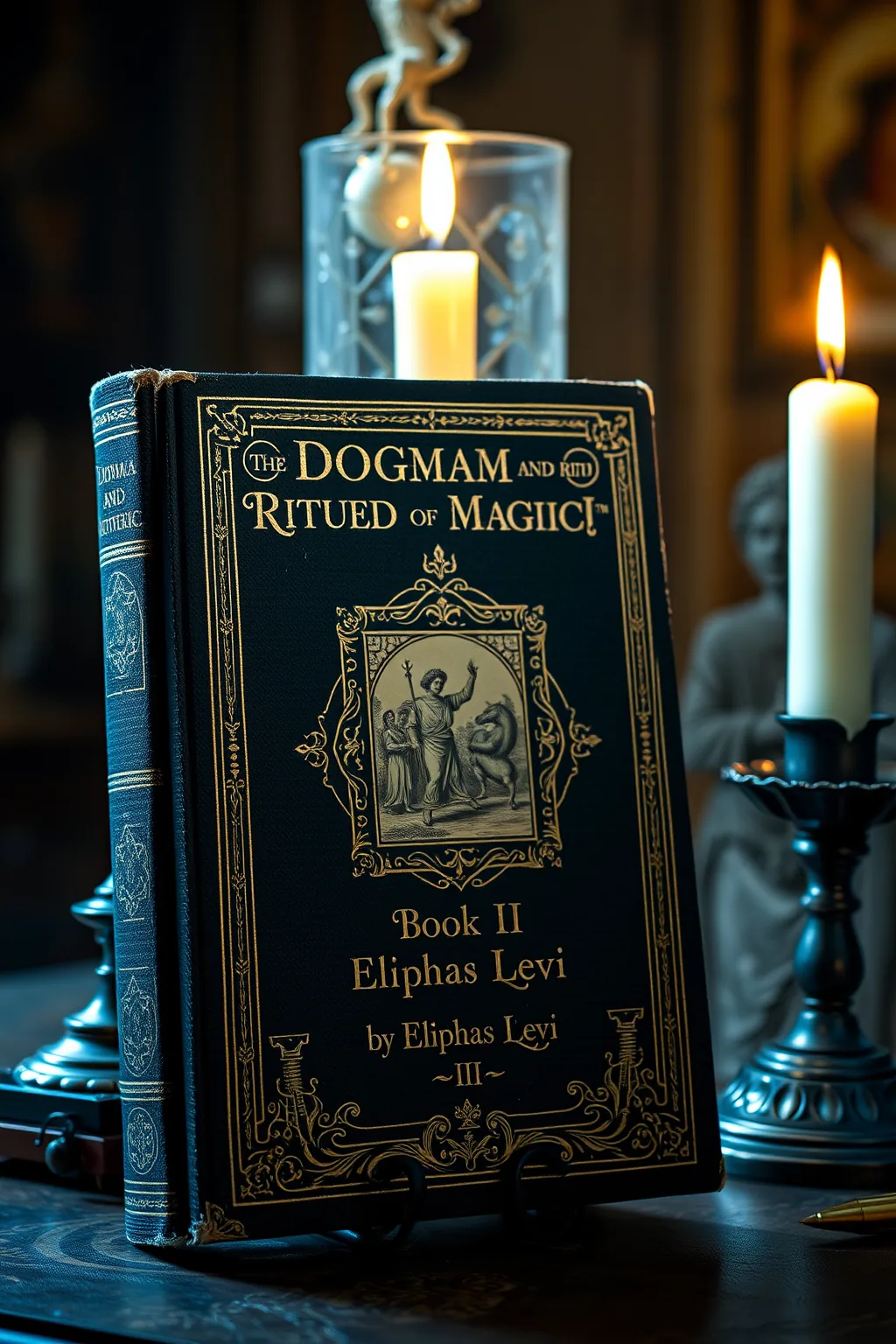
Dogma and Ritual of High Magic. Book II
 61
61

Dogma and Ritual of High Magic. Book II


Isolde Whitaker, Sacred Texts Editor — Eliphas Levi's 'Dogma and Ritual of High Magic, Book II' remains an unparalleled beacon for students of the occult. Levi's erudition shines as he meticulously dissects the symbolic language of magic, bridging ancient Hermeticism with contemporary esoteric thought. This volume offers profound insights into the architecture of the universe, the nature of the astral plane, and the precise methodologies of ritual. Its strength lies in its intellectual rigor, presenting complex concepts with clarity and an almost alchemical precision. Essential reading for serious practitioners and scholars alike, it demands contemplation and dedicated study to fully grasp its transformative potential. A true masterpiece of occult literature.
📝 Description
61
Eliphas Levi published 'Dogma and Ritual of High Magic, Book II' in 1856, detailing the practical application of occult principles.
This second volume by Eliphas Levi expands on the theoretical framework established in his first book. It addresses the practical aspects of high magic, focusing on the proper use of ritual and symbolism. Levi explains how to interpret divine symbols and discusses the relationship between the individual (microcosm) and the universe (macrocosm). The text is written for serious students of occultism, aiming to show magic as a science for spiritual development rather than mere illusion.
Levi's work here is not about simple trickery but a structured approach to understanding universal laws and aligning one's will with them. It presents magic as a means to elevate consciousness and grasp the divine order. The book aims to clarify the philosophical basis of these practices, offering insights that can alter one's perception of reality.
Published in the mid-19th century, 'Dogma and Ritual of High Magic, Book II' is a significant text within the revival of Western esoteric traditions. It draws upon Kabbalistic concepts, Hermeticism, and ceremonial magic, aiming to synthesize these elements into a coherent system. Levi's work sought to reframe occult knowledge for a more educated audience, distinguishing it from folk magic and presenting it as a serious philosophical and spiritual discipline. It stands as a key reference point for understanding the development of modern occultism.
💡 Why Read This Book?
Unravel the deepest secrets of magic and the universe. 'Dogma and Ritual of High Magic, Book II' offers profound philosophical insights, a systematic approach to ritual, and a rich tapestry of symbolism. Ideal for seekers of hidden knowledge, practitioners aiming for true mastery, and scholars of esoteric traditions who wish to understand the foundations of Western occultism. Embark on a journey of spiritual and intellectual awakening.
⭐ Reader Reviews
Honest opinions from readers who have explored this book.
❓ Frequently Asked Questions
What is the primary focus of Book II?
Book II of 'Dogma and Ritual of High Magic' shifts focus from the theoretical underpinnings to the practical application of magic, detailing rituals, ceremonies, and the practical use of occult symbols and talismans for spiritual advancement.
Who was Eliphas Levi?
Eliphas Levi (Alphonse Louis Constant) was a highly influential French occultist, ceremonial magician, and author of the 19th century, widely credited with reviving interest in the occult and shaping modern magical theory.
Is this book suitable for beginners?
While comprehensive, Book II delves into advanced concepts. Beginners are advised to first engage with Book I for foundational understanding, though dedicated and curious newcomers can still find immense value.
What kind of rituals are discussed?
The book explores a wide range of ceremonial rituals, including those for invoking elemental forces, astral projection, divination, and purification, all framed within a robust philosophical and theological context.
Does the book contain illustrations or diagrams?
Yes, 'Dogma and Ritual of High Magic' is renowned for its significant use of symbolic illustrations and diagrams, crucial for understanding Levi's complex theories and ritualistic instructions.
🔮 Key Themes & Symbolism
The Science of the Divine Will
This theme explores magic not as mere superstition, but as a divine science governed by immutable laws. Levi posits that by understanding and aligning one's will with the universal forces, practitioners can effect profound transformations within themselves and their environment. It explores the concept of the 'Great Work,' emphasizing spiritual purification, intellectual illumination, and the harmonious integration of the human will with the cosmic order, making magic a path to enlightenment and self-mastery.
The Language of Symbols and Correspondences
Levi meticulously deciphers the esoteric language embedded within ancient symbols, hieroglyphs, and sigils. This section illuminates the principle of universal correspondences, demonstrating how each element, planet, color, and sound appeals to specific energies and concepts across different planes of existence. Understanding this intricate web of connections is presented as paramount for effective ritual and for comprehending the hidden architecture of reality, revealing the divine blueprint in all things.
The Art of Ritual and Ceremonial Magic
Book II provides a comprehensive exposition on the practice of high magic, detailing the structure, purpose, and execution of various rituals. Levi emphasizes the importance of intention, purification, and the correct use of esoteric tools and incantations. He guides the practitioner in creating sacred space, invoking specific energies, and performing ceremonies designed to achieve spiritual evolution, influence the astral realm, and manifest desired outcomes in accordance with divine law.
💬 Memorable Quotes
Direct passages from the work, attributed to the author.
“The key of the great work is the balancing of forces.”
— This highlights the fundamental principle of duality and equilibrium in magic, essential for harmonizing opposing energies and achieving profound transformation.
“Magic is the science of the secret forces of nature.”
— This defines magic as a rational, observable, and systematic study of the hidden energies that govern the cosmos.
“The universe is a book written in the language of symbols.”
— This emphasizes the symbolic nature of reality and the importance of deciphering these symbols to understand divine truths.
“To know, to dare, to will, to keep silent.”
— These four cardinal virtues of the magician represent the stages of magical practice: intellectual understanding, courageous action, resolute intention, and discretion in execution.
“The greatest mystery is the union of the divine and the human.”
— This points to the ultimate goal of esoteric paths: achieving a state of conscious unity and integration between the individual soul and the universal spirit.
🌙 Esoteric Significance
Tradition
Levi's work is a core part of modern Western Esotericism, synthesizing elements from Hermeticism, Kabbalah, Gnosticism, and ceremonial magic. He sought to present an occult tradition that was both ancient and relevant, accessible to the educated mind while retaining its profound spiritual depth. His teachings are foundational for understanding the interconnectedness of the universe and the potential for human consciousness to interact with these hidden forces.
Symbolism
The book is steeped in rich, layered symbolism, drawing heavily from the Tarot, Hebrew alphabet, and alchemical iconography. Levi masterfully deciphers these symbols, revealing them not as mere decorative elements but as keys to unlocking cosmic principles and divine truths. He illustrates how these symbols represent fundamental forces, archetypes, and stages of spiritual evolution, providing a visual and conceptual language for the esoteric practitioner to engage with the hidden architecture of reality.
Modern Relevance
Despite its 19th-century origins, 'Dogma and Ritual of High Magic, Book II' remains remarkably relevant. Its exploration of consciousness, the power of intention, symbolic language, and the pursuit of self-mastery resonates deeply with contemporary seekers of spiritual and personal growth. The book provides a timeless framework for understanding the energetic underpinnings of reality and offers practical guidance for those wishing to cultivate inner discipline and explore the deeper dimensions of human potential.
👥 Who Should Read This Book
This volume is indispensable for serious students of Western Esotericism, occult practitioners seeking a deeper theoretical and practical understanding of ceremonial magic, and scholars of religious and philosophical history. It is particularly suited for those who have already familiarized themselves with foundational esoteric concepts and are ready to engage with complex, detailed analyses of magical dogma and ritual. While challenging, the diligent reader will find immense rewards, offering useful insights into the nature of reality, consciousness, and the Great Work.
📜 Historical Context
Written in the mid-19th century, 'Dogma and Ritual of High Magic' emerged during a period of intense spiritual and intellectual ferment in Europe. The Victorian era saw a resurgence of interest in ancient mysteries, occultism, and spiritualism, partly as a reaction against the prevailing materialism and rationalism of the Enlightenment. Eliphas Levi, a charismatic and prolific author, synthesized Kabbalah, Hermeticism, Tarot, and Christian mysticism into a coherent system of Western esotericism. His work profoundly influenced subsequent generations of occultists, magicians, and thinkers, shaping the range of modern magical orders and esoteric philosophy by providing a sophisticated, albeit challenging, framework for understanding the occult arts.
📔 Journal Prompts
Reflect on a moment in your life where balancing opposing forces was crucial for progress. How did you achieve this balance?
Identify a common symbol in your daily life. What deeper meanings or hidden correspondences might it hold?
Describe a personal ritual, however simple, that brings you a sense of peace or empowerment. What elements make it effective for you?
Consider the concept of 'knowing, daring, willing, and keeping silent' in relation to a recent challenge or aspiration. How can you better embody these principles?
What does the 'union of the divine and the human' mean to you personally? How might you cultivate this sense of connection in your life?
🗂️ Glossary
The Great Work
In esoteric traditions, the 'Great Work' (Main work) refers to the process of spiritual transformation, self-perfection, and the attainment of enlightenment, often paralleled with alchemical transmutation.
Kabbalah
A system of Jewish mysticism and esoteric tradition that explores the divine nature and the creation of the universe through a complex symbolic language and cosmology, particularly the Sephirot.
Hermeticism
An ancient philosophical and religious tradition based on the purported teachings of Hermes Trismegistus, emphasizing the unity of all things and the principle of 'as above, so below.'
Astral Plane
In esoteric cosmology, the Astral Plane is a subtle, non-physical field of existence, often considered the domain of emotions, desires, and intermediate states of consciousness.
Talismans
Objects enchanted or inscribed with symbols and rituals, believed to possess specific magical properties or to attract or repel certain energies or influences.
This book appears in 3 collections
🔮 Readers Also Liked
Browse all →








More by Eliphas Levi
All books →




From the “Ritual Magic” Collection
View all →




More Free Magic & Ritual Books
View all →