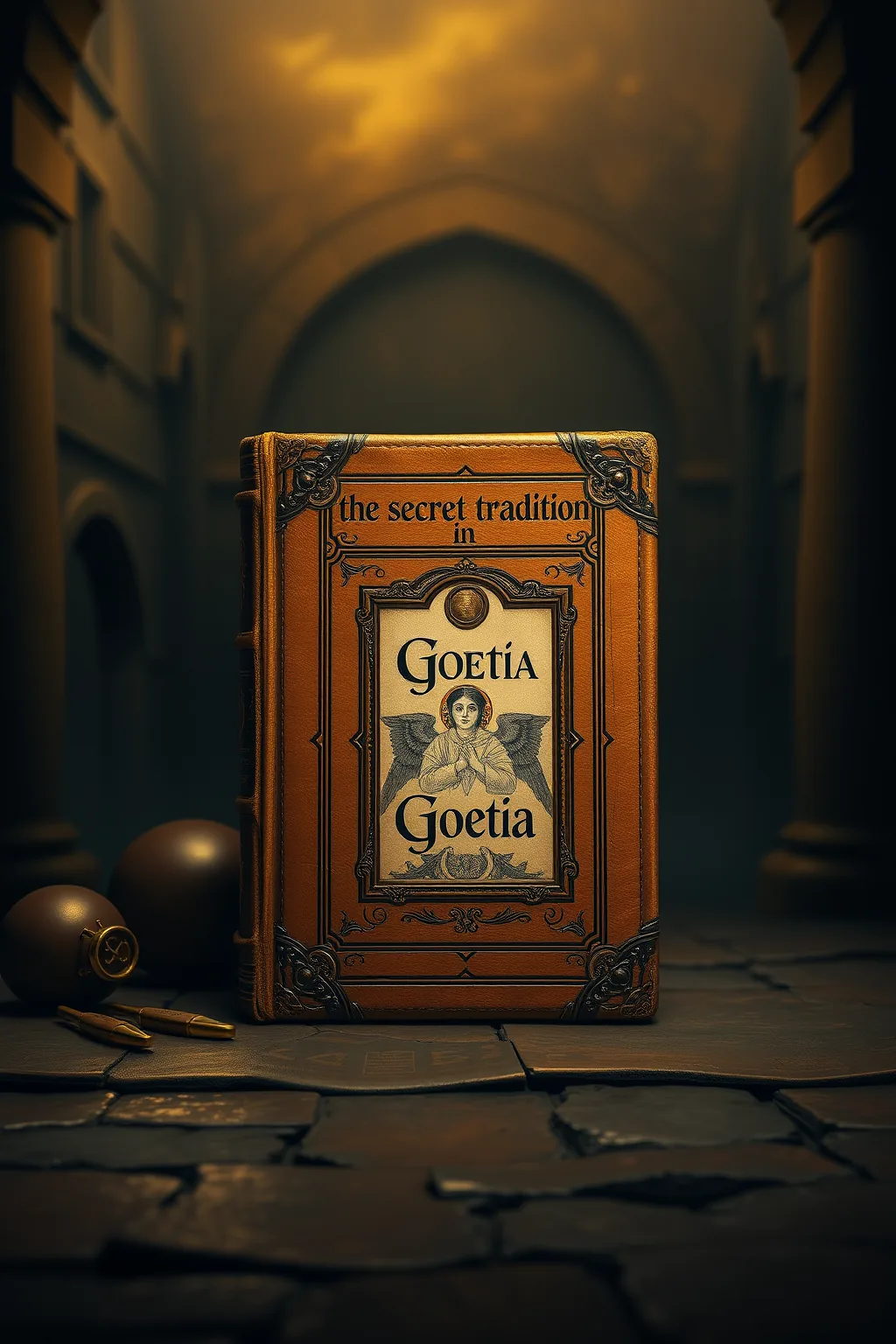
The secret tradition in Goe tia
 61
61

The secret tradition in Goe tia



Silas Hawthorne (Hermetic Studies Editor) — Arthur Edward Waite's 'The Secret Tradition in Goetia' stands as a monumental achievement in the study of Western esotericism. Waite masterfully navigates the treacherous currents of Goetic lore, revealing its profound symbolic language and psychological depth. He eschews sensationalism, instead offering a scholarly yet deeply insightful exploration of the forces and philosophies at play. This work is essential for anyone serious about understanding the practical and theoretical foundations of ceremonial magic. It is a challenging yet rewarding read, particularly for those engaged in the serious study of hermeticism, alchemy, and the Kabbalistic arts, offering crucial context for practitioners and scholars alike.
📝 Description
61
Arthur Edward Waite published 'The Secret Tradition in Goetia' in 1931, examining ceremonial magic.
Arthur Edward Waite's 1931 book, 'The Secret Tradition in Goetia,' investigates the historical and philosophical aspects of Goetic magic. Waite, a significant figure in occult studies, analyzes the rituals, symbols, and demonology associated with this tradition. He argues that Goetia is not simply about summoning spirits but represents a system of spiritual development and psychological insight.
The author details the complex structures of infernal hierarchies and the sigils used in Goetic practices. He emphasizes that the true aim of this art is self-mastery and understanding subtle cosmic energies, rather than the accumulation of power. The work aims to clarify the place of ceremonial magic within the broader scope of esoteric movements.
This work situates itself within the Western esoteric tradition, specifically examining a branch of ceremonial magic often associated with the grimoires. Waite's approach historically contrasts with more purely occultist or magical interpretations by focusing on the psychological and spiritual dimensions. It connects to traditions that explore the invocation of spiritual entities and the use of symbolic systems for inner transformation, placing it alongside studies of Kabbalah, alchemy, and other historical magical systems.
💡 Why Read This Book?
Uncover the hidden architectures of ceremonial magic, demystifying the intricate lore of Goetia. Gain profound insights into the symbolic language and psychological dimensions of occult practice from a leading scholar. Ideal for serious seekers, esoteric historians, and practitioners aiming for a deeper, more nuanced understanding of magical traditions. Explore the philosophical underpinnings of spiritual invocation and the quest for inner mastery.
⭐ Reader Reviews
Honest opinions from readers who have explored this book.
❓ Frequently Asked Questions
What is Goetia?
Goetia refers to a specific branch of ceremonial magic, often associated with the invocation and command of spirits, as detailed in grimoires like the Lesser Key of Solomon. Waite examines its historical and symbolic context.
Is this book a practical grimoire?
While it details historical practices and theories, 'The Secret Tradition in Goetia' is primarily a scholarly and philosophical exploration rather than a direct instruction manual for performing rituals.
Who was Arthur Edward Waite?
Waite was a prolific author and scholar of the occult, mysticism, and Freemasonry, co-creator of the Rider-Waite Tarot deck, known for his meticulous research and esoteric interpretations.
What is the 'secret tradition' Waite refers to?
He refers to the hidden, often esoteric or symbolic, meanings and applications of Goetic practices that are not immediately apparent on the surface, linking them to deeper spiritual and psychological principles.
Is this book suitable for beginners in magic?
It is more suited for those with some background or a strong academic interest in occult history and philosophy. Beginners might find its scholarly depth challenging but rewarding with dedicated study.
🔮 Key Themes & Symbolism
The Symbolic Language of Goetia
This volume meticulously deciphers the rich symbolic collection woven throughout Goetic traditions. Waite argues that the entities, sigils, and rituals are not merely literal entities but potent metaphors for internal psychological states and cosmic forces. Understanding this symbolic language is presented as the key to unlocking the true efficacy of these practices, transforming them from crude conjurations into sophisticated tools for spiritual alchemy and self-realization. The book encourages a contemplative approach, urging readers to look beyond the surface narrative to the profound psychological and philosophical truths embedded within.
Esoteric Psychology and Spiritual Discipline
Waite posits that Goetic practices, when understood through an esoteric lens, serve as a profound system of spiritual discipline. The invocation and perceived mastery of external forces are, in essence, a metaphor for the inner work of confronting and integrating one's own shadow aspects and latent potentials. The book explores how these ancient rites can be employed for psychological purification, the development of willpower, and the attainment of higher consciousness. It emphasizes that true power derived from such traditions lies in self-mastery and the cultivation of an enlightened will, rather than external dominion.
Historical Roots and Western Esotericism
Exploring the historical lineage of Goetia, Waite traces its roots through various esoteric currents that have shaped Western occultism. He contextualizes these practices within the broader field of Hermeticism, Kabbalah, and Renaissance magic, highlighting their interconnectedness. The 'secret tradition' he uncovers is one that has been passed down through clandestine channels, often veiled in allegory and symbolic language. The book serves as a critical examination of how these ancient traditions have been preserved, interpreted, and transmitted, offering invaluable insights for understanding the evolution of esoteric thought in the West.
💬 Memorable Quotes
Direct passages from the work, attributed to the author.
“Magic is the ultimate expression of the human will.”
— This emphasizes the central role of intention and focused will in magical operations, suggesting that it is the directed force of the practitioner's mind that shapes reality.
“The abyss is not a place, but a state of consciousness.”
— This philosophical statement redefines a common occult concept, suggesting that the 'abyss' is an internal, psychological realm rather than an external location, signifying profound self-exploration.
“Symbols are the language of the soul.”
— This underscores the importance of symbolism in esoteric traditions, presenting it as a direct means of communication with the deeper, intuitive aspects of the self and the cosmos.
“True knowledge is not acquired, but awakened.”
— This speaks to the esoteric belief that profound wisdom is not merely learned from external sources but is an inherent potential within the individual that needs to be consciously evoked.
💡 Key Ideas
Editorial paraphrase of the work's core concepts — not direct quotes.
The occult is not a mere art of the possible, but the science of the impossible.
This quote highlights Waite's perspective that true occultism transcends conventional limitations, aiming to achieve what is deemed impossible through esoteric knowledge and spiritual will.
🌙 Esoteric Significance
Tradition
This work is deeply rooted in the Western Esoteric Tradition, specifically focusing on the branch often referred to as Ceremonial Magic and Grimoire Magic. Waite meticulously examines the historical development and symbolic interpretation of Goetic practices, linking them to Hermeticism, Kabbalah, and Neoplatonic philosophy. He positions Goetia not as mere demonology, but as a complex system for spiritual development, self-mastery, and the exploration of inner psychological landscapes through symbolic invocation.
Symbolism
The symbolism in Goetia, as explored by Waite, is complex. It includes the intricate sigils of the spirits, the hierarchical structures of their dominion, and the ritualistic apparatus used in their evocation. Waite interprets these not only literally but as potent symbols representing aspects of the human psyche, cosmic forces, and stages of spiritual attainment. The 'keys' and 'words of power' are seen as symbolic tools for unlocking hidden potentials and influencing subtle energies, requiring deep contemplation and understanding for their effective application.
Modern Relevance
In contemporary occult and esoteric circles, Waite's 'The Secret Tradition in Goetia' remains highly relevant for its scholarly rigor and nuanced interpretation. It provides a critical lens through which modern practitioners can engage with Goetic lore, encouraging a move away from simplistic or fearful interpretations towards a deeper psychological and philosophical understanding. The book's emphasis on self-mastery and symbolic interpretation offers enduring value for anyone interested in the transformative power of ritual and the exploration of consciousness within esoteric frameworks.
👥 Who Should Read This Book
This profound work is essential for serious students of Western Esotericism, occult history, and comparative religion. Scholars of magic and mysticism will find Waite's meticulous research useful for contextualizing Goetic traditions. For practitioners, it offers a critical, philosophical foundation, encouraging a deeper, more conscious approach to ritual and spiritual work. Seekers interested in the psychological dimensions of the occult and the symbolic language of ancient traditions will also find much to explore. Beginners with a dedicated interest in the philosophical underpinnings of magic will benefit, though prior familiarity with esoteric concepts is advisable.
📜 Historical Context
Arthur Edward Waite published 'The Secret Tradition in Goetia' during a period of intense resurgence and intellectualization of occultism in late Victorian and Edwardian England. This era saw a fervent interest in ancient mysteries, spiritualism, and esoteric philosophies, often driven by a reaction against the perceived materialism of the age. Scholars and practitioners alike sought to reconstruct and understand forgotten magical systems, often drawing from rediscovered grimoires and manuscripts. Waite, as a central figure in this movement, aimed to provide a scholarly, critical, and philosophically grounded interpretation of these traditions, particularly those considered arcane or morally ambiguous. His work sought to elevate the study of magic from mere curiosity to a serious philosophical and psychological discipline, placing Goetia within the broader lineage of Western esotericism.
📔 Journal Prompts
Reflect on one Goetic sigil discussed. What does its form and associated entity symbolize to you on a personal, psychological level?
Waite speaks of 'true knowledge being awakened.' How does this concept resonate with your own learning experiences in esoteric subjects?
Consider the idea that external 'spirits' might represent internal aspects of the self. Which aspects of your own psyche do you feel are most aligned with the archetypes presented in Goetic lore?
How does Waite's scholarly approach challenge or affirm your existing understanding of ceremonial magic?
What ethical considerations arise when exploring traditions that involve the invocation of potentially powerful or challenging forces, according to Waite's perspective?
🗂️ Glossary
Goetia
A branch of ceremonial magic, often documented in grimoires, focused on the invocation and command of spirits or demons, traditionally associated with the figure of King Solomon.
Sigil
A magical symbol or emblem, often representing a spirit, entity, or concept, used in ritual for purposes of invocation, evocation, or manifestation.
Grimoire
A textbook of magic, typically containing instructions on how to perform spells, rituals, and incantations, often detailing the names, ranks, and powers of spirits.
Ceremonial Magic
A system of magic that involves elaborate rituals, incantations, and symbolic actions, often aiming at spiritual development or the manifestation of specific outcomes.
Esoteric
Intended for or likely to be understood by only a small number of people with specialized knowledge or interest; relating to hidden meanings or knowledge.
This book appears in 3 collections
🔮 Readers Also Liked
Browse all →





More by Arthur Edward Waite
All books →
From the “Ritual Magic” Collection
View all →








More Free Magic & Ritual Books
View all →