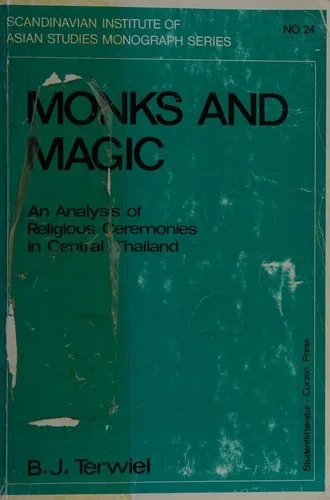
Monks and magic
 61
61

Monks and magic


Isolde Whitaker, Sacred Texts Editor: 'Monks and Magic' is a seminal exploration into the often-overlooked magical dimensions of Theravada Buddhism. Barend Jan Terwiel offers a meticulously researched yet accessible account of the rituals, incantations, and cosmological beliefs that permeate monastic life in Southeast Asia. His work demystifies complex practices, revealing them not as mere superstitions but as integral components of a sophisticated spiritual system aimed at influencing the visible and invisible realms. This book is essential for scholars of religion, practitioners seeking deeper context for ritual, and anyone fascinated by the intersection of faith and the arcane. Terwiel's insights are profound, shedding light on the enduring power of ritual in maintaining cosmic order and personal well-being.
📝 Description
61
Barend Jan Terwiel's 2019 book examines the relationship between Buddhist monks and magic in Southeast Asia.
In 'Monks and Magic,' Barend Jan Terwiel examines the role of magical beliefs and practices within Southeast Asian Buddhist monasticism. The book moves beyond a simple description of rituals to investigate the cosmological understandings that underpin them and the perceived power attributed to these practices. Terwiel details how chanting, ritual performance, and other monastic activities were seen not merely as religious observances but as means to influence events and shape destiny.
This work presents a view of a spiritual tradition where the sacred and the supernatural are closely linked. It shows how faith, the pursuit of liberation, and belief in magical efficacy are interwoven in the lives of monks and the communities they serve. Terwiel's research offers insight into the less visible aspects of religious life and the enduring human desire for spiritual power.
This book situates itself within the study of folk Buddhism and popular religious practices in Southeast Asia, areas often considered 'esoteric' due to their divergence from strictly orthodox doctrines. It acknowledges that while Buddhism promotes liberation from worldly concerns, local traditions frequently incorporate beliefs in supernatural forces and magical interventions. Terwiel's work highlights how monks, as central figures in these communities, were often seen as conduits or practitioners of such powers, blurring the lines between spiritual attainment and magical ability.
💡 Why Read This Book?
Uncover the hidden magical underpinnings of Buddhist monastic life. 'Monks and Magic' offers a rare window into the esoteric knowledge and ritualistic practices that shape spiritual realities in Southeast Asia. It is perfect for seekers of hidden wisdom, scholars of comparative religion, and practitioners interested in the practical application of Buddhist cosmology. Understand the profound connection between faith, ritual, and the perceived manipulation of unseen forces.
⭐ Reader Reviews
Honest opinions from readers who have explored this book.
❓ Frequently Asked Questions
What is the primary focus of 'Monks and Magic'?
The book primarily focuses on the magical beliefs, rituals, and ceremonies practiced within Buddhist monastic communities in Southeast Asia, exploring their connection to esoteric traditions and cosmological understandings.
Is this book suitable for beginners interested in Buddhism?
Yes, while it delves into esoteric aspects, Terwiel's writing is accessible, making it suitable for beginners who are curious about the deeper, less commonly understood dimensions of Buddhist practice beyond basic doctrine.
Does the book discuss specific magical spells or techniques?
The book discusses the *context* and *purpose* of magical practices within the monastic system, rather than providing a 'how-to' guide. It examines the beliefs and efficacy attributed to these rituals.
What geographical region does 'Monks and Magic' primarily cover?
The book's primary focus is on Theravada Buddhist traditions in Southeast Asia, particularly Thailand and its surrounding regions, where monastic magic has been historically prominent.
Is 'Monks and Magic' available for free online?
Availability for free online reading can vary. We recommend checking our 'Read Free Online' section or reputable digital archives for this title.
🔮 Key Themes & Symbolism
The Intertwined Nature of Faith and Magic
This theme explores the profound integration of what might be perceived as 'magic' into the very fabric of Buddhist religious life. It posits that for many practitioners, the rituals, incantations, and amulets are not separate from faith but are active expressions of it, aimed at influencing the material and spiritual worlds. The book reveals how monks, as custodians of spiritual knowledge, often served as intermediaries, employing these practices to address concerns ranging from health and prosperity to protection and spiritual progress, thereby demonstrating a holistic worldview where the sacred and the potent are inseparable.
Ritual as Cosmic Order and Personal Transformation
The book studies how Buddhist rituals are understood not merely as symbolic acts but as vital mechanisms for maintaining cosmic harmony and facilitating personal transformation. Terwiel illustrates how the meticulous performance of ceremonies, chanting of sutras, and the creation of sacred objects are believed to resonate with universal energies, warding off malevolent forces and inviting beneficial ones. This theme highlights the practical, often alchemical, aspect of these practices, where adherence to prescribed forms is essential for achieving desired outcomes, both for the community and the individual aspirant on the path to enlightenment.
The Monk as Esoteric Practitioner and Guardian
Central to the work is the role of the Buddhist monk as a repository and practitioner of esoteric knowledge. Far from being solely ascetics focused on meditation, monks in this tradition were often seen as possessing the spiritual authority and power to engage with the unseen realms. Terwiel examines how their training equipped them to understand and utilize complex ritual systems, amulets, and astrological knowledge. This theme underscores the monk's dual role: as a spiritual guide and as a protector, wielding esoteric arts to safeguard individuals and communities from spiritual and physical afflictions.
💬 Memorable Quotes
Direct passages from the work, attributed to the author.
“Ritual provided a framework for the ineffable.”
— This highlights how structured ceremonies gave form and expression to abstract spiritual concepts and experiences that are otherwise difficult to articulate.
“Sacred objects held elements of divine intention.”
— This implies that the creation and consecration of ritual items imbued them with a spiritual essence, connecting them to higher powers and purposes.
“The visible world was but a reflection of deeper currents.”
— This points to a core esoteric belief: that everyday reality is influenced by unseen forces and spiritual dynamics that can be understood and, to some extent, manipulated.
“Magic was the art of aligning oneself with cosmic forces.”
— This defines magic not as arbitrary spellcasting, but as a disciplined practice of understanding and harmonizing with the fundamental energies of the universe.
💡 Key Ideas
Editorial paraphrase of the work's core concepts — not direct quotes.
The chanting of the monks was not merely sound, but a conduit.
This quote suggests that monastic chants possessed a power beyond auditory perception, acting as a direct channel for spiritual energy or influence.
🌙 Esoteric Significance
Tradition
This work is profoundly significant within the esoteric traditions of Theravada Buddhism, particularly as practiced in mainland Southeast Asia. It illuminates a branch of Buddhism that integrates shamanic, animistic, and Brahmanical elements into its ritualistic framework, often unseen in more academically focused studies. The book reveals how monastic communities served as custodians of these hidden arts, employing them not just for personal spiritual development but also for the well-being and protection of the laity, demonstrating a practical application of esoteric principles.
Symbolism
The book unpacks the strong symbolism embedded within Buddhist magical practices. This includes the potent iconography of deities, animals, and geometric patterns found on amulets and talismans, each carrying specific meanings and energies. The precise arrangement of ritualistic elements, the efficacy of sacred syllables and mantras, and the cosmological diagrams used in spells all represent a symbolic language designed to interact with the subtle realms. Terwiel shows how these symbols are not mere decorations but are active agents, designed to invoke specific forces and achieve desired transformations.
Modern Relevance
In an age often dominated by secularism and scientific materialism, 'Monks and Magic' offers a compelling counterpoint by highlighting the enduring human need for meaning, agency, and connection to something beyond the observable. It demonstrates that esoteric practices, far from being relics of the past, continue to resonate with people seeking spiritual depth, ritualistic engagement, and a sense of control or solace in a complex world. The book invites modern readers to reconsider the limitations of purely rationalistic worldviews and to appreciate the profound psychological and spiritual benefits that structured ritual and symbolic belief can offer.
👥 Who Should Read This Book
Scholars of religion and anthropology will find 'Monks and Magic' an indispensable resource for understanding the practical, ritualistic dimensions of Southeast Asian Buddhism. For spiritual seekers and practitioners of Buddhist or related traditions, the book offers useful insights into the hidden layers of ritual and the potency of sacred practices. Beginners curious about the esoteric aspects of Buddhism will find Terwiel's accessible prose a gateway to a deeper understanding, while those interested in comparative mysticism and the intersection of magic and religion will discover a wealth of fascinating material.
📜 Historical Context
Barend Jan Terwiel's 'Monks and Magic' is deeply rooted in the historical and cultural milieu of Southeast Asia, particularly during the colonial and post-colonial periods. This era was characterized by a complex interplay between traditional indigenous beliefs, the pervasive influence of Theravada Buddhism, and the encroaching presence of Western thought and scientific rationalism. The book shines a light on how Buddhist monasticism, a core part of societal structure and spiritual life, preserved and evolved its esoteric traditions amidst these shifting paradigms. Terwiel's work captures a time when the efficacy of ancient rituals and magical practices was still widely accepted, often serving as a crucial social and psychological support system for communities. It provides invaluable insight into the resilience of these spiritual technologies and their adaptation within a rapidly changing world, offering a nuanced perspective on how tradition navigates modernity.
📔 Journal Prompts
How do you perceive the relationship between faith and what might be considered 'magic' in your own spiritual or belief system?
Reflect on a ritual or ceremony you have participated in. What symbolic meanings did you find within its structure or actions?
Consider the role of 'keepers of knowledge' or spiritual intermediaries in your culture or personal experience. What is their significance?
In what ways do you believe unseen forces or energies influence your daily life or the world around you?
How might understanding the 'practical' application of spiritual beliefs enhance one's personal journey or connection to the divine?
🗂️ Glossary
Amulet
A small object believed to possess protective or magical powers, often inscribed with symbols or spells, worn by individuals for good luck or to ward off evil.
Mantra
A sacred sound, syllable, word, or group of words believed by practitioners to have psychological and spiritual power, often used in meditation or ritual.
Theravada Buddhism
The elder or orthodox school of Buddhism, prevalent in Sri Lanka and Southeast Asia, which adheres closely to the earliest recorded teachings of the Buddha.
Cosmology
The branch of astronomy that deals with the origin, evolution, and eventual fate of the universe, often including philosophical and theological perspectives on the nature of reality.
Ritual
The established form of conducting a ceremony, often a series of actions performed according to a prescribed order, having symbolic meaning and religious or spiritual significance.
This book appears in 3 collections
🔮 Readers Also Liked
Browse all →








From the “Ritual Magic” Collection
View all →









More Free Magic & Ritual Books
View all →