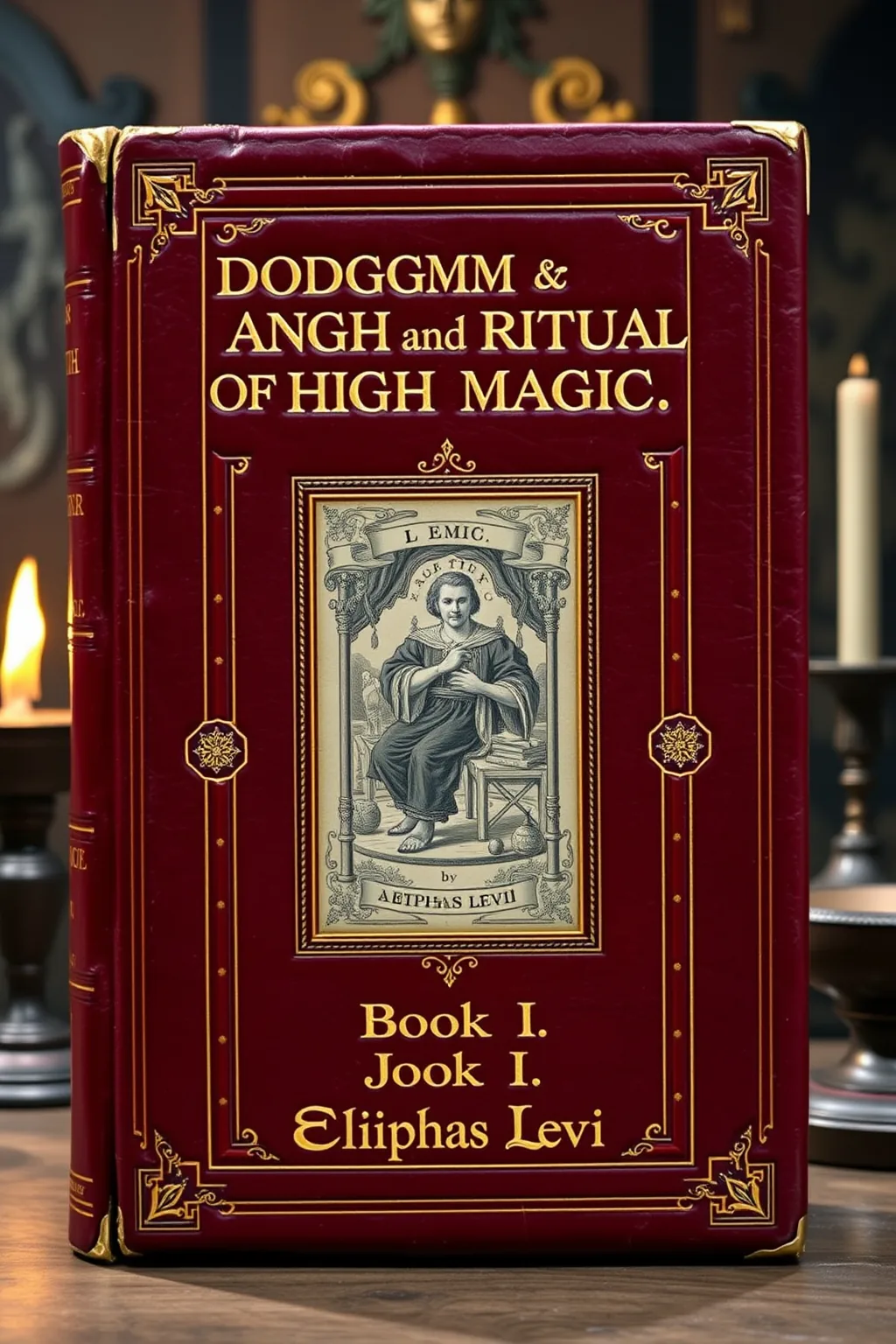
Dogma and Ritual of High Magic. Book I
 61
61

Dogma and Ritual of High Magic. Book I


Lorelei Sage (Contemplative Literature Editor) — Eliphas Levi's 'Dogma and Ritual of High Magic, Book I' remains an unparalleled gateway into the theory and practice of ceremonial magic. Levi masterfully synthesizes diverse esoteric currents, presenting a coherent and deeply symbolic system. His prose, though dense, is richly evocative, illuminating the profound connections between the microcosm and macrocosm. This volume is essential for serious students of occultism, offering not just ritualistic instruction but a robust philosophical underpinning. Its strength lies in its intellectual rigor and the sheer breadth of its esoteric knowledge, making it a vital text for anyone seeking to understand the architecture of spiritual reality.
📝 Description
61
Eliphas Levi published 'Dogma and Ritual of High Magic, Book I' in 1854, detailing occult doctrine.
Eliphas Levi's 'Dogma and Ritual of High Magic, Book I,' first issued in 1854, details the principles of magic as understood in the 19th century. Levi synthesizes elements from various traditions, including Kabbalah, Hermeticism, and Neoplatonism, to form a coherent system of occult philosophy. He examines the symbolic language used in magical texts and practices, interpreting divine names, celestial influences, and the forces that shape the cosmos.
The book addresses the nature of the divine, the human soul, and the relationship between the material and spiritual worlds. Levi presents a structured approach to understanding the universe through magical principles, intended for those who seek deeper knowledge of hidden traditions. He explains the philosophical underpinnings of magic, aiming to provide a framework for its study and practice.
Published during a period of renewed interest in occultism, Levi's work synthesized disparate esoteric traditions into a unified system. It drew heavily on older Hermetic texts, Kabbalistic lore, and figures like Paracelsus and Swedenborg. This synthesis aimed to present magic not as mere superstition, but as a philosophical science with its own internal logic and governing principles. Levi sought to revive and codify a form of Western esotericism that could be studied intellectually and applied practically.
💡 Why Read This Book?
Uncover the foundational principles of High Magic, explore the intricate symbolism of the Kabbalah, and understand the philosophical underpinnings of ritual. This book is essential for serious students of esotericism, occult practitioners, and scholars seeking to delve into the heart of Western magical traditions. It offers a unique lens through which to view the universe, empowering seekers with hidden knowledge.
⭐ Reader Reviews
Honest opinions from readers who have explored this book.
❓ Frequently Asked Questions
What is High Magic according to Eliphas Levi?
Levi defines High Magic as the science of the secrets of nature and the divine, a profound art of manipulating occult forces through will, symbolism, and ritual to achieve spiritual enlightenment and manifest desired outcomes.
What is the role of symbolism in this book?
Symbolism is paramount. Levi elucidates how symbols, from the Tetragrammaton to Tarot figures, act as keys to unlocking cosmic truths and facilitating communication with higher realms.
Is this book suitable for beginners?
While challenging, 'Book I' lays the theoretical groundwork. Beginners should approach it with dedication, perhaps alongside introductory texts, to grasp its complex concepts.
What esoteric traditions does Levi draw upon?
Levi synthesizes Kabbalah, Hermeticism, Gnosticism, Pythagoreanism, and elements of Christian mysticism to create his unique magical philosophy.
Does this book provide practical rituals?
Yes, 'Book I' introduces fundamental rituals and the principles behind them, preparing the practitioner for more advanced work outlined in subsequent volumes.
🔮 Key Themes & Symbolism
The Divine Union and the Great Work
Levi posits that the ultimate goal of High Magic is the 'Great Work,' a process of spiritual alchemy aimed at reuniting the human soul with the divine. This involves understanding the fundamental duality of existence – spirit and matter, masculine and feminine – and their eventual synthesis through profound inner transformation. He explores the divine names and their power, the nature of God, and the path of initiation that leads the adept towards this ultimate reunion, transcending the limitations of the material world and achieving a state of gnosis.
The Science of the Divine Names and Kabbalistic Keys
Central to Levi's system is the potent efficacy of divine names and their arrangement within the Kabbalistic Tree of Life. He meticulously dissects the Tetragrammaton (YHVH) and other sacred appellations, revealing their correspondence to cosmic forces and human faculties. Understanding these names, he argues, is crucial for invoking spiritual energies, commanding elemental forces, and unlocking the secrets of creation. The book serves as a comprehensive guide to the symbolic language of Kabbalah, offering practical applications for the magician.
The Principles of Magical Equilibrium and Astral Projection
Levi emphasizes the vital importance of balance and equilibrium in all magical operations. He explores the concept of the 'astral light' or 'nervous fluid,' the universal medium through which magical forces are transmitted. Understanding how to harness and direct this force, maintaining personal equilibrium, and achieving a state of astral projection are presented as essential skills for any serious practitioner. The book guides the reader in developing the mental discipline and spiritual purity required for safe and effective magical work.
💬 Memorable Quotes
Direct passages from the work, attributed to the author.
“Magic is the science of the secrets of nature and the divine.”
— A concise definition of magic as a profound, knowledge-based discipline seeking to uncover fundamental truths about existence and its creator.
“The symbol is the chain which links the visible to the invisible.”
— This emphasizes the crucial role of symbolic representation in bridging the gap between the material realm and the spiritual dimensions, acting as a conduit for understanding.
“The Great Work is the accomplishment of the union of the soul with God.”
— This defines the ultimate esoteric goal as the spiritual culmination of the magician's journey – achieving divine consciousness and integration with the Absolute.
“He who knows how to read the stars knows how to read the destinies of men.”
— This highlights the interconnectedness of celestial movements and human fate, suggesting that astrological observation is a key to understanding life's unfolding patterns.
💡 Key Ideas
Editorial paraphrase of the work's core concepts — not direct quotes.
The Absolute is the divine will, and the relative is the divine manifestation.
This quote expresses Levi's dualistic yet ultimately unified view of existence, highlighting the primal force of divine intention and its subsequent expression in the tangible world.
🌙 Esoteric Significance
Tradition
Levi's work is a masterful synthesis, deeply rooted in Hermeticism and Kabbalah, yet also drawing from Gnosticism, Neoplatonism, and even elements of Christian mysticism. He sought to establish a universal and rational science of magic, making it accessible to the educated mind of his era. His system is built upon the principle of correspondence (as above, so below) and the belief in a divine order reflected in both the macrocosm and the microcosm, making it a central to modern occult philosophy.
Symbolism
The book is a collection of esoteric symbolism. Levi meticulously deciphers the meaning behind the Hebrew alphabet, the Tarot, alchemical imagery, astronomical signs, and divine names. He presents these symbols not as mere decorative elements, but as potent keys to understanding the structure of the universe, the nature of consciousness, and the forces that govern existence. His interpretations reveal a profound interconnectedness between the divine, the human, and the natural world, making symbolism the very language of magic.
Modern Relevance
Despite its 19th-century origins, Levi's 'Dogma and Ritual' remains remarkably relevant. Its exploration of consciousness, the power of intention, and the interconnectedness of all things resonates deeply with contemporary seekers of spiritual truth and practitioners of various mystical arts. The emphasis on personal transformation, ethical application of power, and the pursuit of wisdom provides a timeless framework for working through the complexities of modern life and seeking deeper meaning. Its influence continues to be felt in modern occultism, New Age thought, and psychological exploration of the subconscious.
👥 Who Should Read This Book
This foundational text is indispensable for serious students of Western esotericism, occult philosophy, and ceremonial magic. Scholars of religion, history, and comparative mythology will find invaluable insights into arcane traditions. Aspiring practitioners seeking a rigorous theoretical framework before engaging in ritual will benefit immensely. Seekers of spiritual knowledge and deeper understanding of universal principles will discover a profound and challenging, yet ultimately rewarding, intellectual and spiritual journey.
📜 Historical Context
Published in the mid-19th century, 'Dogma and Ritual of High Magic' emerged during a period of intense spiritual and intellectual ferment in Europe. The Victorian era witnessed a resurgence of interest in mysticism, occultism, and forgotten ancient wisdom, partly as a reaction against the perceived materialism and rationalism of the Enlightenment. Eliphas Levi, a French occultist and writer, became a central figure in this revival, synthesizing various esoteric traditions like Kabbalah, Hermeticism, and Freemasonry into a coherent and influential magical system. His work provided a sophisticated intellectual framework that appealed to scholars, artists, and those seeking deeper meaning beyond conventional religion and science, profoundly shaping the course of modern Western esotericism.
📔 Journal Prompts
Reflect on the concept of the 'Great Work' in your own life. What does spiritual union or ultimate fulfillment mean to you?
Choose a symbol that holds personal significance and explore its potential hidden meanings, drawing parallels to Levi's approach to Kabbalistic symbols.
Consider the idea of 'magic as a science.' How does this perspective challenge or align with your current understanding of magic?
Meditate on the principle of 'as above, so below.' How do you see the macrocosm reflected in your personal experiences or immediate environment?
Levi emphasizes the importance of equilibrium. Identify areas in your life where balance is lacking and brainstorm how to cultivate greater harmony.
🗂️ Glossary
Kabbalah
A system of Jewish mysticism and esoteric interpretation of scripture, focusing on the divine nature, creation, and the relationship between God and humanity, often visualized through the Tree of Life.
Hermeticism
A philosophical and religious tradition based on the writings attributed to Hermes Trismegistus, emphasizing the unity of all things, the principle of correspondence, and the pursuit of divine knowledge through spiritual alchemy.
Tetragrammaton
The four-letter Hebrew name of God (YHVH), considered one of the most sacred and powerful divine names in Jewish mysticism and occult traditions, representing the divine essence and creative power.
Astral Light
In esoteric traditions, a subtle, pervasive medium or fluid that permeates the universe, acting as a conduit for psychic and magical forces, and through which the soul can travel during altered states of consciousness or astral projection.
Gnosis
Spiritual knowledge or insight, often characterized as intuitive, direct, and experiential understanding of divine truths, leading to liberation or salvation.
This book appears in 3 collections
🔮 Readers Also Liked
Browse all →









More by Eliphas Levi
All books →




From the “Ritual Magic” Collection
View all →






More Free Magic & Ritual Books
View all →