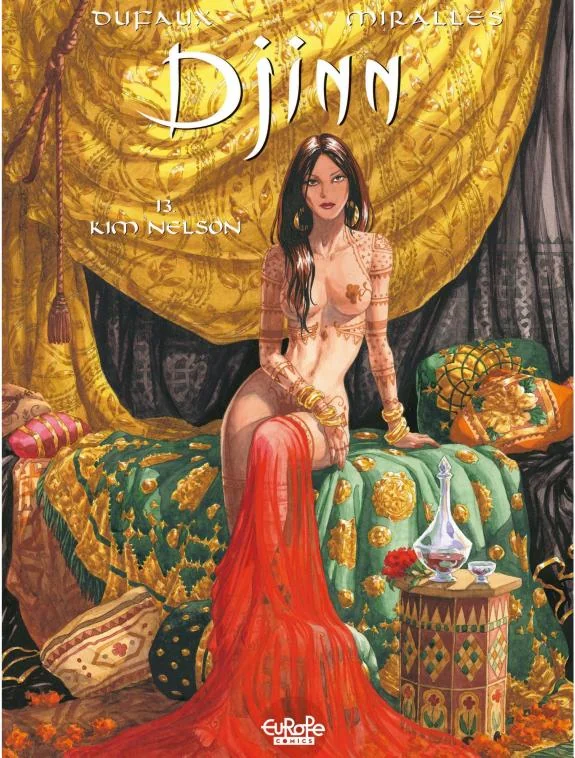
Djinn - Volume 13 - Kim Nelson
 71
71

Djinn - Volume 13 - Kim Nelson
Jean Dufaux’s Djinn - Volume 13 arrives not with a whisper, but with the thunderous finality of a story that has reached its predestined, inevitable conclusion. The narrative’s strength lies in its commitment to Kim Nelson’s evolution. We witness her shed the skin of the victim and don the mantle of a potent, albeit morally compromised, agent of retribution. The artwork, consistently a highlight throughout the series, here depicts Kim’s empowerment with stark, effective visuals, particularly during her confrontations in Africa. However, the sheer density of plot threads, meticulously laid over thirteen volumes, means that the resolution, while satisfying, occasionally feels rushed in its final act. Certain thematic resolutions, especially concerning the Djinn Jade’s motivations, could have benefited from more breathing room. Despite this, the volume solidifies the series’ reputation for ambitious storytelling. It’s a conclusion that delivers on its promise of vengeance, however cruel, proving sweet in its finality.
📝 Description
71
Jean Dufaux's Djinn - Volume 13, published in 2016, concludes the saga of Kim Nelson.
This final volume of the Djinn series brings Kim Nelson's story to a close, tracing her journey from India to Africa and back. It details her ultimate confrontation with a vow made by the Djinn, Jade. Kim transforms into a powerful temptress, embracing justice and vengeance.
This graphic novel is for mature readers who have followed the Djinn series. It appeals to those interested in character driven narratives about fate, justice, and personal power. Readers who enjoy complex storytelling that blends the mystical with the personal will find this conclusion satisfying.
While a modern series, Djinn draws on ancient Middle Eastern folklore concerning djinn. The narrative engages with themes of predestination and curses. It reflects a longer tradition of exploring how power manifests in individuals, a subject that has long interested esoteric thought, especially since the occult revival of the late 19th and early 20th centuries.
💡 Why Read This Book?
• Understand the full arc of Kim Nelson's transformation into a 'temptress' figure by engaging with her journey from India to Africa as depicted in Volume 13. • Explore the esoteric implications of fulfilling ancient vows, particularly the pact made with the Djinn, Jade, as presented in this concluding installment. • Witness a narrative that concludes in 2016, offering a modern interpretation of justice and vengeance through the lens of a character assuming her personal power.
⭐ Reader Reviews
Honest opinions from readers who have explored this book.
❓ Frequently Asked Questions
What is the main plot of Djinn - Volume 13?
Volume 13 concludes the Djinn series, detailing Kim Nelson's return to Africa to fulfill a vow made by the Djinn, Jade. It focuses on her transformation into a powerful figure seeking justice and vengeance.
Who is Kim Nelson in the Djinn series?
Kim Nelson is the protagonist whose journey from India to Africa and back forms the central narrative of the Djinn series, culminating in her assuming significant personal power.
What are the key themes in Djinn - Volume 13?
Key themes include the fulfillment of ancient vows, personal empowerment through embracing one's darker aspects (like vengeance), and the cyclical nature of curses and their resolution.
What is the significance of the Djinn, Jade?
Jade is an elusive Djinn who made a vow that drives much of Kim Nelson's journey. Her presence and the vow are central to the plot's resolution in Volume 13.
When was Djinn - Volume 13 originally published?
Djinn - Volume 13 was first published on October 5, 2016.
Is Djinn - Volume 13 the end of the series?
Yes, Djinn - Volume 13 is explicitly stated as the thirteenth and final volume of the epic Djinn series.
🔮 Key Themes & Symbolism
Fulfilling Ancient Vows
The narrative culminates in the necessity of fulfilling a vow made by the enigmatic Djinn, Jade. This theme explores the weight of ancient promises and their inescapable influence on individual destinies. Kim Nelson's journey is fundamentally shaped by her commitment to see this vow through, irrespective of the personal cost or the moral implications of her actions. It highlights how past agreements can dictate present realities and necessitate difficult choices.
The Empowered Temptress
Kim Nelson's arc is defined by her transformation into a 'temptress' figure, not merely for seduction, but as a conduit for justice and vengeance. This theme examines the reclamation of power, particularly for female characters, by embracing traditionally negative archetypes. Her actions are driven by a desire for retribution, showcasing a complex understanding of justice that transcends simple morality, where vengeance is portrayed as both cruel and satisfying.
Curses and Retribution
The concept of a cursed child princess of Eschinapur introduces the pervasive theme of curses and their long-reaching consequences. Volume 13 deals with the breaking or fulfillment of these curses through direct intervention and retribution. The narrative suggests that justice, when denied through conventional means, may manifest through potent, even vengeful, actions, exploring the cyclical nature of suffering and the drive to end it decisively.
Journey of Self-Discovery
Kim Nelson's physical journey from India to Africa and back mirrors her internal transformation. This theme focuses on her coming into her own, discovering and assuming her inherent power. The challenges and confrontations she faces are catalysts for this growth, forcing her to confront her capabilities and make definitive choices about her role in the unfolding drama, ultimately leading to a profound personal reckoning.
💬 Memorable Quotes
Direct passages from the work, attributed to the author.
“Vengeance, always cruel, but always sweet...”
— This interpretation of vengeance suggests a complex duality: the harshness of the act itself, contrasted with the profound satisfaction or relief it brings to the avenger. It frames vengeance as a powerful, albeit dark, motivator.
“...to fulfill a vow made by the elusive Djinn, Jade.”
— This phrase identifies a core plot device: an ancient vow made by a mystical entity. The fulfillment of this vow is presented as the driving force behind Kim's ultimate confrontation and transformation.
“The cursed child princess of Eschinapur...”
— This refers to a specific, central element of the series' mythology. The 'curse' and the identity of the princess are integral to the overarching conflict and Kim's mission within the narrative.
💡 Key Ideas
Editorial paraphrase of the work's core concepts — not direct quotes.
Kim truly comes into her own, assuming her power as a temptress in the name of justice and vengeance.
This passage highlights the central arc of Kim Nelson in the final volume. It signifies her active embrace of a powerful, morally ambiguous role, driven by a desire for retribution and a redefined sense of justice.
The circumstances that lead Kim Nelson from India to Africa and back again...
This quote points to the narrative's geographical and thematic scope, emphasizing the extensive journey Kim undertakes. It implies that her movements are not random but are dictated by unfolding events and a predetermined path.
🌙 Esoteric Significance
Tradition
The Djinn series, and particularly its conclusion in Volume 13, engages with themes that resonate with a syncretic esoteric tradition, drawing loosely from Middle Eastern folklore regarding Djinn while framing their influence within a narrative structure akin to Western notions of fate and karmic retribution. It departs from strict adherence to any single lineage, instead utilizing the mystique of the Djinn as a catalyst for exploring human agency, destiny, and the darker aspects of justice, aligning with broader modern occult interests in archetypal powers and psychological transformation.
Symbolism
The Djinn themselves symbolize ancient, potent forces that exist beyond human comprehension, capable of influencing mortal lives through pacts and vows. Kim Nelson's transformation into a 'temptress' serves as a symbol of embracing one's shadow self to enact justice, reclaiming power through traditionally feared archetypes. The 'cursed child princess of Eschinapur' represents the enduring impact of ancient grievances and the potential for a single individual to carry and resolve historical trauma.
Modern Relevance
Contemporary practitioners interested in shadow work, archetypal psychology, and the reclamation of power by marginalized figures might find resonance in Kim Nelson's arc. The series' exploration of vengeance as a force for eventual justice, albeit a cruel one, speaks to modern discussions about accountability and retribution outside conventional legal frameworks. Thinkers examining the intersection of folklore, psychology, and narrative in shaping belief systems can find fertile ground in its complex character dynamics.
👥 Who Should Read This Book
• Mature readers of graphic novels who appreciate complex, character-driven narratives exploring themes of fate, justice, and personal power, particularly those who have followed the Djinn series since its inception. • Students of comparative mythology and folklore interested in modern interpretations of entities like Djinn and their narrative function in contemporary storytelling. • Individuals drawn to stories featuring strong female protagonists who undergo significant transformations and confront morally ambiguous situations to achieve their goals.
📜 Historical Context
Published in October 2016, Djinn - Volume 13 arrived at a time when graphic novels had firmly established themselves as a medium for complex, mature storytelling, moving beyond superhero fare. The series, initiated in 2004, coincided with a growing interest in global mythologies and darker, character-driven fantasy narratives. While not directly engaged with specific contemporary occult movements, its exploration of fate, destiny, and the manifestation of power through individual will echoes themes present in neo-pagan and esoteric circles influenced by Jungian psychology and archetypal studies. The reception of the series generally acknowledged its ambitious scope and artistic merit, though specific critical engagements with its esoteric underpinnings by named scholars are less common than its appreciation as a compelling graphic narrative. In the broader range of speculative fiction, it stands alongside works that sought to blend intricate plotting with supernatural elements, distinct from the more direct philosophical inquiries of authors like Alan Moore.
📔 Journal Prompts
Kim Nelson's assumption of power as a temptress.
The nature of the vow made by the Djinn, Jade.
The resolution of the curse concerning the child princess of Eschinapur.
The geographical journey from India to Africa and its symbolic meaning.
The duality of vengeance as cruel yet sweet.
🗂️ Glossary
Djinn
Supernatural creatures from Arabian and Islamic mythology, often depicted as beings of smokeless fire, capable of interacting with humans, granting wishes, or influencing events.
Eschinapur
A fictional location central to the Djinn series, associated with a cursed child princess and significant plot developments driving the narrative.
Temptress
In this context, not solely a figure of sexual allure, but one who wields influence and power, often through manipulation or by embodying dangerous archetypes, to achieve justice or vengeance.
Vow
A solemn promise, often made to a deity or supernatural entity. In the series, a specific vow made by the Djinn, Jade, is a critical plot element driving character actions.
Vengeance
The act of seeking retribution or punishment for a perceived wrong. The series portrays vengeance as a powerful, albeit morally complex, motivator for justice.
Curse
A supernatural affliction or source of misfortune placed upon a person, place, or object. The series features a prominent curse linked to the princess of Eschinapur.
Kim Nelson
The primary protagonist of the Djinn series, whose journey from India to Africa and her eventual empowerment form the core narrative arc.
This book appears in 1 collection
🔮 Readers Also Liked
Browse all →









From the “Djinn” Collection
View all →







More Free Occult Philosophy Books
View all →