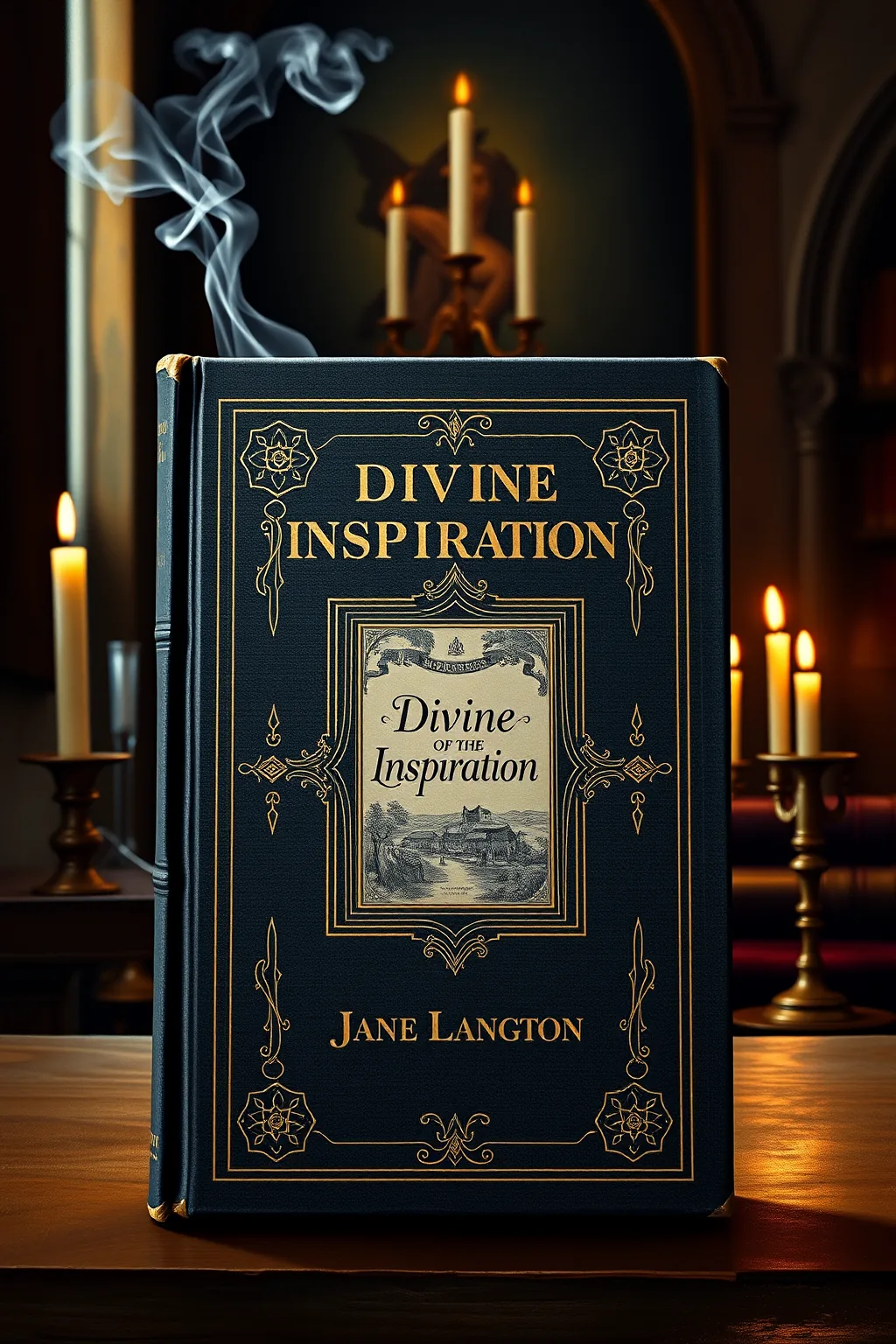
Divine Inspiration
 63
63

Divine Inspiration



Marcus Thorne, Esoteric Sciences Reviewer: Jane Langton's 'Divine Inspiration' offers a uniquely compelling blend of intellectual mystery and esoteric exploration. The character of Homer Kelly serves as an astute guide through a narrative rich with hidden meanings and symbolic resonance. Langton expertly navigates the intersection of academic life and occult undertones, suggesting that profound insights often arise from the disruption of the familiar. This novel is a testament to the power of observation and the potential for spiritual awakening within seemingly mundane environments. Highly recommended for readers who appreciate a well-crafted mystery with a significant philosophical and metaphysical undercurrent.
📝 Description
63
Jane Langton's 1981 novel centers on a Cambridge teacher uncovering occult secrets.
Jane Langton's 'Divine Inspiration' was first published in 1981. The story follows Homer Kelly, a college teacher in Cambridge, Massachusetts, who becomes involved in a mystery. This mystery touches upon arcane knowledge, symbolism, and the connections between events that appear unrelated. Langton combines academic settings with a sense of the occult. The novel suggests that true inspiration can arise unexpectedly.
The book invites readers to consider the hidden aspects of existence, intuition, and the interplay between logic and unseen influences. It functions as a detective story while also prompting contemplation of deeper meanings in daily life. The narrative weaves together intellectual puzzles with a subtle exploration of esoteric themes.
Published in 1981, 'Divine Inspiration' engages with themes common in esoteric fiction of the late 20th century. It touches upon the idea that hidden knowledge and subtle forces influence everyday reality, a concept explored in various occult traditions. The novel's focus on symbolism and intuition aligns with traditions that posit a deeper, unseen order to the universe, accessible through non-rational means. It situates these ideas within a contemporary academic milieu, contrasting the rational world with the potential for supernatural or hidden insights.
💡 Why Read This Book?
Delve into a captivating mystery where academic life meets ancient secrets. 'Divine Inspiration' offers a unique exploration of hidden knowledge and the power of intuition. Ideal for seekers of esoteric wisdom, literary scholars interested in symbolic narratives, and anyone drawn to mysteries that ponder the deeper currents of existence. Discover how the divine spark can illuminate the ordinary.
⭐ Reader Reviews
Honest opinions from readers who have explored this book.
❓ Frequently Asked Questions
What is the primary genre of 'Divine Inspiration'?
'Divine Inspiration' is primarily a mystery and detective fiction novel, intricately woven with strong elements of the occult and metaphysical. It appeals to readers who enjoy intellectual thrillers with a subtle yet pervasive esoteric undercurrent.
Who is Homer Kelly?
Homer Kelly is a fictitious character, a college teacher at the heart of the mystery. He serves as the protagonist through whose experiences the reader encounters the novel's esoteric themes and unfolding secrets.
Where is the novel set?
The novel is set in Cambridge, Massachusetts, a location known for its prestigious academic institutions, which provides a fitting backdrop for the blend of intellectual pursuits and hidden occult knowledge explored within the story.
Does the book require prior knowledge of occult practices?
No, prior knowledge is not strictly required. While the book draws upon esoteric themes, Jane Langton introduces them in a way that is accessible to the general reader, allowing for discovery and contemplation.
What makes this book suitable for an 'Esoteric Library' collection?
'Divine Inspiration' is a perfect fit due to its exploration of hidden knowledge, symbolism, intuition, and the idea that profound truths can be found beyond the material world, often intertwined with intellectual pursuits.
🔮 Key Themes & Symbolism
The Veil Between Worlds
This theme explores the subtle yet profound boundary between the ordinary, observable world and the area of the unseen. The narrative suggests that hidden knowledge and spiritual truths are not entirely inaccessible but often require a shift in perception or a particular sensitivity to discern. It posits that inspiration, whether artistic, intellectual, or spiritual, can originate from beyond the mundane, manifesting through intuition, synchronicity, and symbolic encounters. The college setting becomes a microcosm where the rational intellect grapples with phenomena that defy conventional explanation, highlighting the ongoing human quest to understand the greater cosmic order.
Symbolism and Synchronicity
The novel masterfully employs symbolism as a language of the subconscious and the divine, imbuing everyday objects and occurrences with deeper meaning. Readers are invited to look beyond the surface and recognize patterns of synchronicity – meaningful coincidences that suggest an underlying order or guidance. These occurrences are not random but serve as signposts, nudging the protagonist and the reader towards hidden truths and the interconnectedness of all things. The narrative encourages an active engagement with these symbols, fostering a deeper appreciation for the subtle messages woven into the fabric of reality.
The Nature of Inspiration
Jane Langton examines the many-sided nature of inspiration, questioning its origin and manifestation. Is it purely a product of the human mind, or does it possess a divine or cosmic source? The character of Homer Kelly, a college teacher, becomes a conduit for exploring how inspiration can strike within intellectual pursuits, transforming academic inquiry into a quest for profound understanding. The book suggests that true inspiration is often linked to moments of clarity, intuition, and a willingness to embrace the unknown, leading to breakthroughs that transcend ordinary comprehension and illuminate the path towards greater self-awareness.
💬 Memorable Quotes
Direct passages from the work, attributed to the author.
“He saw patterns where others saw only chaos.”
— This speaks to the power of intuition and esoteric perception, highlighting the ability to discern hidden order and meaning in seemingly random events.
“Inspiration is not found, it is recognized.”
— This implies that divine or profound inspiration is not actively sought but rather acknowledged when it presents itself, often through subtle cues and inner knowing.
“The truth often hides in plain sight, veiled by familiarity.”
— This emphasizes how the extraordinary can be overlooked due to its commonness, suggesting that a deeper, more perceptive gaze is required to uncover hidden realities.
“Each coincidence was a breadcrumb on a path less traveled.”
— This metaphor illustrates how synchronicities, or meaningful coincidences, act as guides, leading one towards significant discoveries on an unconventional or spiritual journey.
💡 Key Ideas
Editorial paraphrase of the work's core concepts — not direct quotes.
The library held more than just books; it held whispers of forgotten knowledge.
This quote suggests that academic institutions and their collections can be repositories of ancient wisdom and esoteric secrets, accessible to those who know how to listen beyond the written word.
🌙 Esoteric Significance
Tradition
While not strictly adhering to a single esoteric tradition, 'Divine Inspiration' draws heavily on themes prevalent in Hermeticism, Gnosticism, and Jungian psychology. It explores the concept of gnosis (direct knowledge of the divine), the idea of hidden wisdom veiled by the material world, and the significance of archetypal symbols and synchronicity as manifestations of the collective unconscious. The narrative suggests a universe imbued with meaning, where subtle forces guide events and individuals.
Symbolism
The novel is rich in symbolism, utilizing elements of academia, architecture, and everyday objects to represent deeper metaphysical concepts. Books in libraries can symbolize stored knowledge, shadows can represent the unknown or the subconscious, and patterns in seemingly random events signify synchronicity and divine order. The act of teaching and learning becomes a metaphor for spiritual awakening and the quest for enlightenment, where hidden truths are gradually revealed.
Modern Relevance
In an age often dominated by materialism and rationalism, 'Divine Inspiration' offers a timely reminder of the importance of intuition, symbolism, and the unseen forces that shape our lives. It encourages readers to look beyond the surface of reality, to question assumptions, and to cultivate a more holistic understanding of existence. The novel’s themes resonate with contemporary interest in mindfulness, personal growth, and the exploration of consciousness, making its esoteric insights relevant to modern seekers of deeper meaning.
👥 Who Should Read This Book
This novel is a compelling read for a diverse audience. **Beginners** curious about esoteric concepts will find a gentle introduction through an engaging mystery narrative. **Scholars** of literature and philosophy will appreciate the intricate symbolism and thematic depth. **Seekers** of spiritual knowledge will be drawn to the exploration of intuition and hidden truths. **Practitioners** of divination or metaphysical studies might find resonance in the novel's portrayal of subtle energies and symbolic language. Anyone who enjoys a well-crafted mystery with a philosophical and mystical twist will find 'Divine Inspiration' a rewarding experience.
📜 Historical Context
Published in the latter half of the 20th century, 'Divine Inspiration' emerged during a period of burgeoning interest in the esoteric and metaphysical. The counter-culture movements of the preceding decades had opened many minds to alternative spiritualities and philosophies, creating a fertile ground for literature that explored the intersection of the mundane and the mystical. Jane Langton's work taps into this cultural zeitgeist, presenting a narrative that, while rooted in a classic mystery framework, allows for a deeper contemplation of consciousness, intuition, and the hidden forces that may influence human affairs. The academic setting of Cambridge, with its rich intellectual history, further grounds the novel's exploration of knowledge, suggesting that clear insights can be found not only in ancient texts but also within the very fabric of modern intellectual life.
📔 Journal Prompts
Reflect on a time you experienced a powerful synchronicity. What did it teach you?
Consider the 'hidden knowledge' within your own field of interest or daily life. How might it be perceived differently?
Describe a place that feels imbued with a sense of mystery or ancient wisdom. What elements contribute to this feeling?
If inspiration were a tangible entity, what form would it take for you, and where would you seek it?
Analyze a common object or symbol in your environment. What deeper meanings or connections can you uncover?
🗂️ Glossary
Gnosis
A Greek term meaning 'knowledge,' often referring to spiritual or mystical insight that transcends empirical understanding. In esoteric contexts, it implies direct, intuitive apprehension of divine truth.
Hermeticism
A philosophical and religious tradition based on the writings attributed to Hermes Trismegistus. It emphasizes principles like 'As above, so below,' and the interconnectedness of the microcosm and macrocosm.
Synchronicity
A concept developed by Carl Jung, describing meaningful coincidences that appear to be related but lack a discernible causal connection. It suggests an underlying acausal connecting principle.
Esoteric
Intended for or likely to be understood by only a small number of people with a specialized knowledge or interest. Pertaining to hidden or secret knowledge, often of a mystical or spiritual nature.
Metaphysical
Concerned with the fundamental nature of reality, including the relationship between mind and matter, substance and attribute, and potentiality and actuality. It explores concepts beyond the physical realm.
This book appears in 3 collections
🔮 Readers Also Liked
Browse all →






From the “Tarot” Collection
View all →







More Free Divination & Tarot Books
View all →