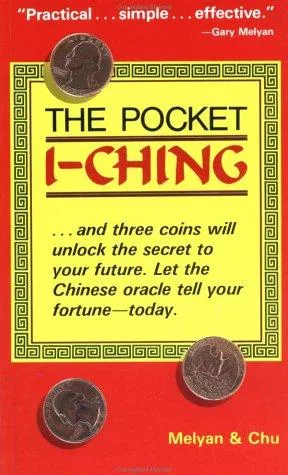
The Pocket I Ching (Yenbooks)
 62
62

The Pocket I Ching (Yenbooks)



Marcus Thorne (Esoteric Sciences Reviewer) — The Pocket I Ching is an indispensable guide for any serious student of esoteric arts. This edition masterfully distills the profound complexities of the Book of Changes into an accessible format, preserving its potent oracular power. Its strength lies in its clarity, allowing practitioners to swiftly access the deep symbolic language and philosophical underpinnings essential for understanding cosmic cycles and personal transformation. Esoteric scholars will appreciate its concise yet comprehensive nature, while seekers will find it an invaluable companion for divination and spiritual growth. It’s a portable gateway to ancient wisdom.
📝 Description
62
First published in 1985, The Pocket I Ching presents the classic Chinese oracle in a compact format.
This edition of the I Ching, a foundational text in Chinese philosophy and divination, provides access to its core principles. The book presents the sixty-four hexagrams, each composed of six lines, which represent archetypal situations and transformations. Each hexagram is accompanied by commentary, offering guidance on understanding change and making decisions. The I Ching functions as a mirror to the user's present circumstances, suggesting courses of action aligned with natural patterns. It is not merely a predictive tool but a system for cultivating wisdom and adapting to life's shifts.
This version aims to make the complex symbolism of the I Ching accessible. It translates the ancient text, retaining the imagery of the lines and their associated meanings. The goal is to enable readers to consult the oracle for personal insight and to study its philosophical underpinnings. By engaging with the I Ching's structure, users can develop a deeper appreciation for the cyclical nature of events and the interplay of opposing forces.
The I Ching, or 'Book of Changes,' is one of the oldest Chinese classic texts, with roots in shamanistic divination practices dating back to the Western Zhou dynasty. It is a cornerstone of Taoism and Confucianism, viewed as a symbolic representation of the universe's dynamic processes. The text's philosophical interpretations, particularly from the Ten Wings attributed to Confucius, transformed it from a simple oracle into a profound system for understanding cosmic principles, ethical conduct, and the art of living in harmony with the natural order. Its esoteric significance lies in its ability to map universal forces and guide human action through symbolic resonance.
💡 Why Read This Book?
Unlock the timeless wisdom of the I Ching, a foundational text for divination and philosophy. This pocket edition offers immediate access to profound insights into change, destiny, and personal growth. Ideal for seekers of hidden knowledge, students of ancient traditions, and practitioners seeking to deepen their connection with universal patterns. It’s your portable oracle for navigating life’s complexities.
⭐ Reader Reviews
Honest opinions from readers who have explored this book.
❓ Frequently Asked Questions
What is the I Ching?
The I Ching, or Book of Changes, is an ancient Chinese divination text and philosophical classic. It uses a system of hexagrams, formed by six stacked lines, to interpret situations and predict potential outcomes, offering guidance for decision-making.
How does the I Ching work?
Through a divination process, typically involving coins or yarrow stalks, hexagrams are generated. Each hexagram represents a specific state or situation, accompanied by an interpretation that provides wisdom and advice for navigating the present.
Who is the intended audience for this pocket edition?
This edition is perfect for beginners curious about the I Ching, as well as experienced practitioners seeking a portable and accessible reference for daily consultation and deeper study.
What are the key benefits of consulting the I Ching?
Consulting the I Ching can offer clarity on challenging situations, foster self-reflection, reveal hidden dynamics, and provide strategic guidance for personal and professional endeavors, promoting a more harmonious approach to life.
Is the I Ching a religious text?
While deeply influential in Taoism and Confucianism, the I Ching is primarily a philosophical and divinatory text. Its wisdom is universal and can be applied by individuals of any spiritual or secular background.
🔮 Key Themes & Symbolism
The Nature of Change (Bian)
Fundamentally, the I Ching is a profound exploration of Bian, the immutable principle of change that governs all phenomena. It teaches that existence is a dynamic flux, a perpetual cycle of arising, transformation, and dissolution. By understanding the patterns of change, individuals can learn to adapt, flow with circumstances, and find stability amidst impermanence, moving from resistance to acceptance and wise action. This theme encourages a fluid perspective on life's challenges and opportunities.
Cosmic Harmony and Human Agency
The I Ching posits a deep interconnectedness between the celestial, terrestrial, and human realms. It reveals how understanding cosmic patterns and aligning oneself with universal forces can influence personal destiny. While acknowledging the power of fate and external influences, the text emphasizes human agency – our capacity to make conscious choices and cultivate inner virtue to shape our path. It's a guide to harmonizing inner intentions with outer realities, fostering balance and serendipity.
Symbolism and Archetypal Wisdom
The hexagrams of the I Ching are rich tapestries of archetypal symbols, each carrying layers of meaning derived from nature, human relationships, and cosmic forces. These symbols act as a universal language, allowing for the interpretation of complex situations through metaphor and imagery. The book serves as a key to deciphering this symbolic lexicon, offering useful insights into the archetypal forces at play in our lives and the collective unconscious, promoting a deeper, intuitive understanding.
💬 Memorable Quotes
Direct passages from the work, attributed to the author.
“When the stars have set, the moon is the highest.”
— This poetic line speaks to the transition of power or influence, suggesting that even the most dominant forces eventually yield to new ones, emphasizing the cyclical nature of dominance and change.
“Stillness leads to clarity.”
— A fundamental principle for divination and self-reflection, this emphasizes the importance of inner calm and quietude to perceive truth and make wise decisions, free from the noise of external distractions.
“To know the path, you must walk it.”
— This pragmatic aphorism underscores that true understanding and wisdom are not merely theoretical but are gained through lived experience and active engagement with life's journey.
“The Book of Changes is a mirror for the soul.”
— This evocative phrase suggests that the I Ching's oracular insights serve to reflect one's inner state, revealing hidden aspects of the self and providing opportunities for introspection and personal growth.
💡 Key Ideas
Editorial paraphrase of the work's core concepts — not direct quotes.
The superior man understands the changes in accordance with the course of heaven.
This quote highlights the ideal of aligning one's actions and understanding with the natural order of the universe, suggesting that true wisdom comes from observing and harmonizing with cosmic rhythms.
🌙 Esoteric Significance
Tradition
The I Ching is a foundational text within Chinese esoteric traditions, deeply intertwined with Taoism, Confucianism, and folk religions. It embodies principles of cosmic balance, Yin and Yang dynamics, and the flow of Qi (vital energy). Its oracular function is not merely predictive but also a method for aligning one's consciousness with universal patterns, a practice central to many forms of spiritual cultivation and inner alchemy aimed at achieving harmony with the Tao.
Symbolism
The hexagrams are the I Ching's primary symbolic language, each composed of six lines representing Yin (broken) and Yang (solid). These lines combine into 64 archetypal representations of fundamental life situations and transformations. The trigrams (three-line combinations) further symbolize core elements like Heaven, Earth, Water, Fire, and Thunder. This intricate symbolic system allows the I Ching to map the entirety of cosmic and human experience, offering useful insights into the interplay of forces.
Modern Relevance
In the modern era, the I Ching continues to be a powerful tool for reading through the complexities of contemporary life. Its emphasis on adaptability, understanding cyclical patterns, and ethical decision-making offers timeless guidance for personal growth, psychological insight, and strategic planning. Esoteric practitioners use it for divination and meditation, while many find its philosophical depth useful for developing resilience, mindfulness, and a greater sense of purpose in an ever-changing world.
👥 Who Should Read This Book
This Pocket I Ching is an essential companion for a diverse range of individuals. **Beginners** will find it an accessible entry point into the profound world of Chinese divination and philosophy, offering clear guidance for initial exploration. **Scholars of comparative religion and philosophy** will appreciate its status as a foundational text and its rich historical context. **Spiritual seekers and practitioners** of occult arts will discover a potent oracle for introspection, decision-making, and deepening their connection to universal energies. **Anyone navigating significant life transitions or seeking greater clarity and wisdom** will benefit from its timeless insights into the nature of change and the art of living harmoniously.
📜 Historical Context
Emerging from the Zhou Dynasty (c. 1046–256 BCE), the I Ching stands as one of China's oldest philosophical and divinatory texts, predating much of recorded Western philosophy. Its compilation and interpretation spanned centuries, evolving from an oracle for rulers to a core part of Confucianism and a vital influence on Taoism and Chinese thought. Revered as one of the Five Classics, it was central to education and governance, shaping ethical frameworks and cosmological understandings. Its enduring relevance lies in its ability to address timeless human concerns about change, destiny, and the art of living wisely, resonating across diverse cultures and eras.
📔 Journal Prompts
Reflect on a recent situation where change was inevitable. How did you respond, and what hexagram might describe your approach?
Consider the interplay of Yin and Yang in your current life. Where do you feel an imbalance, and how can you restore harmony?
What does the concept of 'the course of heaven' mean to you personally? How can you better align your actions with this understanding?
Choose a hexagram that speaks to you today. What archetypal wisdom does its imagery and text offer for your immediate challenges?
How can embracing the principle of constant change lead to greater peace and resilience in your daily life?
🗂️ Glossary
Hexagram
A symbol composed of six stacked lines, either solid (Yang) or broken (Yin), representing a specific situation or stage in the cycle of change. There are 64 distinct hexagrams.
Trigram
A symbol composed of three lines, forming the building blocks of hexagrams. The eight trigrams (e.g., Heaven, Earth, Water) represent fundamental forces and concepts.
Yin
In I Ching philosophy, Yin represents the passive, dark, feminine, receptive, and yielding principle. It is symbolized by a broken line (---).
Yang
In I Ching philosophy, Yang represents the active, light, masculine, creative, and assertive principle. It is symbolized by a solid line (—).
Tao (Dao)
The fundamental principle of the universe in Taoism, often translated as 'the Way.' It represents the natural order, the underlying source of all existence, and the path to harmony.
This book appears in 3 collections
🔮 Readers Also Liked
Browse all →








From the “Tarot” Collection
View all →







More Free Divination & Tarot Books
View all →