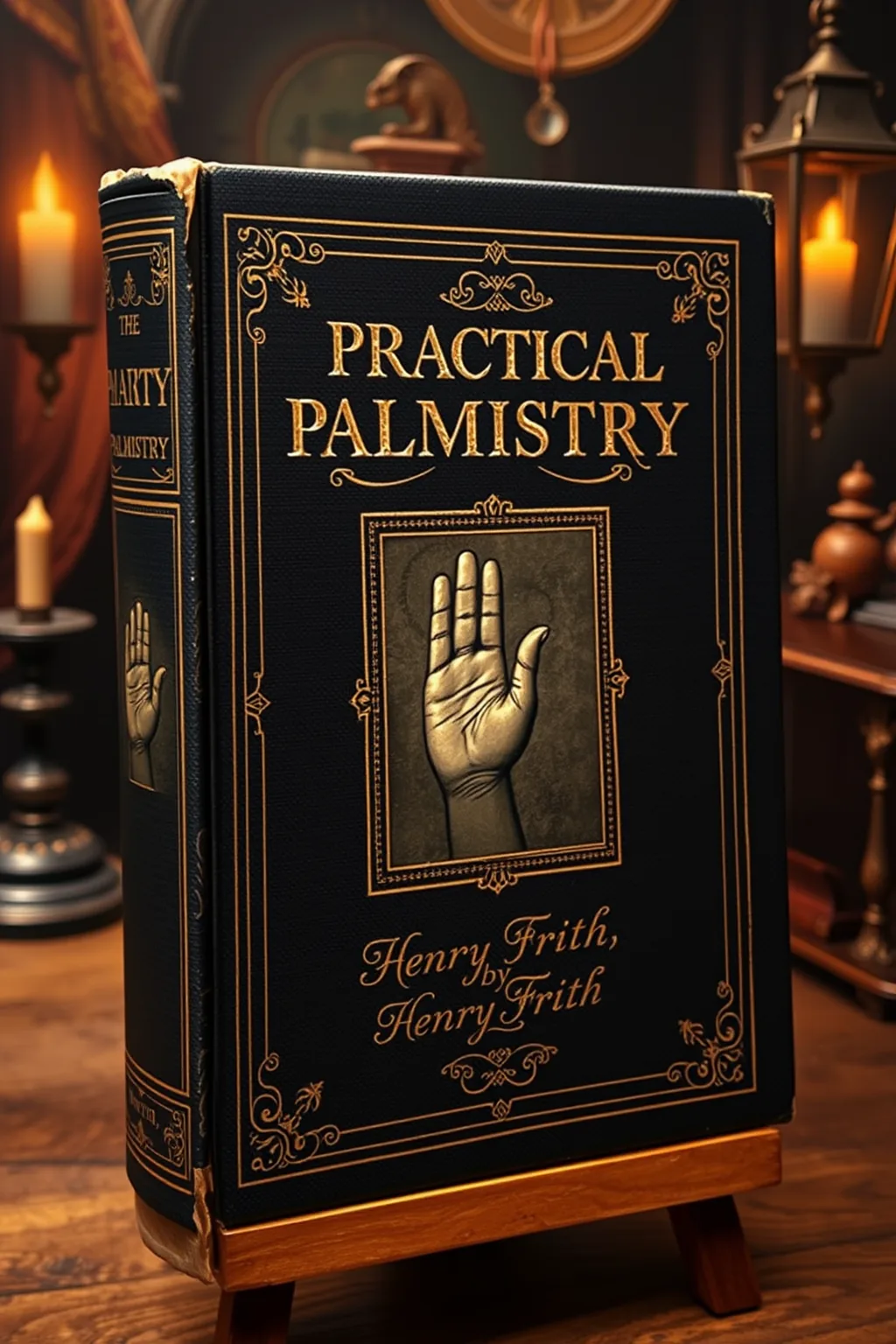
Practical Palmistry - a Treatise on Chirosophy Based upon Actual Experiences
 61
61

Practical Palmistry - a Treatise on Chirosophy Based upon Actual Experiences



Evander Ashcroft (Alchemy & Hermeticism Editor) — Henry Frith's 'Practical Palmistry' stands as a robust testament to the enduring power of chirosophy. Eschewing superficial prognostication, Frith grounds his teachings in empirical observation and a deep understanding of physiological correspondences, aligning it with older traditions of body-as-microcosm. The work's strength lies in its systematic approach, encouraging practitioners to see the hand not just as a static map, but as a dynamic reflection of inner states and potential. It is ideally suited for the serious student of divination, the aspiring practitioner seeking a solid foundation, and the scholar interested in the historical development of esoteric arts.
📝 Description
61
Henry Frith published 'Practical Palmistry' in 1922, claiming it was based on actual experiences.
Henry Frith's 'Practical Palmistry' examines chirosophy, the art of reading the hand. Frith asserts that his methods come from direct experience, not just theory. The book details how hand lines, mounts, and shapes are interpreted to reveal character and potential life events. It goes beyond simple prediction, suggesting a connection between the physical hand and deeper cosmic influences.
This work is for those interested in understanding the symbolic language of the hand. Frith aims to show how the physical form can be a map of personal destiny and inner truths. He discusses the symbolism found in each crease and contour, presenting them as keys to self-understanding and broader universal principles. The book is written for readers who see a link between the material world and spiritual concepts.
This book belongs to the tradition of Western esoteric palmistry that gained traction in the late 19th and early 20th centuries. It follows in the vein of earlier works that sought to systematize chirosophy, often blending observational methods with occult philosophies. Frith’s emphasis on 'actual experiences' suggests an attempt to ground the practice in empirical observation, distinguishing it from purely speculative or mystical approaches. It sits alongside other esoteric disciplines that look for correspondences between the human body and the cosmos.
💡 Why Read This Book?
Discover the profound connection between your palm and your destiny. 'Practical Palmistry' offers a grounded yet mystical exploration of chirosophy, revealing hidden knowledge encoded in your hands. Ideal for spiritual seekers, practitioners of divination, and scholars of esoteric traditions seeking an authentic, experience-based guide to understanding the self and the universe through the art of palmistry.
⭐ Reader Reviews
Honest opinions from readers who have explored this book.
❓ Frequently Asked Questions
What is chirosophy?
Chirosophy is the art and science of reading the hand, often referred to as palmistry. It involves interpreting the lines, mounts, shapes, and other features of the hand to gain insights into a person's character, potential, and life path.
Is this book for beginners or advanced practitioners?
This book offers a comprehensive approach suitable for both beginners seeking a solid foundation and experienced practitioners looking to deepen their understanding with practical, experience-based insights.
Does 'Practical Palmistry' focus on fortune-telling?
While it touches upon predictive elements, the primary focus is on understanding character, potentials, and life influences, positioning palmistry as a tool for self-awareness and personal growth rather than solely fortune-telling.
What makes this book 'practical'?
The 'practical' aspect stems from Henry Frith's emphasis on 'actual experiences,' suggesting a methodology grounded in observation and real-world application, making the principles tangible and actionable for the reader.
What is the historical context of this book?
'Practical Palmistry' emerged during a period of renewed interest in occult and esoteric studies in the late 19th and early 20th centuries, drawing from older traditions while seeking to systematize and validate them.
🔮 Key Themes & Symbolism
The Hand as a Microcosm
This theme posits the hand as a miniature reflection of the entire human being and, by extension, the cosmos. Frith explores how the intricate patterns, lines, and mounts are not arbitrary but symbolic representations of internal energies, psychological traits, and destined life currents. The treatise examines the profound idea that our physical form, particularly the hand, acts as a living map, charting the journey of the soul and the interplay of celestial influences. Understanding this connection allows for a deeper self-awareness and a more profound appreciation of the interconnectedness of all things.
Empirical Observation in Esotericism
Frith's emphasis on 'actual experiences' highlights a crucial aspect of esoteric practice: the integration of empirical observation with intuitive understanding. This theme challenges the notion that occult arts are purely theoretical or superstitious. Instead, it advocates for a rigorous, grounded approach where traditional knowledge is tested, refined, and validated through practical application and careful analysis. The book encourages readers to become active observers, developing their own discerning eye to interpret the subtle language of the hand, thereby building a personal connection to the wisdom of chirosophy.
The Symbolism of Lines and Mounts
Central to 'Practical Palmistry' is the exploration of the rich symbolic language embedded within the hand's geography. Each line—whether the Line of Life, Head, Heart, or Fate—and each raised area, or mount, is presented as a potent symbol carrying specific meanings related to health, intellect, emotion, destiny, and character. Frith guides the reader through the intricate interplay of these symbols, revealing how their depth, clarity, and intersections offer clear insights into an individual's inner world and outward journey. This thematic focus provides a framework for deciphering the palm's complex narrative.
💬 Memorable Quotes
Direct passages from the work, attributed to the author.
“Lines are not destiny, but indications of tendencies.”
— This emphasizes that palmistry reveals potential paths and inclinations, not immutable fate, empowering individuals to understand and potentially shape their future.
“Observe closely, for truth lies in the details.”
— A call to meticulous study and attention, highlighting that the nuanced features of the palm hold the keys to accurate interpretation and deeper understanding.
“The mounts speak of the passions and powers within.”
— This points to the significance of the fleshy pads on the palm, associating them with specific inherent strengths, desires, and energetic potentials of the individual.
“Wisdom is found in the convergence of knowledge and experience.”
— This philosophical statement underscores Frith's approach, advocating for a blend of theoretical understanding and practical, hands-on application to achieve true mastery in chirosophy.
💡 Key Ideas
Editorial paraphrase of the work's core concepts — not direct quotes.
The hand is the mirror of the soul.
This quote captures the core belief that our physical hands are not mere instruments but profound reflections of our inner essence, character, and spiritual journey.
🌙 Esoteric Significance
Tradition
This work is deeply rooted in the Western esoteric tradition, particularly within the lineage of chirosophy and hermeticism that views the human body as a microcosm reflecting the macrocosm. It draws upon ancient Hellenistic, Roman, and medieval European practices of hand divination, synthesizing them with a more empirical, observational approach characteristic of late 19th and early 20th-century occult revivalism. The emphasis on symbolic correspondence and the belief in hidden universal laws align it with foundational esoteric principles.
Symbolism
The symbolism in 'Practical Palmistry' is many-sided, treating the hand as a complex symbolic map. Lines represent life's journey, mental faculties, and emotional currents; mounts embody planetary energies and inherent character traits (e.g., Venus for love, Mars for courage); and finger shapes and lengths offer further nuances of personality. The interplay and configuration of these elements create a rich symbolic language, allowing for the interpretation of potential, challenges, and the unfolding of an individual's destiny. It's a system where form directly conveys meaning.
Modern Relevance
In an age often characterized by rapid change and a disconnect from deeper personal understanding, 'Practical Palmistry' offers a timeless tool for self-reflection and introspection. Its emphasis on observing subtle patterns and understanding inherent tendencies provides a framework for navigating personal challenges and opportunities. For modern seekers, it remains a valuable resource for cultivating intuition, developing self-awareness, and exploring the profound connection between the physical and the psychological, bridging ancient wisdom with contemporary quests for meaning and authenticity.
👥 Who Should Read This Book
This treatise is important for the aspiring palmist seeking a foundational, practical guide grounded in experience. Scholars of esoteric history and divination will find its empirical approach and historical context clear. Spiritual seekers and those on a path of self-discovery will appreciate its insights into character and potential, offering a unique lens for understanding themselves and their life journey. Practitioners of other divinatory arts may also find it a complementary tool for deepening their understanding of symbolic interpretation and human nature.
📜 Historical Context
Published during a period of fervent interest in spiritualism, occultism, and esoteric philosophy—roughly spanning the late Victorian era into the early 20th century—Henry Frith's 'Practical Palmistry' emerged as part of a broader movement to systematize and legitimize ancient mystical arts. This era saw a resurgence of inquiries into divination, astrology, and other forms of hidden knowledge, often seeking to reconcile them with emerging scientific thought or to provide a spiritual counterpoint to materialism. Frith's work reflects this zeitgeist by grounding chirosophy in 'actual experiences,' aiming to present it not as mere superstition but as a disciplined practice based on observation and repeatable results. It stood alongside similar treatises on graphology, phrenology, and other 'sciences of the mind,' contributing to the body of esoteric literature that sought to unlock the secrets of human nature and the universe.
📔 Journal Prompts
Reflect on the dominant lines on your dominant hand. How do their characteristics (depth, clarity, breaks) align with your perceived life experiences and personality traits?
Consider the mounts on your palm. Which ones are most pronounced, and how do the associated planetary influences manifest in your daily life and core desires?
Analyze a specific line (e.g., Head Line or Heart Line) on your hand. What are its key features, and what potential insights does it offer about your thinking patterns or emotional landscape?
Frith emphasizes 'actual experiences.' Document a time when your palm's features seemed to accurately reflect a significant life event or a strong personal tendency.
How can the principles of chirosophy, as presented in this book, be applied not just for prediction, but for fostering greater self-awareness and personal growth?
🗂️ Glossary
Chirosophy
The art and science of reading the hand, commonly known as palmistry. It involves the interpretation of lines, mounts, shapes, and other features of the hand to understand character, potential, and life path.
Mounts
The fleshy, raised pads found on the palm, typically located at the base of the fingers and the fleshy part of the palm. Each mount is associated with a planet and represents specific human qualities, passions, and energies.
Line of Life
The semicircular line originating between the thumb and index finger and curving around the base of the thumb. It is traditionally associated with vitality, physical health, and major life experiences, not necessarily lifespan.
Line of Head
The horizontal line originating near the Line of Life and extending across the palm. It symbolizes intellectual capacity, mental processes, reasoning abilities, and the way one thinks.
Line of Heart
The horizontal line located above the Line of Head, running across the palm towards the little finger. It represents emotional nature, romantic life, love, and the expression of affection.
This book appears in 2 collections
🔮 Readers Also Liked
Browse all →








More by Henry Frith
All books →




From the “Palmistry” Collection
View all →






More Free Divination & Tarot Books
View all →