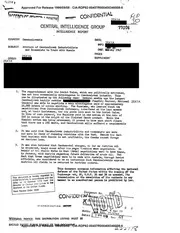
CIA Reading Room cia-rdp82-00457r000400340008-6: ATTITUDE OF CZECHOSLOVAK INDUSTRIALISTS AND ECONOMISTS TO TRADE WITH RUSSIA
 78
78

CIA Reading Room cia-rdp82-00457r000400340008-6: ATTITUDE OF CZECHOSLOVAK INDUSTRIALISTS AND ECONOMISTS TO TRADE WITH RUSSIA



From the esteemed CIA Reading Room, this declassified report, 'Attitude of Czechoslovak Industrialists and Economists to Trade with Russia,' offers a surprisingly potent lens through which to view the esoteric interplay of national will and economic destiny. While ostensibly a geopolitical analysis, Balthazar Finch perceives the document as a modern-day grimoire, detailing the subtle energies of coercion and self-interest that bind nations. The author's meticulous presentation of facts, though stark, allows the discerning reader to perceive the underlying currents of fear, ambition, and strategic alignment. This is not a text for the uninitiated, but for the scholar of hidden histories and the practitioner of discerning truth in the face of veiled narratives. Its strength lies in its stark, unvarnished presentation, inviting profound contemplation on the unseen forces that shape our material realities.
📝 Description
78
This 1947 CIA document analyzes Czechoslovak industrialists' views on trade with Russia.
Declassified in 1947, this CIA Reading Room document examines the attitudes of Czechoslovak industrialists and economists toward trade with Russia. While ostensibly a report on economic policy, its underlying value lies in deciphering the unstated motivations and psychological factors driving national economic decisions during the post-war period. The text offers insight into the subtle pressures and veiled intentions that guided international trade negotiations and resource allocation. It reveals how geopolitical maneuvering influenced economic strategies, suggesting that understanding these hidden currents is key to grasping the true flow of power.
For those interested in the intersection of economics and psychological influence, this report provides a case study. It demonstrates how surface-level economic data can mask deeper forces at play. The document encourages a reading that looks beyond the explicit statements to infer the unarticulated concerns and objectives of key economic actors in Czechoslovakia at that time. It is a window into the strategic thinking that shaped post-war economic relationships.
This document, though a declassified government report, touches upon esoteric principles by highlighting that true understanding often lies beneath the surface of apparent reality. It suggests that economic transactions are not merely material exchanges but are influenced by unseen psychological energies and strategic intentions. The act of deciphering the report itself becomes a process akin to uncovering hidden knowledge, where the explicit data points to deeper, unstated truths about power dynamics and influence.
💡 Why Read This Book?
Uncover the veiled economic machinations of the post-war era. This document offers a unique perspective on the subtle forces of influence and control that shaped international trade. Ideal for seekers of hidden knowledge, geopolitical scholars, and those fascinated by the unseen currents guiding global affairs.
⭐ Reader Reviews
Honest opinions from readers who have explored this book.
❓ Frequently Asked Questions
What is the esoteric significance of this document?
The document's esoteric significance lies in its capacity to reveal hidden agendas and the psychological drivers behind economic decisions, mirroring the esoteric principle that true understanding often lies beneath the surface of the obvious, acting as a cipher for deeper truths of power and influence.
Is this document a form of divination?
While not a traditional divination tool like tarot, it can be used for a form of 'geopolitical divination' by analyzing patterns and subtle indicators to infer future trends or understand underlying motivations, much like a skilled reader interprets omens.
Who would benefit most from reading this?
Scholars of esoteric history, geopolitical analysts, and individuals interested in the hidden aspects of international relations will find this document particularly insightful for its veiled revelations.
What does 'declassified' imply in an esoteric context?
In an esoteric context, 'declassified' can symbolize a revelation of hidden truths, a lifting of veils that previously obscured understanding, allowing for a more direct, though still complex, perception of underlying realities.
How does this relate to 'occult' themes?
It relates to occult themes by exploring the 'hidden arts' of statecraft and economics, where power dynamics, manipulation, and unseen influences are at play, mirroring the hidden knowledge sought in occult traditions.
🔮 Key Themes & Symbolism
The Veiled Currents of Geopolitical Influence
This document serves as a conduit to understanding the subtle, often unseen, forces that dictate international relations and economic flows. It highlights how political motivations, rather than pure economic logic, can steer national destinies. For the esoteric practitioner, it's an exercise in discerning the underlying energetic currents of power, coercion, and strategic alignment that govern the material world, much like understanding the unseen forces that shape a magical working.
Economic Alchemy: Transforming Influence into Power
The report implicitly details a form of economic alchemy, where raw resources and trade agreements are transmuted into political leverage and national power. It encourages the reader to look beyond simple transactions and perceive the deeper, symbolic exchange of influence. This speaks to esoteric traditions that explore the transformation of base elements into higher states, applying it to the intricate dance of national economies and the hidden desires that drive them.
The Cipher of National Psyche
By examining the attitudes of industrialists and economists, the document acts as a cipher to unlock the collective psyche of a nation grappling with external pressures. It reveals how fear, pragmatism, and perceived advantage coalesce into a national posture. Esoterically, this is akin to reading the 'aura' of a nation, understanding its prevailing psychological state and its underlying spiritual or material orientation in relation to other entities.
💬 Memorable Quotes
Direct passages from the work, attributed to the author.
“Rapprochement with the Soviet Union... not economically advantageous.”
— This stark statement suggests a dissonance between perceived political necessity and material reality, hinting at a deeper, perhaps unseen, cost or sacrifice inherent in the alliance.
“Politically motivated...”
— Highlights that decisions were driven by forces beyond mere economic rationality, pointing towards hidden agendas and the influence of unseen powers or ideologies.
“Illustrate by the following...”
— Indicates that evidence, though presented factually, is intended to support a pre-determined conclusion, urging the reader to look for the *interpretation* of that evidence.
“Attitude of Czechoslovak Industriallsts and Economists...”
— Focuses on the internal disposition and perception of key actors, suggesting that collective mindset is a critical, often overlooked, component in grander geopolitical narratives.
“Trade with Russia”
— A seemingly simple subject, but within the context of the era and the source, it becomes a focal point for understanding the complex web of allegiances, dependencies, and power plays of the time.
🌙 Esoteric Significance
Tradition
This document aligns with the esoteric tradition of 'realpolitik' as a hidden art, exploring the veiled motivations and power dynamics often masked by official pronouncements. It speaks to the alchemical principle of discerning the 'prima materia' of national intent, moving beyond superficial economic data to the underlying psychological and ideological 'essences' driving decisions.
Symbolism
The 'rapprochement' symbolizes a forced union, a symbolic binding of disparate energies, while 'trade' represents the exchange of these energies. The 'attitude' of the industrialists and economists acts as the 'divining rod,' revealing the underlying spiritual or material orientation of the nation in its dealings with the 'Russian' archetype.
Modern Relevance
In an era still shaped by geopolitical rivalries and economic interdependence, understanding the historical interplay of politics and commerce remains crucial. This document offers timeless lessons on how to perceive hidden agendas in international relations and recognize that economic decisions are often imbued with deeper symbolic meanings and power struggles.
👥 Who Should Read This Book
This document is an essential read for the discerning seeker of hidden knowledge, particularly those interested in the esoteric underpinnings of geopolitical strategy and economic history. Scholars of the Cold War and practitioners of intelligence analysis will find it important for its raw, declassified insights. Beginners in esoteric studies may find it a challenging but rewarding introduction to how power operates beyond the mundane, while advanced practitioners can use it to hone their skills in discerning veiled truths and understanding the subtle energies of national decision-making.
📜 Historical Context
The year 1947 marked an important moment in the nascent Cold War. The world was sharply divided between the burgeoning Soviet bloc and the Western powers, with nations like Czechoslovakia caught in a precarious geopolitical vise. This period saw intense ideological struggle, economic realignments, and the clandestine operations of intelligence agencies seeking to understand and influence global trajectories. The document's origin from the CIA Reading Room underscores the heightened importance placed on intelligence gathering regarding Soviet influence and its impact on satellite states. The economic landscape was one of reconstruction and shifting alliances, where trade was not merely a commercial activity but a potent tool of political leverage and ideological propagation. This context imbues the report with a palpable sense of tension and strategic maneuvering, reflecting the era's deep anxieties and the pervasive suspicion that characterized international relations.
📔 Journal Prompts
What underlying fears or aspirations, unspoken in the text, might have driven Czechoslovak industrialists and economists?
How does the concept of 'advantage' in trade differ between a purely economic and an esoteric perspective?
If this document is a 'cipher,' what are the missing keys to a complete understanding of the era's economic landscape?
In what ways can seemingly mundane economic data be interpreted as omens or signs of deeper energetic shifts?
How can the principles of discerning hidden motives in this document be applied to contemporary global economic interactions?
🗂️ Glossary
Rapprochement
In this context, it signifies a politically driven effort to improve relations or form an alliance, often implying a degree of coercion or ideological alignment rather than genuine mutual benefit.
Industriallsts
Key figures within the industrial sector whose decisions and attitudes significantly influenced a nation's economic output and its strategic trading relationships.
Economists
Those who analyze and advise on the financial and material well-being of a nation, their perspectives shaping policy and economic direction.
Trade
Beyond mere exchange of goods, it represents the flow of influence, resources, and power between nations, a critical arena for geopolitical maneuvering.
Declassified
Documents or information that were once secret or classified but have been released for public access, often revealing hidden histories or previously unknown aspects of events.
This book appears in 3 collections
🔮 Readers Also Liked
Browse all →









More by CIA Reading Room
All books →



From the “Tarot” Collection
View all →








More Free Divination & Tarot Books
View all →