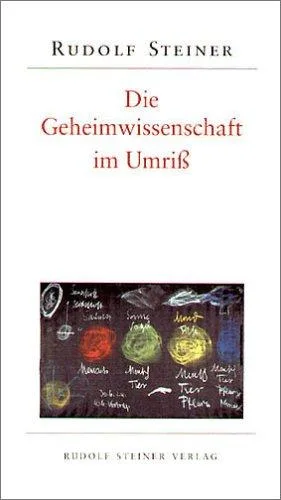
Die Geheimwissenschaft im Umriß
 83
83

Die Geheimwissenschaft im Umriß
Rudolf Steiner's *Die Geheimwissenschaft im Umriß* is a demanding but rewarding text for those committed to understanding the foundational principles of Anthroposophy. Its strength lies in Steiner's methodical presentation of a complex spiritual worldview, offering a coherent system for understanding human evolution and cosmic forces. The book's detailed descriptions of the human constitution—physical, etheric, astral bodies, and the ego—provide a unique lens through which to view consciousness. However, its sheer density and the reliance on a specific, often idiosyncratic, vocabulary can present a significant barrier to entry. A passage detailing the 'Menschheitsentwickelung' (human evolution) through Saturn, Sun, and Moon periods, while central to his cosmology, requires considerable sustained focus to grasp. The work’s value is undeniable for its adherents, though its abstract nature may alienate readers seeking more experiential or historically comparative esoteric texts.
📝 Description
83
Rudolf Steiner published Die Geheimwissenschaft im Umriß in 1930, outlining his spiritual science.
Rudolf Steiner's Die Geheimwissenschaft im Umriß, first published in 1930, is a detailed exposition of his concept of 'spiritual science.' This work does not survey historical occultism but instead systematically presents Steiner's anthroposophical cosmology and epistemology. It describes a method for perceiving non-material realities, explaining the nature of the human being, cosmic evolution, and spiritual hierarchies.
This book is for individuals seriously investigating consciousness and the universe beyond materialistic viewpoints. It suits those who want a structured, non-dogmatic path to spiritual knowledge, especially those interested in Anthroposophy's core ideas. Readers should be prepared to engage with abstract concepts and potentially new terminology regarding the human soul and spirit.
Emerging from the spiritual and intellectual currents of the early 20th century, Die Geheimwissenschaft im Umriß was Steiner's articulation of a modern spiritual science. Following his departure from the Theosophical Society in 1912, he founded the Anthroposophical Society to develop his ideas further. Steiner's work synthesized and departed from existing esoteric traditions, responding to contemporary interests in phenomena like spiritualism and the new fields of psychology and physics. He aimed to place these within a spiritual framework, influencing later spiritual movements.
💡 Why Read This Book?
• Gain a structured understanding of Anthroposophy's core tenets, including Steiner's model of the human being's threefold and fourfold constitution, which offers a unique esoteric psychology. • Explore the concept of the 'path of knowledge' as presented by Steiner, detailing the ethical and meditative disciplines required for developing spiritual perception, a distinct approach to esoteric training. • Grasp the anthroposophical view of cosmic evolution, including the specific planetary stages (Saturn, Sun, Moon) and their influence on human development, providing a unique cosmological framework.
⭐ Reader Reviews
Honest opinions from readers who have explored this book.
❓ Frequently Asked Questions
What is the main purpose of Rudolf Steiner's Die Geheimwissenschaft im Umriß?
The book's primary aim is to present Steiner's 'spiritual science' (Anthroposophy) as a rigorous, observable path to understanding the spiritual dimensions of existence, human consciousness, and cosmic evolution.
When was Die Geheimwissenschaft im Umriß first published?
This foundational work by Rudolf Steiner was first published in 1930, several years after his passing in 1925, compiling his lectures and writings on the subject.
Is this book suitable for beginners in esotericism?
While it is a foundational text for Anthroposophy, its dense philosophical and spiritual concepts can be challenging for absolute beginners. Prior familiarity with Steiner's broader work or esoteric philosophy may be beneficial.
What does 'spiritual science' mean in the context of this book?
In Steiner's view, 'spiritual science' refers to a method of direct perception and understanding of supersensible realities, akin to natural science but focused on spiritual phenomena and accessible through disciplined inner development.
Does the book discuss practical exercises for spiritual development?
Yes, the work outlines the principles and inner attitudes necessary for the 'path of knowledge,' emphasizing meditation, ethical development, and imaginative thinking as core practices for spiritual perception.
How does this book relate to Theosophy?
Steiner was formerly a prominent figure in the Theosophical Society but broke away to form Anthroposophy. While sharing some common ground with Theosophy, his 'spiritual science' presents a distinct cosmology and methodology.
🔮 Key Themes & Symbolism
The Threefold and Fourfold Human Being
Steiner systematically breaks down the human constitution into distinct bodies: the physical body, the etheric (life) body, and the astral (soul/consciousness) body. He further adds the 'I' or ego as the organizing principle. This framework is central to understanding human development, karma, and the process of reincarnation within his spiritual science, offering a detailed esoteric anatomy of consciousness.
The Path of Knowledge
This theme details the rigorous method Steiner proposed for developing the capacity to perceive spiritual realities. It emphasizes disciplined meditation, ethical cultivation, and the transformation of thinking from purely intellectual to imaginative and inspirational cognition. The 'path' is presented not as mystical revelation but as a verifiable inner science.
Cosmic Evolution and Spiritual Hierarchies
The book outlines a grand cosmology, describing the evolution of the cosmos and humanity through successive planetary stages (Saturn, Sun, Moon, Earth, etc.). It details the roles of various spiritual beings or hierarchies (e.g., Archai, Archangels, Angels) in guiding these evolutionary processes, offering a comprehensive spiritual view of history and existence.
Karma and Reincarnation
Steiner presents karma and reincarnation not as abstract doctrines but as observable laws governing human development across lifetimes. The work explains how past actions and choices shape present circumstances and future potentials, providing a moral and causal framework for individual and collective human destiny.
💬 Memorable Quotes
Direct passages from the work, attributed to the author.
“The being of man is only understandable when one sees him in the context of the spiritual world.”
— This statement captures Steiner's core thesis: that a complete understanding of human nature, consciousness, and destiny requires acknowledging and investigating the supersensible realms, which he believed were as real and knowable as the physical.
“Spiritual science must be a science of the soul and spirit.”
— This emphasizes that Anthroposophy, as Steiner conceived it, is not merely speculative philosophy or religious dogma but a systematic, empirical approach to the study of non-physical realities, employing methods analogous to those of natural science.
“The ego is the spiritual kernel that must permeate and organize the lower bodies.”
— This highlights the central role of the 'I' or ego in Steiner's anthropology. It is presented as the unique, immortal spiritual center of the human being, responsible for individual development, consciousness, and the integration of the various bodily sheaths.
“The physical world is a manifestation of spiritual forces.”
— This interpretation reflects Steiner's view that the material reality we perceive is not fundamental but arises from and is sustained by underlying spiritual processes and beings, which are the true basis of existence.
💡 Key Ideas
Editorial paraphrase of the work's core concepts — not direct quotes.
Through the evolution of consciousness, humanity progresses through different stages of being.
This paraphrased concept refers to Steiner's extensive cosmogenesis and anthropogenesis. It suggests that human development is not merely biological but a conscious unfolding across vast epochs, influenced by spiritual forces and leading to higher forms of awareness.
🌙 Esoteric Significance
Tradition
This work is a core part of Anthroposophy, a spiritual philosophy founded by Rudolf Steiner. While drawing upon broader Western esoteric currents like Hermeticism, Gnosticism, and Kabbalah, Anthroposophy presents a unique synthesis and a distinct methodology for spiritual perception. It departs from traditional Theosophy by emphasizing a Christ-centered esoteric path and a more rigorous, 'scientific' approach to the supersensible.
Symbolism
Key symbols include the threefold human being (physical, etheric, astral bodies) representing the layers of human existence, and the fourfold being including the 'I' or ego. The evolutionary stages, often symbolized by planets (Saturn, Sun, Moon, Earth), represent epochs of cosmic and human development, each imbued with specific spiritual forces and challenges.
Modern Relevance
Anthroposophy, as articulated in this work, continues to influence various contemporary movements. These include Waldorf education, biodynamic agriculture, anthroposophical medicine, and diverse artistic and spiritual communities. Thinkers and practitioners in these fields often engage with Steiner's concepts of the human being, cosmic evolution, and spiritual development.
👥 Who Should Read This Book
• Individuals interested in the philosophical and cosmological underpinnings of Waldorf education, seeking to understand the spiritual view of child development. • Students of comparative spirituality and esotericism looking for a detailed exposition of a modern, Western spiritual path distinct from Theosophy. • Seekers of a systematic, non-materialistic worldview who are prepared for dense philosophical and psychological concepts regarding consciousness and evolution.
📜 Historical Context
Rudolf Steiner's *Die Geheimwissenschaft im Umriß*, published posthumously in 1930, emerged from a fertile period of esoteric and spiritual inquiry in Europe. The late 19th and early 20th centuries saw widespread interest in phenomena like spiritualism, Theosophy, and various occult traditions. Steiner himself had been a significant figure within the Theosophical Society, but his divergence in 1912, leading to the formation of the Anthroposophical Society, marked a critical shift. His 'spiritual science' offered a distinct alternative to the more Eastern-influenced syncretism of Helena Blavatsky's Theosophy, focusing on a Western, Christ-centered esoteric path. While figures like Annie Besant continued to lead Theosophy, Steiner developed his own elaborate cosmology and pedagogy. The era also saw the rise of scientific materialism, which Steiner sought to counter by demonstrating the reality and knowability of the spiritual world through disciplined inner work and a rigorous, though unconventional, methodology.
📔 Journal Prompts
The concept of the etheric body and its functions.
Steiner's description of the 'path of knowledge'.
The role of the 'I' or ego in human evolution.
Reflect on the spiritual hierarchies as presented by Steiner.
The evolutionary significance of the Moon period.
🗂️ Glossary
Anthroposophy
A spiritual philosophy and practice founded by Rudolf Steiner, aiming to bridge the spiritual and material worlds through a 'spiritual science' accessible via disciplined inner development.
Etheric Body
In Anthroposophy, the subtle body responsible for life processes, growth, and reproduction; it is considered the vehicle of life forces distinct from the physical and astral bodies.
Astral Body
The body of soul-life, consciousness, and sensation; it is the vehicle for thinking, feeling, and willing, and connects the human being to the psychic and spiritual realms.
I / Ego
The highest spiritual principle in the human being, considered the center of individuality, self-consciousness, and the capacity for moral action and spiritual development.
Spiritual Science
Steiner's term for Anthroposophy, emphasizing its systematic, empirical, and verifiable approach to the study of spiritual phenomena and realities.
Karma
The law of moral cause and effect governing human lives, influencing reincarnation and personal development across lifetimes according to spiritual principles.
Reincarnation
The process by which the individual spiritual being (the 'I') lives through successive earthly existences, learning and evolving through the experiences of birth, life, and death.
🔮 Readers Also Liked
Browse all →








More by Rudolf Steiner
All books →




More Free Theosophy & Anthroposophy Books
View all →