The deeper mysteries

 84
84

The deeper mysteries
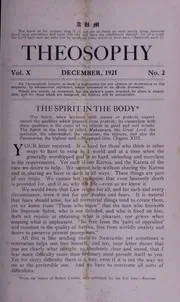
Edward Clarence Farnsworth’s The Deeper Mysteries offers a rigorous, if somewhat dense, exposition on esoteric principles. The 1921 publication date positions it as a product of its time, drawing from a rich milieu of early 20th-century occult thought. Farnsworth’s strength lies in his methodical approach; he doesn't shy away from complex ideas, attempting to articulate the mechanics of spiritual development with a clarity that bridges philosophical inquiry and practical application. One particular section detailing the interaction of thought-forms and the astral plane provides a concrete example of his detailed analysis.
However, the prose can be challenging, often requiring multiple readings to fully grasp the nuances. The lack of extensive practical exercises, while perhaps intentional given the book’s philosophical bent, might leave some readers wanting more direct guidance. Despite this, the work provides a valuable lens through which to view the architecture of esoteric cosmology. It is a serious study for the dedicated seeker.
📝 Description
84
Edward Clarence Farnsworth's The Deeper Mysteries was first published in 1921.
Published in 1921, The Deeper Mysteries offers a systematic look at occult philosophy. Edward Clarence Farnsworth examines the connections between consciousness, the physical world, and the forces influencing existence. He moves past simple explanations to discuss the philosophical and spiritual ideas behind esoteric traditions. The book aims to help readers grasp spiritual growth and the way everything is linked.
This work is for those seriously studying metaphysics, occultism, and world religions. It will appeal to people who want more than basic answers about reality and are curious about the cosmos and the human mind. Anyone pursuing self-knowledge, spiritual growth, or academic research into esoteric thought will find much to consider.
The Deeper Mysteries appeared in 1921, a time marked by the influence of the Theosophical Society and a general rise in spiritualist and occult interests. Farnsworth's approach was more academic and philosophical than some sensationalist occult writings of the era. It aimed to present occult concepts in a reasoned manner, distinguishing it from the more flamboyant occult literature of the early 20th century.
💡 Why Read This Book?
• Gain insight into the concept of 'man as microcosm' as detailed in the text, understanding how universal laws are reflected within the individual's being, a perspective not commonly found in contemporary self-help literature. • Comprehend the esoteric doctrine of initiation as described by Farnsworth, examining the stages and internal transformations involved, which offers a structured view of spiritual progression beyond generalized spiritual concepts. • Grasp the mechanics of subtle bodies and their energetic interactions, as presented in the book's early chapters, providing a specific framework for understanding consciousness that differs from mainstream psychological models.
⭐ Reader Reviews
Honest opinions from readers who have explored this book.
❓ Frequently Asked Questions
What is the primary focus of Edward Clarence Farnsworth's 'The Deeper Mysteries'?
The book primarily focuses on exploring the intricate relationship between consciousness, the material world, and unseen forces, presenting a systematic examination of occult principles and spiritual evolution.
When was 'The Deeper Mysteries' first published?
'The Deeper Mysteries' was first published in 1921, placing it within the early 20th-century surge of interest in esoteric and metaphysical subjects.
What esoteric traditions does 'The Deeper Mysteries' draw upon?
The work synthesizes elements from various esoteric traditions, including Hermeticism and Gnosticism, focusing on universal laws and the nature of consciousness.
Is 'The Deeper Mysteries' suitable for beginners in occult studies?
While accessible, the book delves into complex philosophical concepts, making it more suitable for dedicated students of metaphysics or those with prior exposure to esoteric thought.
Does the book offer practical exercises for spiritual development?
The Deeper Mysteries leans more towards philosophical exposition and theoretical understanding of esoteric principles rather than providing extensive practical exercises.
Is Edward Clarence Farnsworth a well-known figure in esoteric literature?
Edward Clarence Farnsworth is recognized for his contributions to esoteric literature, particularly for his systematic and philosophical approach to occult subjects in works like 'The Deeper Mysteries'.
🔮 Key Themes & Symbolism
Man as Microcosm
Farnsworth posits that the human being is a miniature representation of the entire universe, the macrocosm. This principle, central to Hermetic philosophy, suggests that understanding oneself through introspection and esoteric study is equivalent to understanding the cosmos. The book details how universal laws and forces manifest within the individual's physical, mental, and spiritual constitution, offering a framework for personal transformation by aligning the inner world with the outer.
The Nature of Initiation
The work extensively explores the concept of initiation not as a mere ritual, but as a profound process of spiritual awakening and evolution. Farnsworth outlines the stages involved in transcending ordinary consciousness and gaining direct knowledge of higher realities. This involves a disciplined cultivation of will, intellect, and spiritual perception, leading to a fundamental restructuring of one's being and understanding of existence.
Universal Laws and Energetic Principles
A core theme is the exposition of fundamental laws governing the universe, such as the Law of Correspondence ('As above, so below'). Farnsworth explains these laws as the operating principles of reality, influencing everything from thought to physical manifestation. He elucidates the concept of subtle energies and their role in shaping the material world and the individual's spiritual journey, providing a blueprint for conscious interaction with these forces.
The Role of Will and Consciousness
The book emphasizes the power of human will and consciousness as active agents in creation and spiritual attainment. Farnsworth differentiates between passive experience and consciously directed will, highlighting how focused intention can influence personal destiny and the surrounding environment. Understanding the nature of consciousness is presented as the key to unlocking deeper mysteries and mastering the lower planes of existence.
💬 Memorable Quotes
Direct passages from the work, attributed to the author.
“The universe is a manifestation of consciousness, and man is a spark of that divine consciousness.”
— This statement expresses Farnsworth's idealistic view of reality, suggesting that existence originates from and is sustained by a universal mind. It implies that by understanding our own consciousness, we can grasp the nature of the cosmos.
“Initiation is the process by which the spiritual self becomes increasingly dominant over the material self.”
— This interpretation of initiation highlights its transformative nature, focusing on the internal shift of power from the lower, material aspects of being to the higher, spiritual self.
“Thought is a force, and its direction determines its effect.”
— This emphasizes the practical application of esoteric principles, underscoring the power of focused intention and mental discipline in shaping one's reality and spiritual progress.
“To know oneself is to know the universe.”
— This aphorism captures the essence of the microcosm-macrocosm relationship, suggesting that deep self-understanding leads to universal comprehension.
💡 Key Ideas
Editorial paraphrase of the work's core concepts — not direct quotes.
The Law of Correspondence reveals the interconnectedness of all planes of existence.
This paraphrase points to a fundamental Hermetic principle, suggesting that understanding the relationships between different levels of reality—physical, mental, spiritual—is key to esoteric knowledge.
🌙 Esoteric Significance
Tradition
Farnsworth's work is deeply rooted in the Western Esoteric Tradition, drawing heavily from Hermeticism and Neoplatonism, with influences from Gnostic thought and possibly elements of Kabbalistic philosophy. It fits within the lineage of authors who sought to synthesize these ancient streams into a cohesive spiritual philosophy for the modern age. Unlike some more populist occult texts of the early 20th century, 'The Deeper Mysteries' emphasizes a structured, philosophical understanding of esoteric principles, positioning itself as a guide to the underlying architecture of spiritual reality.
Symbolism
The book frequently references the concept of the 'divine spark' within humanity, symbolizing the inherent spiritual essence that connects individuals to the universal consciousness. Another recurring motif is the 'path of initiation,' which acts as a symbolic journey through various stages of spiritual awareness and mastery. The interplay between the 'microcosm' (man) and the 'macrocosm' (universe) is also a central symbolic framework, illustrating interconnectedness and the principle that understanding one illuminates the other.
Modern Relevance
Contemporary practitioners of Hermeticism, Gnosticism, and comparative spirituality often reference Farnsworth's work for its structured approach to metaphysical concepts. Modern esoteric schools and individual researchers utilize 'The Deeper Mysteries' as a foundational text for understanding universal laws, the nature of consciousness, and the stages of spiritual development. Its clear exposition of principles like the Law of Correspondence continues to inform discussions on quantum consciousness and the interconnectedness of reality in various New Age and esoteric circles.
👥 Who Should Read This Book
• Students of Hermetic philosophy and metaphysics seeking a systematic exposition of esoteric principles, particularly those interested in the microcosm-macrocosm relationship. • Serious practitioners of spiritual development who wish to understand the theoretical underpinnings of concepts like initiation and the nature of subtle energies. • Researchers in comparative religion and occult history looking to contextualize early 20th-century esoteric thought and its philosophical foundations.
📜 Historical Context
Published in 1921, Edward Clarence Farnsworth's 'The Deeper Mysteries' emerged during a vibrant period of occult revival and philosophical exploration in the West. The era was marked by the widespread influence of Theosophy, founded by Helena Blavatsky, which had brought Eastern spiritual concepts to Western audiences and spurred numerous related movements. Farnsworth's work aligns with this intellectual current, offering a systematic, almost academic, approach to understanding esoteric principles. His contemporaries included figures like Rudolf Steiner, who was developing Anthroposophy, and the continued proliferation of spiritualist and Rosicrucian societies. While the Theosophical Society had already established a significant presence, Farnsworth's text can be seen as contributing to a broader discourse on metaphysics and spiritual science, seeking to articulate a coherent philosophy of the unseen. The work engaged with concepts debated within these circles, such as the nature of subtle bodies and the process of spiritual evolution, often presenting them with a logical structure aimed at the earnest student.
📔 Journal Prompts
The concept of man as microcosm: How do the universal laws you perceive in the world reflect in your personal life?
Reflecting on the stages of initiation described by Farnsworth, what inner shifts have you experienced in your spiritual journey?
The energetic principles governing consciousness: How might your thoughts, as forces, be shaping your immediate environment?
The Law of Correspondence: Identify one instance where 'as above, so below' manifests in your daily experience.
Farnsworth's emphasis on the divine spark: How does this concept influence your understanding of your own potential and purpose?
🗂️ Glossary
Microcosm
In esoteric philosophy, this refers to the human being as a miniature representation of the universe (macrocosm), embodying its principles and laws.
Macrocosm
The universe considered as a vast, ordered whole, reflecting the same fundamental principles and laws as the microcosm (human being).
Initiation
A process of spiritual awakening and advancement, involving stages of learning, testing, and transformation leading to higher consciousness and knowledge.
Subtle Bodies
Non-physical aspects of a human being, such as the astral, mental, and spiritual bodies, which are believed to interact with and influence the physical body and consciousness.
Law of Correspondence
A fundamental Hermetic principle stating that there is a harmony and connection between different planes of existence (e.g., physical, astral, mental), often summarized as 'As above, so below'.
Thought-forms
Emanations created by focused thought or emotion, believed to possess a temporary existence and influence on the mental and astral planes.
Will
In an esoteric context, the faculty of directed intention and spiritual power, essential for conscious creation and spiritual advancement.
🔮 Readers Also Liked
Browse all →







More Free Theosophy & Anthroposophy Books
View all →