Theosophy Vol-60,No-10,August 1972
 81
81

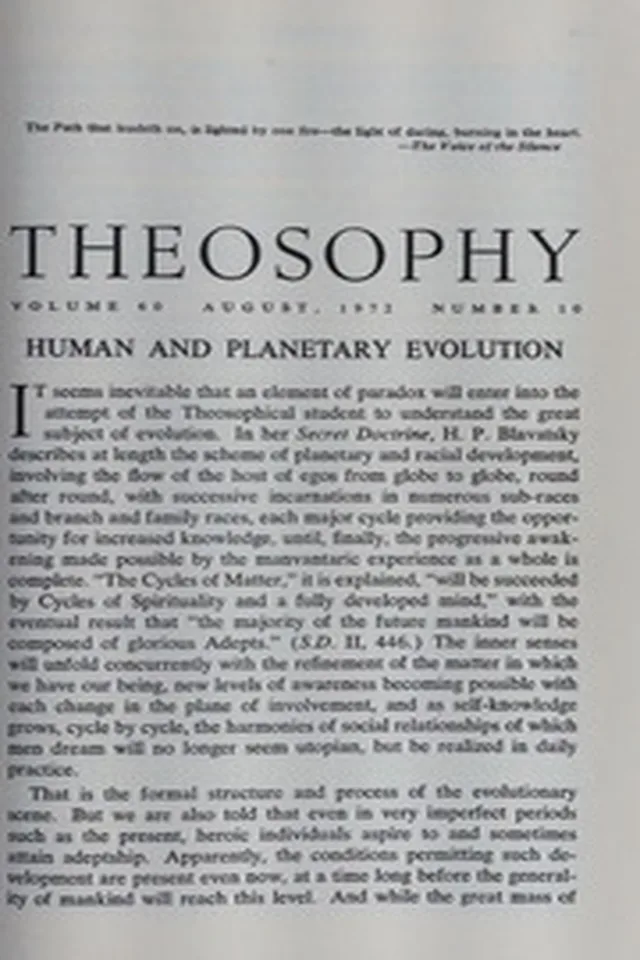
Theosophy Vol-60,No-10,August 1972



As the Hermetic Studies Editor, I find 'Theosophy Vol-60, No-10, August 1972' to be a compelling repository of esoteric thought. This issue offers a profound dive into the nuanced teachings of Theosophy, presenting complex metaphysical concepts with clarity and depth. The anonymous authors skillfully weave together threads of ancient wisdom, providing invaluable insights for those on the path of spiritual awakening. Its strength lies in its ability to provoke contemplation, encouraging readers to question conventional paradigms and embrace a broader understanding of existence. This journal is particularly suited for dedicated students of comparative religion, philosophy, and the occult, offering a rich intellectual and spiritual feast.
📝 Description
81
The August 1972 issue of Theosophy magazine, Vol-60, No-10, addresses spiritual interconnectedness and consciousness.
This particular issue of Theosophy magazine, dated August 1972, contains articles that examine the connections between all things and the structures of awareness. It includes discussions of older philosophies, spiritual concepts that are not widely known, and the symbolic language found throughout the observable world. Each piece aims to deepen the understanding of those who are sincerely looking for knowledge, who study deeply, or who practice alignment with universal laws. The overall feeling of this volume encourages readers to move beyond everyday concerns and accept deeper realities. It demonstrates the lasting influence of Theosophical ideas, giving insights into the self, the soul's development, and the way to spiritual awakening. Readers can expect to find a richer view of existence and their role within it.
Published in 1972, this issue belongs to the Theosophical movement, which began in the late 19th century with Helena Blavatsky. Theosophy seeks to synthesize ancient religious, philosophical, and scientific thought, emphasizing universal brotherhood, comparative religion, and the study of unexplained laws of nature and the latent human powers. This specific volume likely continues that tradition by addressing core Theosophical concepts such as karma, reincarnation, and the spiritual evolution of humanity, placing them within the intellectual currents of the early 1970s.
💡 Why Read This Book?
This issue offers a rare glimpse into the heart of Theosophical discourse from a pivotal era. It is essential reading for anyone seeking to understand the roots of modern esoteric movements, explore hidden spiritual laws, or deepen their understanding of consciousness and the cosmos. Ideal for seekers of truth, academic researchers in mysticism, and practitioners integrating ancient wisdom into their lives.
⭐ Reader Reviews
Honest opinions from readers who have explored this book.
❓ Frequently Asked Questions
What is Theosophy?
Theosophy is a spiritual philosophy that seeks to understand the underlying truths of all religions and philosophies, emphasizing the divine nature of humanity and the interconnectedness of all life. It explores ancient wisdom traditions and promotes universal brotherhood.
Who are the typical readers of 'Theosophy' journal?
Typically, readers are students of esoteric philosophy, seekers of spiritual knowledge, scholars of religion and metaphysics, and individuals interested in comparative mysticism and ancient wisdom traditions.
What kind of content can be expected in this issue?
This issue likely contains articles on topics such as karma, reincarnation, the evolution of consciousness, the nature of the soul, universal principles, and interpretations of ancient texts and symbols, all viewed through a Theosophical lens.
Is this journal suitable for beginners?
While some articles may require prior familiarity with Theosophical concepts, many are designed to introduce core ideas. It's best approached with an open mind and a willingness to engage with profound philosophical inquiries.
Where can I find more information on Theosophy?
The Theosophical Society, founded by Helena Blavatsky, is the primary organization. Their libraries and online resources offer extensive information, publications, and historical context for the movement.
🔮 Key Themes & Symbolism
The Ascent of Consciousness
This theme looks at the journey of the human soul through various stages of evolution, exploring the concept of spiritual awakening and the gradual unfolding of higher faculties. It examines the inner mechanisms of consciousness, offering perspectives on how individuals can transcend limitations and connect with their divine potential. Discussions often touch upon the subtle bodies, planes of existence, and the role of aspiration in spiritual growth, providing a roadmap for those seeking to understand their own inner landscape and cosmic journey.
Ancient Wisdom and Universal Law
This thread unravels the timeless truths embedded within ancient traditions, positing a universal spiritual law that governs the cosmos. It explores how seemingly disparate mythologies and philosophies share a common esoteric core, revealing useful insights into the nature of reality, ethics, and the human condition. The emphasis is on uncovering the underlying principles that transcend cultural and temporal boundaries, offering a framework for understanding the world through the lens of enduring spiritual wisdom and its application in daily life.
Symbolism as a Key to the Unseen
This theme highlights the critical role of symbolism in revealing deeper, often hidden, meanings within spiritual texts and natural phenomena. It explores how archetypal images, myths, and allegories serve as a language of the soul, communicating profound truths that elude direct intellectual grasp. Readers are guided to interpret these symbolic expressions as keys to understanding the subtle energies, cosmic forces, and the intricate interconnectedness of the universe, fostering a more intuitive and profound spiritual perception.
💬 Memorable Quotes
Direct passages from the work, attributed to the author.
“To know thyself is the beginning of all wisdom.”
— A timeless maxim emphasizing introspection and self-awareness as the foundational step towards understanding the greater mysteries of existence and one's place within them.
“Karma is the unerring law of cause and effect, shaping destiny.”
— This defines the fundamental principle of karma, illustrating its role as a cosmic justice system that governs the consequences of actions across lifetimes and influences the unfolding of individual destiny.
“The outer is but a reflection of the inner.”
— This highlights the esoteric principle of correspondence, suggesting that the visible, material world is a manifestation or mirror of unseen spiritual realities and inner states of being.
“Seek not outside what resides within.”
— An exhortation to internalize the search for truth and spiritual realization, pointing towards the divine spark and inherent wisdom present within every individual, rather than external validation.
💡 Key Ideas
Editorial paraphrase of the work's core concepts — not direct quotes.
The universe is a thought of God made visible.
This quote expresses the pantheistic or panentheistic view often found in Theosophy, suggesting that all existence is a manifestation of divine consciousness, a cosmic ideation made tangible.
🌙 Esoteric Significance
Tradition
This volume is firmly rooted in the Theosophical tradition, pioneered by Helena Blavatsky. It engages with core Theosophical concepts such as reincarnation, karma, the Seven Principles of Man, the concept of Masters, and the perennial philosophy – the idea that a single, eternal truth underlies all exoteric religions. It acts as a conduit for disseminating and exploring these profound spiritual teachings.
Symbolism
The issue likely employs a body of symbolism drawn from world religions, mythology, and occult sciences. Expect interpretations of archetypal imagery, geometric patterns, planetary influences, and sacred texts. These symbols are presented not merely as decorative elements but as 'keys' to unlock deeper, often veiled, spiritual truths about the nature of reality, consciousness, and the divine plan.
Modern Relevance
Despite its publication date, the themes explored remain profoundly relevant. Theosophical insights into consciousness, interconnectedness, and ethical living offer potent antidotes to modern alienation and materialism. The emphasis on universal brotherhood and the search for inner wisdom provides guidance for navigating contemporary societal and personal challenges, making its timeless wisdom accessible and applicable to the 21st-century seeker.
👥 Who Should Read This Book
This issue is a rich source for dedicated students of esoteric philosophy, particularly those drawn to the Theosophical tradition. Scholars of comparative religion, mysticism, and occult history will find valuable primary source material and insightful analysis. For spiritual seekers yearning for a deeper understanding of life's mysteries, the karma-reincarnation cycle, and the nature of consciousness, this journal offers profound contemplation. Practitioners of meditation and those integrating spiritual principles into their lives will discover timeless wisdom and practical perspectives for their journey.
📜 Historical Context
Published in August 1972, this issue of 'Theosophy' emerges from a period of significant global transformation and burgeoning interest in Eastern philosophies and esoteric traditions. The 1960s and early 1970s saw a cultural counter-revolution, a questioning of established norms, and a widespread search for deeper meaning beyond materialism. Theosophy, with its synthesis of science, religion, and philosophy, resonated deeply with this zeitgeist. This era was marked by figures like the Beatles exploring Transcendental Meditation, the rise of New Age movements, and increased access to translated spiritual texts. The journal's content likely reflects ongoing dialogues within the Theosophical movement concerning occult science, spiritual evolution, and the application of ancient wisdom to contemporary societal challenges, contributing to the wider esoteric field of the time.
📔 Journal Prompts
Reflect on a personal experience that felt like a manifestation of karma. How did you perceive the cause and effect?
How does the concept of 'the outer reflecting the inner' manifest in your daily life? Identify one instance.
Consider one symbol from mythology or nature that resonates deeply with your understanding of the spiritual. What hidden meaning do you perceive?
In what ways do you believe your current consciousness is evolving? What inner 'awakening' have you experienced?
Explore the idea of universal brotherhood. How can this principle be more actively cultivated in your immediate community or personal interactions?
🗂️ Glossary
Theosophy
A spiritual philosophy that seeks to understand the underlying truths of all religions and philosophies, emphasizing the divine nature of humanity and the interconnectedness of all life. It explores ancient wisdom traditions and promotes universal brotherhood.
Karma
The spiritual principle of cause and effect where intent and actions of an individual influence the future of that individual. It is often translated as 'action' or 'deed' and is a fundamental concept in many Eastern religions.
Reincarnation
The philosophical or religious concept that the non-physical essence of a living being begins a new life in a different physical form or body after biological death. It is a core tenet of Theosophy.
Esoteric
Intended for or likely to be understood by only a small number of people with a specialized knowledge or interest. In a spiritual context, it refers to hidden or inner teachings.
Perennial Philosophy
The idea that all major religions and spiritual traditions share a common metaphysical core or ultimate reality, a universal truth that transcends cultural and historical differences.
This book appears in 2 collections
🔮 Readers Also Liked
Browse all →




From the “Theosophy” Collection
View all →




More Free Theosophy & Anthroposophy Books
View all →