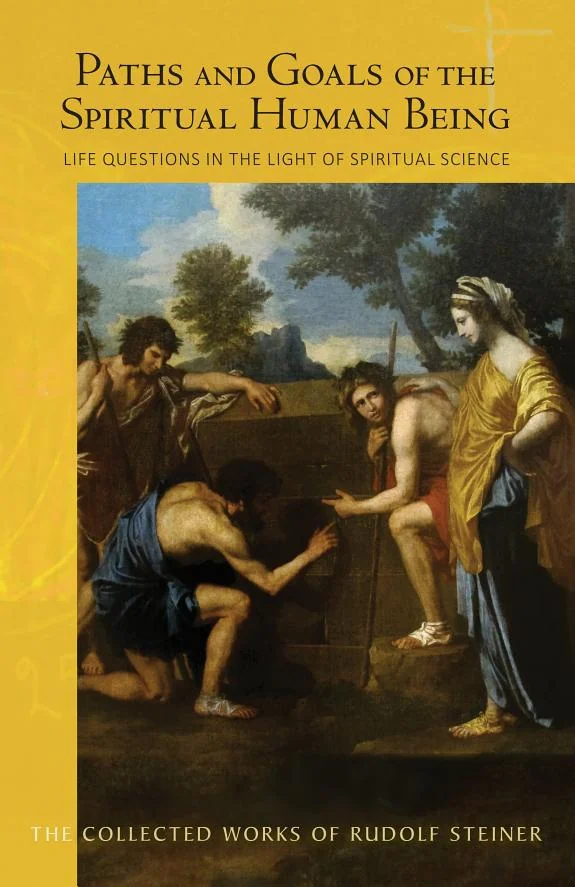
PATHS AND GOALS OF THE SPIRITUAL HUMAN BEING
 80
80

PATHS AND GOALS OF THE SPIRITUAL HUMAN BEING
Rudolf Steiner's "Paths and Goals of the Spiritual Human Being" offers a concentrated dose of his characteristic spiritual science, presented through lectures given to various European audiences. What distinguishes this collection is Steiner's clear articulation of how Christ's incarnation on Earth serves as a central fulcrum for human consciousness evolution. He meticulously details the positive and negative soul capacities, urging a conscious engagement with one's karmic path. A notable strength is the way Steiner adapts his discourse; his reflections on the poet Novalis, for instance, reveal a nuanced appreciation for artistic genius within a spiritual framework. However, the density of his concepts can be challenging for newcomers. The term "spiritual human being" itself requires significant contextualization. While Steiner’s exploration of karma is intellectually rigorous, its practical application feels somewhat abstract within these particular lectures. The book serves as a valuable document of Steiner’s pedagogical methods, demonstrating his ability to convey complex ideas to different groups. Its ultimate value lies in its detailed exploration of consciousness and its evolution, anchored by the Christ event.
📝 Description
80
Rudolf Steiner delivered these lectures on spiritual human development across Europe between 1909 and 1914.
Rudolf Steiner's "Paths and Goals of the Spiritual Human Being" gathers lectures given in Denmark, Germany, and France that address core questions about human existence and spiritual progress. Steiner discusses the interaction between positive and negative soul qualities, the search for true self understanding, and the mechanics of karma. He maps the progression of human consciousness from early historical periods to the present day, consistently situating these changes within the framework of Christ's earthly incarnation. The book shows how Steiner adapted his speaking style for different audiences.
This collection is best suited for individuals committed to serious spiritual study, especially those familiar with Anthroposophy or wanting a deeper grasp of Steiner's ideas. Readers interested in the philosophical basis of spiritual evolution, the character of human consciousness, and the moral aspects of karma will find it valuable. Those who investigate the historical progression of spiritual movements and the influence of figures like Novalis will also gain from it. It is not intended for those looking for introductory spiritual ideas or simple self-help methods.
These lectures were given during the formative years of Anthroposophy, a spiritual philosophy Rudolf Steiner developed in the late 19th and early 20th centuries. Steiner's work grew from an intellectual climate interested in theosophy and spiritual movements, but he aimed for a more scientifically grounded approach to spiritual knowledge. His talks, often presented to developing Anthroposophical societies, aimed to lay out a detailed cosmology and anthropology, distinguishing his path from other contemporary occult traditions.
💡 Why Read This Book?
• Understand the specific nature of positive and negative soul capacities as outlined by Steiner, gaining tools to assess your own inner development beyond generic psychological terms, as discussed in the context of his lectures in Germany. • Grasp Steiner's unique perspective on karma not as fatalism, but as a dynamic law of spiritual cause and effect that shapes individual destiny across lifetimes, a concept explored in his addresses to Danish audiences. • Gain insight into the historical evolution of human consciousness, particularly how Steiner posits the Incarnation of Christ as a pivotal, world-altering spiritual event, a theme central to the lectures given in France.
⭐ Reader Reviews
Honest opinions from readers who have explored this book.
❓ Frequently Asked Questions
What specific year were the lectures in 'Paths and Goals of the Spiritual Human Being' originally delivered?
The book compiles lectures given by Rudolf Steiner across Denmark, Germany, and France. While the compilation was first published on 2015-06-29, the original lecture dates vary depending on the specific location and are not provided in the blurb.
Who was Novalis, and why does Rudolf Steiner discuss him?
Novalis (1772-1801) was a prominent German Romantic writer. Steiner references him to illustrate how artistic and poetic genius can be understood through the lens of spiritual science, particularly concerning consciousness and its development.
Does the book explain how to develop positive soul capacities?
The book discusses the nature of positive and negative soul capacities. While it doesn't offer a step-by-step guide, it illuminates the principles behind their development and the importance of self-knowledge and karma in this process.
Is 'Paths and Goals of the Spiritual Human Being' suitable for beginners in esoteric studies?
The book is best suited for those with some familiarity with Rudolf Steiner's work or general esoteric concepts. It delves into complex ideas like karma and consciousness evolution, which may require prior knowledge for full comprehension.
What is the central role of the Incarnation of Christ in Steiner's discussion?
Steiner presents the Incarnation of Christ as a fundamental spiritual event that profoundly impacted the evolution of human consciousness and earthly development, serving as a key reference point for understanding historical and individual paths.
Are these lectures related to Steiner's broader Anthroposophical movement?
Yes, these lectures are integral to Rudolf Steiner's Anthroposophical teachings, exploring core concepts such as karma, soul development, and the spiritual evolution of humanity, presented to diverse audiences during his active lecturing career.
🔮 Key Themes & Symbolism
Evolution of Consciousness
The work meticulously traces the development of human consciousness across different historical epochs, from ancient times to the modern era. Steiner posits that this evolution is not merely biological or social but fundamentally spiritual. He emphasizes important moments, such as the Incarnation of Christ, as critical junctures that redirected the course of human spiritual development. Understanding this trajectory is presented as key to comprehending the human being's place and purpose within the cosmos.
The Nature of Karma
Karma is presented not as a punitive force but as a universal law of spiritual cause and effect, governing the intricate web of human lives. Steiner explores how actions, intentions, and experiences in one life inevitably create consequences that shape future existences. The book encourages a conscious engagement with karmic patterns, viewing self-knowledge and spiritual awareness as essential tools for navigating and ultimately transforming one's karmic path.
Soul Capacities and Self-Knowledge
Christ's Incarnation as a Spiritual Event
A central thesis is the lasting impact of the Incarnation of Christ on Earth. Steiner presents this event not solely through a religious lens but as a cosmic occurrence with far-reaching consequences for the spiritual evolution of humanity and the planet. It is described as a source of new spiritual forces and a catalyst for the transformation of human consciousness, providing a unique spiritual impulse for the modern age.
💬 Memorable Quotes
Direct passages from the work, attributed to the author.
“True self-knowledge requires examining both our soul's light and shadow.”
— This interpretation captures Steiner's emphasis on a balanced and honest appraisal of one's inner faculties. It points to the necessity of acknowledging both positive and negative soul capacities for genuine spiritual progress.
“Karma is the intelligent ordering of cause and effect across lifetimes.”
— This concept emphasizes the purposeful nature of karmic laws according to Steiner. It suggests that karma is not random but an inherent principle of cosmic justice and spiritual development guiding the soul's journey.
“Reflecting on figures like Novalis reveals spiritual insights into genius.”
— This concept indicates Steiner's method of using specific historical or artistic figures to exemplify broader spiritual principles. It suggests that understanding genius requires looking beyond the purely material or psychological.
💡 Key Ideas
Editorial paraphrase of the work's core concepts — not direct quotes.
Human consciousness has undergone fundamental changes since ancient times.
This paraphrased concept highlights Steiner's view of consciousness as dynamic and historically evolving. It suggests that our current modes of perception and understanding are not static but are the result of a long spiritual and evolutionary process.
The incarnation of Christ introduced a new spiritual dynamic to Earth.
This paraphrased idea underscores the unique significance Steiner attributed to the Christ event. It frames it as a transformative spiritual impulse that fundamentally altered the evolutionary trajectory of humanity and the planet.
🌙 Esoteric Significance
Tradition
Steiner's work is rooted in the Western Esoteric Tradition, particularly drawing from Christian mysticism, Neoplatonism, and German Romantic philosophy. Anthroposophy, as presented here, aims to synthesize these streams into a 'spiritual science'. It departs from purely Theosophical models by centering the Christ event as the important impulse for modern human evolution and by advocating for a rigorous, disciplined path of inner development accessible through conscious effort rather than solely through inherited spiritual capacities.
Symbolism
While specific symbols aren't detailed in the blurb, Steiner's work frequently employs Christian symbolism (like the Christ event) reinterpreted through his spiritual-scientific lens. The concept of the "Spiritual Human Being" itself functions symbolically, representing the potential for humanity to evolve beyond its purely material existence towards a higher spiritual nature. The idea of "Paths and Goals" suggests a symbolic journey, an ascent or progression through different states of consciousness and spiritual understanding.
Modern Relevance
Contemporary thinkers and practitioners in fields like Waldorf education, biodynamic agriculture, and Anthroposophical medicine draw directly from Steiner's extensive corpus. His ideas on consciousness evolution and karma continue to inform spiritual seekers interested in a non-dogmatic, developmental approach to spirituality. Modern transpersonal psychology and consciousness studies sometimes engage with Steiner's concepts, seeking to understand the deeper layers of the human psyche and its potential.
👥 Who Should Read This Book
['• Students of Rudolf Steiner and Anthroposophy seeking to understand his core teachings on human evolution and consciousness, particularly regarding the Christ event and karmic laws.', '• Esotericists interested in comparative studies of spiritual traditions, especially those exploring the development of consciousness and the concept of karma outside of Eastern philosophies.', '• Readers grappling with questions of personal destiny and spiritual purpose, looking for a structured, albeit challenging, framework to explore self-knowledge and life goals.']
📜 Historical Context
Rudolf Steiner delivered these lectures during the height of his independent lecturing career, primarily in the early 20th century, though the publication date is 2015. His work flourished in an era marked by intense spiritual seeking and the rise of various esoteric movements, including Theosophy, from which Steiner himself had initially emerged before founding Anthroposophy. Anthroposophy distinguished itself by aiming for a 'spiritual science' grounded in verifiable, albeit non-physical, experience, contrasting with the more devotional or purely speculative approaches common in other occult circles. Steiner's emphasis on the Incarnation of Christ, while resonating with Christian tradition, was presented through a unique cosmological framework that set it apart from orthodox theology. His engagement with figures like Novalis places him in dialogue with German Idealism and Romanticism. While specific contemporary reception details for these particular lectures aren't provided, Steiner's broader work faced both fervent interest and considerable skepticism from academic and religious institutions.
📔 Journal Prompts
The concept of positive and negative soul capacities as discussed in the context of lectures given in Denmark.
Rudolf Steiner's perspective on the historical changes in human consciousness.
The role of karma in shaping individual paths and goals.
The significance attributed to the Incarnation of Christ within the lectures delivered in Germany.
Reflections on the polymath Novalis as presented by Steiner.
🗂️ Glossary
Spiritual Human Being
In Steiner's work, this refers to the potential for humanity to evolve beyond its current physical and psychological state towards higher spiritual dimensions through conscious effort and understanding.
Soul Capacities
The various faculties and tendencies of the human psyche, categorized by Steiner into positive (aiding spiritual development) and negative (hindering it), which require self-knowledge to manage.
Self-Knowledge
A rigorous process of inner investigation, according to Steiner, aimed at understanding one's true spiritual nature, karmic predispositions, and potential for growth, beyond superficial personality traits.
Karma
The spiritual law of cause and effect, governing the consequences of actions and intentions across multiple lifetimes, shaping individual destiny and evolution.
Incarnation of Christ
The central event in Steiner's cosmology where the spiritual being of Christ took on human form on Earth, introducing a unique spiritual impulse for planetary and human evolution.
Human Consciousness
The state of awareness and perception of the human being, which Steiner viewed as historically evolving and capable of transformation through spiritual insight and practice.
Novalis
A key figure of German Romanticism (pen name of Georg Philipp Friedrich Freiherr von Hardenberg), whose work Steiner referenced to discuss genius and spiritual perception.
This book appears in 1 collection
🔮 Readers Also Liked
Browse all →







From the “Anthroposophy” Collection
View all →



More Free Theosophy & Anthroposophy Books
View all →