Die Djinn schlafen nicht
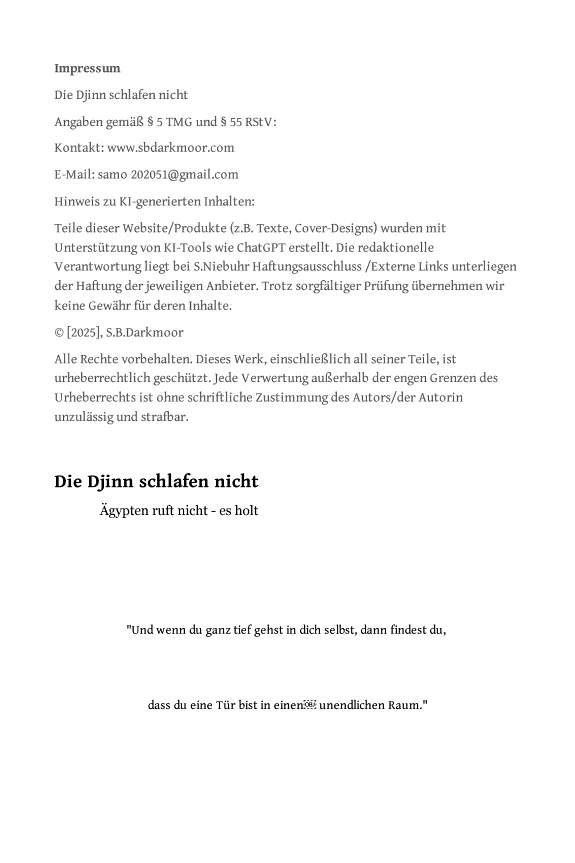
 77
77

Die Djinn schlafen nicht
S.B. Darkmoor's *Die Djinn schlafen nicht* begins with a compelling premise: an inherited diary that unlocks a hidden world. The portrayal of Sandra's initial bewilderment and growing unease is skillfully handled, creating a palpable sense of atmospheric dread. The concept of 'Petra' as a dream-manifested location is particularly intriguing, hinting at a Gnostic or Hermetic undertone. However, the narrative's pacing falters in its mid-section, occasionally becoming too introspective without sufficient plot momentum. A stronger focus on the tangible manifestations of the 'Djinn' or the forces Sandra is uncovering, perhaps by drawing more explicitly on the diary's contents, could have elevated the tension. The resolution, while thematically sound, feels somewhat abrupt, leaving certain symbolic threads less explored than the setup promised. Despite this, the book offers a unique perspective on latent potential and the power of forgotten histories.
📝 Description
77
S.B. Darkmoor's 2025 novel, Die Djinn schlafen nicht, begins with a found diary.
Sandra discovers an old diary in her grandmother's home. This finding triggers a shift in her understanding of herself and her family, blurring the lines between personal growth and a supernatural awakening. The narrative follows Sandra as she unearths hidden realities through this discovery.
The story is suited for readers who enjoy narratives that combine introspection with uncanny elements. Those interested in inherited legacies, the hidden potentials within everyday lives, and altered states of consciousness will find resonance. It offers a slow-burn mystery with a supernatural undercurrent.
Published in 2025, Die Djinn schlafen nicht engages with a recent resurgence of interest in occult and metaphysical themes. It builds on a tradition of questioning perception and reality, similar to authors who explore layered realities and the nature of storytelling. The novel introduces specific esoteric concepts like 'Petran' or 'Petra' as a liminal state accessed through dreams and intuition.
💡 Why Read This Book?
• Gain insight into how ancestral knowledge might be encoded in everyday objects, as seen with Sandra's discovery of the mysterious diary, offering a new perspective on family history. • Explore the concept of 'Petra' as a symbolic landscape accessed through dreams, a unique metaphysical construct that challenges conventional notions of reality. • Understand the narrative's exploration of dormant personal abilities, suggesting that profound transformations can be initiated by confronting cryptic family legacies.
⭐ Reader Reviews
Honest opinions from readers who have explored this book.
❓ Frequently Asked Questions
What is the significance of the title 'Die Djinn schlafen nicht'?
The title, translating to 'The Djinn Do Not Sleep,' suggests the perpetual presence and activity of unseen forces or spiritual entities. It implies that these entities are always watchful and potentially influential, even when unnoticed by humans.
Who is S.B. Darkmoor?
S.B. Darkmoor is the author of *Die Djinn schlafen nicht*, a work first published in August 2025. Information about the author's other works or biographical details is limited, adding to the enigmatic nature of the publication.
What is the role of the diary in the story?
The diary serves as the primary catalyst for the plot. Found by Sandra in her grandmother's house, its cryptic entries and revelations open portals to a different reality, triggering Sandra's own latent abilities and connection to the supernatural.
What does the name 'Petra' refer to in the book?
'Petra' appears to be a significant, possibly mystical, location or state of being that Sandra's daughter, Sophie, accesses in her dreams. It represents a hidden reality or a spiritual dimension central to the narrative's unfolding mystery.
Is 'Die Djinn schlafen nicht' a horror novel?
While it contains elements of mystery and the uncanny, *Die Djinn schlafen nicht* is better categorized as esoteric fiction or supernatural fiction rather than outright horror. It focuses more on psychological discovery and metaphysical exploration than on jump scares or gore.
When was 'Die Djinn schlafen nicht' first published?
The book was first published on August 9, 2025, indicating it is a recent addition to the esoteric literature genre.
🔮 Key Themes & Symbolism
Ancestral Legacy and Hidden Potential
The narrative explores how latent abilities and ancestral knowledge are passed down through generations, often lying dormant until triggered by specific events or artifacts. Sandra's discovery of her grandmother's diary serves as the conduit through which forgotten family secrets and dormant personal powers are awakened. The book suggests that our lineage holds keys to understanding ourselves and our place in a larger cosmic order, challenging the notion of individual isolation.
The Veil Between Worlds
A central theme is the permeability of the boundary between the mundane and the supernatural or alternate realities. This veil is depicted as thinning through dream states, inherited sensitivity, and the exploration of esoteric texts, such as the mysterious diary. The concept of 'Petra' signifies a reality accessible beyond ordinary perception, accessible through intuition and altered consciousness, suggesting that spiritual exploration can lead to tangible shifts in awareness.
Symbolism and Dream Interpretation
The work emphasizes the importance of symbols and dream imagery as a means of accessing deeper truths and hidden aspects of the self. Sophie's dreams and the cryptic entries in the diary are not mere narrative devices but potent symbols pointing towards a larger spiritual reality. The interpretation of these symbols becomes crucial for Sandra's journey of self-discovery and her understanding of the forces at play.
The Nature of Reality
Through Sandra's experiences, the book questions the solidity and singularity of perceived reality. It posits that individual consciousness, influenced by ancestral memory and esoteric forces, can shape or perceive different layers of existence. The narrative invites readers to consider that what we understand as reality is merely one facet of a much larger, more complex, and interconnected cosmos.
💬 Memorable Quotes
Direct passages from the work, attributed to the author.
“This house remembers more than we do.”
— This statement imbues the physical environment with a form of consciousness or historical memory. It suggests that places can retain traces of past events and energies, which can be accessed or felt by sensitive individuals.
“Sandra discovered she was not merely a reader of the past, but a participant in its unfolding.”
— This interpretation reflects Sandra's transformation from an observer of her family's history to an active agent within it. It signifies her realization of her own role in the ongoing spiritual or supernatural narrative.
💡 Key Ideas
Editorial paraphrase of the work's core concepts — not direct quotes.
The ink on these pages is not dry; it still whispers secrets.
This line highlights the active, living nature of the knowledge contained within the diary. It suggests that the past isn't static but continues to influence the present, and that the diary itself possesses a form of sentience or communicative power.
Sophie speaks of Petra in her sleep, a place I have never seen but somehow know.
This passage captures the intuitive, dream-based connection to another reality. It illustrates how subconscious or inherited knowledge can manifest, creating a sense of familiarity with places or concepts beyond conscious experience.
The Djinn do not sleep; they watch, they wait, they are the shadows in the periphery.
This quote directly addresses the title's theme, personifying unseen forces as constant observers. It imbues the narrative with a sense of perpetual hidden agency, suggesting that these entities are always present, influencing events from the edges of perception.
🌙 Esoteric Significance
Tradition
The work appears to draw significantly from Hermetic and Gnostic traditions, emphasizing the concept of hidden knowledge, the spark of the divine within the individual, and the existence of other realities accessible through spiritual awakening. It departs from strict adherence by focusing on a more personal, familial transmission of esoteric understanding, rather than solely on codified texts or initiatory lineages. The narrative suggests an immanent form of gnosis, accessible through intuition and dream.
Symbolism
The 'old diary' functions as a potent symbol of inherited wisdom and the hidden past, acting as a key to unlock spiritual potential. 'Petra' serves as a symbolic landscape representing an alternate dimension or a state of higher consciousness, accessible through dreams and intuition. The 'Djinn' themselves, while potentially referencing pre-Islamic spirits, here symbolize the persistent, often unseen, forces that shape human destiny and consciousness.
Modern Relevance
In contemporary esoteric circles, *Die Djinn schlafen nicht* speaks to practitioners of modern witchcraft, chaos magic, and those exploring Jungian archetypes and shadow work. Its focus on the accessibility of hidden knowledge through personal experience and intuition aligns with contemporary trends emphasizing subjective spiritual authority and the integration of the 'occult' into everyday life. Thinkers interested in the paranormal and the subconscious will find its exploration of dream states and inherited memory particularly relevant.
👥 Who Should Read This Book
• Individuals interested in esoteric fiction that blends psychological drama with supernatural elements, offering a unique take on inherited legacies. • Aspiring practitioners of dream work and intuitive development, seeking narratives that explore the symbolic language of the subconscious and its connection to hidden realities. • Readers drawn to themes of familial mystery and the idea that personal transformation can be unlocked by confronting ancestral secrets and latent spiritual gifts.
📜 Historical Context
When *Die Djinn schlafen nicht* emerged in August 2025, it tapped into a contemporary milieu that has seen a significant resurgence of interest in esoteric philosophy and occult literature, a trend building since the late 20th century. This period is marked by a widespread questioning of materialist paradigms and a search for deeper meaning, often through non-traditional spiritual paths. The book's exploration of inherited mysticism and hidden realities echoes themes found in the works of authors like Carlos Castaneda, whose early books, starting with *The Teachings of Don Juan* (1968), explored altered states and shamanic traditions, though Darkmoor's approach is distinct. Unlike the more anthropological focus of earlier works, Darkmoor's narrative centers on personal awakening through familial connection. There is no immediate record of specific censorship or major academic reception events for this 2025 publication, but its thematic concerns align with a growing popular engagement with Jungian psychology, Gnosticism, and Hermeticism.
📔 Journal Prompts
The cryptic entries within the grandmother's diary—what initial impressions do they evoke?
Reflect on the nature of 'Petra' as described through Sophie's dreams.
Consider the 'Djinn' not as literal beings, but as metaphors for hidden ancestral influences.
How does Sandra's perception of reality shift upon discovering the diary?
Explore the concept of a house 'remembering' past events and energies.
🗂️ Glossary
Djinn
Spirits or supernatural entities found in pre-Islamic Arabian and later Islamic folklore. In this context, they represent unseen forces or hidden aspects of reality that are perpetually active and influential.
Petra
A significant, possibly mystical, place or state of being accessed primarily through dreams and intuition within the narrative. It represents an alternate reality or a dimension of heightened spiritual awareness.
Old Diary
A physical artifact found in the grandmother's house that acts as a catalyst for the story. It contains cryptic entries that reveal hidden truths and awaken dormant abilities.
Verstummte Tochter
Literally 'muted daughter,' referring to Sandra's daughter, Sophie. Her condition suggests a withdrawal or inability to communicate normally, often linked to her experiences with the supernatural or altered states.
Tante, die sich verändert hat
The 'aunt who has changed.' This character's transformation suggests she may have had prior knowledge or experience with the esoteric elements that Sandra is now encountering.
Gates to another reality
A metaphorical description of the opening of perception that occurs when Sandra engages with the diary. It signifies a transition from ordinary consciousness to an awareness of hidden dimensions or spiritual truths.
Latent abilities
The inherent, undeveloped powers or sensitivities within individuals, often tied to their lineage or spiritual potential. These are awakened through the events of the narrative.
This book appears in 1 collection
🔮 Readers Also Liked
Browse all →









From the “Djinn” Collection
View all →








More Free Occult Philosophy Books
View all →