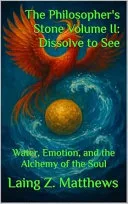
The Philosopher's Stone Volume II: Dissolve to See: Water, Emotion, and the Alchemy of the Soul
 71
71

The Philosopher's Stone Volume II: Dissolve to See: Water, Emotion, and the Alchemy of the Soul
Laing Z. Matthews' "Dissolve to See" moves beyond the often-invoked fire of ego dissolution explored in its predecessor, plunging instead into the symbolic depths of water and emotion. The book’s strength lies in its direct, unvarnished approach to psychological un-forming. Matthews avoids the common pitfall of overly academic or abstract discourse, grounding the esoteric concepts in tangible processes of grief, dream, and symbol. The exploration of the "dissolution" phase, particularly as it relates to the soul's capacity to hold sorrow without breaking, offers a potent alchemical lens. However, the text's dense, symbolic language, while rich, can sometimes feel exclusionary to those not already well-versed in Jungian archetypes or specific alchemical treatises. A particular passage detailing the alchemical marriage of Sol and Luna, framed through the lens of emotional integration, stands out for its evocative power. This is not a gentle introduction but a rigorous immersion for the dedicated alchemist of the soul.
📝 Description
71
Published in 2025, The Philosopher's Stone Volume II examines water's role in soul alchemy.
Laing Z. Matthews' second volume on inner alchemy, "Dissolve to See: Water, Emotion, and the Alchemy of the Soul," shifts focus from ego dissolution to the symbolic depths of the soul, using water as its primary element. It is written for serious students of esoteric traditions, especially those interested in Western alchemy and Jungian psychology. The book guides readers toward a process of psychological un-forming, distinct from common self-help approaches.
Matthews places this work within a long history of Western esoteric thought, drawing connections to Carl Jung's alchemical symbolism. The text addresses a renewed interest in these older practices, making them accessible for contemporary practitioners. A core idea is the alchemical concept of 'dissolution' as a necessary step before transformation, a theme found in many esoteric systems. The book's central principle, "dissolving to see," uses water to help integrate emotions, grief, and the subconscious through dream work and symbolic interpretation.
This book follows a path within Western esoteric traditions, aligning with alchemical symbolism discussed by thinkers like Carl Jung. It acknowledges a modern revival of these ancient practices, adapting them for today's practitioners. The text engages with the alchemical idea of "dissolution" as a prerequisite for profound change, a concept present across various esoteric movements. It focuses on integrating emotions and the subconscious, using water as the operative element for transformation.
💡 Why Read This Book?
• You will learn to apply the alchemical principle of dissolution, using water symbolism, to your emotional landscape, moving beyond mere intellectual understanding to practical soul-work, as detailed in the chapters on grief and dream. • You will gain a deeper appreciation for the symbolic language of the soul, understanding how archetypes and mysteries function as transformative agents, a concept central to the book's approach to un-forming. • You will discover how to engage with the process of "un-forming," a unique alchemical practice distinct from self-improvement, by confronting what fire could not reach, as presented in the contrast between Volume I and Volume II.
⭐ Reader Reviews
Honest opinions from readers who have explored this book.
❓ Frequently Asked Questions
What is the core alchemical principle explored in "The Philosopher's Stone Volume II"?
The core principle is "dissolve to see," which utilizes the element of water to break down emotional and psychological structures that hinder spiritual progress, allowing for deeper perception and transformation.
How does this book differ from "Volume I: Burning Down the False Self"?
While Volume I focused on ego dissolution through the element of fire, Volume II shifts to the element of water, exploring the soul's capacity to hold grief, mystery, and symbolism for a different kind of transformative un-forming.
Is this book suitable for beginners in alchemy?
It is best suited for those with some foundational knowledge of esoteric traditions, particularly Western alchemy and Jungian psychology, as it builds upon concepts of dissolution and symbolic language.
What role do emotions play in the alchemical process described?
Emotions, particularly grief, are presented not as obstacles but as essential waters for the alchemical process. They are the medium through which "un-forming" occurs, allowing deeper layers of the soul to be accessed.
What is meant by "un-forming" in the context of this book?
"Un-forming" refers to a process of deconstruction and dissolution of the egoic self and ingrained psychological patterns, which is seen as a necessary precursor to genuine alchemical transformation, contrasting with typical self-improvement narratives.
What are the primary esoteric traditions referenced by Laing Z. Matthews?
The primary traditions referenced are Western esoteric alchemy and Jungian psychology, with an emphasis on how alchemical principles can be applied to modern psychological and spiritual development.
🔮 Key Themes & Symbolism
The Water Element in Alchemy
This volume centers on water as the primary alchemical agent, contrasting with the fire of Volume I. It explores water's properties of dissolution, fluidity, and its connection to the subconscious, emotions, and the soul's capacity for holding sorrow and mystery. The book details how this element facilitates the breaking down of rigid psychic structures, essential for deeper alchemical work.
Symbolism and Dream as Alchemical Tools
Matthews posits that symbols and dreams are not mere psychological byproducts but potent alchemical tools. They serve as the language of the soul, revealing hidden patterns and offering pathways for "un-forming." The work guides readers to interpret these symbolic messages, particularly those arising from the watery depths of the psyche, as integral to the Great Work.
The Process of Un-Forming
Distinct from self-help's focus on construction, "un-forming" is presented as a crucial alchemical stage. It involves dissolving the false self and ingrained egoic patterns that the initial fire of dissolution could not reach. This process is facilitated by engaging with the soul's fluid nature, embracing vulnerability and the dissolution of fixed identities.
Alchemy of Grief and Emotion
The book directly addresses the integration of grief and complex emotions within the alchemical framework. Rather than suppressing or avoiding them, Matthews presents these states as vital components of the soul's journey. By dissolving into these emotional currents, practitioners can achieve a profound level of inner transformation and spiritual insight.
💬 Memorable Quotes
Direct passages from the work, attributed to the author.
“The fire burns away the false self; the water dissolves what the fire could not reach.”
— This expresses the core transition from Volume I to Volume II. It highlights that ego dissolution via fiery purification is only one stage, and a deeper, more fluid alchemical process involving the soul's emotional and symbolic dimensions is necessary for complete transformation.
“Understanding is not the goal; un-forming is the path.”
— This statement challenges conventional intellectual approaches to spirituality and self-improvement. It emphasizes that true alchemical change comes not from cognitive comprehension but from a process of deconstruction and letting go of fixed psychic structures.
“Grief is the symbol of the soul's capacity to hold the abyss.”
— This evocative phrase positions grief not as a pathology but as a sacred capacity. It suggests that the soul's ability to contain profound sorrow is a measure of its depth and its readiness for higher alchemical work.
“Dream is the river where the soul remembers its ancient forms.”
— This metaphor illustrates the role of dreams in accessing the soul's deeper, perhaps ancestral, layers. The dream state, like a river, is fluid and carries forgotten wisdom and original patterns that are crucial for the process of un-forming.
“To see, we must first unmake what obscures the inner eye.”
— This speaks to the necessity of purification and dissolution in esoteric practice. It suggests that true spiritual vision requires the dismantling of egoic illusions and psychological obstructions that prevent direct perception of reality.
🌙 Esoteric Significance
Tradition
This work is deeply rooted in the Western esoteric tradition, specifically Hermetic alchemy and its later interpretations through Jungian psychology. It adapts the ancient alchemical laboratory processes (solve et coagula) to the inner field of the soul. Matthews' approach moves beyond mere theoretical understanding of alchemy, positioning it as a practical, psychological, and spiritual discipline for contemporary practitioners seeking integration and transformation.
Symbolism
Central symbols include water, representing the soul, emotions, and the unconscious, and fire from the previous volume, symbolizing ego dissolution. The 'dissolution' process itself is a key motif, signifying the breaking down of rigid psychic structures. Dreams and grief are treated as symbolic gateways, not hindrances, offering pathways to the soul's deeper truths and facilitating the "un-forming" required for spiritual progress.
Modern Relevance
Matthews' work speaks to contemporary thinkers and practitioners exploring embodied spirituality and depth psychology. It offers a distinct approach for those disillusioned with purely intellectual or superficial self-help methods. The emphasis on integrating shadow aspects and emotional depth through symbolic work finds echoes in modern somatic practices and transpersonal psychology movements, providing a structured alchemical framework for these endeavors.
👥 Who Should Read This Book
• Students of Western Esotericism: Those studying Hermeticism, alchemy, or Kabbalah will find a modern, practical application of ancient principles focused on psychological integration. • Jungian Psychology Enthusiasts: Individuals interested in Carl Jung's work on archetypes and alchemy will appreciate the direct application of his theories to the process of soul transformation. • Seekers of Deep Psychological Work: Readers looking for a rigorous, symbolic approach to confronting emotions, grief, and the subconscious, moving beyond surface-level self-improvement.
📜 Historical Context
Laing Z. Matthews' "The Philosopher's Stone Volume II" emerges in 2025, a period witnessing a renewed global interest in practical esoteric disciplines. It stands within the tradition of Western Hermeticism and Jungian psychology, which saw a significant resurgence in the late 20th century, particularly after Carl Jung's explorations of alchemy in works like "Psychology and Alchemy" (1944). Matthews' work revisits the alchemical opus, framing it not as a historical curiosity but as a living process for modern psychological and spiritual development. It engages with the symbolic language of alchemy, a practice that has been alternately embraced by movements like the Hermetic Order of the Golden Dawn and critically examined by academic scholars. The book's emphasis on "un-forming" through water and emotion offers a counterpoint to more fire-centric or purely intellectual spiritual paths prevalent in contemporary esoteric circles.
📔 Journal Prompts
The soul's capacity for holding the abyss, as symbolized by grief.
The river of dreams and its ancient forms within your psyche.
The process of "un-forming" versus building your identity.
Interpreting the dissolution of rigid psychic structures through water symbolism.
The alchemical marriage of Sol and Luna within your emotional life.
🗂️ Glossary
Dissolution (Solve)
In alchemy, the process of breaking down a substance into its fluid or elemental components. In this work, it refers to the psychological process of dissolving rigid ego structures and emotional blockages.
Un-forming
A concept central to this volume, referring to the alchemical process of deconstructing the false self and ingrained psychological patterns, distinct from constructive self-improvement.
The Soul's Waters
Metaphorical representation of the emotional, subconscious, and symbolic dimensions of the psyche, where grief, dreams, and mystery reside and alchemical transformation occurs.
Alchemical Marriage (Coniunctio)
The union of opposites, often symbolized by Sol (Sun/masculine) and Luna (Moon/feminine), representing the integration of conscious and unconscious, spirit and soul, or other dualities within the psyche.
The False Self
The constructed egoic identity, often based on societal conditioning and personal defense mechanisms, which must be purified or dissolved in the initial stages of alchemical work.
Inner Alchemy
The practice of applying the principles and processes of material alchemy to the transformation of the human psyche and spirit, aiming for spiritual realization and wholeness.
Symbol
An image, sign, or concept that represents deeper, often unconscious, meanings. In this context, symbols are crucial conduits for the soul's language and alchemical transformation.
![The Works of Edgar Allan Poe [68 stories, 31 poems]](/img/thumb/the-works-of-edgar-allan-poe-68-stories-31-poems-edgar-allan-poe-092903.webp)