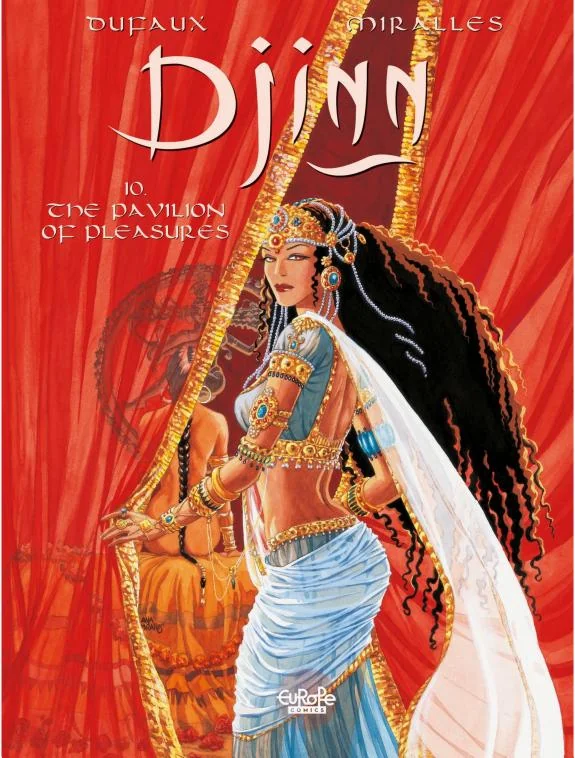
Djinn - Volume 10 - The Pavilion of Pleasures
 75
75

Djinn - Volume 10 - The Pavilion of Pleasures
The tenth volume of Jean Dufaux's *Djinn* series shifts its gaze to colonial India, presenting a narrative that is as politically charged as it is sensual. Dufaux masterfully positions Jade within the intricate court of the Maharajah, tasked with a delicate diplomatic mission cloaked in the guise of romantic tutelage. The strength of this volume lies in its atmospheric depiction of the Palace of Eschinapur and the inherent tension between Jade's assigned role and her own agency. The plot, while compelling, occasionally feels over-reliant on the established character dynamics of the series, with the motivations of the Rani and Radjah Sing sometimes appearing more as plot devices than fully fleshed-out intentions. A particularly striking moment involves Jade's contemplation of her role, questioning the ethical implications of her task amidst the opulence. Despite minor narrative compressions, *The Pavilion of Pleasures* offers a rich, visually arresting continuation of Jade's complex story.
📝 Description
75
Published in 2016, Djinn Volume 10 places Jade in colonial India to instruct a future bride in the 'art of love.'
This tenth volume of Jean Dufaux's Djinn series unfolds in the opulent Palace of Eschinapur during India's colonial period. The protagonist Jade receives a summons from the Rani, mother of the Maharajah. Her task is to teach the Maharajah's intended bride the 'art of love.' This instruction is intended to secure a political alliance with the rebel Radjah Sing. The narrative weaves political intrigue with a focus on personal relationships and their strategic use.
The story appeals to established fans of the series, particularly those following Jade's arc and the complex, morally grey plots characteristic of the Djinn universe. Readers who enjoy historical fiction infused with occult or esoteric elements will appreciate the Indian setting, its political machinations, and mystical undertones. The detailed artwork also contributes to the evocative atmosphere of the historical period.
The setting in colonial India highlights British influence and intricate local power structures. Placed chronologically after the 'Ottoman and African cycles,' this volume broadens the Djinn series' scope. The plot reflects the customs of princely states, where arranged marriages and political maneuvering were common, grounding the esoteric elements in historical context.
The 'art of love' discussed in this volume transcends simple physical connection. It is framed as a strategic diplomatic tool, drawing on historical precedents where personal relationships and sexual initiation were used to consolidate power and forge alliances. This aligns with esoteric traditions that view sexuality not just as a biological function but as a potent force capable of shaping social and political landscapes. The narrative grounds these esoteric concepts within the specific historical and cultural milieu of colonial India, suggesting a universal application of these principles across different eras and societies.
💡 Why Read This Book?
• Gain insight into the strategic use of personal relationships for political ends, exemplified by the Rani's command for Jade to teach the 'art of love' in the context of the planned alliance. • Experience the exotic atmosphere of colonial India, specifically the Palace of Eschinapur, as depicted in Dufaux's detailed artwork, offering a unique historical setting. • Understand Jade's complex role as an intermediary and instructor, navigating the political and personal desires within the Maharajah's court during this specific historical period.
⭐ Reader Reviews
Honest opinions from readers who have explored this book.
❓ Frequently Asked Questions
What is the chronological placement of 'The Pavilion of Pleasures' within the Djinn series?
This volume, published in 2016, chronologically fits between the Ottoman and African cycles of the *Djinn* series, shifting the narrative to colonial India.
Who are the main political players in 'The Pavilion of Pleasures'?
The key figures include the Rani, mother of the Maharajah; the Maharajah himself; Jade, the protagonist; and Radjah Sing, a rebel leader whose daughter is to marry the Maharajah.
What is Jade's primary task in this volume?
Jade is summoned to the Palace of Eschinapur to initiate the Maharajah's future bride into the 'art of love,' a mission intended to secure a political alliance.
What is the historical setting for this Djinn volume?
The story unfolds in colonial India, specifically within the context of princely states and their intricate political landscapes during the period of British influence.
Is 'The Pavilion of Pleasures' a standalone story or part of a larger arc?
It is part of the larger *Djinn* graphic novel series, marking the beginning of a new cycle that expands upon Jade's adventures and the series' established continuity.
What esoteric themes are explored in this volume?
The volume explores themes of power dynamics, manipulation through personal intimacy, and the intersection of political strategy with esoteric knowledge, framed within an exotic historical setting.
🔮 Key Themes & Symbolism
Political Matrimony and Power
The narrative hinges on the strategic use of marriage to forge political alliances. The Rani of Eschinapur commissions Jade to prepare the future Maharajah's bride, not just for marital duty, but as a tool to pacify the rebellious Radjah Sing. This highlights how personal unions were historically leveraged for statecraft, blending diplomacy with intimate instruction. The 'art of love' becomes a metaphorical weapon, aimed at securing peace through cultivated affection and influence within the context of 19th-century Indian princely states.
The Esoteric 'Art of Love'
Beyond carnal pleasure, the 'art of love' in this volume is presented as a sophisticated discipline, potentially drawing on ancient Tantric or diplomatic traditions of influence. Jade's role as initiator suggests a transmission of knowledge that transcends mere physical acts, encompassing psychological and emotional mastery. This esoteric dimension elevates the act of love-making into a form of subtle warfare or peace-making, a concept explored in various mystical traditions that seek to harness primal energies for higher purposes.
Colonial India as a Stage
The setting of colonial India provides a backdrop of existing power structures, cultural exchanges, and potential exploitation. The Palace of Eschinapur represents a localized center of power, juxtaposed against the looming influence of colonial forces and internal rebellions like that of Radjah Sing. This environment allows for explorations of cultural encounters, the exoticization of Eastern practices, and the inherent tensions within societies undergoing significant external and internal pressures during the 19th century.
Jade's Moral Ambiguity
Jade, as a recurring character, is placed in a morally complex situation. Tasked with initiating a young bride into a potentially manipulative act, she embodies the outsider navigating intricate local customs and political machinations. Her internal reflections likely grapple with the ethics of her role, the potential for her actions to be perceived as benevolent guidance or as complicity in political maneuvering, reflecting the nuanced moral landscape often found in esoteric narratives.
💬 Memorable Quotes
Direct passages from the work, attributed to the author.
“Jade is summoned to the Palace of Eschinapur by the Rani.”
— This sets the stage for the central conflict, immediately placing Jade in a position of responsibility within a new, politically charged environment and hinting at the unusual nature of her summons.
“The Rani wishes for Jade to initiate the future bride to the art of love.”
— This reveals the specific, potentially controversial, nature of Jade's task, framing the narrative around themes of seduction, diplomacy, and the strategic use of intimacy.
“The goal is for the bride to be able to win over the young Maharajah.”
— This clarifies the ultimate political objective behind Jade's instruction, underscoring the transactional nature of the arranged marriage and Jade's role in ensuring its success.
“This episode takes place chronologically between the Ottoman and African cycles.”
— This contextualizes the volume within the broader *Djinn* series, indicating it's a bridge between major narrative arcs and expands the established timeline and geography.
“Jade arrives accompanied by Lord and Lady Nelson.”
— This detail introduces supporting characters and establishes Jade's entourage, suggesting a journey and arrival that signifies the beginning of a significant new chapter in her adventures.
🌙 Esoteric Significance
Tradition
This work does not strictly adhere to a single established esoteric tradition but draws inspiration from broader themes of mystic sexuality and power dynamics found in various lineages. It touches upon concepts reminiscent of certain interpretations within Tantra, where sexual union is a path to spiritual or worldly power, and Hermeticism's emphasis on hidden knowledge and influence. The narrative's focus on Jade as a conduit of this 'art of love' aligns with archetypal figures who transmit specialized, often forbidden, knowledge.
Symbolism
The Palace of Eschinapur functions as a symbol of decadent power and hidden desires, a gilded cage where political machinations are veiled by luxury. The 'art of love' itself is a potent symbol, representing not just physical intimacy but the strategic deployment of sensuality and emotional influence to achieve political ends. Jade, as the instructor, symbolizes a figure of wisdom or potentially dangerous knowledge, bridging external influence with internal transformation within the narrative's specific context.
Modern Relevance
Contemporary interest in works exploring the intersection of spirituality and sexuality, particularly within graphic novel formats, draws on narratives like this. Thinkers and practitioners exploring embodied spirituality, the psychology of influence, and the deconstruction of traditional power structures might find parallels in Jade's role and the strategic use of intimacy depicted. The series' continued exploration of complex female characters in positions of power also speaks to modern discussions on gender and agency.
👥 Who Should Read This Book
• Readers interested in historical graphic novels that explore political intrigue through personal relationships, particularly those set in exotic locales like colonial India. • Fans of the *Djinn* series seeking to follow Jade's narrative arc and understand her placement between the Ottoman and African cycles. • Individuals drawn to narratives that subtly blend historical fiction with themes of esoteric knowledge, specifically concerning the 'art of love' as a tool of influence.
📜 Historical Context
Published in 2016, *Djinn - Volume 10 - The Pavilion of Pleasures* is situated within the broader narrative of Jean Dufaux's graphic novel series, which began in 2001. This specific installment transports readers to colonial India, a period marked by intricate political maneuvering among princely states under the overarching influence of the British Empire. The plot, focusing on a strategic marriage and the initiation of the bride into the 'art of love,' reflects historical practices where alliances were solidified through dynastic unions and the cultivation of personal influence. The narrative's placement between the "Ottoman and African cycles" indicates a deliberate expansion of the series' scope, exploring diverse cultural and political landscapes. While the series itself is a work of fiction, its engagement with the social customs and power dynamics of 19th-century Indian courts provides a backdrop that speaks to historical realities. The intellectual climate surrounding such narratives often involves discussions of Orientalism and the representation of non-Western cultures, a context in which Dufaux's work can be critically examined.
📔 Journal Prompts
The Rani's directive to Jade regarding the 'art of love' and its political aims.
Jade's arrival at the Palace of Eschinapur and her initial impressions.
The symbolic significance of the 'art of love' as presented in the narrative.
Reflecting on the power dynamics between the Rani, Radjah Sing, and the Maharajah.
Jade's potential internal conflict regarding her task and its ethical implications.
🗂️ Glossary
Djinn
In Islamic mythology, jinn are supernatural creatures, often depicted as spirits or demons, capable of influencing human affairs. In the context of the series, 'Djinn' likely refers to a broader concept of powerful, perhaps supernatural, entities or forces.
Rani
A title for a Hindu queen or a princess, typically the wife of a Maharaja or Raja. In this context, she is the mother of the Maharajah and a key political figure.
Maharajah
A title indicating a ruling prince or king in India. The young Maharajah's upcoming marriage is central to the political plot of this volume.
Radjah Sing
A title for a Hindu ruler, often a king or prince. Radjah Sing is presented as a rebel figure, whose political stance is significant to the alliance being negotiated.
Art of Love
In this narrative, this refers not just to sexual technique but to a strategic and potentially esoteric form of intimacy intended to influence, persuade, and solidify political bonds.
Eschinapur
A fictional palace or state within the context of the graphic novel, serving as the primary setting for the events of this volume, representing a seat of power in colonial India.
Colonial India
The historical period and geographical setting where British rule exerted significant influence over Indian states and societies, shaping political, social, and cultural landscapes.
This book appears in 1 collection
🔮 Readers Also Liked
Browse all →









From the “Djinn” Collection
View all →








More Free Occult Philosophy Books
View all →