The New Revelation
 76
76

The New Revelation
Arthur Conan Doyle’s foray into spiritualism, as documented in The New Revelation, is less about proving the existence of spirits and more about the intellectual and emotional journey of a man seeking answers beyond the material. The inclusion of an introduction detailing his personal life and an afterword on his complex relationship with Harry Houdini adds significant biographical texture. However, the work occasionally falters under the weight of its earnest advocacy, sometimes presenting anecdotal evidence with an assurance that may not satisfy modern critical scrutiny. Doyle’s attempt to reconcile his scientific background with his spiritual convictions is the book’s strongest element, offering a compelling glimpse into a mind wrestling with profound questions. The text remains a valuable artifact of early 20th-century spiritualist discourse, but its persuasive force is diminished by its historical distance and the evolution of critical thinking.
📝 Description
76
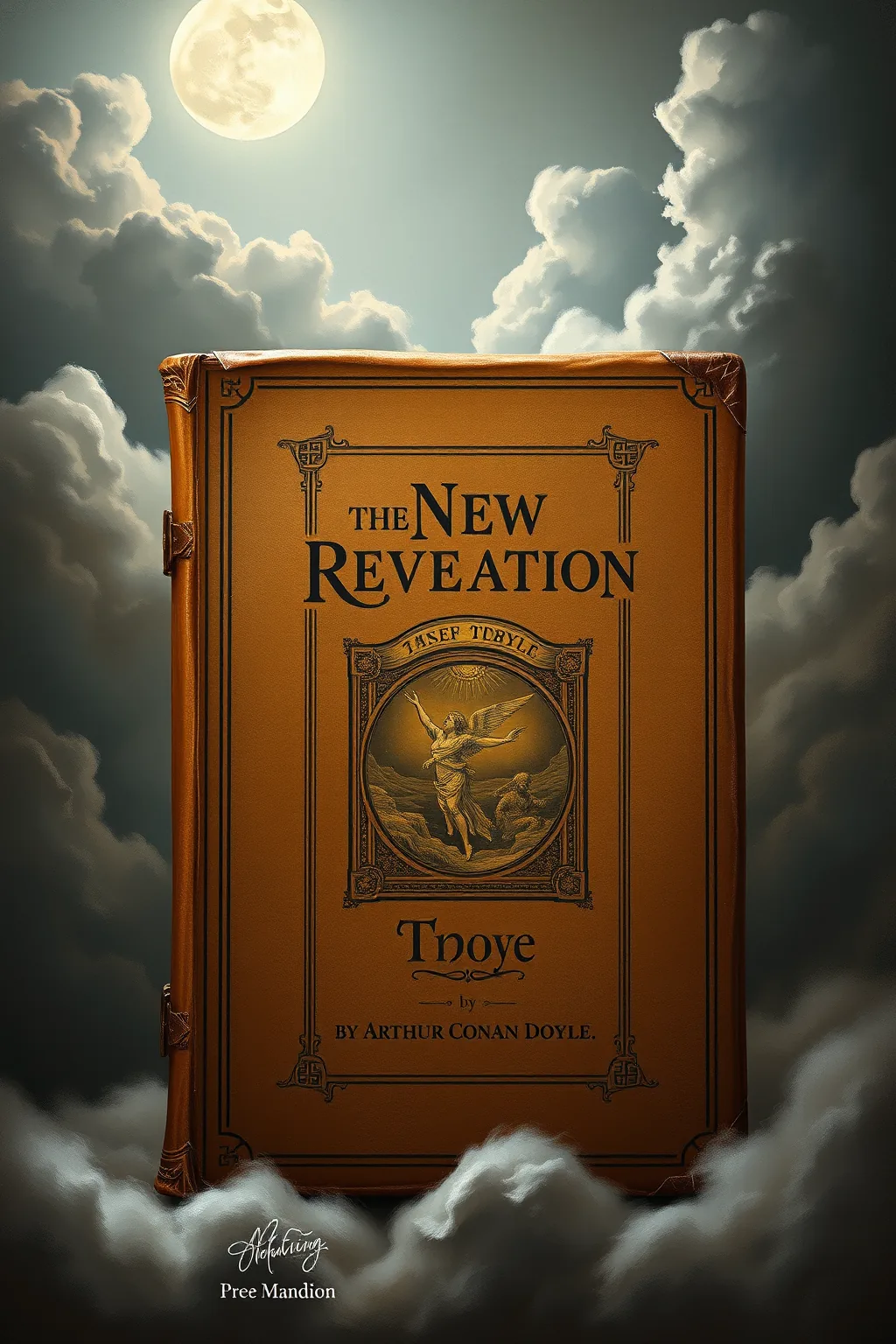
In 1918, Arthur Conan Doyle published The New Revelation, detailing his engagement with spiritualism.
Arthur Conan Doyle's The New Revelation documents his personal involvement with the spiritualist movement in the early 20th century. Written after World War I, a time of widespread grief and heightened interest in contacting the deceased, the book reflects Doyle's shift from rational detective stories to an exploration of spiritual phenomena. He investigated claims that challenged scientific norms, seeking evidence of an afterlife and communication with those who had passed. Doyle, a former physician and celebrated author, lent his public platform to the spiritualist cause, often encountering skepticism from both the scientific community and the general public.
The work addresses the nature of communication with spirits, the possibility of evidence that lies outside empirical science, and the philosophical questions raised by such experiences. Doyle also considered the interplay of belief and doubt when assessing unusual assertions, a topic connected to his own background. This book offers a look into the mind of a prominent figure grappling with the unseen, presenting his direct testimony on matters of the spirit world.
The New Revelation is situated within the broader spiritualist movement that gained traction in the late 19th and early 20th centuries, particularly in the wake of major conflicts like World War I. This period saw many individuals, including prominent figures from scientific and literary backgrounds, turn to spiritualism in search of solace and evidence of life after death. Doyle's engagement reflects a specific cultural moment where established beliefs were being questioned, and alternative frameworks for understanding consciousness and the afterlife were actively pursued by groups like the Society for Psychical Research.
💡 Why Read This Book?
• Gain insight into Arthur Conan Doyle's personal conviction regarding spiritualism, moving beyond his fictional detective work to understand his philosophical explorations in the early 20th century. • Understand the specific cultural climate of the early 1900s that fueled widespread interest in spiritualism, particularly in the aftermath of World War I. • Examine Doyle's arguments for spiritualism, offering a firsthand perspective on the evidence and reasoning presented by a prominent public figure of the era.
⭐ Reader Reviews
Honest opinions from readers who have explored this book.
❓ Frequently Asked Questions
What is the primary focus of "The New Revelation"?
The book's primary focus is Sir Arthur Conan Doyle's personal investigation and advocacy for the spiritualist movement in the early 20th century, detailing his experiences and beliefs about communication with the deceased.
How does "The New Revelation" relate to Arthur Conan Doyle's other works?
It stands apart from his Sherlock Holmes mysteries, offering a genuine account of his personal philosophical and spiritual inquiries, contrasting with his fictional deductive reasoning.
When was the spiritualist movement particularly active, as discussed in the book?
The book reflects the height of the spiritualist movement in the early 20th century, a period amplified by the widespread grief following World War I, prompting many to seek solace through alleged communication with the afterlife.
What is the significance of Arthur Conan Doyle's friendship with Harry Houdini in this context?
The book's afterword explores Doyle's complex relationship with Harry Houdini, a famous escape artist and skeptic of spiritualism. Their interactions highlight the tension between belief and skepticism surrounding the movement.
Does the book offer scientific proof of spiritualism?
While Doyle presents his investigations and belief in evidence, the book is a personal account and philosophical exploration rather than a collection of scientifically verifiable proofs as understood by modern standards.
What historical period does "The New Revelation" primarily address?
The book primarily addresses the early 20th century, a time when spiritualism gained significant traction, influenced by societal events like World War I and the public profiles of figures like Doyle.
🔮 Key Themes & Symbolism
Personal Conviction
This theme centers on Doyle's unwavering belief in spiritualism, developed after personal tragedy and extensive investigation. It highlights his transition from a man of science and logic, known for Sherlock Holmes, to a public advocate for the unseen world. The book details his personal conviction that communication with spirits was not only possible but observable, a stance he defended rigorously against a skeptical society.
The Nature of Evidence
The work grapples with what constitutes valid evidence, particularly when dealing with phenomena outside conventional scientific paradigms. Doyle contrasts empirical, material evidence with the testimonial and intuitive evidence he encountered in spiritualist circles. He argues for an expanded definition of proof, one that accommodates subjective experience and spiritual intuition, challenging the limitations of purely materialistic viewpoints prevalent in his era.
Spiritualism in Society
This theme contextualizes Doyle's spiritualism within the broader social and cultural range of the early 20th century. It explores the widespread appeal of spiritualism, especially post-World War I, as a means of coping with loss and seeking connection. The book implicitly addresses the societal pressures and critiques faced by proponents of spiritualism, including Doyle himself, who risked his reputation to champion these beliefs.
Doyle and Houdini
The dynamic between Arthur Conan Doyle and Harry Houdini serves as a crucial thematic element, representing the tension between fervent belief and determined skepticism. Their famous friendship, despite their opposing views on spiritualism, underscores the complexity of the subject. Houdini's performances and debunking efforts are presented alongside Doyle's continued faith, illustrating the ongoing debate and personal relationships within the spiritualist community.
💬 Memorable Quotes
Direct passages from the work, attributed to the author.
“My own experiences have been so varied, so consistent, and so convincing.”
— This statement expresses Doyle's personal validation of spiritualist phenomena. It suggests that his belief is not based on a single event but on a cumulative body of evidence and personal encounters that solidified his conviction.
“Skepticism is healthy, but it must not become blind prejudice.”
— This sentiment highlights Doyle's frustration with those who dismissed spiritualism outright without fair consideration. He advocates for an open mind, suggesting that true skepticism involves inquiry, not outright rejection of phenomena that challenge existing frameworks.
“The facts of spiritualism are as demonstrable as the facts of science, if one is willing to observe.”
— This assertion, representing a key idea in the book, challenges the exclusive domain of science. Doyle suggests that spiritual phenomena can be observed and understood, implying that the methodology of observation itself needs to be broadened to include spiritual realities.
💡 Key Ideas
Editorial paraphrase of the work's core concepts — not direct quotes.
The world is not a purely material place; there are forces and intelligences beyond our immediate perception.
This paraphrased concept reflects Doyle's core argument against scientific materialism. He posits the existence of a spiritual dimension and non-physical entities that interact with our reality, a fundamental tenet of his spiritualist beliefs.
Communication with those who have passed on offers solace and evidence of continuity.
This quote captures Doyle's belief in the therapeutic and evidential value of spiritualist communication. He saw it not just as proof of survival but as a source of comfort for the bereaved, a key driver for the movement's popularity.
🌙 Esoteric Significance
Tradition
While not strictly adhering to a single lineage, Doyle's engagement with spiritualism places him within the broader currents of Western Esotericism, particularly influenced by 19th-century phenomena like mesmerism and early psychical research. His work touches upon themes common in spiritualist traditions, which often integrate elements of Theosophy and other metaphysical movements seeking to bridge the material and spiritual realms, emphasizing direct experience and communication with unseen intelligences.
Symbolism
The central symbol is the 'communication' itself – the bridge between the living and the dead. This represents the potential for knowledge and connection beyond the veil of mortality. Another motif is the 'séance,' a ritualized space where this communication is attempted, symbolizing a liminal zone where ordinary reality is suspended to allow for extraordinary experience. The 'medium' acts as a conduit, a living symbol of the interconnectedness between different states of being.
Modern Relevance
Doyle's exploration of spiritualism continues to inform contemporary discussions on consciousness, the afterlife, and the limits of scientific inquiry. His willingness to bridge the gap between empirical observation and subjective experience appeals to modern researchers in parapsychology and consciousness studies. Furthermore, his work provides historical context for understanding the enduring appeal of spiritualist ideas in popular culture and alternative spirituality movements today.
👥 Who Should Read This Book
• Students of early 20th-century social history interested in the widespread appeal of spiritualism and its impact on post-war society. • Researchers of Western Esotericism and the history of psychical research seeking firsthand accounts from influential proponents of spiritualism. • Readers curious about the personal philosophy and spiritual beliefs of Sir Arthur Conan Doyle, beyond his famous fictional detective narratives.
📜 Historical Context
The New Revelation emerges from the fertile ground of early 20th-century spiritualism, a movement that surged in popularity following the immense casualties of World War I. Millions sought solace and connection with deceased loved ones, making séances and mediumship a significant cultural force. Sir Arthur Conan Doyle, already a global literary figure and a respected medical doctor, lent his considerable authority to this cause. He actively investigated spiritualist claims, often defending mediums and phenomena against widespread scientific skepticism and public ridicule. His work existed within a broader intellectual current that included figures like Sir Oliver Lodge, another prominent scientist who embraced spiritualism, and contrasted sharply with the rationalist and materialist philosophies gaining ground in academic circles. The Society for Psychical Research, founded in 1882, was also actively exploring these phenomena, though often with a more cautious, academic approach than Doyle's personal advocacy.
📔 Journal Prompts
The contrast between Sherlock Holmes's deductive reasoning and Doyle's spiritualist convictions.
The personal experiences that solidified Doyle's belief in spiritualism.
The role of grief and loss in the rise of spiritualism during the early 1900s.
How Doyle's advocacy for spiritualism might have influenced his public perception.
The nature of 'evidence' presented in The New Revelation and its comparison to scientific proof.
🗂️ Glossary
Spiritualism
A religious movement and belief system that asserts the possibility of communicating with the spirits of the deceased, often through mediums, and that these spirits can provide guidance or evidence of an afterlife.
Medium
An individual believed to be able to communicate with spirits of the dead and act as an intermediary between the spirit world and the living.
A meeting or gathering at which people attempt to make contact with the spirit world, typically involving a medium and often conducted in low light conditions.
Psychical Research
The field of study that investigates alleged psychic phenomena and other paranormal claims, including telepathy, clairvoyance, and mediumship, often employing scientific methods.
Materialism
A philosophical stance that asserts that matter is the fundamental substance in nature, and that all phenomena, including mental states and consciousness, can be explained by the interactions of matter.
Empirical Evidence
Information acquired through observation and experience, verifiable by the senses, which forms the basis of scientific inquiry.
Theosophy
A philosophical and religious movement founded in the late 19th century that sought to explore the divine mysteries and the hidden nature of reality through ancient wisdom traditions and esoteric teachings.