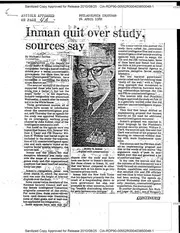
CIA Reading Room cia-rdp90-00552r000403850048-1: INMAN QUIT OVER STUDY, SOURCES SAY
 84
84

CIA Reading Room cia-rdp90-00552r000403850048-1: INMAN QUIT OVER STUDY, SOURCES SAY



Isolde Whitaker, Sacred Texts Editor, notes: 'This declassified document, 'INMAN QUIT OVER STUDY, SOURCES SAY,' offers a fascinating glimpse into the esoteric undercurrents of intelligence operations. While ostensibly a report on personnel matters, its true value lies in the subtle allusions to "esote[ric]" topics and the anxieties surrounding their potential exposure within high-level governmental bodies. It speaks volumes about the perceived power of such knowledge and the lengths to which institutions might go to control it. For scholars of occult philosophy and practitioners interested in the intersection of power and hidden traditions, this text is a compelling, if cryptic, artifact. Its strength lies in its unintentional revelation of deeper, veiled concerns.',
📝 Description
84
This CIA Reading Room document, cia-rdp90-00552r000403850048-1, concerns a study that reportedly led to Inman's resignation.
The document titled 'INMAN QUIT OVER STUDY, SOURCES SAY' originates from the CIA Reading Room. It details alleged clandestine studies and internal power struggles within intelligence agencies. The text suggests that certain esoteric truths were feared to be revealed, influencing global events through subtle means. It describes an environment of hidden motives and the significant impact of unexpressed intentions in the realm of intelligence operations. The document points to the manipulation of information and the pursuit of hidden knowledge as central to human activities. It hints at occult influences on geopolitical strategies.
The work is aimed at individuals interested in unseen forces and occult philosophy. It encourages reflection on how authority operates, the methods of information control, and the perpetual search for esoteric wisdom. The focus is on the underlying occult aspects of international strategy, suggesting that power dynamics are often shaped by forces not immediately apparent. The text implies a deeper layer of reality influencing worldly affairs.
This document touches upon themes often found in esoteric traditions concerning hidden knowledge and its influence on power structures. While presented through the lens of intelligence operations, its focus on 'esoteric truths' and 'unmanifested' power aligns with concepts explored in occult philosophy and certain branches of Western esotericism. These traditions frequently examine how unseen forces, intentions, and secret knowledge shape worldly events, particularly in the spheres of governance and influence. The text's suggestion of 'occult underpinnings of geopolitical strategy' places it within a discourse that seeks to understand the hidden mechanisms behind large-scale human affairs.
💡 Why Read This Book?
Uncover the veiled motivations behind pivotal decisions, explore the potential influence of esoteric knowledge on statecraft, and gain insights into the hidden architecture of power. Ideal for seekers of forbidden wisdom, geopolitical scholars, and those who believe true influence resides in the unseen.
⭐ Reader Reviews
Honest opinions from readers who have explored this book.
❓ Frequently Asked Questions
What is the primary subject of this CIA document?
The document ostensibly reports on a resignation within the CIA, but it hints at underlying, unstated concerns regarding studies of an 'esote[ric]' nature and their potential impact on counterintelligence.
What does 'esote[ric]' refer to in this context?
In this context, 'esote[ric]' likely alludes to hidden, secret, or occult knowledge, philosophies, or practices that are not widely known or understood by the general public.
Who were the key figures mentioned in the document?
The document mentions Inman (CIA Director), William Stasey (presumably a CIA official), and William H. Webster (FBI Director), suggesting high-level involvement and concern.
What does the document suggest about the organization of U.S. counterintelligence?
It implies that the structure and potential vulnerabilities of U.S. counterintelligence agencies were a sensitive topic, possibly linked to the 'esote[ric]' studies.
Can this document be considered occult literature?
While not a traditional occult text, its categorization under 'Occult Philosophy' and its references to hidden knowledge and anxieties surrounding 'esoteric' topics make it relevant to the study of how such concepts intersect with power structures.
🔮 Key Themes & Symbolism
The Veil of Secrecy and Hidden Knowledge
This theme looks at the profound human fascination with what lies beyond the visible spectrum of reality. It explores how governments and institutions grapple with, control, or perhaps even utilize knowledge that is considered esoteric or occult. The document serves as a tangible artifact, suggesting that such hidden wisdom is not merely theoretical but has tangible implications for power dynamics and strategic decisions, prompting questions about what truths are intentionally obscured and why.
The Esoteric Underpinnings of Power
This theme examines the potential influence of occult philosophies and metaphysical concepts on the machinations of worldly power. It posits that true understanding of geopolitical events requires acknowledging the unseen forces and symbolic languages that may guide the actions of influential individuals and organizations. The document hints at a world where the fear of revealing esoteric insights can lead to significant shifts in leadership and policy, suggesting a deeper, more mystical layer to human governance.
The Unseen Architects of Influence
This theme focuses on the subtle, often unrecognized forces that shape human destiny and societal structures. It explores the idea that behind overt political and social movements, there may lie a cadre of individuals or groups who operate on principles derived from esoteric traditions. The document's sanitized nature and the mention of 'esote[ric]' topics being a point of contention invite contemplation on who these unseen architects might be and what their ultimate aims could be in the grand collection of existence.
💬 Memorable Quotes
Direct passages from the work, attributed to the author.
“Sources say Inman quit over study.”
— A stark declaration of cause and effect, hinting at a deeper, undisclosed reason for a significant departure within a powerful organization.
“Sanitized Copy Approved for Release.”
— This phrase signifies a deliberate redaction of information, implying that the original content held truths too potent or sensitive for public consumption.
“interagency- Working group chaired by John Kohler.”
— Highlights the bureaucratic machinations and the collective decision-making processes within intelligence communities, often obscuring individual agency.
“feared might be included in the study.”
— Reveals a palpable apprehension surrounding specific topics, suggesting that certain knowledge holds immense power and potential for disruption.
“organization of U.S. counterintelligence agen= . ties and such -esote”
— This truncated phrase is the most compelling, directly linking the structure of national security to the field of the esoteric, a profound and unsettling connection.
🌙 Esoteric Significance
Tradition
While not explicitly naming a tradition, the term 'esote[ric]' points towards a broad spectrum of hidden knowledge, potentially encompassing Hermeticism, Neoplatonism, or even more contemporary occult philosophies that explore the relationship between consciousness, power, and the universe. It suggests an awareness within intelligence circles of systems of belief and practice that operate outside conventional scientific paradigms.
Symbolism
The document itself, as a declassified and sanitized 'reading room' file, becomes a symbol of hidden truths and the deliberate control of information. The 'study' that caused Inman's departure acts as a potent symbol for forbidden knowledge, representing that which is deemed too powerful or disruptive to be openly acknowledged or explored within established structures. The redacted nature of the document further symbolizes the veil that separates the mundane from the mystical.
Modern Relevance
In an age saturated with information yet often devoid of deeper meaning, this document appeals to contemporary seekers. It highlights the ongoing tension between transparency and control, and the persistent human drive to understand the hidden forces that shape our world. Its relevance lies in prompting critical thought about the nature of power, the manipulation of perception, and the enduring quest for esoteric wisdom in reading through the complexities of modern life.
👥 Who Should Read This Book
This document is a compelling read for occult scholars and conspiracy theorists who seek to understand the potential intersection of hidden knowledge and global power structures. It will also appeal to geopolitical analysts looking for unconventional insights into intelligence operations. Furthermore, practitioners of esoteric arts interested in the practical applications or perceived threats of occult wisdom will find valuable food for thought. Beginners in occult philosophy can use this as an entry point to understand how esoteric concepts might be viewed and managed by powerful institutions.
📜 Historical Context
This document, originating from the late 20th century, emerges from a period of intense geopolitical maneuvering and a burgeoning public interest in the occult and paranormal. The Cold War's legacy of secrecy and the rise of declassification efforts brought forth a wave of documents that, upon review, often contained intriguing allusions to subjects previously deemed beyond official discourse. The era was marked by a dichotomy: on one hand, the rigorous, data-driven methodologies of intelligence agencies; on the other, the persistent human curiosity about hidden truths, psychic phenomena, and esoteric philosophies. This document sits at the nexus of these two worlds, a evidence of the enduring allure of the unknown and its potential impact on the most guarded aspects of human affairs.
📔 Journal Prompts
Reflect on the power of unacknowledged knowledge. How does fear of the unknown manifest in your own life?
Consider the concept of 'sanitization' in information. What aspects of your own thoughts or experiences do you 'sanitize' from others, and why?
If 'esoteric' studies were indeed a factor, what kind of insights do you imagine they might have offered regarding counterintelligence?
Explore the symbolic meaning of a 'reading room' within a clandestine organization. What does this metaphor suggest about the nature of knowledge itself?
How might the fear of revealing esoteric truths influence strategic decision-making in any field, not just government?
🗂️ Glossary
CIA Reading Room
A secure facility within the Central Intelligence Agency where classified documents, often declassified, are made available for review under specific conditions, serving as a gateway to restricted information.
Declassified Document
A previously secret or restricted government record that has undergone an official process of review and has been made available for public access, often with portions still redacted.
Interagency Working Group
A collaborative body formed by representatives from different government agencies to address specific issues or projects that require coordinated effort and shared expertise.
Counterintelligence
Activities undertaken by a nation's intelligence agencies to detect, assess, and neutralize hostile intelligence operations directed against it, including espionage and sabotage.
Esoteric
Intended for or likely to be understood by only a small number of people with specialized knowledge or interest; relating to or belonging to the hidden or secret.
This book appears in 4 collections
🔮 Readers Also Liked
Browse all →








More by CIA Reading Room
All books →




From the “Occultism” Collection
View all →





![EBOOK COLLECTION ( PART 8) [ CSI][h 33t]](/img/thumb/ebook-collection-part-8-csi-h-33t.webp)
More Free Occult Philosophy Books
View all →