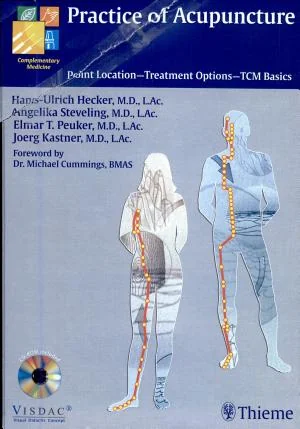
Practice of Acupuncture
 82
82

Practice of Acupuncture
Hecker, Steveling, and Peuker's "Practice of Acupuncture" achieves a commendable synthesis of Traditional Chinese Medicine and Western anatomical knowledge. The methodical presentation of point locations, particularly the inclusion of in vivo photography and detailed anatomical diagrams, provides an exceptionally clear reference. This systematic approach is a significant strength, demystifying the precise placement of needles. However, the integration of Western trigger point therapy, while valuable, occasionally feels more like an addendum than a fully realized fusion with TCM channel theory. The work does dedicate considerable space to the systematic guidance through channels and points from head to toe, a practical asset. Despite this minor imbalance, the book serves as a robust professional standard for acupuncture practice.
📝 Description
82
Published in 2004, Practice of Acupuncture integrates TCM with Western medical acupuncture.
This book systematically maps the body's meridian channels, acupuncture point locations, and trigger points. It provides detailed anatomical illustrations alongside depictions of each point, aiming for clarity for practitioners. The work is structured to give a thorough understanding of point selection and application.
The text is intended for acupuncturists, physicians, physiotherapists, and other healthcare professionals who want to improve their knowledge of acupuncture techniques. It is suited for those who need precise anatomical detail and a structured method for locating and palpating points. Students in advanced acupuncture programs and researchers interested in the connection between Eastern and Western medical ideas will also find it useful.
Originating in China over 2,000 years ago, Traditional Chinese Medicine views the body as a system of energetic channels, or meridians, through which vital energy (Qi) flows. Imbalances or blockages in this flow are seen as the root of illness. Acupuncture, a core component of TCM, uses fine needles inserted at specific points along these meridians to restore harmonious flow and promote healing. This book connects these ancient energetic concepts with contemporary Western anatomical and physiological understandings, particularly concerning pain mechanisms and trigger points.
💡 Why Read This Book?
• Gain precise anatomical understanding of over 300 acupuncture points, including detailed in vivo images and anatomical correlations, aiding accurate needle placement beyond what generic TCM texts offer. • Master the identification and therapeutic application of trigger points, integrating Dr. Janet Travell's concepts with established acupuncture protocols for enhanced pain management. • Systematically review meridian channels and point selection from head to toe, providing a structured learning framework that surpasses fragmented approaches to acupuncture education.
⭐ Reader Reviews
Honest opinions from readers who have explored this book.
❓ Frequently Asked Questions
What is the primary focus of 'Practice of Acupuncture'?
The book's primary focus is the integration of Traditional Chinese Medicine (TCM) principles with Western medical acupuncture, offering a systematic guide to meridian channels, acupuncture point locations, and trigger points with detailed anatomical illustrations.
Who are the main authors of 'Practice of Acupuncture'?
The main authors are Hans-Ulrich Hecker, Angelika Steveling, and Elmar T. Peuker. The work was first published in December 2004.
Does the book include trigger points?
Yes, the book systematically guides readers through trigger points in addition to traditional acupuncture point locations, offering a combined approach to therapy.
What kind of illustrations are used in the book?
The book utilizes detailed anatomical illustrations alongside in vivo images showing each acupuncture point on the body, ensuring clarity for practitioners.
What is the anatomical scope covered by the book?
The anatomical scope covers the entire body, guiding practitioners through channels and point locations from head to toe, providing comprehensive coverage.
When was the first edition of 'Practice of Acupuncture' published?
The first edition of 'Practice of Acupuncture' was published on December 8, 2004.
🔮 Key Themes & Symbolism
Anatomical Precision
The work places significant emphasis on the precise anatomical location of acupuncture points. It moves beyond generalized descriptions by providing detailed illustrations, including in vivo photography and clear anatomical diagrams. This focus ensures practitioners can accurately palpate and access points, reducing ambiguity and enhancing therapeutic efficacy. The correlation of traditional point names with Western anatomical landmarks and nerve pathways is a core element of this precision.
Integration of Modalities
A central theme is the deliberate merging of Traditional Chinese Medicine (TCM) channel theory with Western medical concepts, specifically myofascial trigger points. This integration aims to offer a more comprehensive approach to treatment, particularly for pain management. By presenting both systems side-by-side, the authors facilitate a broader understanding of the body's energetic and biomechanical systems.
Systematic Meridian Mapping
The book systematically charts the body's meridian channels, a foundational concept in TCM. It details the pathways of these energy conduits and the specific acupuncture points located along them. This systematic approach, covering the entire body from head to toe, provides a structured framework for learning and practice, ensuring no major channel or point cluster is overlooked.
Trigger Point Therapy
Beyond traditional acupoints, the text extensively covers myofascial trigger points, drawing from Western clinical research. It details their identification, palpation, and treatment strategies. This inclusion broadens the therapeutic toolkit offered, allowing practitioners to address localized areas of muscular dysfunction that may not be directly covered by standard acupuncture point selection alone.
💬 Memorable Quotes
Direct passages from the work, attributed to the author.
“Each acupuncture point is shown in vivo and then explained in detail, using illustrations that show its exact anatomical location.”
— This statement highlights the book's commitment to visual and anatomical clarity, a crucial factor for practitioners seeking precision in needling and palpation techniques.
“Combining the principles of Traditional Chinese Medicine (TCM) with Western medical acupuncture.”
— This foundational description underscores the book's core objective: to bridge the gap between ancient Eastern healing arts and modern Western anatomical and physiological understanding.
“Leading experts from diverse disciplines.”
— This points to the interdisciplinary nature of the book's creation, suggesting a well-rounded perspective that draws from various fields of expertise within medicine and healing.
“The entire field of acupuncture to a new professional standard.”
— This asserts the book's ambition to elevate the practice and understanding of acupuncture through its detailed and integrated approach.
💡 Key Ideas
Editorial paraphrase of the work's core concepts — not direct quotes.
The authors... systematically guide you through the channels, point locations and trigger points in the body, from head to toe.
This paraphrased concept emphasizes the comprehensive and organized structure of the text, promising a thorough exploration of the subject matter across the entire body.
🌙 Esoteric Significance
Tradition
While "Practice of Acupuncture" is primarily a clinical and anatomical text, its roots lie deeply within the esoteric tradition of Traditional Chinese Medicine (TCM). TCM views the body not merely as a physical structure but as a complex energetic system governed by concepts like Qi and meridians. This energetic understanding, while presented here with anatomical correlations, originates from ancient Chinese metaphysical philosophies that sought to map unseen vital forces and their influence on health and disease.
Symbolism
The meridian channels themselves can be seen as symbolic pathways of vital energy (Qi) flowing through the body. Specific acupuncture points, often named poetically (e.g., 'Sea of Vitality,' 'Three Yin Intersection'), carry symbolic weight, representing crucial junctures or regulators within these energetic flows. The integration with trigger points introduces a different symbolic language – that of localized dysfunction and referred pain patterns, representing disruptions in the body's physical and energetic harmony.
Modern Relevance
Contemporary thinkers and practitioners in fields like integrative medicine, pain management, and somatics frequently draw upon the principles exemplified in this book. The fusion of TCM with Western anatomy and trigger point therapy informs modern approaches to treating chronic pain, musculoskeletal disorders, and psychosomatic conditions. It is relevant to practitioners seeking to validate traditional methods with anatomical precision and to those exploring the mind-body connection through tangible physiological and energetic frameworks.
👥 Who Should Read This Book
• Acupuncturists and TCM practitioners seeking to enhance their anatomical knowledge and integrate Western trigger point therapy into their practice. • Western medical professionals (physicians, physical therapists) interested in understanding and applying acupuncture and trigger point techniques for pain and dysfunction. • Advanced students of acupuncture and manual therapies looking for a detailed, systematic reference that bridges Eastern and Western diagnostic and treatment paradigms.
📜 Historical Context
Published in December 2004, "Practice of Acupuncture" emerged during a period of significant global interest in complementary and alternative medicine (CAM). The early 2000s saw increased academic research and institutional recognition of practices like acupuncture, spurred by organizations such as the World Health Organization. This work sought to professionalize acupuncture by rigorously integrating its traditional principles, originating in China over two millennia ago, with precise Western anatomical and physiological knowledge. It arrived at a time when Western medical acupuncture was gaining traction, often influenced by pioneers like Dr. Janet Travell whose work on trigger points was foundational. While TCM faced scrutiny regarding its theoretical underpinnings, this book aimed to provide a concrete, evidence-informed approach. It contributed to the ongoing discourse between traditional healing systems and modern scientific paradigms, offering a practical resource that resonated with practitioners seeking to bridge these worlds.
📔 Journal Prompts
Meridian channel pathways and their anatomical correlations.
The precise location and palpation techniques for specific acupuncture points.
Myofascial trigger points and their relationship to traditional acupuncture points.
The integration of Western anatomical knowledge with TCM theory.
Systematic application of point selection from head to toe.
🗂️ Glossary
Acupuncture Point
Specific locations on the body, typically along meridian pathways, used in acupuncture to regulate the flow of Qi and treat various conditions.
Meridian Channel
An intricate network of pathways in Traditional Chinese Medicine through which Qi (vital energy) flows, connecting different parts of the body and internal organs.
Trigger Point
A hyperirritable spot in skeletal muscle that is associated with a local point of tenderness and often refers pain to other areas of the body.
Traditional Chinese Medicine (TCM)
A comprehensive system of medical theory and practice developed in China over thousands of years, encompassing acupuncture, herbal medicine, diet, and other therapies.
In vivo
Within a living organism; in this context, referring to images or descriptions of acupuncture points as they appear on the actual body.
Qi
The fundamental concept in TCM referring to vital energy or life force that flows through the body's meridians.
Palpation
The process of using the hands to examine the body, especially to locate anatomical structures or assess tenderness and texture.









![The Complete Tales and Poems of Edgar Allan Poe [67 stories, 52 poems, 4 essays]](/img/thumb/the-complete-tales-and-poems-of-edgar-allan-poe-67-stories-52-poems-4-essays-edgar-allan-poe-716787.webp)