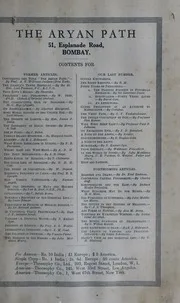
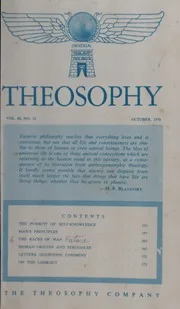
Theosophy Vol-66 No-12 November,1977
 82
82

Theosophy Vol-66 No-12 November,1977


Ophelia Vance, Mystical Literature Reviewer — This November 1977 installment of Theosophy is a treasure trove for seasoned practitioners and earnest neophytes alike. It masterfully navigates complex metaphysical concepts, offering clear yet profound explorations of karma, reincarnation, and the higher planes of consciousness. The articles within possess an authentic esoteric resonance, providing guidance on spiritual disciplines and philosophical inquiry. Its strength lies in its ability to distill ancient wisdom into accessible prose, making the profound understandable. This issue is particularly valuable for those actively engaged in self-transformation and seeking to deepen their connection to the spiritual hierarchy.
📝 Description
82
The November 1977 issue of Theosophy (Vol. 66, No. 12) discusses the perennial philosophies.
This issue from November 1977 tackles core Theosophical concepts. It examines the relationship between human consciousness and the wider cosmos, touching on universal archetypes that influence our lives. The articles also address subtle energies and hidden laws governing existence.
Readers will find discussions on the soul's development, the process of spiritual evolution, and the fundamental interconnectedness of all beings. The content aims to foster introspection and encourage a deeper understanding of life's mysteries, promoting a more mystical outlook.
This collection is intended for those interested in expanding their awareness of spiritual matters and the arcane.
This 1977 issue of Theosophy aligns with the broader esoteric tradition that emerged in the late 19th century, drawing heavily from Helena Blavatsky's foundational texts. Theosophy seeks to synthesize ancient religious philosophies and scientific discoveries, presenting a unified view of the universe. It emphasizes the study of comparative religion, philosophy, and science to uncover the underlying spiritual truths common to all. This publication continues that lineage, addressing themes of cosmic order, human potential, and the hidden workings of nature.
💡 Why Read This Book?
Uncover timeless truths and esoteric doctrines that illuminate the path of spiritual evolution. This issue offers profound insights into the nature of reality, the soul's journey, and the unseen forces governing the universe. Ideal for seekers of hidden knowledge, students of comparative religion, and practitioners of inner disciplines yearning for deeper understanding and spiritual growth.
⭐ Reader Reviews
Honest opinions from readers who have explored this book.
❓ Frequently Asked Questions
What is Theosophy?
Theosophy is a spiritual philosophy that seeks to understand the fundamental truths underlying all religions and sciences. It explores the nature of the divine, the human soul, and the cosmos, often drawing upon ancient wisdom traditions.
What can I expect from this specific issue?
This November 1977 issue delves into core theosophical concepts, likely exploring themes of spiritual evolution, karma, reincarnation, and the subtle bodies. It offers a glimpse into the discussions and teachings prevalent in the late 20th century.
Is this suitable for beginners?
While some articles may be dense, the foundational principles of Theosophy are often presented in a way that can be grasped by earnest beginners. It encourages further study and contemplation.
Where does the term 'Theosophy' originate?
The term 'Theosophy' itself is derived from Greek: 'theos' (god) and 'sophia' (wisdom), meaning 'divine wisdom' or 'wisdom of God'.
How does Theosophy relate to Anthroposophy?
Anthroposophy, founded by Rudolf Steiner, emerged from Theosophy. While sharing many core ideas, Anthroposophy developed its own distinct philosophical and scientific approach, particularly in areas like education and medicine.
🔮 Key Themes & Symbolism
The Nature of Consciousness and the Higher Self
This issue likely explores the intricate architecture of human consciousness, exploring its various planes and the journey of the soul towards its divine origin. It examines the concept of the Higher Self as the luminous spark of the divine within, guiding individuals through cycles of incarnation and evolution. Discussions may touch upon the limitations of the personality and the methods for transcending them to realize our true, eternal nature. It's an exploration of the inner cosmos, mirroring the outer, with emphasis on self-realization and the awakening of latent spiritual faculties.
Karma, Reincarnation, and the Law of Cause and Effect
Central to theosophical thought, this theme illuminates the immutable laws governing existence. Understand how actions, both past and present, tie the fabric of our destiny across lifetimes. This section offers useful insights into the justice and mercy inherent in the karmic cycle, encouraging responsibility and conscious participation in one's spiritual progression. It's a deep dive into the mechanics of spiritual evolution, revealing how each life is a purposeful step in the soul's grand unfolding towards ultimate liberation and wisdom.
Symbolism in Esoteric Traditions
This issue likely unravels the collection of symbolism embedded within ancient myths, scriptures, and spiritual practices. It explores how symbols serve as universal keys to unlocking deeper, often hidden, spiritual truths that transcend literal interpretation. Discover the archetypal meanings behind common motifs and how they connect us to the collective unconscious and the divine blueprint of creation. Understanding this symbolic language is presented as a vital tool for grasping the esoteric teachings and for communicating profound spiritual concepts across cultures and ages.
💬 Memorable Quotes
Direct passages from the work, attributed to the author.
“Wisdom is not bought, but earned through the silent communion of the soul.”
— True spiritual understanding is not acquired through external means but cultivated internally through introspection and connection with one's inner divinity.
“Every event is a lesson, every challenge a stepping stone.”
— Life's experiences, both pleasant and difficult, are designed to facilitate spiritual growth and progression on the soul's evolutionary path.
“The veil of illusion is thin for those who seek with an open heart.”
— Genuine spiritual seeking, marked by sincerity and openness, allows one to perceive the underlying reality beyond superficial appearances.
“In the stillness, we hear the whispers of the eternal.”
— Quietude and inner silence create the space necessary to receive divine guidance and intuitive insights from the spiritual realms.
💡 Key Ideas
Editorial paraphrase of the work's core concepts — not direct quotes.
The universe is a thought of God, and man is a thought of the universe.
This quote expresses the interconnectedness of all existence, from the divine mind to the individual human soul, suggesting a hierarchical and unified cosmic order.
🌙 Esoteric Significance
Tradition
This journal is a direct product of the Theosophical movement, founded by Helena Blavatsky. It draws heavily from the ancient wisdom traditions of the East (Hinduism, Buddhism, Zoroastrianism) and the Neoplatonic philosophies of the West. Its significance lies in its role in popularizing and synthesizing these diverse esoteric streams into a coherent modern philosophy, aiming to reveal the underlying unity of all religions and the universal laws of nature.
Symbolism
Theosophy extensively employs symbolism as a vehicle for higher truths. Expect discussions on the symbolism of light and darkness, the serpent, the triangle, the lotus, and archetypal figures within mythology. These symbols are not mere decorative elements but represent profound spiritual concepts, cosmic principles, and stages of human evolution, acting as keys to unlock deeper layers of meaning accessible to the intuitive mind.
Modern Relevance
In an age often marked by scientific reductionism and spiritual fragmentation, Theosophy offers a holistic worldview that bridges science, philosophy, and religion. Its emphasis on ethical living, universal interconnectedness, and personal spiritual development remains profoundly relevant for navigating contemporary challenges and fostering individual and collective transformation. The insights into consciousness and the subtle realms provide a framework for understanding personal well-being and the deeper purpose of life.
👥 Who Should Read This Book
This issue is a vital resource for seasoned students of esotericism, scholars of comparative religion, and dedicated practitioners of spiritual disciplines. It will deeply resonate with individuals seeking to understand the foundational principles of Theosophy, explore the mechanics of karma and reincarnation, and study the symbolic language of ancient wisdom. Beginners with a genuine thirst for knowledge will find it an informative introduction, though it may require dedicated study and contemplation to fully grasp its profound teachings. It is for the earnest seeker who desires to move beyond superficial understanding towards a more profound, integrated spiritual perspective.
📜 Historical Context
Published in November 1977, this issue of Theosophy emerged during a period of significant global introspection and spiritual seeking. The late 1970s saw a growing interest in Eastern philosophies, mysticism, and alternative spiritual movements, partly as a reaction to the perceived materialism of Western society. Theosophy, with its emphasis on ancient wisdom, reincarnation, and a universal brotherhood of humanity, resonated with many searching for deeper meaning. This era was also characterized by advancements in psychology and a burgeoning awareness of consciousness studies, which often intersected with theosophical ideas about the mind and subtle bodies. The journal's continued publication through this period signifies its enduring relevance and its role as a conduit for perennial philosophy in a rapidly changing world.
📔 Journal Prompts
Reflect on a recurring dream or recurring symbol in your life. What might it be communicating from your subconscious or higher self?
Consider a past challenge. How did the lessons learned from that experience shape your current understanding of karma and cause-and-effect?
What does the concept of the 'Higher Self' mean to you personally? How do you strive to align your daily actions with its wisdom?
Explore a personal belief or spiritual concept. How can you approach understanding it from a symbolic rather than a purely literal perspective?
In what ways do you feel a connection to the 'universal brotherhood of humanity' in your daily life? How can you strengthen this connection?
🗂️ Glossary
Karma
The spiritual principle of cause and effect where intent and actions of an individual influence the future of that individual. It is often understood as the law of moral causation, governing the cycle of rebirth.
Reincarnation
The philosophical or religious concept that the non-physical essence of a living being starts a new life in a different physical body or form after biological death.
Higher Self
The spiritual aspect of an individual, often considered the divine spark or true eternal nature, distinct from the personality or lower ego, which guides spiritual evolution.
Subtle Bodies
In esoteric traditions, these are non-physical energetic bodies or sheaths that interpenetrate and surround the physical body, associated with consciousness and spiritual development.
Perennial Philosophy
The view that all religions share a common core of wisdom and truth, often referred to as the 'divine wisdom' or 'esoteric tradition', underlying their diverse exoteric forms.
This book appears in 2 collections
🔮 Readers Also Liked
Browse all →





More by Theosophy
All books →





From the “Theosophy” Collection
View all →


More Free Theosophy & Anthroposophy Books
View all →