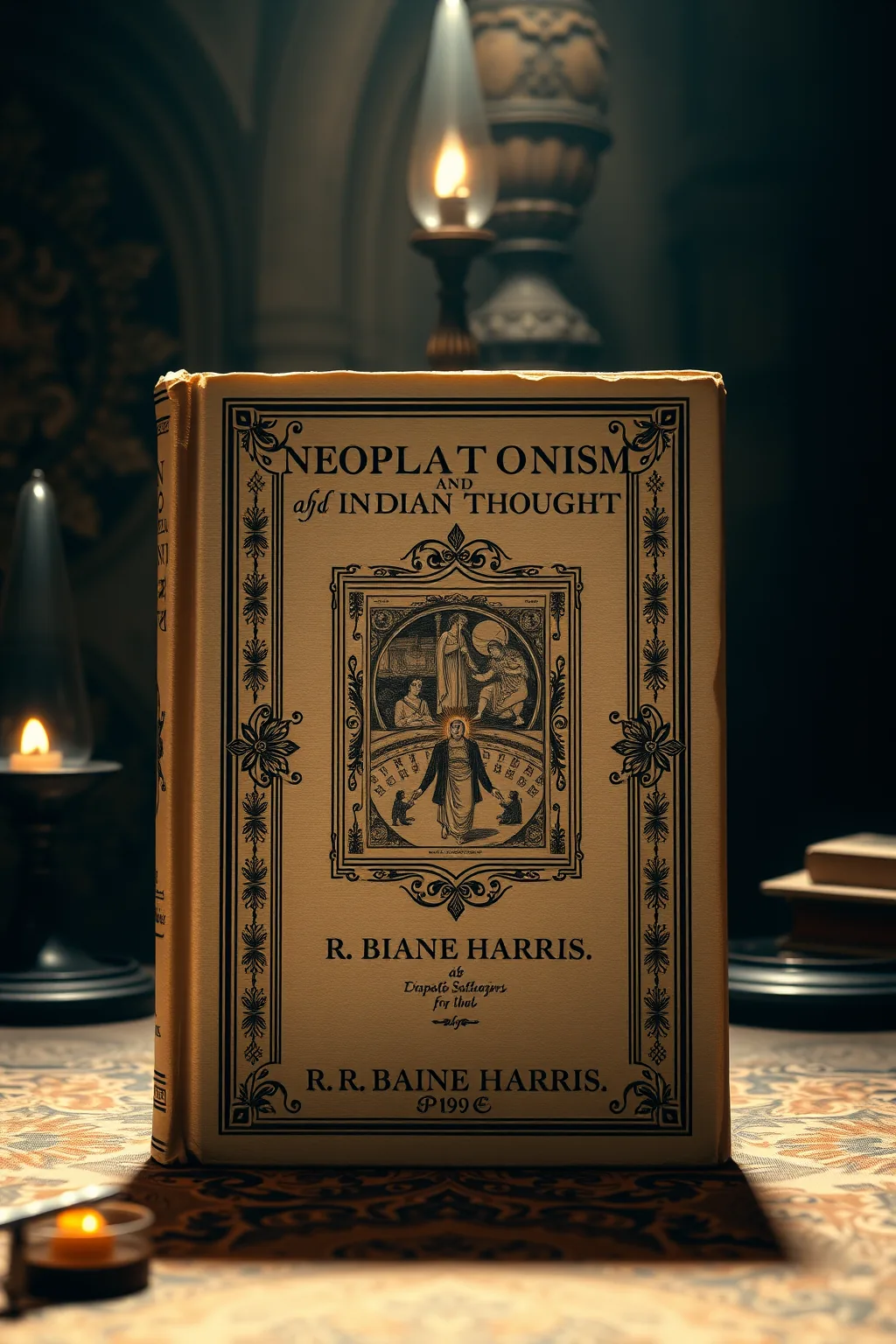
Neoplatonism and Indian Thought
 78
78

Neoplatonism and Indian Thought
R. Baine Harris's compilation, *Neoplatonism and Indian Thought*, offers a dense but rewarding examination of shared conceptual landscapes between two seemingly disparate philosophical giants. The strength lies in the sheer breadth of scholarly engagement, bringing together diverse perspectives that highlight striking analogies in the concepts of the One and emanation. However, the collection occasionally suffers from its academic focus, making some essays less accessible to the general esoteric reader. The discussion of Plotinus's possible awareness of Indian philosophical currents, for instance, is meticulously argued but requires significant background knowledge. Despite this, the work's value is undeniable for anyone seeking to understand the universal aspirations of ancient thought.
📝 Description
78
Nineteen essays from a 1981 conference examine parallels between Neoplatonism and Indian thought.
This volume collects nineteen essays presented at a 1981 conference that brought together specialists in Neoplatonism and Indian thought. The goal was to explore conceptual parallels and possible historical connections between these two ancient philosophical systems. The essays investigate areas where their metaphysical assertions and cosmological frameworks show overlap.
The book is intended for scholars of comparative philosophy, advanced students of Greek and Indian intellectual history, and practitioners interested in the cross-pollination of ancient traditions. It is particularly useful for those researching the philosophical underpinnings of late antiquity and its potential global dialogues. The collection reflects academic efforts from the late 20th century to trace Indian ideas into the Hellenistic world.
This collection engages with the esoteric philosophical currents of late antiquity and classical India. It probes the concept of an ultimate, ineffable divine principle, akin to Neoplatonic The One and the Hindu Brahman. The essays also consider emanation as a cosmological process and the role of intellect in bridging the material and spiritual. These themes resonate with traditions that seek direct knowledge of ultimate reality and emphasize the soul's ascent or liberation.
💡 Why Read This Book?
• Gain a deeper understanding of the concept of 'the One' as explored in both Neoplatonic and Hindu traditions, as detailed in essays discussing Plotinus and Upanishadic thought. • Explore the historical possibility of Indian philosophical influence on late Greek thinkers, particularly the Alexandrine Platonists, as examined in the volume's historical analyses. • Connect with the ancient pursuit of spiritual liberation and intellectual unification, as illuminated by comparisons between Neoplatonic henōsis and concepts like moksha.
⭐ Reader Reviews
Honest opinions from readers who have explored this book.
❓ Frequently Asked Questions
What specific Indian traditions are most frequently compared to Neoplatonism in this book?
The essays primarily focus on Hinduism, with particular attention given to concepts found in the Upanishads and Vedanta. Some discussions may also touch upon Buddhist philosophical ideas.
When was Neoplatonism and Indian Thought first published?
The book was first published on June 30, 1981, reflecting scholarship and comparative philosophy discussions from that era.
Does this book explore direct historical influence or just conceptual similarities?
The volume investigates both conceptual parallels and the potential for historical influence of Indian sources on late Greek philosophy, particularly the Alexandrine Platonists.
Who is R. Baine Harris?
R. Baine Harris was an academic and editor who specialized in the history of philosophy, particularly in comparative studies between Western and Eastern traditions.
Are the essays in this book accessible to beginners in philosophy?
The essays are written by specialists for an academic audience, so they may be challenging for beginners. However, the foundational concepts are explained within the comparative context.
What is the 'Alexandrine Platonists' mentioned in the book's context?
This refers to philosophers in Alexandria, Egypt, during late antiquity who followed Platonic traditions. Figures like Ammonius Saccas and Plotinus are associated with this intellectual milieu.
🔮 Key Themes & Symbolism
The Ineffable One
A central theme is the exploration of the ultimate, transcendent principle – the One in Neoplatonism and Brahman in Hinduism. The essays examine how both traditions posit an ineffable, unified source from which all reality emanates, emphasizing its absolute simplicity and beyond-being status. This concept is crucial for understanding the metaphysical architecture of both systems and their shared pursuit of ultimate reality.
Emanation and Hierarchy
The volume scrutinizes the doctrine of emanation, where the divine manifests sequentially through various levels of existence, from the Intellect (Nous/Buddhi) down to the material world. This hierarchical structure is a commonality discussed, illustrating how both Neoplatonism and certain Indian philosophies explain the relationship between the singular divine source and the manifold phenomenal reality.
The Soul's Ascent
The essays examine the paths and goals of the soul's journey. Comparisons are drawn between the Neoplatonic pursuit of henōsis (union with the One) and Indian concepts like moksha (liberation). The role of knowledge, purification, and philosophical practice in achieving this ultimate spiritual aim is a recurring point of intersection.
Historical Interconnections
Beyond conceptual parallels, the book addresses the intriguing question of potential historical cross-pollination. Scholars investigate whether Indian philosophical ideas, transmitted through trade routes or intellectual exchange, might have influenced late Greek thinkers, especially those in centers like Alexandria during the early centuries CE.
💬 Memorable Quotes
Direct passages from the work, attributed to the author.
“Comparison of the Intellect (Nous) and Buddhi.”
— This represents a key area of comparative analysis, highlighting how both traditions conceive of a divine or cosmic mind as the primary emanation and the locus of true reality.
“The soul's journey toward unification.”
— This expresses the shared soteriological goal found in both traditions: the return of the individual soul to its divine source through spiritual discipline and philosophical understanding.
“Potential influence of Indian thought on Hellenistic philosophy.”
— This phrase points to the historical inquiry within the book, examining the possibility of intellectual exchange that might have shaped the development of late antique Western philosophies.
“Shared ideas on cyclical time and cosmic cycles.”
— This refers to the exploration of cosmological models in both traditions, noting similarities in how time and existence are viewed as recurring patterns or vast cycles.
💡 Key Ideas
Editorial paraphrase of the work's core concepts — not direct quotes.
The One is beyond being and comprehension.
This paraphrased concept captures the Neoplatonic and some Hindu views of the ultimate reality as utterly transcendent, existing prior to any conceptual framework or manifest form, making direct knowledge impossible.
🌙 Esoteric Significance
Tradition
This work sits at the intersection of comparative philosophy and esoteric studies. While not strictly a manual for practice, it provides the intellectual framework for understanding connections between Western Hermeticism, Neoplatonism, and Eastern mystical traditions like Vedanta and certain Buddhist schools. It aligns with the esoteric goal of finding universal principles across diverse spiritual paths.
Symbolism
Key symbols explored include the abstract concept of 'The One' or 'Brahman' as the ultimate, ineffable source, often symbolized by light or pure being. The emanation of reality from this source can be seen as a symbolic representation of divine unfolding, while the soul's journey towards unification mirrors the alchemical process of purification and return to origin.
Modern Relevance
Contemporary thinkers and practitioners in fields like Integral Philosophy, perennial philosophy, and comparative mysticism draw upon the foundational insights presented here. It informs modern dialogues on consciousness, non-duality, and the search for common ground among global spiritual and philosophical traditions, particularly for those interested in the roots of Western esotericism.
👥 Who Should Read This Book
• Students of Comparative Religion and Philosophy: To understand the striking conceptual overlaps and potential historical links between major Western and Eastern philosophical systems. • Scholars of Late Antiquity and Hellenistic Thought: To examine the intellectual context of Neoplatonism and explore theories regarding its engagement with non-Western ideas. • Esoteric Practitioners seeking Universal Principles: To find common ground in the metaphysical and soteriological aims of ancient wisdom traditions, informing their personal spiritual development.
📜 Historical Context
Published in 1981, *Neoplatonism and Indian Thought* arrived at a time when the academic study of comparative philosophy was gaining significant traction. The late 20th century saw a growing recognition of the interconnectedness of ancient worldviews, challenging the previously Eurocentric focus of intellectual history. This volume emerged from a specific conference, indicating a scholarly desire to bridge the divide between Hellenistic studies and Indology. It engaged with ongoing debates about the transmission of ideas in the ancient world, particularly concerning potential influences on figures like Plotinus and the broader Neoplatonic school active in centers such as Alexandria. This effort occurred within a broader intellectual climate that was re-examining classical philosophy and its relationship to Eastern traditions, moving beyond earlier Orientalist perspectives.
📔 Journal Prompts
The concept of 'the One' as an ultimate source, compared across Neoplatonism and Indian thought.
Plotinus's cosmology and its possible resonance with Upanishadic ideas.
The hierarchical structure of reality as depicted in emanation doctrines.
The soul's path to unification (henōsis/moksha) and its philosophical implications.
Historical evidence for cross-cultural philosophical exchange in the ancient Mediterranean and Indian worlds.
🗂️ Glossary
Neoplatonism
A school of philosophy originating in the 3rd century CE, primarily associated with Plotinus, which interprets Plato's philosophy in a mystical and metaphysical direction, emphasizing the One as the ultimate principle.
The One
In Neoplatonism, the ultimate, transcendent, and ineffable source of all reality, beyond being and comprehension, from which all existence emanates.
Brahman
In Hinduism, particularly Vedanta, the ultimate, unchanging reality, the supreme cosmic spirit, which is the source and sustainer of all existence.
Emanation
The process by which reality flows or issues forth from a divine source, typically in a hierarchical series, without diminishing the source itself.
Nous
Greek for 'mind' or 'intellect.' In Neoplatonism, it is the second hypostasis after the One, a divine area of forms and intellect.
Buddhi
In Hindu philosophy, the higher intellect or discerning faculty, often considered the seat of pure consciousness and a bridge to the spiritual realm.
Henōsis
Greek for 'union.' In Neoplatonism, the ultimate goal of the philosophical life: the ecstatic union of the soul with the One.