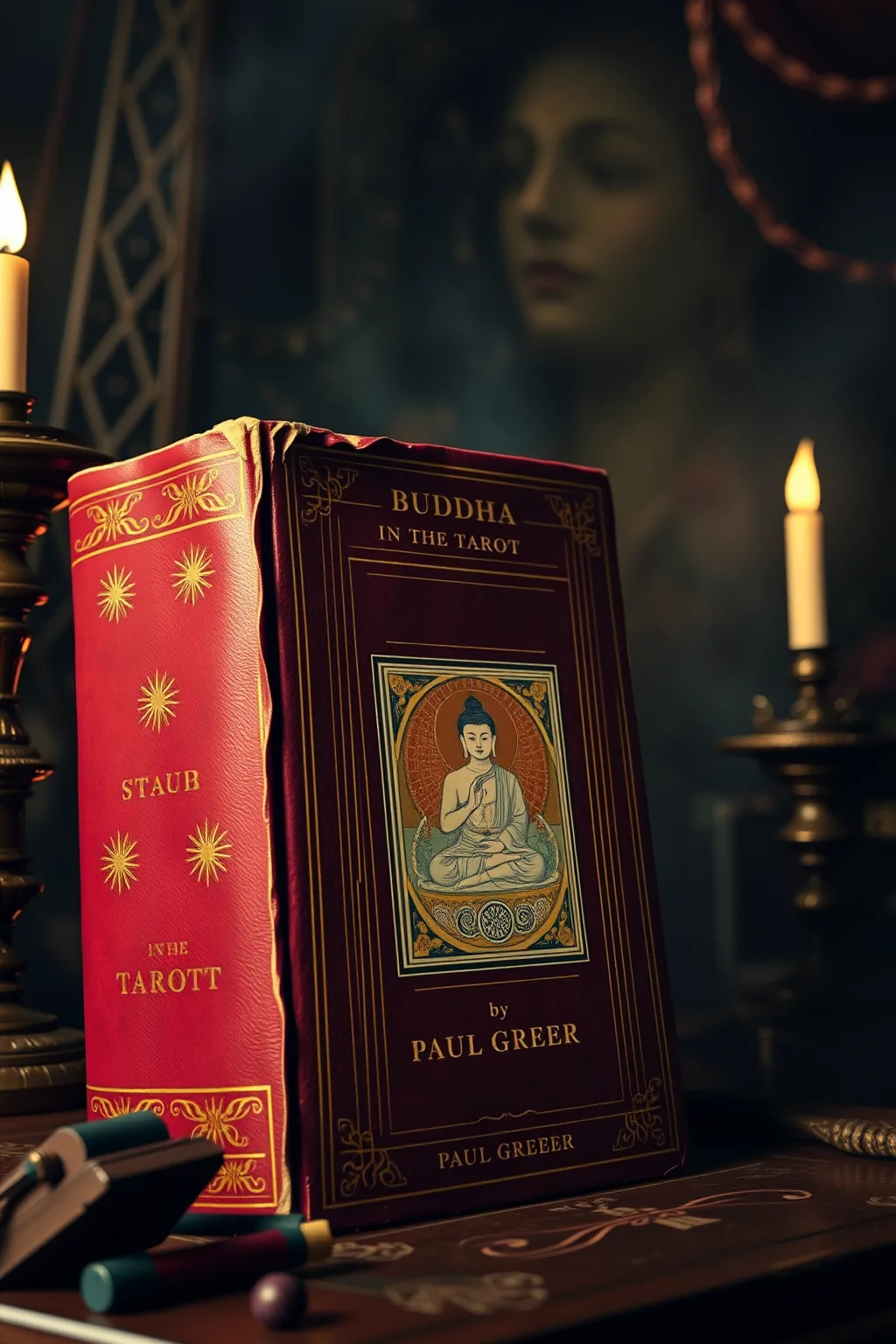
Buddha in the Tarot
 61
61

Buddha in the Tarot



Isolde Whitaker (Sacred Texts Editor) — 'Buddha in the Tarot' is an indispensable addition to the esoteric library, offering a rare and potent synthesis of Buddhist philosophy and Tarot divination. Paul Greer's scholarship is evident as he navigates complex spiritual concepts with clarity and grace, illuminating the Tarot's deeper archetypal currents. This work transcends mere card interpretation, providing a framework for spiritual growth and self-discovery. Its esoteric insights are profound, making it an essential read for serious practitioners and scholars alike. Those seeking a more meditative and philosophically rich approach to Tarot will find this book deeply rewarding.
📝 Description
61
Paul Greer's 'Buddha in the Tarot' (1997) maps Buddhist concepts onto Tarot archetypes.
Paul Greer's 'Buddha in the Tarot' draws connections between Buddhist philosophy and the imagery of the Tarot. The book examines how the archetypes found in Tarot cards reflect core Buddhist ideas. Greer looks at concepts such as impermanence, enlightenment, and the path to liberation through the lens of Tarot symbolism.
The text aims to encourage deeper reflection on the self. It suggests that the Tarot can serve as a guide for spiritual growth, moving beyond surface-level readings. By interpreting the cards with Buddhist principles, readers are invited to find a map for inner development and self discovery. The book posits that the Tarot can help awaken an individual's inherent Buddha nature.
This book fits within a tradition of Western esotericism that seeks to integrate Eastern spiritual systems with existing symbolic languages. It follows in a lineage where figures have attempted to find correspondences between diverse mystical traditions, often using systems like astrology, alchemy, or the Tarot as a framework. The goal is typically to uncover universal spiritual truths that transcend cultural boundaries. Greer's work specifically bridges the gap between a modern Western esoteric tool, the Tarot, and a major Eastern philosophical and religious tradition, Buddhism.
💡 Why Read This Book?
Uncover the hidden spiritual lineage connecting the Tarot and Buddhist wisdom. 'Buddha in the Tarot' offers a unique lens for interpreting cards through the lens of enlightenment, impermanence, and the path to liberation. Ideal for Tarot practitioners seeking deeper meaning, spiritual seekers exploring Eastern philosophies, and scholars interested in the cross-pollination of esoteric traditions. Discover how ancient archetypes can illuminate your personal journey towards inner peace and profound self-understanding.
⭐ Reader Reviews
Honest opinions from readers who have explored this book.
❓ Frequently Asked Questions
Is this book suitable for beginners to Tarot?
Yes, while it offers profound esoteric insights, the book is structured to guide both newcomers and experienced readers through its unique perspective, making the wisdom accessible to all levels of understanding.
What specific Buddhist concepts are explored in relation to the Tarot?
The book delves into concepts such as the Four Noble Truths, the Eightfold Path, karma, impermanence (anicca), suffering (dukkha), and the nature of enlightenment, weaving them into the fabric of Tarot card meanings.
Does this book require prior knowledge of Buddhism?
Prior knowledge of Buddhism is not strictly necessary, as the author introduces and explains relevant concepts within the context of Tarot interpretation. However, it enhances the depth of understanding.
Can this book be used for practical divination?
Absolutely. The book provides a sophisticated framework for using the Tarot for practical divination, emphasizing introspection and spiritual guidance rather than mere fortune-telling.
What makes this approach to Tarot unique?
Its uniqueness lies in the deep integration of Buddhist philosophy, offering a path to understand the Tarot not just as a predictive tool, but as a profound map for spiritual awakening and the cultivation of inner wisdom.
🔮 Key Themes & Symbolism
The Archetypal Resonance of Buddhist Principles
This theme explores the profound alignment between the archetypal imagery of the Tarot and core Buddhist doctrines. It posits that the cards, when viewed through a Buddhist lens, become vivid representations of spiritual concepts like impermanence, the cycle of suffering and liberation, and the journey towards enlightenment. Greer meticulously draws parallels between specific Tarot trumps and major Buddhist teachings, revealing how the cards can serve as a visual guide to understanding the nature of reality and the path to awakening. This section invites readers to see the Tarot not just as symbolic, but as a sacred text reflecting universal spiritual truths.
Tarot as a Path to Mindfulness and Self-Awareness
The book frames the practice of Tarot reading as a form of active meditation and a catalyst for profound self-awareness. By engaging with the archetypes presented in the cards, readers are encouraged to cultivate mindfulness, observe their own thought patterns, and gain deeper insights into their inner landscape. The process of drawing, contemplating, and interpreting cards becomes an exercise in present-moment awareness, mirroring Buddhist practices of meditation. This theme emphasizes how the Tarot can be a powerful tool for dismantling illusions, confronting shadow aspects, and fostering a more compassionate and understanding relationship with oneself.
Esoteric Symbolism and the Unfolding of Consciousness
This key theme studies the rich, multilayered symbolism inherent in both Buddhist iconography and the Tarot. Greer illuminates how these symbols act as keys to unlocking deeper levels of consciousness and understanding the subtle energies that govern existence. The book meticulously decodes the esoteric significance of various card images, connecting them to concepts of karma, rebirth, and the ultimate realization of Buddhahood. It explores how the Tarot, when approached with this esoteric understanding, becomes more than a divinatory tool; it transforms into a sacred map for the evolution of consciousness itself.
💬 Memorable Quotes
Direct passages from the work, attributed to the author.
“Each card is a mirror reflecting the Buddha-nature within.”
— This highlights the book's unique perspective: the Tarot is not merely an external system, but a reflection of the inherent divine potential and enlightenment that resides within every individual.
“To truly see is to understand the interconnectedness of all things.”
— This emphasizes the Buddhist concept of dependent origination and interconnectedness, suggesting that true perception, facilitated by the Tarot's wisdom, reveals the unity underlying all phenomena.
💡 Key Ideas
Editorial paraphrase of the work's core concepts — not direct quotes.
The Tarot, like the Dharma, offers a map to the soul's journey.
This quote establishes the central thesis, positioning the Tarot as a spiritual guide akin to Buddhist teachings, essential for working through the inner realms and understanding life's profound questions.
Impermanence is not a curse, but the very essence of liberation.
This quote captures a core Buddhist tenet, reinterpreted through the Tarot. It suggests that embracing change and the transient nature of all things is key to spiritual freedom, a concept often mirrored in the Tarot's cycles.
The fool's journey is the path to wisdom, fraught with both innocence and profound truth.
This quote speaks to the transformative power of the Fool card, linking its journey of new beginnings and potential to the broader spiritual quest for wisdom, acknowledging its inherent challenges and illuminations.
🌙 Esoteric Significance
Tradition
This work deeply draws from the rich esoteric traditions of both Buddhism, particularly Mahayana and Zen philosophies, and Western esotericism, specifically the Hermetic and Kabbalistic underpinnings of Tarot symbolism. It seeks to synthesize these streams by viewing the Tarot as a vehicle for transmitting Buddhist principles, transforming it from a mere divinatory tool into a sacred text for spiritual realization.
Symbolism
The book decodes the profound esoteric symbolism within Tarot cards, reinterpreting them through the lens of Buddhist concepts. For instance, the High Priestess might symbolize emptiness (sunyata), while The World could represent nirvana. Greer meticulously unpacks how these archetypal images serve as potent metaphors for the human condition and the journey towards spiritual awakening, aligning them with Buddhist notions of karma, impermanence, and enlightenment.
Modern Relevance
In a world often characterized by materialism and existential angst, 'Buddha in the Tarot' offers a timeless pathway to inner peace and self-understanding. Its relevance lies in providing practical, contemplative tools for navigating modern life with greater wisdom and compassion. By integrating ancient spiritual insights with a universally accessible divinatory system, the book empowers individuals to cultivate mindfulness, confront their inner challenges, and start a personal journey towards enlightenment.
👥 Who Should Read This Book
This informative text is a treasure for dedicated Tarot practitioners seeking to deepen their understanding beyond surface-level interpretations. Spiritual seekers exploring the intersection of Eastern philosophy and Western esotericism will find a profound roadmap for inner growth. Scholars of comparative religion and occult studies will appreciate the nuanced synthesis of Buddhist doctrines and Tarot archetypes. Beginners interested in a more mindful and philosophically rich approach to divination will also find this book to be an invaluable and accessible guide.
📜 Historical Context
Published in an era where esoteric traditions were experiencing a resurgence of interest, 'Buddha in the Tarot' emerged as a significant contribution to the growing dialogue between Eastern spirituality and Western occult practices. The late 20th and early 21st centuries saw a greater accessibility to diverse philosophical systems, allowing for cross-cultural explorations. This book stands as a proof of that intellectual curiosity, bridging the gap between the ancient wisdom of Buddhism and the venerable archetypal language of the Tarot. Its influence lies in offering a sophisticated, integrated approach that appealed to a readership seeking deeper, more meaningful interpretations beyond conventional divination.
📔 Journal Prompts
Meditate on the concept of impermanence as represented by the Wheel of Fortune. How does this concept manifest in your life?
Consider the Fool card. In what ways is your own life a 'fool's journey' towards wisdom?
Reflect on a moment where you experienced a profound sense of interconnectedness. Which Tarot card best symbolizes this feeling?
Explore the meaning of suffering (dukkha) as depicted through cards like The Tower or The Hanged Man. How can these archetypes offer insight into navigating personal challenges?
Visualize the attainment of enlightenment as represented by The World card. What steps can you take today to move closer to your own inner awakening?
🗂️ Glossary
Anicca (Impermanence)
A fundamental Buddhist concept referring to the transient nature of all phenomena, suggesting that nothing is permanent and all things are in a constant state of flux.
Sunyata (Emptiness)
A core Mahayana Buddhist doctrine that posits the absence of inherent existence in all phenomena, not as a void, but as a condition of interdependence and potentiality.
Bodhisattva
An enlightened being in Mahayana Buddhism who delays their own nirvana out of compassion to help all sentient beings achieve enlightenment.
Archetype
A universal, archaic symbol or model of a person, behaviour, or pattern that is frequently recurring in literature, myths, and dreams, often seen as fundamental to the collective unconscious.
Nirvana
The ultimate goal of Buddhism; a state of liberation from suffering, desire, and the cycle of rebirth (samsara), characterized by profound peace and enlightenment.
This book appears in 3 collections
🔮 Readers Also Liked
Browse all →









More by Paul Greer
All books →
From the “Tarot” Collection
View all →





More Free Divination & Tarot Books
View all →