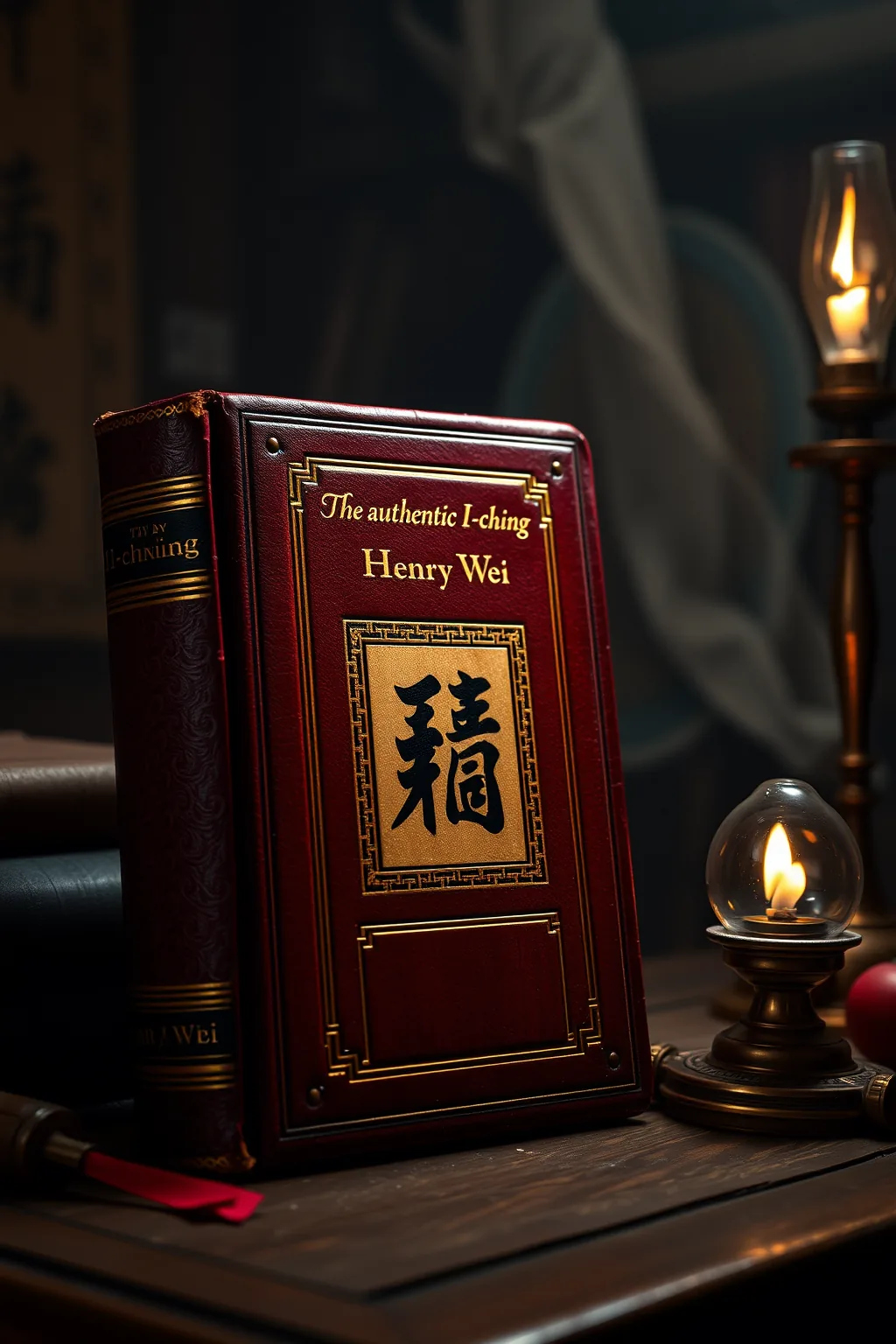
The authentic I-ching
 62
62

The authentic I-ching



Silas Hawthorne, Hermetic Studies Editor: Henry Wei's 'The Authentic I-Ching' stands as a beacon for serious students of esoteric lore. Wei masterfully deciphers the intricate symbolic language of the Yi Jing, moving beyond mere fortune-telling to reveal its profound philosophical underpinnings. This edition offers unparalleled clarity on the archetypal forces at play, particularly the dynamic interplay of Yin and Yang, and their manifestation in the sixty-four hexagrams. Its strength lies in its rigorous yet accessible approach, making the complex wisdom of the I-Ching available to both neophytes and seasoned practitioners. A truly indispensable resource for anyone seeking to understand the cyclical nature of existence and the subtle threads of fate.
📝 Description
62
Henry Wei's 'The Authentic I-Ching' was published to clarify the Yi Jing's philosophical core.
Henry Wei's 'The Authentic I-Ching' examines the Yi Jing, the ancient Chinese Book of Changes. Wei presents the text not merely as a tool for divination, but as a philosophical framework and a guide to life's changes. His research details the symbolism within each hexagram, uncovering deeper meanings. The book discusses the interaction of Yin and Yang, the basic forces influencing reality, and how their balance provides insights into personal fate and universal structures.
This edition is intended for those seriously interested in the I-Ching, whether for study or practice. It aims to foster a greater understanding of the fundamental archetypes that influence existence. 'The Authentic I-Ching' encourages readers to discover the principles of cosmic balance and to recognize the energies that affect daily life. The work emphasizes the potential for self-awareness through engaging with the Oracle.
This book engages with the I-Ching, a central text in Chinese philosophy and religion with roots stretching back thousands of years. It is considered a foundational work within Daoism and a significant influence on East Asian thought. Its esoteric dimension lies in its complex system of divination and its cosmological explanations, which aim to reveal patterns in both human affairs and the natural world. Wei's work seeks to elucidate these deeper connections, positioning the I-Ching as a system for understanding cosmic order and personal alignment.
💡 Why Read This Book?
Unlock the profound philosophical and divinatory secrets of the ancient Chinese Oracle. 'The Authentic I-Ching' offers unparalleled clarity on its complex symbolism and esoteric wisdom. Ideal for seekers of hidden knowledge, students of metaphysics, and practitioners of ancient divination arts looking for a deep, authentic understanding of life's turning points.
⭐ Reader Reviews
Honest opinions from readers who have explored this book.
❓ Frequently Asked Questions
What is the I-Ching?
The I-Ching, or Book of Changes, is an ancient Chinese divination text and one of the oldest Chinese classics. It is revered for its philosophical depth, offering insights into the cycles of nature and human experience through a system of hexagrams.
How does one use the I-Ching for divination?
Divination typically involves casting coins or yarrow stalks to generate a hexagram, which is then interpreted using the text's explanations and associated judgments to gain guidance on a particular situation.
Is this book suitable for beginners?
Yes, while rich in esoteric detail, Henry Wei's clear explanations make 'The Authentic I-Ching' accessible to those new to the subject, providing a solid foundation for understanding its core principles.
What makes this translation 'authentic'?
The term 'authentic' signifies a translation that aims to preserve the original philosophical intent and esoteric nuances of the I-Ching, avoiding superficial interpretations and focusing on its deeper symbolic meanings.
What is the philosophical significance of the I-Ching?
Philosophically, the I-Ching explores concepts like change, balance, destiny, and the interconnectedness of all things. It teaches acceptance of impermanence and wisdom in adapting to life's transformations.
🔮 Key Themes & Symbolism
The Cosmic Dance of Yin and Yang
This theme examines the fundamental duality that structures the universe according to I-Ching philosophy. Yin, the receptive, passive, feminine principle, and Yang, the active, assertive, masculine principle, are not seen as opposites but as complementary forces in perpetual motion. Their interaction, transformation, and balance are the source of all phenomena. The book meticulously illustrates how this cosmic dance manifests in the sixty-four hexagrams, offering a framework for understanding change, potential, and the inherent order within apparent chaos. It’s a profound exploration of how balance and imbalance dictate the ebb and flow of life, guiding one towards harmonious existence.
Hexagrams as Archetypal Blueprints
Each of the sixty-four hexagrams is presented not merely as a random combination of lines, but as a distinct archetypal situation or cosmic pattern. 'The Authentic I-Ching' unveils these hexagrams as living blueprints of universal experiences, from creation and growth to decline and renewal. Henry Wei illuminates the detailed symbolism embedded within each trigram and their combination, revealing how they represent dynamic forces and potential outcomes. Understanding these archetypes allows the reader to recognize recurring patterns in their own lives and the world around them, fostering wisdom and enabling proactive engagement with destiny.
The Art of Navigating Change
Central to the I-Ching is the understanding that change is the only constant. This theme explores the book's profound teachings on adapting to the inevitable flux of existence. 'The Authentic I-Ching' provides practical and philosophical guidance on how to discern the nature of a given situation and respond with appropriate action or stillness. It emphasizes the importance of timing, inner disposition, and the cultivation of virtues that allow one to flow with, rather than resist, the currents of change, ultimately leading to greater resilience and spiritual growth.
💬 Memorable Quotes
Direct passages from the work, attributed to the author.
“Within every ending lies the seed of a new beginning.”
— This aphorism speaks to the cyclical philosophy of the I-Ching, emphasizing the continuous nature of transformation and the inherent potential for renewal found even in perceived conclusions.
“To know the Way is to understand the ebb and flow.”
— This emphasizes the core teaching of the I-Ching: understanding and aligning oneself with the natural, dynamic patterns of existence, much like the tide's predictable movement.
“The wise person adapts, the fool resists.”
— This succinctly captures the I-Ching's emphasis on flexibility and intelligent response to life's circumstances, advocating for adaptability as a hallmark of wisdom.
💡 Key Ideas
Editorial paraphrase of the work's core concepts — not direct quotes.
The Book of Changes is not a book of fate, but a book of possibilities.
This quote highlights the I-Ching's empowering nature, suggesting it offers guidance and insight into potential outcomes rather than rigidly predetermined destinies, encouraging proactive engagement.
Stillness reveals the truth that motion obscures.
This quote points to the value of introspection and quiet contemplation as a means to gain clarity and deeper insight, a key practice for interpreting the I-Ching's wisdom.
🌙 Esoteric Significance
Tradition
The I-Ching is a foundational text within Taoist and Confucian esoteric traditions, deeply interwoven with Chinese metaphysics. Its principles of balance, change, and the interplay of cosmic forces align with Taoist concepts of the Tao, Wu Wei (non-action), and the Yin-Yang dynamic. For Confucians, it served as a guide for ethical conduct, governance, and understanding one's place in the cosmic order. Esoterically, it's seen as a map of consciousness, a tool for spiritual alchemy, and a means to harmonize the microcosm (human) with the macrocosm (universe).
Symbolism
The core symbolism of the I-Ching lies in its hexagrams, composed of six lines, each representing either Yin (broken line) or Yang (solid line). These lines combine to form 64 unique hexagrams, each a potent symbol of a specific situation, archetypal energy, or stage of transformation. The trigrams (three-line combinations) within the hexagrams further enrich this symbolic language, representing fundamental elements like Heaven, Earth, Water, Fire, and so forth. The interpretation of these symbols offers useful insights into cause and effect, potential outcomes, and the underlying patterns of reality.
Modern Relevance
In the modern era, the I-Ching continues to offer profound relevance as a tool for self-discovery, decision-making, and navigating complexity. Its emphasis on adaptability, understanding cyclical patterns, and finding balance resonates deeply in a world characterized by rapid change and uncertainty. For practitioners of esoteric arts, it remains an invaluable oracle and a source of wisdom for spiritual growth. Its philosophical insights provide a framework for ethical living and a deeper connection to the natural world, offering timeless guidance for the challenges of contemporary life.
👥 Who Should Read This Book
This work is essential for seasoned practitioners of divination and esoteric studies seeking a deeper, more authentic understanding of the Yi Jing beyond superficial interpretations. Scholars of comparative philosophy and ancient wisdom traditions will find its meticulous scholarship useful for grasping the I-Ching's philosophical underpinnings. For the earnest seeker starting a path of self-discovery, it offers a profound guide to navigating life's challenges and understanding cosmic patterns. Beginners will appreciate the clarity with which complex concepts are explained, making this a rich and accessible entry point into one of the world's most ancient and revered oracles.
📜 Historical Context
The I-Ching, or Book of Changes, emerged from the crucible of ancient Chinese civilization, its origins stretching back over three millennia. Initially a manual for divination, likely used by shamans and royalty to consult with the divine and understand the will of heaven, it gradually evolved into a profound philosophical text. During the Zhou Dynasty (c. 1046–256 BCE), its influence deepened, with figures like King Wen and the Duke of Zhou contributing significant commentaries. Later, Confucian scholars integrated its teachings into their ethical and political frameworks, cementing its status as one of the Five Classics of Chinese literature. The Qin Dynasty's 'burning of books' famously spared the I-Ching, underscoring its perceived importance. Throughout subsequent dynasties, it remained a core part of Chinese thought, influencing strategy, medicine, art, and personal development, continuously interpreted and reinterpreted, making its legacy enduring and its wisdom adaptable to changing eras.
📔 Journal Prompts
Reflect on a recent change in your life. Which hexagram from the I-Ching might represent this transition, and why?
Consider the interplay of Yin and Yang in your daily interactions. Where do you see balance, and where do you observe imbalance?
How can the concept of 'adapting to change' be applied to a current challenge you are facing?
If you were to consult the I-Ching about a future endeavor, what specific question would you ask and why?
What does the idea of 'hidden knowledge' within the I-Ching mean to you personally?
🗂️ Glossary
Hexagram
A figure composed of six horizontal lines, each either solid (Yang) or broken (Yin). The 64 hexagrams are the primary symbolic units of the I-Ching, representing archetypal situations and patterns of change.
Trigram
A figure composed of three lines, either solid (Yang) or broken (Yin). There are eight fundamental trigrams (e.g., Heaven, Earth, Water), which combine to form the 64 hexagrams.
Yin
In I-Ching philosophy, the passive, receptive, dark, feminine, and yielding principle. It is represented by a broken line ( -- ).
Yang
In I-Ching philosophy, the active, assertive, light, masculine, and dominant principle. It is represented by a solid line ( — ).
Divination
The practice of seeking knowledge of the future or the unknown by supernatural means. In the context of the I-Ching, it involves interpreting the generated hexagrams to gain insight into present circumstances and potential outcomes.
This book appears in 3 collections
🔮 Readers Also Liked
Browse all →









From the “Tarot” Collection
View all →






More Free Divination & Tarot Books
View all →