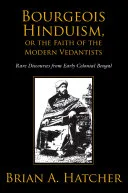
Bourgeois Hinduism, or Faith of the Modern Vedantists
 79
79

Bourgeois Hinduism, or Faith of the Modern Vedantists
Brian Hatcher's study of the Tattvabodhini Sabha offers a much-needed scholarly lens on a critical juncture in Hindu reform. By focusing on the 1839 founding and the group's self-styled "Vedanta," Hatcher avoids the common pitfalls of oversimplification. The book's strength lies in its detailed translation and analysis of primary discourses, illuminating the Sabha's commitment to a rational, morally grounded faith. A limitation, however, is the sometimes dense academic prose, which may challenge readers unaccustomed to historical religious studies. The section discussing the Sabha's reinterpretation of ancient texts to support non-idolatrous worship is particularly compelling. Ultimately, "Bourgeois Hinduism" serves as a vital corrective to monolithic views of religious development.
📝 Description
79
Brian Hatcher's 2014 book examines the Tattvabodhini Sabha, a 19th-century group that redefined Vedanta.
Brian Hatcher's "Bourgeois Hinduism, or Faith of the Modern Vedantists" scrutinizes the Tattvabodhini Sabha, a Calcutta society founded in 1839. This organization aimed to formulate a Hindu faith free from idolatry, grounded in reason, and ethically upright. They drew on older spiritual texts to articulate a form of modern theism they called "Vedanta." Hatcher translates and analyzes the writings and actions of this significant group.
The book is situated in the intellectual climate of 19th-century Calcutta, a center for reform movements and the interaction between Indian and Western ideas. The Tattvabodhini Sabha emerged as traditional Hindu practices faced scrutiny from within, from colonial administrators, and from Christian missionaries. The group's focus on "Vedanta" as a rational, ethical monotheism was a response to these pressures. They sought to present Hinduism as a sophisticated and contemporary religion, similar to reformist efforts by figures like Ram Mohan Roy.
Hatcher details how the Tattvabodhini Sabha promoted "Vedanta" as a philosophy emphasizing rational and ethical principles, distinguishing it from devotional or ritualistic worship. The book also addresses the group's "non-idolatrous" approach and its engagement with the concept of a universal religion.
This book illuminates a period where traditional Indian religious frameworks were being reinterpreted through rationalist and monotheistic lenses, partly in response to colonial encounters. The Tattvabodhini Sabha's project to distill a 'pure' Vedanta, stripped of ritual and idolatry, aligns with broader reformist and revivalist movements within Hinduism that sought to present its philosophical depth to a modern, educated audience. It reflects a historical engagement with concepts that would later influence various schools of modern Hinduism.
💡 Why Read This Book?
• Gain insight into the Tattvabodhini Sabha's formation in 1839, understanding its specific goals for religious reform beyond generalized "Hindu revivalism. • Explore the concept of "Vedanta" as articulated by the Sabha, differentiating it from later, more devotional interpretations and appreciating its emphasis on rational theism. • Understand the socio-intellectual climate of 19th-century Calcutta that fostered reform movements, recognizing how "bourgeois" aspirations shaped religious expression.
⭐ Reader Reviews
Honest opinions from readers who have explored this book.
❓ Frequently Asked Questions
What was the primary objective of the Tattvabodhini Sabha when it was founded in 1839?
The Tattvabodhini Sabha's primary objective was to propagate a non-idolatrous, rational, and morally responsible form of Hindu worship, which they termed "Vedanta," drawing upon ancient spiritual sources.
How did the Sabha's "Vedanta" differ from other Hindu practices of the time?
The Sabha's "Vedanta" emphasized a monotheistic or henotheistic understanding of the divine and advocated for rational, ethical worship, consciously moving away from ritualistic and idolatrous practices prevalent in some other Hindu traditions.
What does the term "bourgeois" signify in the book's title?
The term "bourgeois" refers to the social and intellectual milieu of the Sabha's members, often educated elites who sought to modernize and legitimize their reformist religious vision within the changing social landscape of 19th-century India.
Which city was the center for the Tattvabodhini Sabha's activities?
The Tattvabodhini Sabha was centered in Calcutta, which was a significant hub for intellectual and religious reform movements during the 19th century.
What kind of sources did the Tattvabodhini Sabha draw upon for their modern theism?
The Sabha drew upon ancient sources of Hindu spirituality, reinterpreting them to support their vision of a rational and morally responsible mode of worship that they identified as "Vedanta."
Who is the author of "Bourgeois Hinduism, or Faith of the Modern Vedantists"?
The author of "Bourgeois Hinduism, or Faith of the Modern Vedantists" is Brian Hatcher, with the book first published in 2007.
🔮 Key Themes & Symbolism
Rational Vedanta
The work meticulously details the Tattvabodhini Sabha's project to define and promote a "Vedanta" grounded in reason and ethical conduct. This wasn't merely a revival but a re-articulation, seeking to strip away perceived accretions of ritualism and idolatry. Hatcher shows how the Sabha leaders selectively interpreted ancient scriptures, prioritizing philosophical and moral teachings to construct a monotheistic or henotheistic framework suitable for educated urbanites navigating colonial modernity.
Non-Idolatrous Worship
A central tenet explored is the Sabha's commitment to non-idolatrous worship. This involved a significant theological and devotional shift, moving away from aniconic representations towards a more abstract, conceptual understanding of the divine. The book traces the intellectual debates and scriptural justifications used by members to advocate for this purified form of faith, positioning it as a superior, modern alternative.
Religious Reform and Modernity
"Bourgeois Hinduism" situates the Sabha's efforts within the broader context of 19th-century religious reform movements. It examines how intellectual currents, colonial encounters, and the aspirations of an emerging educated class shaped the desire for a "modern" Hinduism. The "bourgeois" label highlights the socio-economic and cultural positioning of the reformers and their attempt to align their faith with contemporary standards of rationality and morality.
Translation and Interpretation
Central to Hatcher's scholarship is the translation and critical analysis of the Sabha's own writings and discourses. This focus on primary source material allows for a nuanced understanding of their theological positions and the hermeneutical strategies employed. The book demonstrates the active role of interpretation in shaping religious identity and practice, especially when adapting ancient traditions to new social and intellectual environments.
💬 Memorable Quotes
Direct passages from the work, attributed to the author.
“In 1839 a diverse group of Hindu leaders began gathering in Calcutta to share and propagate their faith in a non-idolatrous form of worship.”
— This foundational statement anchors the book's subject, pinpointing the genesis of the Tattvabodhini Sabha and its core mission. It immediately signals the reformist agenda focused on a purified, rational approach to Hinduism.
“The group, known as the Tattvabodhini Sabha, met weekly to worship and hear discourses from members on the virtues of a rational and morally responsible mode of worship.”
— This highlights the structured, intellectual nature of the Sabha's gatherings. It emphasizes their focus on 'rational' and 'morally responsible' worship, key differentiators from more traditional or devotional practices.
“They called upon ancient sources of Hindu spirituality to guide them in developing a form of modern theism they referred to as "Vedanta."”
— This points to the intellectual methodology of the Sabha: a selective engagement with tradition to construct a contemporary theological framework. It underscores the attempt to legitimize their innovations by rooting them in antiquity.
“Brian Hatcher translates these hither”
— This phrase, likely an incomplete excerpt from the original blurb, signals the book's scholarly contribution: the provision of translated primary materials that allow readers direct access to the Sabha's own words and ideas.
💡 Key Ideas
Editorial paraphrase of the work's core concepts — not direct quotes.
The book examines the Tattvabodhini Sabha's efforts to establish a non-idolatrous form of worship.
This paraphrased concept underscores a primary thematic concern of the book: the Sabha's deliberate move away from icon-based devotion towards a more abstract, conceptual understanding of the divine.
🌙 Esoteric Significance
Tradition
While not strictly falling into a single Western esoteric lineage like Hermeticism or Kabbalah, this work engages with a form of spiritual inquiry that speaks to the perennialist quest for universal truths within diverse traditions. The Sabha's project to distill a rational, ethical essence from ancient Hindu texts aligns with the esoteric aim of accessing deeper, often hidden, spiritual principles behind exoteric religious forms. It represents an internal esoteric reformation within Hinduism itself.
Symbolism
The primary 'symbol' the Sabha sought to redefine was the divine itself, moving towards an abstract, non-iconic representation. Their reinterpretation of ancient scriptures functions symbolically, transforming textual motifs from literal narratives into philosophical allegories supporting a rational monotheism. The concept of 'Vedanta' itself becomes a symbolic placeholder for this purified, modern spiritual expression.
Modern Relevance
Contemporary scholars of religion and spirituality continue to draw on Hatcher's work to understand the evolution of Hindu thought, particularly in response to modernity and globalization. Thinkers exploring comparative theology, religious syncretism, and the challenges of maintaining tradition in secularizing societies find valuable case studies in the Sabha's intellectual project. The focus on rational faith also speaks to ongoing dialogues about science and religion.
👥 Who Should Read This Book
• Scholars of South Asian Religions: Researchers studying the history of Hinduism, particularly the 19th-century reform movements and the development of Vedanta, will find detailed primary source analysis and historical context. • Students of Comparative Religion: Individuals interested in how different religious traditions adapt and respond to intellectual challenges, modernity, and cross-cultural exchange will benefit from this case study. • Intellectual Historians: Those examining the intersection of religious thought, social change, and the rise of an educated elite in colonial India will find a focused examination of a key reformist group.
📜 Historical Context
Brian Hatcher's "Bourgeois Hinduism" is deeply embedded in the intellectual range of 19th-century Calcutta, a vibrant center of religious and social reform. The founding of the Tattvabodhini Sabha in 1839 occurred during a period of intense engagement with Western ideas, Christian missionary critiques, and internal debates about Hindu tradition. This era saw figures like Ram Mohan Roy championing Brahmoism, another reform movement advocating for monotheism and rational worship, presenting a competing vision of Hindu modernity. Hatcher details how the Sabha, in response to these pressures and opportunities, sought to articulate a "rational and morally responsible" form of theism, which they termed "Vedanta." The reception of such reformist ideas was complex, often debated within educated Indian circles and viewed with skepticism by both orthodox traditionalists and colonial observers.
📔 Journal Prompts
The Tattvabodhini Sabha's emphasis on a "rational and morally responsible mode of worship" suggests a deliberate intellectual project.
Reflect on the Sabha's reinterpretation of "Vedanta" as a modern theism.
Consider the implications of "non-idolatrous worship" for devotional practices.
Analyze the role of "ancient sources" in the Sabha's articulation of contemporary faith.
How might the "bourgeois" context have influenced the Sabha's reformist agenda?
🗂️ Glossary
Tattvabodhini Sabha
A Hindu reformist group founded in Calcutta in 1839, dedicated to propagating a rational, non-idolatrous form of worship based on ancient scriptures, which they termed "Vedanta."
Vedanta
In the context of the Tattvabodhini Sabha, "Vedanta" referred to their specific conception of a modern theism characterized by rationality, ethical responsibility, and non-idolatrous worship, derived from ancient Hindu spiritual sources.
Non-idolatrous worship
A form of religious practice that eschews the use of idols or physical representations of deities, focusing instead on abstract concepts or a direct, unmediated relationship with the divine.
Rational theism
A belief in God or a supreme being that emphasizes logical reasoning and philosophical coherence, often prioritizing intellectual understanding over faith or emotional devotion.
19th-century Calcutta
The capital of British India during the 19th century, serving as a major center for intellectual, social, and religious reform movements influenced by both Indian traditions and Western thought.
Discourses
Formal speeches or public discussions, particularly those addressing religious or philosophical topics, as delivered by members of the Tattvabodhini Sabha.
Bourgeois
Relating to or characteristic of the middle class, often implying a focus on respectability, material comfort, and conventional values, applied here to the social milieu of the reformers.