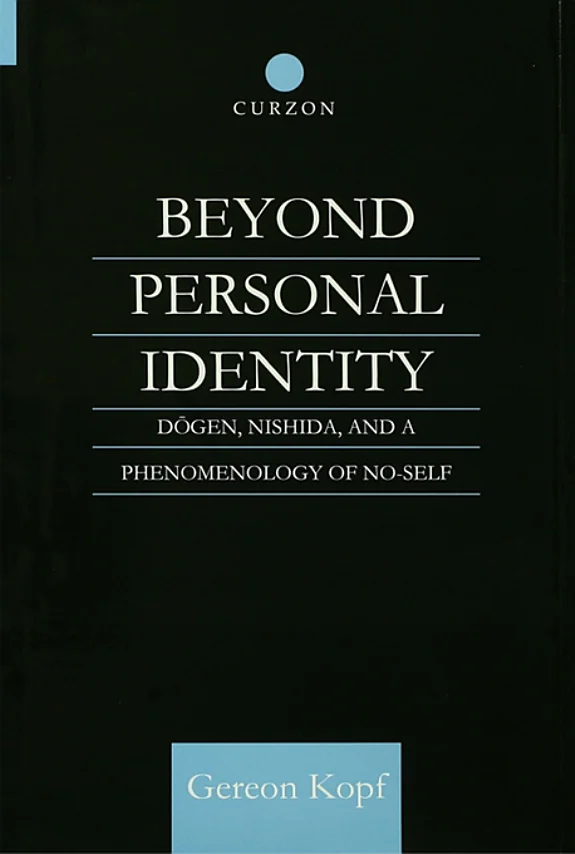
Beyond Personal Identity
 76
76

Beyond Personal Identity
Gereon Kopf's "Beyond Personal Identity" offers a formidable intellectual bridge between Zen Buddhist philosophy and Western metaphysics. The book's singular strength lies in its sophisticated deployment of Dogen Kigen's and Nishida Kitaro's ideas to deconstruct the Western preoccupation with a substantial, enduring self. Kopf meticulously unpacks the concept of 'being-time' (uji) and Nishida's 'logic of basho' (place), demonstrating their capacity to reframe the problems of selfhood, otherness, and temporality. A particularly compelling section is where the author contrasts the Buddhist concept of anatta with Western notions of personal identity, highlighting the radical implications of a self understood not as a fixed entity but as a dynamic, temporal process. However, the book's density can be a significant hurdle; the intricate philosophical arguments, while precise, demand considerable reader concentration and may leave those less steeped in both Zen and Kyoto School thought feeling adrift. Ultimately, Kopf presents a challenging but rewarding intellectual endeavor for those willing to wrestle with its profound philosophical propositions.
📝 Description
76
Gereon Kopf's 2001 book, Beyond Personal Identity, examines the self through Japanese philosophy.
Published in 2001, Gereon Kopf's Beyond Personal Identity undertakes a rigorous philosophical examination of personal identity. The work applies the ideas of Dogen Kigen and Nishida Kitaro, two key figures in Japanese philosophy, to long-standing questions about the self. Kopf scrutinizes how their concepts, especially those concerning non-self, can shed light on persistent problems of selfhood, otherness, and the nature of time.
This book is suited for advanced students and scholars of philosophy, specifically those interested in comparative philosophy, Eastern thought, and existential questions of identity. It assumes a basic grasp of Western philosophical discussions on personal identity and prepares readers for complex ideas from Zen Buddhism and the Kyoto School. Kopf's interdisciplinary approach bridges distinct philosophical traditions, engaging with Western thinkers like Hume and Locke while introducing Dogen's 'being-time' and Nishida's 'logic of basho' to a Western audience. The central objective is to question typical Western views of a fixed, lasting self.
This work places itself within the contemplative traditions of Zen Buddhism and the Kyoto School of philosophy. It engages with Dogen Kigen's deep explorations of time and existence, particularly his concept of 'being-time,' and Nishida Kitaro's philosophical system, notably his 'logic of basho.' These Japanese philosophical frameworks offer a distinct perspective on the nature of reality and the self, contrasting with many Western philosophical approaches. By drawing on these traditions, the book seeks to reframe understandings of personal identity, moving beyond conventional notions of a static ego.
💡 Why Read This Book?
• Gain a novel perspective on personal identity by engaging with Dogen Kigen's concept of 'being-time' (uji), offering a dynamic alternative to static Western notions of selfhood. • Understand Nishida Kitaro's 'logic of basho' (place) and its application to philosophical problems, providing a unique framework for comprehending selfhood and otherness. • Explore the Buddhist doctrine of anatta (non-self) as applied by Kopf to Western philosophical debates, potentially altering your conception of personal continuity through time.
⭐ Reader Reviews
Honest opinions from readers who have explored this book.
❓ Frequently Asked Questions
What specific philosophical problems does Gereon Kopf address regarding personal identity?
Kopf applies Dogen Kigen's and Nishida Kitaro's philosophies to problems of selfhood, otherness, and temporality, specifically examining how the concept of non-self can reframe the conundrum of personal identity.
What is the primary philosophical tradition used to analyze personal identity in this book?
The book primarily utilizes the religious philosophy of Dogen Kigen and the philosophy of Nishida Kitaro, both central figures in Japanese thought, particularly Zen Buddhism and the Kyoto School.
When was "Beyond Personal Identity" first published?
The book "Beyond Personal Identity" by Gereon Kopf was first published in 2001.
How does the book relate the concept of 'non-self' to Western philosophical problems?
It probes the applicability of the Buddhist concept of anatta (non-self) to Western philosophical issues of selfhood, otherness, and temporality, suggesting it offers a distinct lens for understanding identity.
What are the key Japanese philosophers whose work is central to "Beyond Personal Identity"?
The two key figures are Dogen Kigen, the founder of Soto Zen, and Nishida Kitaro, the founder of the Kyoto School of philosophy.
What is the main challenge Kopf addresses concerning personal identity?
Kopf addresses the philosophical conundrum of personal identity by examining the persistence of selfhood through change, and the nature of self and other, using Eastern philosophical frameworks.
🔮 Key Themes & Symbolism
Non-Self and Identity
This theme critically examines the Buddhist doctrine of anatta (non-self) and its implications for the Western philosophical problem of personal identity. Kopf contrasts the notion of a stable, enduring self with the impermanent, interdependent nature of existence as understood in Zen. The work explores how understanding the self as 'non-self' can dissolve conventional anxieties about personal continuity and the fear of dissolution, offering a radical reinterpretation of what it means to persist through time and change.
Dogen's Being-Time
The concept of 'being-time' (uji) from Dogen Kigen's philosophy is central to Kopf's argument. Uji posits that time is not a linear progression but a present, lived reality where each moment is pregnant with all of existence. Kopf applies this to personal identity by suggesting that our sense of self is not a pre-existing entity that occupies time, but rather an ongoing process of temporalization. This re-evaluation challenges the idea of a fixed self that endures across different temporal states.
Nishida's Logic of Place
Nishida Kitaro's 'logic of basho' (place) provides a framework for understanding selfhood and otherness. Basho refers to the underlying, non-objectifiable ground of experience from which both subject and object arise. Kopf uses this concept to deconstruct the dualistic separation between the self and the other, suggesting that our identity is not formed in opposition to others but emerges from a shared, foundational 'place' of being. This perspective offers a relational understanding of selfhood.
Temporality and Selfhood
The book deeply probes the relationship between our experience of time and our sense of self. By drawing on Dogen's 'being-time,' Kopf challenges the conventional Western view of time as a neutral container for discrete events and individuals. Instead, he presents a view where temporality is intrinsically linked to the very fabric of existence and identity. This challenges the notion of a static self that merely passes through time, proposing instead a self that is constituted by its temporal unfolding.
💬 Memorable Quotes
Direct passages from the work, attributed to the author.
“The application of Dogen's 'being-time' to the problem of personal identity.”
— This highlights the book's core methodological innovation: using Dogen's concept of temporal existence as a lens to re-examine Western philosophical puzzles about who we are over time.
“The Buddhist notion of non-self as a challenge to the Western concept of an enduring ego.”
— This expresses the book's central philosophical tension, pitting the radical deconstruction of the self in Buddhism against the persistent Western philosophical search for a stable, continuous identity.
“Exploring the philosophical problem of personal identity through Japanese Buddhist thought.”
— This statement emphasizes the book's interdisciplinary nature, bridging distinct philosophical traditions to tackle a universal human concern: the nature of the self.
“Selfhood, otherness, and temporality as culminating in the conundrum of personal identity.”
— This points to the book's structure, showing how the examination of interconnected concepts like self, other, and time ultimately converge on the profound question of what constitutes personal identity.
💡 Key Ideas
Editorial paraphrase of the work's core concepts — not direct quotes.
Nishida's 'logic of basho' offers a way to understand the self not as a discrete entity, but as arising from a relational ground.
This paraphrased concept points to how Nishida's philosophy can dissolve strict boundaries between self and other, proposing an interconnectedness that redefines personal identity.
🌙 Esoteric Significance
Tradition
While not strictly an esoteric text in the Western sense (e.g., Hermetic or Kabbalistic), "Beyond Personal Identity" draws heavily from the esoteric dimensions of Zen Buddhism, particularly Dogen Kigen's practice-based philosophy. It engages with the meditative and experiential aspects of realizing 'non-self' (anatta), aligning it with contemplative traditions that seek liberation from egoic identification. The work serves as a philosophical bridge, translating these useful insights into a language accessible to those interested in the metaphysical underpinnings of consciousness beyond conventional religious dogma.
Symbolism
The primary 'symbol' explored is the concept of 'emptiness' (sunyata) inherent in the Buddhist doctrine of non-self. This is not mere nihilism but a profound understanding of interdependence and lack of inherent existence. Another motif is the 'present moment' or 'being-time' (uji), which symbolizes the totality of existence accessible now, challenging linear conceptions of past, present, and future that structure our egoic identity. The 'place' (basho) in Nishida's philosophy can be seen as a symbolic ground of being, representing the interconnectedness that underlies apparent separation.
Modern Relevance
This work remains highly relevant for contemporary discussions in consciousness studies, neuroscience, and artificial intelligence, particularly concerning the nature of subjective experience and the possibility of non-biological or distributed forms of identity. Thinkers in mindfulness-based therapies and contemplative neuroscience often find resonance with Kopf's philosophical articulation of egolessness and temporal experience. Furthermore, the growing interest in non-dual philosophies and transpersonal psychology sees Kopf's work as a vital resource for understanding Eastern perspectives on the self.
👥 Who Should Read This Book
• Students of comparative philosophy: Gain a rigorous understanding of how Japanese Buddhist thought, specifically Dogen and Nishida, offers unique solutions to perennial Western philosophical problems. • Seekers of existential clarity: Explore alternative frameworks for understanding selfhood and identity beyond conventional Western psychological and philosophical models. • Advanced practitioners of meditation: Deepen your theoretical comprehension of concepts like non-self and temporal awareness through a sophisticated philosophical lens.
📜 Historical Context
Published in 2001, Gereon Kopf's "Beyond Personal Identity" arrived at a time when Western philosophy was increasingly engaging with non-Western traditions, though the complex thought of Dogen Kigen and Nishida Kitaro remained relatively niche. The book situated itself within the ongoing Western discourse on personal identity, a field heavily influenced by empiricists like David Hume and later analytic philosophers. Kopf's work provided a significant counterpoint by introducing the radical insights of Zen Buddhism and the Kyoto School, which challenged core Western assumptions about subjectivity and substance. While comparative philosophy was gaining traction, the intricate nature of Nishida's 'logic of basho' and Dogen's 'being-time' presented a formidable intellectual challenge. The reception of such works often involved specialized academic circles, with scholars like Thomas Kasulis being instrumental in introducing and contextualizing Japanese philosophy for Western audiences during this period.
📔 Journal Prompts
The implications of Dogen's 'being-time' for your personal sense of continuity.
Reflecting on Nishida's 'logic of basho' in relation to your interactions with others.
How does the concept of anatta challenge your current understanding of 'self'?
Consider a moment of intense presence: how does it align with or diverge from the idea of 'being-time'?
What does it mean to experience 'otherness' from the perspective of a relational 'place'?
🗂️ Glossary
Anatta
A core Buddhist doctrine, often translated as 'non-self' or 'no-soul.' It posits that there is no permanent, unchanging, independent self or soul underlying existence, emphasizing impermanence and interdependence.
Uji (Being-Time)
A central concept in Dogen Kigen's philosophy, signifying that time is not a linear progression but a present, actualized reality where each moment is the entirety of existence. It emphasizes the dynamic, participatory nature of temporal experience.
Basho (Place)
A key concept in Nishida Kitaro's philosophy, referring to the foundational, non-objective ground of experience from which subjects and objects arise. It signifies a universal, self-negating place that is the basis of all determination.
Selfhood
The state or condition of being an individual person; the distinctive qualities of a person that are considered to be the subject of their consciousness and experiences. In this book, it is critically examined through Eastern philosophical lenses.
Otherness
The quality or state of being different from something else; the condition of being external to oneself. The book explores how this concept is reframed by philosophies that de-emphasize a rigidly defined self.
Temporality
The state or quality of existing in time. The book examines how our experience and philosophical understanding of time profoundly shape our concept of personal identity.
Kyoto School
A school of Japanese philosophy founded by Nishida Kitaro, known for its attempts to synthesize Western philosophy with Eastern thought, particularly Zen Buddhism, and to articulate a distinct philosophical position from a Japanese perspective.
This book appears in 1 collection
🔮 Readers Also Liked
Browse all →









From the “Zen Buddhism” Collection
View all →









More Free Occult Philosophy Books
View all →