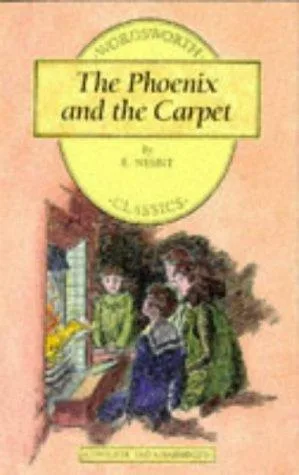
The Phoenix and the Carpet
 71
71

The Phoenix and the Carpet
Edith Nesbit's posthumously published "The Phoenix and the Carpet" presents a curious artifact from 1931. While ostensibly a children's tale, its depiction of a wish-granting carpet offers a surprisingly sharp look at the mechanics of desire and its often unruly consequences. The children's pragmatism in wishing for mundane things, like pies or school holidays, contrasts intriguingly with the carpet's more flamboyant, and occasionally perilous, interpretations. A notable strength lies in Nesbit's characteristic sharp dialogue and the vivid, almost tangible, presence of the magical carpet itself. However, the pacing can feel uneven in places, with some wish sequences feeling more drawn out than others. The climax, involving a rather abrupt resolution, doesn't quite match the inventive build-up of earlier magical mishaps. Nevertheless, the novel remains a compelling exploration of how we articulate our deepest, and sometimes silliest, wants.
"The Phoenix and the Carpet" offers a unique, if slightly uneven, exploration of wish fulfillment.
📝 Description
71
Edith Nesbit's 1931 novel, The Phoenix and the Carpet, centers on a Persian carpet that grants wishes.
The story follows the Burgis children as they discover a magical Persian carpet. This is not a simple children's tale; it examines how desires manifest and the often surprising consequences of magic. The children attempt to control the carpet's power, leading to a series of chaotic and revealing events.
Nesbit's work, published posthumously, engages with the nature of wishes, exploring how their phrasing and the intent behind them shape outcomes. The narrative contrasts the children's attempts to gain worldly goods and experiences with the carpet's unpredictable responses. It offers a thoughtful look at the gap between what is wanted and what is received.
Published in 1931, The Phoenix and the Carpet appeared when interest in Eastern mysticism was growing, partly due to groups like the Theosophical Society. This cultural climate provided a receptive audience for narratives featuring magical objects from the East. Nesbit's story taps into this fascination with exotic artifacts and their potential for both wonder and peril, reflecting a broader engagement with the occult and supernatural in early 20th-century literature.
💡 Why Read This Book?
• Gain insight into the nature of desire and consequence, as the magical carpet's wishes often manifest in unexpected and challenging ways, a concept explored throughout the 1931 narrative. • Understand the evolution of children's fantasy literature by examining Edith Nesbit's distinct style and her nuanced approach to magical elements, differentiating it from earlier or contemporary works. • Appreciate the symbolic power of the enchanted carpet, recognizing how a central magical object can drive both plot and character development in imaginative fiction.
⭐ Reader Reviews
Honest opinions from readers who have explored this book.
❓ Frequently Asked Questions
When was Edith Nesbit's 'The Phoenix and the Carpet' first published?
Edith Nesbit's novel 'The Phoenix and the Carpet' was first published in 1931, several years after the author's death in 1924.
What is the main magical element in 'The Phoenix and the Carpet'?
The primary magical element is an enchanted Persian carpet that can grant wishes to the children who discover it.
Does 'The Phoenix and the Carpet' have any connection to Edith Nesbit's other works?
While sharing Nesbit's characteristic style, 'The Phoenix and the Carpet' is a standalone story and not directly part of a series like 'The Railway Children' or 'The Story of the Amulet'.
What kind of wishes do the children make in the book?
The children make a variety of wishes, ranging from practical desires like food and holidays to more ambitious or whimsical requests, often leading to unforeseen complications.
What themes are explored in 'The Phoenix and the Carpet'?
The book explores themes of desire, the consequences of wishes, sibling relationships, and the contrast between ordinary life and magical intervention.
Is 'The Phoenix and the Carpet' considered a classic of children's literature?
Yes, it is regarded as a notable work within early 20th-century children's fantasy, appreciated for its imaginative premise and Nesbit's distinctive narrative voice.
🔮 Key Themes & Symbolism
The Nature of Wishes
The narrative meticulously examines how human desires, when articulated, can lead to outcomes far removed from their original intent. The magical carpet, acting as a literalizer of spoken wishes, forces the Burgis children to confront the discrepancy between what they think they want and what they actually receive. This exploration aligns with esoteric traditions that caution against poorly formulated intentions, emphasizing the power and responsibility that accompany any invocation of magical forces or the manipulation of reality.
Chaos and Order
The introduction of the wish-granting carpet injects an element of profound chaos into the otherwise ordinary lives of the children. Their attempts to manage the carpet's powers and mitigate the resulting disorder reflect a struggle to impose order on unpredictable forces. This dynamic mirrors occult philosophies that grapple with the interplay between primordial chaos and the human drive to establish structure and understanding in the cosmos.
The Ordinary Transformed
Nesbit excels at juxtaposing the mundane reality of the Burgis children's lives with the extraordinary occurrences brought about by the carpet. This transformation of the everyday into the magical highlights how hidden potential or unexpected forces can lie dormant within familiar surroundings. It suggests that reality itself is more fluid and permeable to enchantment than commonly perceived, a notion explored in various mystical traditions.
Sibling Dynamics Under Magic
The enchanted carpet serves as a crucible for the children's relationships. Their shared experiences with the carpet's unpredictable magic, their squabbles over wishes, and their eventual reliance on each other to read through the ensuing predicaments reveal the complexities of familial bonds. The magic amplifies both their conflicts and their capacity for cooperation, illustrating how external forces can test and redefine internal relationships.
💬 Memorable Quotes
Direct passages from the work, attributed to the author.
“The carpet is alive, and it grants wishes.”
— This statement expresses the central magical premise of the novel. It signifies the carpet's agency and its role as a conduit for extraordinary events, setting the stage for the children's adventures and the subsequent exploration of wish fulfillment.
“We wished for things we thought would make us happy.”
— This phrase highlights the fundamental human pursuit of happiness through external means. It serves as a precursor to the narrative's exploration of how the interpretation and fulfillment of such wishes rarely align perfectly with genuine contentment.
“Every wish had an unexpected consequence.”
— This interpretation captures the core thematic concern of the book: the unpredictable nature of magic and desire. It underscores the idea that even well-intentioned wishes can lead to complications, reflecting a cautionary principle found in many esoteric teachings about the careful handling of power.
“The carpet seemed to understand more than we said.”
— This reflects the subtle intelligence attributed to the magical object. It suggests that the carpet operates on a level beyond literal interpretation, perhaps responding to deeper, unexpressed desires or intentions, a concept resonant with animistic or sentient magical traditions.
“Ordinary life was interrupted by magic.”
— This simple observation points to the disruptive yet transformative power of the fantastical. It frames the narrative as an exploration of how the intrusion of the extraordinary can alter the course of the mundane, challenging established routines and perceptions.
🌙 Esoteric Significance
Tradition
While not explicitly aligned with a single esoteric school, "The Phoenix and the Carpet" echoes themes found in Hermeticism and folk magic traditions. The concept of a sentient, wish-granting object draws parallels to talismans and enchanted artifacts believed to possess their own will or respond to specific invocations. The narrative's focus on the power of spoken intent and the unpredictable manifestation of desires aligns with the Hermetic principle of 'As Above, So Below,' suggesting a potent connection between the human mind and the fabric of reality.
Symbolism
The most prominent symbol is the enchanted carpet itself. As a Persian rug, it evokes ancient craftsmanship, intricate patterns, and the concept of a 'flying carpet' from folklore, symbolizing travel beyond the ordinary. Its ability to grant wishes represents materialized desire and the potential for reality to be reshaped by will. The phoenix motif, implied in the title, traditionally symbolizes rebirth, renewal, and overcoming destruction, hinting at the transformative potential inherent in the children's magical encounters.
Modern Relevance
Contemporary interest in "The Phoenix and the Carpet" persists within circles exploring the psychology of desire, narrative theory in fantasy, and the history of children's literature. Its subtle commentary on wish fulfillment and unintended consequences remains relevant to discussions on manifestation practices and the ethical considerations of wielding influence. Modern readers might find parallels in contemporary fantasy where magical items serve as catalysts for character growth and ethical dilemmas, reflecting Nesbit's enduring influence on the genre.
👥 Who Should Read This Book
• Aspiring authors of children's fantasy: To study how Edith Nesbit masterfully blends the magical with the mundane, using a unique object like the enchanted carpet to drive plot and explore character. • Students of early 20th-century literature: To understand the stylistic nuances and thematic concerns prevalent in children's fiction published around 1931, particularly Nesbit's contribution. • Readers interested in the philosophy of desire: To engage with a narrative that playfully yet pointedly examines the nature of wishes and their often surprising, complex outcomes.
📜 Historical Context
Edith Nesbit's "The Phoenix and the Carpet," published in 1931, emerged from a rich period of British children's literature. Nesbit herself, who passed away in 1924, was a significant figure alongside contemporaries like E. Nesbit (her pseudonym), J.M. Barrie, and A.A. Milne. The early 20th century saw fantasy tales move beyond strict fairy tales to incorporate more realistic child protagonists and complex social undertones. The rise of movements like Theosophy, with its interest in Eastern mysticism and ancient wisdom, also contributed to a cultural milieu where magical objects and transformative narratives held a certain appeal. While Nesbit's work often predated or ran parallel to more overtly Theosophical children's literature, her imaginative approach to magical artifacts like the carpet found a receptive audience. The novel’s themes of desire and consequence can be seen as echoing the caution often present in philosophical and esoteric traditions regarding the manipulation of unseen forces.
📔 Journal Prompts
The carpet's unpredictable interpretations of wishes.
The contrast between the children's stated desires and their actual experiences.
The role of the phoenix symbol in relation to the carpet's magic.
Sibling dynamics when faced with extraordinary circumstances.
The potential for chaos inherent in the fulfillment of desire.
🗂️ Glossary
Enchanted Carpet
A magical rug capable of granting wishes to its discoverers. In the novel, it acts as a capricious agent, often interpreting wishes in unexpected or literal ways.
Wish Fulfillment
The concept of having desires or wishes granted. The book explores the complexities and often unforeseen consequences associated with the actualization of these wishes.
Phoenix Motif
Symbolically represents rebirth, renewal, and immortality. In the context of the title, it suggests a transformative or cyclical element associated with the magical events or the carpet itself.
Sibling Rivalry
The competition or conflict between brothers and sisters. This dynamic is heightened and tested by the shared magical experiences and the distribution of wishes.
Literal Interpretation
Understanding words or commands in their most basic, direct sense, without considering nuance or implied meaning. The carpet often operates on this principle.
Unforeseen Consequences
Outcomes that were not anticipated or planned for. This is a central theme, as most wishes granted by the carpet lead to such results.
Posthumous Publication
A work released after the author's death. 'The Phoenix and the Carpet' falls into this category, having been published in 1931 after Edith Nesbit's passing in 1924.
🔮 Readers Also Liked
Browse all →









More by Edith Nesbit
All books →





More Free Occult Philosophy Books
View all →