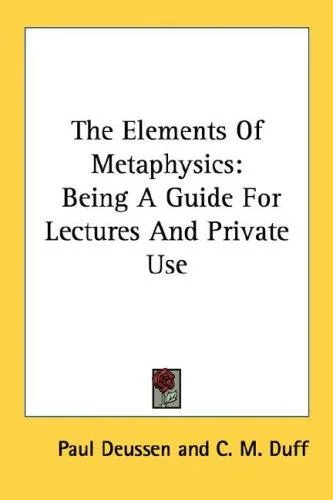
The Elements Of Metaphysics
 82
82

The Elements Of Metaphysics
Paul Deussen’s *The Elements of Metaphysics* presents a formidable challenge, not through obscure jargon, but through its sheer density and the ambitious scope of its comparative analysis. Deussen’s particular strength lies in his meticulous examination of the parallels between Kantian philosophy and the Vedanta tradition, a synthesis that feels both audacious and deeply insightful. His discussion of the Atman-Brahman concept, for instance, is rendered with a clarity that illuminates the concept’s philosophical underpinnings rather than merely its religious mystique. However, the book’s primary limitation is its academic tone, which, while precise, can occasionally feel dry, making the profound ideas less accessible to a general reader. A particularly striking section is his analysis of causality, where he contrasts Western deterministic views with Indian notions of karma and divine will. Ultimately, Deussen offers a scholarly bridge between two immense philosophical landscapes, demanding patience but rewarding the diligent reader with a unique perspective on existence.
📝 Description
82
Paul Deussen published "The Elements of Metaphysics" in 1894, a systematic study of reality and consciousness.
Published in 1894, Paul Deussen's "The Elements of Metaphysics" is an academic treatise that examines fundamental philosophical questions about existence and consciousness. Deussen, a scholar of Sanskrit, connects Western philosophical traditions with insights from Indian metaphysics, especially the Vedanta school. The book is not devotional but a rigorous analysis of concepts for students of philosophy and comparative religion. It engages with thinkers like Kant and Hegel while drawing parallels with the Upanishads. This work addresses those interested in the historical development of philosophical ideas and the exchange between different cultures.
Readers will find substantial material on concepts such as causality, space, time, and the nature of the self. Deussen systematically analyzes core metaphysical categories, contrasting Western philosophical treatments with those found in ancient Indian texts. The book focuses on the identity of Atman and Brahman, alongside discussions of Being and Becoming. Its interdisciplinary approach was part of a broader trend in the late 19th century of translating and analyzing Sanskrit texts, though it sometimes met with skepticism from traditional Western philosophers.
Deussen's work emerged during a period of significant Western engagement with Indian philosophical traditions. As a Sanskrit scholar, he was part of a movement to make Eastern thought accessible to a Western audience, linking it to established Western philosophical discourse. His detailed comparison of Vedanta, particularly the Upanishads, with German Idealism represented a serious academic effort to find common ground and illuminate shared metaphysical concerns across vastly different cultural and historical contexts. This bridged the gap between academic philosophy and a more generalized interest in Eastern spiritual and metaphysical systems.
💡 Why Read This Book?
• Gain a structured understanding of metaphysical inquiry by examining Deussen’s systematic breakdown of concepts like Causality and Space-Time, as presented in his 1894 publication. • Explore the philosophical underpinnings of Vedanta, specifically the Atman-Brahman identity, through Deussen’s comparative lens, understanding its echoes in Western thought. • Appreciate the historical context of late 19th-century comparative philosophy, seeing how Deussen engaged with figures like Kant and Sanskrit scholars to bridge Eastern and Western metaphysical traditions.
⭐ Reader Reviews
Honest opinions from readers who have explored this book.
❓ Frequently Asked Questions
What is the primary philosophical tradition Paul Deussen draws from in The Elements of Metaphysics?
Paul Deussen primarily draws from both Western Idealism, particularly the philosophies of Kant and Hegel, and Eastern metaphysical traditions, with a significant focus on the Vedanta school of Hindu philosophy, as evidenced by his detailed comparisons.
When was The Elements of Metaphysics first published, and why is this significant?
The work was first published in 1894. This date is significant as it falls within a period of increased Western scholarly interest in translating and understanding Sanskrit texts, facilitating the cross-cultural philosophical dialogue Deussen champions.
Does The Elements of Metaphysics discuss the concept of Atman-Brahman?
Yes, a central theme in the book is the exploration and philosophical interpretation of the Atman-Brahman identity from Vedanta, which Deussen posits as a profound statement on the unity of individual consciousness and ultimate reality.
What kind of reader would benefit most from reading The Elements of Metaphysics?
Students of philosophy, comparative religion, and intellectual history, particularly those interested in the intersection of Western Idealism and Indian Vedanta, would find this book highly beneficial due to its analytical and comparative approach.
What are some of the core metaphysical concepts examined in the book?
The book systematically examines core concepts such as Being and Becoming, Causality, Space, Time, the Soul, and the nature of reality, often contrasting their treatment across different philosophical traditions.
Is The Elements of Metaphysics considered an esoteric text in the same vein as occult manuals?
While it explores profound metaphysical and spiritual concepts, *The Elements of Metaphysics* is primarily an academic philosophical treatise rather than an occult manual. Its esoteric nature lies in its deep exploration of reality's fundamental principles.
🔮 Key Themes & Symbolism
Vedanta and Western Idealism
This theme centers on Deussen's ambitious project to synthesize the core tenets of Indian Vedanta philosophy, particularly the Upanishadic concept of Atman-Brahman, with the philosophical frameworks of Western Idealism, notably the works of Immanuel Kant and G.W.F. Hegel. Deussen meticulously draws parallels between the concept of the self (Atman) and the absolute reality (Brahman) and Western ideas about the transcendental ego and the noumenal world. This comparative approach seeks to demonstrate a universal philosophical quest for understanding existence, bridging seemingly disparate traditions through rigorous intellectual analysis, highlighting the potential for a unified metaphysical understanding across cultures.
The Nature of Causality
Deussen confronts the problem of causality, a persistent question in philosophical discourse. He contrasts the deterministic or mechanistic views prevalent in much of Western thought with the Indian concepts of Karma and divine providence. The work explores how different metaphysical systems grapple with the principle that every effect has a cause, and whether this principle is absolute or subject to exceptions. Deussen's analysis considers the implications for free will, moral responsibility, and the overall structure of reality, suggesting that understanding causality is fundamental to grasping the nature of existence itself.
Space, Time, and the Absolute
The book systematically investigates the metaphysical status of Space and Time. Deussen examines whether these are objective realities, subjective constructs of the mind, or something else entirely, drawing upon both Kantian critiques and Indian philosophical perspectives. This exploration is intrinsically linked to the concept of the Absolute, the ultimate ground of all being. By analyzing how different traditions conceptualize the container of existence (Space-Time) and the ultimate reality that underlies it, Deussen aims to clarify our understanding of the fundamental architecture of the cosmos and our place within it.
The Self and Ultimate Reality
A core preoccupation of *The Elements of Metaphysics* is the nature of the individual self (Atman) and its relationship to the ultimate, universal reality (Brahman). Deussen explores the philosophical arguments that suggest the self is not merely an empirical ego but possesses a deeper, perhaps eternal, essence. He explores the Vedantic assertion of the identity between Atman and Brahman, interpreting it not solely as a religious dogma but as a profound metaphysical insight into the interconnectedness of all consciousness and the fundamental unity of existence.
💬 Memorable Quotes
Direct passages from the work, attributed to the author.
“The aim of metaphysics is to attain knowledge of the absolute or of the unconditioned.”
— This statement captures the fundamental goal of metaphysical inquiry as Deussen understood it. It posits that the ultimate purpose of this philosophical discipline is to move beyond the relative, observable world to grasp the underlying, unconditional reality that gives rise to all phenomena.
“The relation of the Atman to the Brahman is the central doctrine of the Vedanta.”
— This highlights the central concept within the Vedanta school of Indian philosophy. Deussen emphasizes that understanding the nature of the individual soul (Atman) and its ultimate identity with the supreme, universal spirit (Brahman) is key to unlocking the system's metaphysical insights.
“Every effect must have a cause.”
— This states the principle of causality that Deussen critically examines. The work likely explores the implications and potential limitations of this principle when applied to the entirety of existence, contrasting different philosophical interpretations of cause and effect.
💡 Key Ideas
Editorial paraphrase of the work's core concepts — not direct quotes.
The question of the freedom of the will is one of the most persistent problems in philosophy.
Deussen acknowledges the enduring debate surrounding free will versus determinism. This quote signals his intention to engage with this complex issue, likely by examining how different metaphysical systems, including those from India and the West, attempt to resolve or address this fundamental tension.
Space and Time are the forms of our perception, according to Kant.
Referencing Immanuel Kant's critical philosophy, this quote points to a key concept Deussen uses in his comparative analysis. It frames the discussion on the nature of Space and Time as potentially subjective categories of human understanding rather than objective features of reality.
🌙 Esoteric Significance
Tradition
While *The Elements of Metaphysics* is primarily a work of academic philosophy, its exploration of consciousness, ultimate reality, and the self aligns it with the contemplative and metaphysical traditions within esoteric thought. Specifically, its deep engagement with Vedanta places it within the broader lineage of Indian philosophical inquiry that underpins many esoteric practices and worldviews. Deussen's approach, however, is analytical and comparative, seeking to articulate the philosophical logic rather than providing a direct guide for practice, distinguishing it from more devotional or ritualistic esoteric texts.
Symbolism
The book centrally engages with the symbolism inherent in the Atman-Brahman concept, interpreting the Upanishadic assertion of identity not merely as a metaphor but as a profound metaphysical truth about the unity of individual consciousness and the universal Absolute. Deussen also implicitly discusses the symbolism of the cosmos itself, examining Space and Time as fundamental structures that frame existence, akin to how many esoteric traditions view cosmic architecture. The concept of causality, particularly through Karma, also carries symbolic weight, representing the universal law of action and consequence that governs the cycle of existence.
Modern Relevance
Contemporary thinkers and practitioners in fields ranging from comparative religion and consciousness studies to transpersonal psychology continue to draw upon Deussen's work. His systematic comparison of Vedanta and Western Idealism provides a foundational text for understanding the philosophical dialogues that shaped modern interpretations of Eastern thought. Scholars studying the history of philosophy of religion, particularly the transmission of Indian ideas to the West, find his analyses invaluable. Furthermore, individuals seeking to integrate spiritual or metaphysical insights into a rational framework often find his rigorous, yet expansive, approach a valuable resource.
👥 Who Should Read This Book
• Academic researchers in comparative philosophy and religious studies seeking to understand the historical dialogue between Western Idealism and Indian Vedanta. • Students of metaphysics and epistemology interested in rigorous analyses of concepts like causality, space, time, and the nature of reality from a cross-cultural perspective. • Individuals exploring the philosophical foundations of Eastern spiritual traditions, particularly Vedanta, and seeking a structured, analytical approach to its core doctrines.
📜 Historical Context
Published in 1894, *The Elements of Metaphysics* emerged during a period of intense cross-cultural intellectual exchange, particularly between European and Indian scholarship. The late 19th century saw burgeoning academic interest in Sanskrit literature, fueled by figures like Max Müller, who made Indian texts more accessible to Western readers. Paul Deussen, a prominent German Indologist and philosopher, was at the forefront of this movement. His work engaged directly with the philosophical currents of German Idealism, particularly the critical philosophy of Immanuel Kant and the speculative system of G.W.F. Hegel, seeking to find parallels and divergences with the ancient Indian Vedanta tradition. This ambitious synthesis aimed to elevate Indian philosophy to the status of rigorous academic study, challenging the prevailing Eurocentric view of intellectual history. While lauded by some for its comparative insights, it also faced scrutiny from traditional Western philosophers who questioned the philosophical depth of Eastern thought. Deussen's work contributed significantly to the academic study of comparative philosophy and the reception of Indian metaphysics in the West.
📔 Journal Prompts
The Atman-Brahman identity as presented by Deussen: explore its implications for personal identity.
Deussen's analysis of causality: contrast the Vedantic view with a modern scientific understanding.
Reflect on the role of Space and Time as forms of perception versus objective reality.
Consider the concept of the Absolute in Deussen's metaphysics and its relation to everyday experience.
Analyze the philosophical arguments for the unity of consciousness discussed in the text.
🗂️ Glossary
Metaphysics
The branch of philosophy that deals with the fundamental nature of reality, existence, and the world. It explores questions about being, causality, space, time, and the relationship between mind and matter.
Vedanta
A school of Hindu philosophy based on the Upanishads, which are considered the end or essence of the Vedas. It focuses on the nature of Brahman (the ultimate reality) and its relationship with Atman (the individual soul).
Atman
In Hindu philosophy, particularly Vedanta, Atman refers to the individual soul, self, or spirit. It is often considered to be eternal and ultimately identical with Brahman.
Brahman
In Vedanta philosophy, Brahman is the supreme, unchanging, ultimate reality or consciousness that underlies all existence. It is the source and sustainer of the universe.
Causality
The principle that every event has a cause. In metaphysics, it is explored in terms of necessity, determinism, free will, and the relationship between cause and effect.
Idealism (Philosophy)
A philosophical approach that emphasizes the primacy of consciousness or mind in shaping reality. German Idealism, influential in Deussen's time, includes thinkers like Kant and Hegel.
Upanishads
Ancient Sanskrit texts that form the core of Vedanta philosophy. They contain philosophical insights, meditations, and discussions on the nature of reality, the self, and the universe.
🔮 Readers Also Liked
Browse all →







More by Paul Deussen
All books →




More Free Occult Philosophy Books
View all →