Occult Chemistry
 80
80

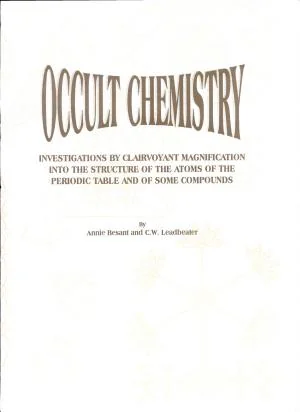
Occult Chemistry
Occult Chemistry offers a fascinating, albeit highly speculative, glimpse into the Theosophical understanding of physical reality. Besant and Leadbeater's detailed descriptions of atomic structures, rendered through claimed clairvoyant vision, are remarkably consistent within their own framework. The strength of the work lies in its audacious attempt to visualize the unseen, providing a rich vocabulary for discussing the energetic underpinnings of matter. However, its primary limitation is its complete divergence from empirical scientific validation. The concept of the 'ultimate atom' and its described configurations, while internally detailed, cannot be reconciled with established atomic theory or quantum mechanics. A particularly striking passage details the 'Etheric Force' and its role in atomic aggregation, illustrating the authors' unique metaphysical lens.
Ultimately, Occult Chemistry serves as a historical document of esoteric scientific inquiry rather than a current scientific text.
📝 Description
80
Occult Chemistry, first published in 1951, details clairvoyant observations of atomic structures.
Annie Besant and Charles Leadbeater penned Occult Chemistry to describe the atomic and subatomic structures of matter as seen through clairvoyant perception. Their work goes beyond the scope of contemporary scientific instruments, proposing that the most basic constituents of matter possess a complex, organized, and energetic nature. This view directly contrasts with standard materialistic understandings of physics and chemistry.
The book is intended for students of esoteric philosophy, especially those interested in Theosophical interpretations of physical reality. It speaks to readers who want to grasp the connection between consciousness and matter, and who seek alternative cosmic models that blend spiritual ideas with scientific inquiry. Those curious about the history of occult science and its efforts to chart unseen dimensions will find this text valuable.
First appearing in its complete form in 1951, Occult Chemistry grew from the intellectual climate of late 19th and early 20th-century Theosophy. This period saw a strong drive to connect material sciences with spiritual traditions. Prominent Theosophists Besant and Leadbeater used their supposed clairvoyant capacities to detail what they understood as the true forms and behaviors of atoms, questioning the scientific paradigms of their era. Their writings were part of a larger trend in esoteric movements aiming to reveal hidden universal laws.
Occult Chemistry emerged from the Theosophical Society, a movement founded by Helena Blavatsky in the late 19th century. Theosophy sought to synthesize Eastern and Western spiritual traditions, occultism, and modern science. Besant and Leadbeater, key figures in the society, applied their purported clairvoyant abilities to investigate the fundamental nature of matter, challenging established scientific models. Their work reflects a broader esoteric interest in the period of bridging empirical observation with mystical insight, aiming to reveal an underlying spiritual reality behind the material world.
💡 Why Read This Book?
• You will gain insight into the Theosophical conceptualization of atomic structure, learning about the 'ultimate atom' as described by Besant and Leadbeater, which offers a distinct alternative to standard physical models. • You can explore the historical development of esoteric science in the early 20th century, understanding how Theosophists like Leadbeater attempted to map sub-physical realms and atomic forms. • You will encounter detailed descriptions of sub-atomic particles and their energetic interactions, as perceived clairvoyantly, providing a unique perspective on the composition of matter beyond conventional scientific understanding.
⭐ Reader Reviews
Honest opinions from readers who have explored this book.
❓ Frequently Asked Questions
What is the 'ultimate atom' as described in Occult Chemistry?
The 'ultimate atom' in Occult Chemistry refers to the smallest conceivable particle of matter according to Besant and Leadbeater's clairvoyant observations. They depict it not as indivisible but as a complex aggregation of smaller energetic units, with specific forms and arrangements.
When was Occult Chemistry first published?
The comprehensive edition of Occult Chemistry, detailing Besant and Leadbeater's extensive work, was first published in 1951. However, earlier versions and contributions by the authors appeared prior to this.
What is the role of clairvoyance in this book?
Clairvoyance is presented as the primary method of investigation. Besant and Leadbeater claim to have used their developed psychic faculties to observe and record the structure and behavior of atoms and sub-atomic particles.
How does Occult Chemistry relate to modern science?
Occult Chemistry's descriptions of atomic structure are largely allegorical or symbolic when compared to modern quantum physics. It represents an esoteric attempt to understand matter, predating much of contemporary scientific discovery in this field.
Who were Annie Besant and Charles Leadbeater?
Annie Besant and Charles Webster Leadbeater were prominent figures in the Theosophical Society. Besant was a noted author and orator, while Leadbeater was known for his extensive writings on esoteric subjects and his claims of clairvoyant ability.
Does the book discuss elements or compounds?
Yes, the work explores the atomic structures of various chemical elements, describing how different arrangements of these 'ultimate atoms' give rise to the diverse properties of known matter.
🔮 Key Themes & Symbolism
The Ultimate Atom
The central concept is the 'ultimate atom,' posited as the fundamental unit of matter. Besant and Leadbeater meticulously describe its form, which they perceived as a complex, dynamic entity composed of smaller, energetic components. This differs radically from the indivisible atom of earlier scientific thought. They detail specific arrangements and configurations of these ultimate atoms, suggesting that the diversity of chemical elements arises from variations in these fundamental structures. The work aims to provide a detailed, visualizable model of matter's building blocks, accessible through clairvoyant perception.
Etheric Matter and Energy Fields
Beyond the 'ultimate atom,' the book looks at the concept of 'etheric matter,' a subtler form of substance that interpenetrates and underlies physical matter. Besant and Leadbeater describe how this etheric substance plays an important role in the aggregation of atoms and the formation of physical objects. They also discuss the energetic fields or 'auras' associated with matter, suggesting that all physical forms are surrounded by and interact with these invisible forces. This expands the understanding of reality to include non-physical energetic dimensions.
Clairvoyant Observation as Method
A core theme is the validation of clairvoyance as a legitimate scientific tool for exploring the universe. The authors present their detailed observations of atomic structures and sub-atomic phenomena as direct evidence gathered through their developed psychic abilities. This positions Occult Chemistry as a product of esoteric investigation, intended to reveal truths about the physical world that are inaccessible to conventional scientific instruments. The book implicitly challenges the materialistic limitations of empirical science.
The Energetic Nature of Matter
The work consistently emphasizes that matter is not inert but fundamentally energetic and alive. Atoms are described as vortices of force, constantly in motion and interaction. This perspective aligns with esoteric philosophies that view the universe as a manifestation of consciousness and energy. By detailing the vibrant, dynamic nature of even the smallest particles, Besant and Leadbeater aim to foster a deeper appreciation for the interconnectedness and living quality of all existence, from the atomic level upwards.
💬 Memorable Quotes
Direct passages from the work, attributed to the author.
“The ultimate atom has a definite form, which varies for different elements.”
— This interpretation underscores the Theosophical view presented in the book that the fundamental building blocks of matter possess specific, observable shapes. These shapes are not random but are directly linked to the identity and properties of the chemical elements.
“The investigation of matter requires faculties beyond the physical senses.”
— This interpretation emphasizes the reliance on psychic or clairvoyant abilities for the research presented. It suggests that a deeper understanding of reality necessitates the development and application of inner perception, going beyond the limitations of ordinary sight and touch.
💡 Key Ideas
Editorial paraphrase of the work's core concepts — not direct quotes.
The atom is not a simple thing, but a highly complex aggregation of forces and energies.
This paraphrased concept highlights the book's departure from the idea of a simple, indivisible atom. It suggests that what we perceive as solid matter is, at its root, a dynamic interplay of forces and energies organized into complex structures.
Etheric matter is the substratum upon which physical matter is built.
This paraphrased concept points to the idea of a subtle, non-physical substance that underlies and supports the material world. It suggests a layered reality where denser physical forms are organized upon a more pervasive, energetic foundation.
Elements are distinguished by the specific arrangement of their ultimate atoms.
This paraphrased concept explains how the diversity of chemical elements is accounted for within the framework of Occult Chemistry. It posits that differences in atomic composition and structure are the direct cause of varying elemental properties.
🌙 Esoteric Significance
Tradition
Occult Chemistry is deeply rooted in the Theosophical tradition, which itself draws from Hermeticism, Neoplatonism, and Eastern philosophies. It represents a specific branch of Theosophical inquiry focused on understanding the physical universe through esoteric means. The work attempts to provide a detailed, visually comprehensible model of matter that aligns with Theosophical cosmology, positing a hierarchical structure of reality from subtle energies to gross physical forms. It departs from purely materialistic science by asserting the primacy of consciousness and subtle energies in shaping the material world.
Symbolism
The book employs the concept of the 'ultimate atom' as a primary symbolic motif, representing the fundamental, irreducible unit of existence within this esoteric framework. Its described forms and arrangements symbolize the underlying order and divine geometry of creation. Another key symbolic element is the 'etheric force,' representing the vital energy that animates matter and connects the physical to the subtle planes. These symbols function to illustrate a universe that is alive, interconnected, and governed by intelligent principles beyond mere physical laws.
Modern Relevance
Contemporary interest in Occult Chemistry persists among students of Theosophy and alternative physics. Thinkers exploring consciousness-based models of reality or seeking to integrate spiritual principles with scientific inquiry may reference its conceptual framework. While not accepted by mainstream science, its detailed descriptions of atomic forms and energies continue to inspire discussions on the limits of perception and the potential for non-conventional methods of investigation into the nature of matter.
👥 Who Should Read This Book
• Students of Theosophy and esoteric philosophy seeking detailed explanations of atomic structure from a clairvoyant perspective. • Researchers interested in the history of occult science and alternative scientific paradigms from the late 19th and early 20th centuries. • Individuals exploring the intersection of consciousness, matter, and energy in metaphysical systems, particularly those looking for conceptual models beyond standard physics.
📜 Historical Context
Occult Chemistry emerged from the vibrant spiritual and intellectual milieu of the Theosophical Society, particularly influential in the late 19th and early 20th centuries. Founded by Helena Blavatsky, Theosophy sought to synthesize Eastern and Western esoteric traditions with a scientific, philosophical, and religious inquiry. Annie Besant and Charles Webster Leadbeater, key figures in the Society, utilized their claimed clairvoyant abilities to investigate the nature of matter. Their work on atomic structures, detailed in Occult Chemistry, was published in stages before its comprehensive 1951 edition. This period saw intense interest in unseen realms, partly fueled by discoveries in physics like radioactivity and X-rays, which hinted at a reality beyond immediate perception. However, Theosophical atomic models stood apart from mainstream scientific discourse, which was rapidly developing quantum mechanics. While figures like Marie Curie were exploring the atom's properties empirically, Besant and Leadbeater offered a metaphysical interpretation. The reception of such works was often divided, appreciated within esoteric circles but viewed as speculative by the scientific establishment.
📔 Journal Prompts
The 'ultimate atom' as described by Besant and Leadbeater.
Etheric matter and its perceived role in atomic aggregation.
The relationship between consciousness and the observed forms of matter.
Comparing clairvoyant observations with current scientific models of the atom.
The energetic nature of physical substances as presented in the text.
🗂️ Glossary
Ultimate Atom
The fundamental, smallest particle of matter as perceived by clairvoyant observation in Occult Chemistry. It is described as a complex aggregation of forces and energies, not a simple, indivisible entity.
Etheric Matter
A subtle, non-physical substance that Theosophists believe underlies and interpenetrates physical matter. It is considered a vehicle for life forces and plays a role in the formation and structure of physical objects.
Clairvoyance
The psychic ability to perceive objects, events, or information beyond the normal range of the senses, often described as 'clear seeing'. In Occult Chemistry, it is presented as the primary investigative tool.
Elemental
In this context, referring to the basic chemical elements. The book describes the atomic structures that differentiate one element from another.
Vortex
A term used to describe the dynamic, swirling nature of the atom and its constituent parts, emphasizing constant motion and energy.
Subtle Body
A concept in esoteric traditions referring to non-physical bodies composed of finer energies that interpenetrate the physical body. While not a primary focus, it relates to the layered understanding of reality.
Theosophy
A spiritual movement founded in the late 19th century, aiming to establish a universal brotherhood and encourage the study of comparative religion, philosophy, and science, particularly its esoteric aspects.
This book appears in 3 collections
🔮 Readers Also Liked
Browse all →







From the “Clairvoyance” Collection
View all →



More Free Occult Philosophy Books
View all →