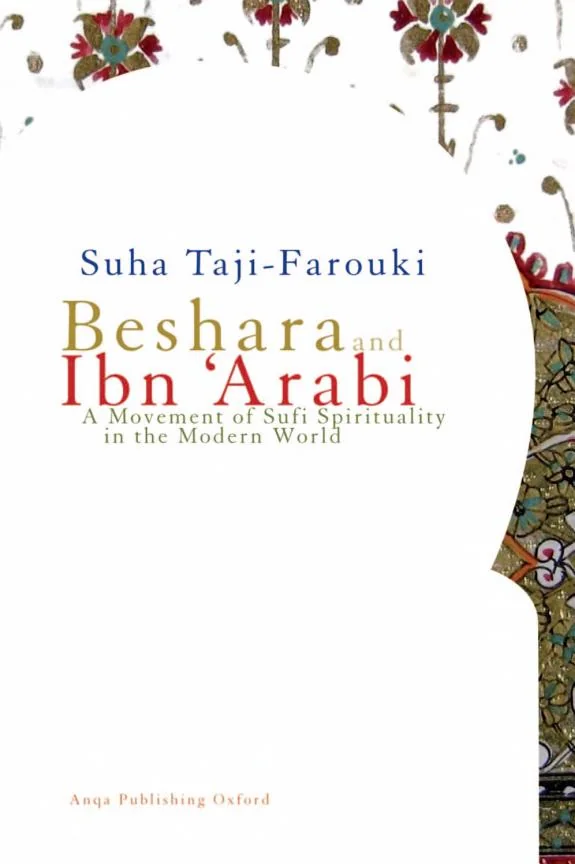
Beshara and Ibn 'Arabi
 75
75

Beshara and Ibn 'Arabi
Suha Taji-Farouki’s investigation into the Beshara School and its connection to Ibn 'Arabi’s legacy offers a meticulously researched account of how profound metaphysical ideas can find fertile ground in the modern West. The strength of this work lies in its rigorous interdisciplinary approach, blending cultural studies with detailed ethnographic observation of the school’s development since its founding in the 1960s. Taji-Farouki avoids hagiography, presenting a balanced view of Beshara’s evolution and its challenges. A point of critique, however, is that at times the dense academic prose can obscure the very spiritual vibrancy it seeks to describe, particularly when discussing the practical pedagogy of the school. The examination of how the school adapted Ibn 'Arabi's concept of 'the one who is in everything and everything is in him' for a contemporary audience is particularly compelling. Ultimately, this book serves as an essential, if demanding, study for understanding the living transmission of esoteric traditions.
📝 Description
75
Suha Taji-Farouki's 2008 study examines how Ibn 'Arabi's teachings manifest in Scotland's Beshara School.
This interdisciplinary study analyzes the influence of Ibn 'Arabi's metaphysical ideas, using the Beshara School in Scotland as a primary example. Founded in the 1960s, Beshara adopted and adapted these complex Sufi concepts for diverse communities. The book details the school's growth and its specific methods for spiritual education.
Scholars of Islamic studies, comparative religion, and mysticism will find this text relevant. It is also suitable for those interested in contemporary spiritual movements, the history of Sufism, and the practical application of esoteric thought. The work offers a thorough look at how spiritual ideas spread across cultures.
The book places the Beshara School within the context of 20th-century spiritual exploration and renewed interest in classical Islamic mysticism. It notes the period when figures like Idries Shah reintroduced Sufi thought to the West. The Beshara School, established in the 1960s, developed its own approach within this intellectual environment, eventually becoming an international center for scholarship.
This work engages with the transmission and adaptation of classical Islamic mystical philosophy, particularly the thought of Ibn 'Arabi. It situates these ideas within the context of mid-20th century Western interest in Sufism, exemplified by figures like Idries Shah. The Beshara School's development serves as a case study for how these complex metaphysical concepts were translated into practical spiritual education and community practice outside of their traditional Islamic settings.
💡 Why Read This Book?
• Gain insight into the practical pedagogical methods of the Beshara School, established in the 1960s, and how it translates the abstract teachings of Ibn 'Arabi into accessible spiritual education. • Understand the historical trajectory of Sufi-inspired thought in the West by examining the Beshara School’s emergence and its role as a center for international scholarship. • Explore the interdisciplinary approach to studying spirituality, combining cultural analysis with data to illuminate the adoption and adaptation of esoteric concepts by diverse groups.
⭐ Reader Reviews
Honest opinions from readers who have explored this book.
❓ Frequently Asked Questions
When was the Beshara School founded and where is it located?
The Beshara School was founded in the 1960s. It is located in Scotland and has become a significant center for international scholarship concerning Sufi-inspired spirituality.
Who was Ibn 'Arabi and what is his significance?
Ibn 'Arabi (1165-1240) was a prolific Andalusian Sufi mystic and philosopher, considered one of the most important figures in the history of Sufism. His extensive writings on metaphysics, cosmology, and the nature of divine love continue to influence spiritual thought.
What is the relationship between Beshara and Ibn 'Arabi's teachings?
The Beshara School was founded to study and transmit the teachings of Ibn 'Arabi. It serves as a modern case study demonstrating how these classical Sufi concepts are adopted and adapted by contemporary Muslims and non-Muslims.
What academic disciplines does this book draw upon?
This interdisciplinary text combines cultural study with solid data analysis. It engages with fields such as Islamic studies, comparative religion, and the sociology of spirituality.
Is this book suitable for beginners in Sufism?
While the book offers a comprehensive look, its academic and interdisciplinary nature makes it best suited for scholars, students, and those with some prior familiarity with esoteric traditions or Ibn 'Arabi's work.
What makes the Beshara School a unique case study?
The Beshara School is unique as a center that emerged in the 1960s specifically to explore and teach the complex metaphysics of Ibn 'Arabi, fostering international scholarship and adapting these ideas for a modern, diverse audience.
🔮 Key Themes & Symbolism
Transmission of Esoteric Knowledge
The book meticulously details how the profound and often abstract teachings of Ibn 'Arabi are transmitted and adapted by the Beshara School. It highlights the challenges and successes in translating classical Sufi metaphysics for a contemporary, international audience, moving beyond mere academic study to explore pedagogical approaches that foster spiritual understanding and practice.
Beshara School as a Modern Hub
Established in the 1960s, the Beshara School in Scotland functions as a vital case study. The work analyzes its emergence, evolution, and its role as a locus of international scholarship. It examines how the school created a unique environment for engaging with Ibn 'Arabi’s philosophy, attracting diverse students and scholars interested in esoteric spirituality.
Interdisciplinary Approach to Spirituality
Suha Taji-Farouki employs an interdisciplinary methodology, merging cultural analysis with empirical data. This approach provides a comprehensive framework for understanding how spiritual movements like Beshara interact with broader societal and intellectual trends, offering a robust model for studying the reception and integration of esoteric traditions in the modern world.
Ibn 'Arabi's Enduring Influence
The central focus remains the enduring relevance of Ibn 'Arabi's metaphysical system. The book investigates how his concepts, such as the unity of being and the nature of divine love, are interpreted and applied within the context of the Beshara School, demonstrating their continued capacity to inspire and guide spiritual seekers across different backgrounds.
💬 Memorable Quotes
Direct passages from the work, attributed to the author.
“The Beshara School in Scotland, founded in the 1960s, serves as a center of international scholarship.”
— This statement anchors the book's primary case study, highlighting the specific time and place where the adaptation of Ibn 'Arabi's teachings is most actively explored and disseminated.
“The work combines cultural study with solid data.”
— This indicates the book's methodological rigor, emphasizing a balanced approach that moves beyond purely theoretical or anecdotal accounts to incorporate empirical observation and analysis.
“The teachings of Ibn 'Arabi have been adopted and adapted by Muslims and non-Muslims.”
— This highlights the cross-cultural and inclusive nature of the spiritual movement studied, underscoring the universal appeal and adaptability of certain esoteric concepts.
“The discussion describes its emergence and evolution, its approach to spiritu[al education].”
— This outlines the narrative structure of the book's analysis of the Beshara School, focusing on its historical development and its specific methods for spiritual instruction.
“Investigating Sufi-inspired spirituality in the modern world.”
— This sets the broad thematic scope of the book, positioning the study within the context of contemporary spiritual seeking and the re-emergence of traditional esoteric paths.
🌙 Esoteric Significance
Tradition
This work engages with the rich lineage of Islamic mysticism, specifically Sufism, and its most influential exponent, Ibn 'Arabi. It situates Ibn 'Arabi's teachings within the broader framework of perennial philosophy, exploring how his concept of Wahdat al-Wujud (Unity of Being) offers a profound metaphysical foundation that can resonate across different spiritual traditions, though its origins and primary expression are firmly rooted in Islamic esoteric thought.
Symbolism
The book implicitly engages with symbolism inherent in Ibn 'Arabi's cosmology, such as the concept of the 'Perfect Human' (al-Insan al-Kamil) as a microcosm reflecting the divine macrocosm. Another significant motif is the exploration of divine names and attributes, which, in Sufi thought, serve as keys to understanding different levels of reality and the divine presence within all existence. The Beshara School's pedagogy often involves contemplating these concepts to foster spiritual realization.
Modern Relevance
Contemporary thinkers and practitioners in fields ranging from comparative mysticism to contemplative psychology draw upon the foundational work of Ibn 'Arabi, as studied through institutions like the Beshara School. The school's success in adapting these ancient teachings for a modern, interfaith audience demonstrates a viable model for spiritual education in an increasingly interconnected world, influencing how esoteric knowledge is disseminated and integrated into secular or pluralistic contexts.
👥 Who Should Read This Book
• Students of Islamic mysticism and Sufism seeking a detailed examination of Ibn 'Arabi's influence and its modern institutionalization. • Scholars of comparative religion and cultural studies interested in how esoteric traditions adapt and thrive in Western contexts. • Individuals exploring contemplative practices and metaphysical philosophies who wish to understand the historical and contemporary reception of key figures like Ibn 'Arabi.
📜 Historical Context
The intellectual field of the mid-to-late 20th century saw a renewed interest in Eastern and esoteric traditions, partly fueled by figures like Idries Shah who were instrumental in reintroducing Sufi thought to Western audiences. Within this milieu, the Beshara School emerged in Scotland in the 1960s, carving out a distinct space for the study and practice of Ibn 'Arabi's complex metaphysical system. This period was marked by diverse spiritual explorations, with various Western esoteric schools and Eastern philosophies gaining traction. The Beshara School, however, focused specifically on the intricate cosmology and divine unity articulated by Ibn 'Arabi, establishing itself as a significant center for scholarship. Its approach represented a dedicated effort to make these profound teachings accessible and relevant to a modern, international readership, differentiating it from broader, more eclectic spiritual movements of the era.
📔 Journal Prompts
The Beshara School's adaptation of Ibn 'Arabi's metaphysics.
The concept of Wahdat al-Wujud in contemporary spiritual discourse.
The emergence of spiritual centers like Beshara in the 1960s.
The role of the 'Perfect Human' as a symbolic key.
Bridging classical Sufi thought with modern educational methods.
🗂️ Glossary
Beshara
An Arabic word often translated as 'good omen' or 'good tidings.' In the context of the book, it refers to the specific school founded in Scotland dedicated to the study of Ibn 'Arabi's teachings.
Ibn 'Arabi
A highly influential 12th-13th century Andalusian Sufi mystic and philosopher, renowned for his extensive writings on metaphysics, cosmology, and the nature of divine love.
Sufism
The mystical dimension of Islam, focused on the pursuit of direct experience of God through practices such as meditation, remembrance, and asceticism. Ibn 'Arabi is a central figure within Sufi thought.
Metaphysics
The branch of philosophy that deals with the fundamental nature of reality, including the relationship between mind and matter, substance and attribute, potentiality and actuality.
Wahdat al-Wujud
An Arabic term, often translated as 'Unity of Being' or 'Unity of Existence,' a central concept in Ibn 'Arabi's philosophy positing that all existence is a manifestation of a single divine reality.
Esoteric
Intended for or likely to be understood by only a small number of people with a specialized knowledge or interest; inner, hidden, or secret teachings.
Pedagogy
The method and practice of teaching, especially as an academic subject or theoretical concept. In this context, it refers to the methods used by the Beshara School to impart spiritual knowledge.
This book appears in 1 collection
🔮 Readers Also Liked
Browse all →









From the “Sufism” Collection
View all →







More Free Sacred Texts & Gnosticism Books
View all →