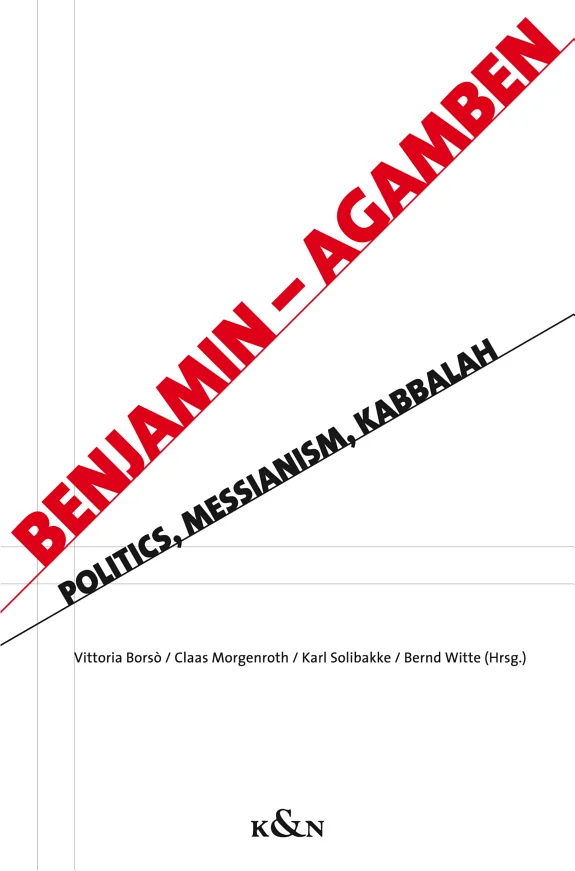
Benjamin - Agamben
 80
80

Benjamin - Agamben
Vittoria Borsò’s Benjamin - Agamben offers a concentrated look at Agamben’s complex thought, particularly his engagement with Walter Benjamin’s critique of historical time and the nature of law. Borsò meticulously traces Agamben's development of concepts like "bare life" and the "state of exception." A notable strength lies in the detailed exegesis of Agamben's engagement with Benjamin's "On the Concept of History," revealing how Agamben reinterprets messianic time. However, the book’s density can be a barrier; it assumes significant prior familiarity with both Agamben and his influences, sometimes leaving the uninitiated reader to grasp connections without explicit signposting. The exploration of "profanation" as a political act, particularly in its potential to disrupt sovereign logic, provides a particularly compelling thread. Ultimately, Benjamin - Agamben serves as a valuable, albeit demanding, academic resource for specialists.
📝 Description
80
Vittoria Borsò's 2010 book examines Giorgio Agamben's "bare life" concept and its political theology.
This 2010 study offers a close reading of Giorgio Agamben's philosophical system, with a particular focus on his central concept of "bare life" (vita nuda). Borsò details how Agamben uses this idea to analyze the relationship between political power and biological existence. The analysis traces Agamben's dialogue with thinkers like Michel Foucault and Hannah Arendt, clarifying his arguments about the "state of exception." This condition, where law suspends itself to define what is included or excluded from political life, is central to Agamben's critique.
Borsò's work unpacks the philosophical underpinnings of biopolitics and sovereignty. It considers how life is reduced to its raw biological state, vulnerable to being killed but stripped of its potential for sacrifice. The book also discusses related concepts such as "profanation," a method to reclaim what sovereign power has separated, and "secularization," understood as a process deeply connected to theological structures. This text is suited for those engaged with political philosophy, critical theory, and continental thought.
While not strictly an esoteric text, this book engages with philosophical traditions that grapple with concepts of power, life, and the sacred. Agamben's work, which Borsò analyzes, draws on historical and theological structures to understand modern political order. The focus on "bare life" and "profanation" touches on the separation and potential reclamation of fundamental human existence from sovereign control. The discussion of secularization as intertwined with theological structures also situates the analysis within broader debates about the persistence of religious frameworks in secular modernity.
💡 Why Read This Book?
• Understand Agamben's unique interpretation of Walter Benjamin's "On the Concept of History," gaining insight into how historical understanding is shaped by sovereign power. • Grasp the philosophical underpinnings of "bare life" (vita nuda) and its relationship to political exclusion, a concept central to biopolitical studies since the late 20th century. • Explore the notion of "profanation" as a political strategy, learning how Agamben proposes reclaiming what has been separated by theological and legal structures.
⭐ Reader Reviews
Honest opinions from readers who have explored this book.
❓ Frequently Asked Questions
What is the central concept explored in Vittoria Borsò's Benjamin - Agamben?
The central concept is Giorgio Agamben's philosophical project, with a particular focus on "bare life" (vita nuda) and the "state of exception," as analyzed through Agamben's engagement with Walter Benjamin's thought.
When was Vittoria Borsò's analysis of Agamben first published?
Vittoria Borsò's analysis, titled Benjamin - Agamben, was first published in 2010.
Which philosophers does Agamben, as analyzed by Borsò, engage with significantly?
Agamben, in Borsò's analysis, engages significantly with philosophers such as Walter Benjamin, Michel Foucault, and Hannah Arendt.
What is the significance of the "state of exception" in Agamben's philosophy, according to Borsò?
According to Borsò's interpretation, the "state of exception" is crucial as it represents a condition where sovereign power establishes law through the suspension of its own norms, often by defining "bare life."
Does this book offer an introduction to Giorgio Agamben's work?
While it analyzes Agamben's thought, the book is geared towards those with some existing familiarity with Agamben and related philosophical concepts, rather than serving as a basic introduction.
What does "profanation" mean in the context of Agamben's work as presented by Borsò?
In this context, "profanation" refers to the act of returning to common use what has been separated or consecrated by sovereign power, a concept explored by Agamben through his reading of Walter Benjamin.
🔮 Key Themes & Symbolism
Bare Life and Sovereignty
The core of Agamben's project, as illuminated by Borsò, is the concept of "bare life" (vita nuda). This is the biological life reduced to its absolute minimum, stripped of all political and social attributes. Agamben argues that sovereign power operates by both including and excluding this bare life, defining its own authority through the power to decide on life and death. This analysis draws heavily on Hannah Arendt's concept of the "political" and Foucault's biopolitics, but pushes beyond them to posit a structure where bare life is not merely managed, but is the very foundation of sovereign law, particularly evident in the "state of exception."
The State of Exception
Borsò's work details Agamben's critical examination of the "state of exception," a condition where the normal legal order is suspended. Agamben argues, following Carl Schmitt and others, that this is not an anomaly but a fundamental mode of modern governance. In this state, the sovereign's command becomes law, and the law is preserved precisely by being suspended. This paradox is central to understanding how political authority can operate outside established legal frameworks, often targeting populations defined by their "bare life" status, such as refugees or stateless individuals.
Profanation and Secularization
A significant theme is Agamben's concept of "profanation" as a response to the theological-political structures that underpin sovereignty and the separation of life. Drawing from Walter Benjamin's ideas on history and critique, Agamben proposes profanation as a way to reclaim what has been consecrated or alienated. This involves returning sacred or separated things (like time, language, or life itself) to common use, thereby disrupting the logic of sovereign power and its creation of exceptional states. Borsò illustrates how this concept offers a potential avenue for political resistance and the reappropriation of lived experience.
Agamben's Reading of Benjamin
The book emphasizes Agamben's unique interpretation of Walter Benjamin's philosophy, particularly his "Theses on the Concept of History." Agamben reconfigures Benjamin's critique of historicism and his notion of messianic time. For Agamben, Benjamin's ideas provide a framework for understanding how history itself is captured by sovereign power and how an "inoperative" critique, one that doesn't seek to produce new norms but rather to suspend existing ones, can offer a different temporal and political horizon. This engagement is crucial for understanding Agamben's broader critique of Western political thought.
💬 Memorable Quotes
Direct passages from the work, attributed to the author.
“The sovereign is he who decides on the state of exception.”
— This statement captures Agamben's core thesis on sovereignty: its ultimate power lies not in enforcing laws, but in its ability to suspend them and create a space where its own will becomes the ultimate arbiter of what constitutes law and life.
“Bare life is that which is exposed to the power of the state.”
— This highlights the vulnerability inherent in 'bare life.' It is the life that lacks political protection or recognition, making it entirely subject to the sovereign's decision, whether through inclusion in a state apparatus or exclusion from it.
“Profanation is the act of returning to common use what had been separated.”
— This defines Agamben's concept of profanation, suggesting a way to dismantle the sacred or exceptional status of certain elements (like time or law) by making them accessible and usable by all, thereby challenging established hierarchies.
“The state of exception is a structure that must be thought of as contiguous to the rule.”
— This interpretation suggests that the 'state of exception' is not an aberration from normal rule, but rather an integral and consistent part of how sovereign power operates, implying a constant potential for its activation.
“We must think of history not as a narrative of progress, but as a broken continuum.”
— This reflects Agamben's engagement with Benjamin's critique of linear historical progression. It points towards an understanding of history as fragmented and punctuated by moments of crisis or suspension, rather than a smooth, teleological unfolding.
🌙 Esoteric Significance
Tradition
While not directly part of a classical esoteric tradition like Hermeticism or Kabbalah, Agamben's work, as analyzed by Borsò, engages with themes that resonate with Gnostic and messianic thought. His focus on "bare life" as a state of pure potentiality, and his concept of "profanation" as a means to disrupt established orders, echo Gnostic ideas of liberation from a flawed demiurgic system. The influence of Walter Benjamin, with his messianic interpretation of history, further links Agamben's thought to currents that question linear progression and seek radical breaks or transformations.
Symbolism
The concept of the "state of exception" itself functions as a powerful symbolic framework, representing the hidden scaffolding of power that operates outside visible norms. "Bare life" (vita nuda) symbolizes existence reduced to its most vulnerable, exposed form, stripped of identity and political agency. The "profane" can be seen as a symbol of reclaimed commonality, a space of potentiality reclaimed from the sacred or sovereign domain, offering a counter-symbol to the exceptional state.
Modern Relevance
Agamben's theories, particularly as explicated by Borsò, remain highly relevant for contemporary critical theory, post-structuralist thought, and studies of political theology. Thinkers concerned with refugee crises, state surveillance, and the ethics of biopower frequently draw upon his concepts. Schools of thought focusing on radical democracy, post-anarchism, and critical engagement with legal and political institutions continue to find Agamben's framework for understanding sovereignty and exception indispensable, albeit often requiring careful qualification and debate.
👥 Who Should Read This Book
• Advanced students and scholars of political philosophy and critical theory seeking to deepen their understanding of Giorgio Agamben's core concepts. • Researchers interested in the philosophical implications of "bare life" (vita nuda) and the "state of exception" within biopolitics and sovereignty studies. • Readers familiar with Walter Benjamin's work who wish to explore Agamben's unique interpretive lens on his "Theses on the Concept of History."
📜 Historical Context
Vittoria Borsò's analysis, published in 2010, arrived during a significant period of reception and debate surrounding Giorgio Agamben's "Homo Sacer" series, which began in 1995. Agamben's work was already a major force in continental philosophy and political theory, challenging prevailing notions of sovereignty, biopolitics, and law. Borsò's text engages directly with Agamben's specific use of Walter Benjamin's critique of history, a topic that had been developing in scholarship since the mid-20th century. At the time, scholars like Judith Butler and Slavoj Žižek were actively engaging with, and sometimes critiquing, Agamben's concepts of "bare life" and the "state of exception." The intellectual climate was marked by post-structuralist critiques of power and a renewed interest in political theology. Agamben's work offered a potent, if controversial, synthesis of these currents, placing him in dialogue with thinkers who grappled with the legacy of Nazism and the nature of modern governance.
📔 Journal Prompts
The "state of exception" as a condition contiguous to the rule: explore its presence in contemporary political discourse.
Analyze the concept of "bare life" (vita nuda) and its exposure to sovereign power in a specific historical or contemporary context.
Reflect on the potential of "profanation" as a tool for reclaiming common space from institutionalized power structures.
Consider Agamben's interpretation of Walter Benjamin's "On the Concept of History" and its implications for understanding historical narratives.
How does the decision-making power of the sovereign regarding the state of exception impact individual agency?
🗂️ Glossary
Bare Life (vita nuda)
The biological existence of a human being stripped of all political, social, or legal status; life that can be killed but not sacrificed, forming the basis of sovereign power.
State of Exception
A condition where the normal legal order is suspended, allowing sovereign power to operate outside established norms, paradoxically reinforcing law through its abrogation.
Profanation
The act of returning to common use what has been separated, consecrated, or made sacred by sovereign power or theological structures.
Sovereignty
The supreme authority within a territory, understood by Agamben as fundamentally tied to the power to decide on the state of exception and manage bare life.
Biopolitics
The administration and regulation of life processes within populations, a concept Agamben extends to explore how political power operates directly on biological life.
Political Theology
The study of the relationship between political power and theological concepts, particularly how theological ideas have shaped secular political structures and vice versa.
Inoperative Community
A concept suggesting a form of community that exists through the suspension of action or normative political engagement, drawing on Benjamin's ideas.
This book appears in 1 collection
🔮 Readers Also Liked
Browse all →









From the “Messianism” Collection
View all →




More Free Kabbalah & Jewish Mysticism Books
View all →