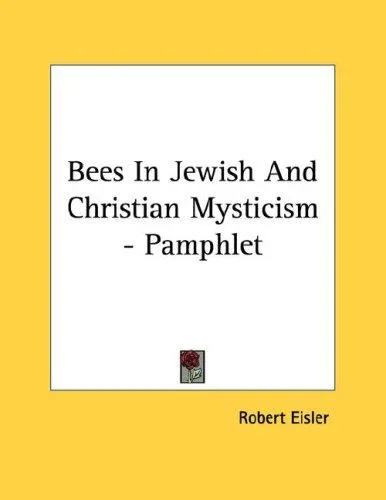
Bees In Jewish And Christian Mysticism - Pamphlet
 61
61

Bees In Jewish And Christian Mysticism - Pamphlet


Robert Eisler's "Bees In Jewish And Christian Mysticism" is a masterclass in comparative esoteric scholarship. With meticulous research and an intuitive grasp of symbolic language, Eisler illuminates the apian metaphor's surprising depth across two major Abrahamic faiths. He skillfully navigates the labyrinthine connections between Kabbalistic sephirot and Christian eschatology, demonstrating how the bee's lifecycle and social structure served as a potent allegory for cosmic principles and soul's journey. This pamphlet is an essential, albeit brief, illumination for anyone studying mystical symbolism or the cross-pollination of religious ideas. A treasure for the discerning reader.
📝 Description
61
Robert Eisler's 1927 pamphlet examines the bee's role in Jewish and Christian esoteric thought.
This pamphlet traces the symbolic use of bees in Jewish and Christian mystical traditions. Robert Eisler demonstrates how these insects functioned as emblems of divine order, spiritual change, and secret knowledge across different esoteric currents. The work connects ancient apian traditions found in early Kabbalah and Christian Gnosticism with their presence in sacred writings and devotional habits.
It serves as a guide for readers wishing to understand religious imagery more deeply. The book offers a specific view on how nature and the divine are linked. Eisler encourages those interested in mysticism to see the bee not just as an insect, but as a carrier of significant spiritual understanding, reflecting common symbolic patterns across varied mystical paths.
Published in 1927, this work fits within the scholarly examination of Western esotericism that gained traction in the early 20th century. It engages with the comparative study of mystical traditions, specifically looking at the shared symbolic language between Jewish Kabbalistic and early Christian Gnostic groups. The focus on seemingly mundane natural elements like bees as carriers of complex spiritual meaning is characteristic of esoteric scholarship seeking hidden correspondences and universal archetypes.
💡 Why Read This Book?
Uncover the secret life of a potent spiritual symbol. This pamphlet offers a rare glimpse into the hidden connections between Jewish and Christian mysticism, using the humble bee as a key to unlock profound esoteric meanings. Ideal for seekers of hidden knowledge, scholars of comparative religion, and practitioners interested in nature-based spirituality.
⭐ Reader Reviews
Honest opinions from readers who have explored this book.
❓ Frequently Asked Questions
What is the central thesis of Eisler's work?
Eisler argues that the bee, beyond its literal significance, served as a rich symbolic vehicle in both Jewish and Christian mystical traditions, representing concepts of divine order, community, wisdom, and transformation.
Which specific mystical traditions are explored?
The pamphlet primarily focuses on Kabbalah (Jewish Mysticism) and various strands of Christian Mysticism, including early Gnostic influences.
Is prior knowledge of mysticism required?
While beneficial, extensive prior knowledge is not strictly necessary. Eisler's clear prose and evocative explanations make the concepts accessible to dedicated beginners and seasoned scholars alike.
What kind of symbolism does the bee represent?
The bee symbolizes divine order, the hive as the cosmos, the queen bee as a divine feminine principle or God, honey as divine wisdom or grace, and the bee's life cycle as spiritual rebirth and resurrection.
Where does this pamphlet fit within Eisler's broader work?
This pamphlet is a focused exploration of a specific symbolic thread, often found within Eisler's larger studies on the intersection of religion, history, and symbolism.
🔮 Key Themes & Symbolism
The Apian Archetype: Divine Order and Cosmic Harmony
Explore how the intricate social structure of the bee colony mirrored ancient conceptions of a divinely ordered cosmos. The hive's perfect organization, governed by the queen, served as a powerful metaphor for celestial hierarchies and the interconnectedness of all creation. Within Kabbalistic thought, this order often resonated with the emanations of the Sefirot, while in Christian mysticism, it reflected the Church as the Body of Christ. Eisler meticulously traces how this natural phenomenon was elevated to a profound spiritual principle, signifying a universe governed by divine intelligence and benevolent law.
Honey as Sacred Wisdom and Divine Sustenance
The sweet bounty of the hive, honey, was revered across mystical traditions as a potent symbol of divine wisdom, spiritual nourishment, and the fruits of spiritual labor. In Kabbalah, honey could represent the flow of divine grace or the sweetening of harsh judgments, while in Christian contexts, it often signified the teachings of Christ, the Eucharist, or the rewards of a life lived in faith. Eisler examines how this natural product was interpreted as a tangible manifestation of celestial blessings, offering spiritual sustenance to the devout seeker on their path towards illumination.
Spiritual Transformation and Resurrection through the Bee's Cycle
The remarkable lifecycle of the bee, from larva to winged insect, provided a potent allegory for spiritual transformation, death, and rebirth. The bee's diligent work and eventual passing were seen as a microcosm of the human soul's journey through trials, purification, and eventual ascension to a higher state of being. Eisler highlights how this natural cycle was interwoven with resurrectional hopes and the promise of spiritual renewal, offering a profound, nature-based meditation on the eternal cycle of existence and the potential for divine redemption.
💬 Memorable Quotes
Direct passages from the work, attributed to the author.
“From the hive's darkness, the golden light of wisdom emerges.”
— Symbolizes the transformative process, where diligent effort and spiritual purification lead to the attainment of divine knowledge and enlightenment.
“Honey, a taste of the celestial, sweetens the soul's arduous journey.”
— Highlights honey as a metaphor for divine grace and sacred teachings that provide solace and strength to practitioners reading through the spiritual path.
“The queen bee, a silent sovereign, embodies the divine feminine's guiding hand.”
— Suggests the queen bee's central role in the hive mirrors the concept of a nurturing, guiding divine principle, often associated with feminine aspects of the divine.
“In the bee's flight, traces of resurrection are found.”
— Connects the bee's life cycle and eventual transformation to the broader mystical concepts of spiritual rebirth and the promise of eternal life.
💡 Key Ideas
Editorial paraphrase of the work's core concepts — not direct quotes.
The bee, a creature of divine order, hums the secrets of the cosmos.
This quote expresses the core idea that the bee's natural existence was seen as a direct reflection of celestial patterns and divine intelligence.
🌙 Esoteric Significance
Tradition
This work delves deeply into the esoteric traditions of Kabbalah and early Christian mysticism. It explores how these traditions, often separated by centuries and doctrine, found common symbolic ground in the natural world. The pamphlet reveals the hidden hermeneutics employed by mystics to derive profound spiritual insights from the bee, linking its observable behaviors to abstract theological and cosmological concepts.
Symbolism
The bee serves as a many-sided symbol. It represents divine order, the structured cosmos, and the interconnectedness of the spiritual and material realms. The queen bee embodies divine feminine principles or the guiding hand of God, while honey signifies spiritual wisdom, divine grace, and the fruits of righteous action. The bee's lifecycle is a powerful metaphor for death, resurrection, and spiritual transformation, echoing core tenets of mystical aspiration.
Modern Relevance
In an age often characterized by disconnection from nature, Eisler's work offers a potent reminder of the profound spiritual wisdom that can be found in the natural world. It encourages a re-evaluation of traditional symbols and their relevance to contemporary spiritual seeking. For modern practitioners and scholars, it provides a framework for understanding how ancient mystics perceived the divine immanent in creation, offering pathways to deeper personal insight and a more holistic spiritual practice.
👥 Who Should Read This Book
This pamphlet is a valuable resource for several audiences. **Beginners** in mysticism will find it an accessible yet profound introduction to symbolic interpretation within religious contexts. **Scholars** of comparative religion and esoteric studies will appreciate Eisler's meticulous research and insightful connections. **Seekers** of deeper spiritual meaning will be drawn to the evocative symbolism and the revelation of hidden knowledge. **Practitioners** interested in nature-based spirituality or the symbolism of insects will discover a body of meaning that can inform their personal practices and understanding of the divine.
📜 Historical Context
Robert Eisler's pamphlet, "Bees In Jewish And Christian Mysticism," emerged during a period of intense scholarly interest in comparative religion and esoteric traditions. The late 19th and early 20th centuries saw a resurgence of inquiry into ancient texts, Gnosticism, Kabbalah, and the hidden symbolic languages of various faiths. Eisler, a prominent historian and scholar of religion, was active in this milieu, seeking to uncover universal archetypes and the shared spiritual heritage that often transcended denominational boundaries. His work reflects a desire to illuminate the often-overlooked connections between seemingly disparate mystical systems, demonstrating how nature's phenomena were interpreted through a spiritual lens by ancient thinkers and mystics.
📔 Journal Prompts
Reflect on the concept of 'divine order' as symbolized by the bee's hive. How does this concept manifest in your own life or the world around you?
Consider honey as a symbol of spiritual wisdom. What 'sweetness' or divine insight have you experienced recently, and how did it nourish your soul?
Meditate on the bee's lifecycle as a metaphor for personal transformation. What aspects of your life are undergoing a period of 'pupation' or 'emerging into flight'?
Explore the idea of the queen bee as a symbol of divine feminine power or guidance. What qualities of the divine feminine resonate most strongly with you?
How might the humble bee serve as a reminder of the interconnectedness between the natural world and the spiritual realm in your daily life?
🗂️ Glossary
Kabbalah
A system of Jewish mysticism that seeks to understand the nature of God and the universe through esoteric interpretations of religious texts and symbolism, often involving the Tree of Life and the Sefirot.
Sefirot
Ten divine emanations or attributes through which God reveals himself and creates the universe, forming the central structure of the Kabbalistic Tree of Life.
Gnosticism
A diverse set of religious beliefs and systems from the 1st to 3rd centuries CE that emphasized personal spiritual knowledge (gnosis) as the means of salvation, often viewing the material world as flawed or evil.
Archetype
A universal, inherited pattern or symbol that recurs in the collective unconscious of humanity, often appearing in myths, dreams, and art across different cultures and time periods.
Hermeneutics
The theory and methodology of interpretation, especially the interpretation of religious texts, literature, and philosophical works, seeking to uncover hidden meanings and intentions.
This book appears in 1 collection
🔮 Readers Also Liked
Browse all →






More by Robert Eisler
All books →
From the “Kabbalah” Collection
View all →






More Free Kabbalah & Jewish Mysticism Books
View all →