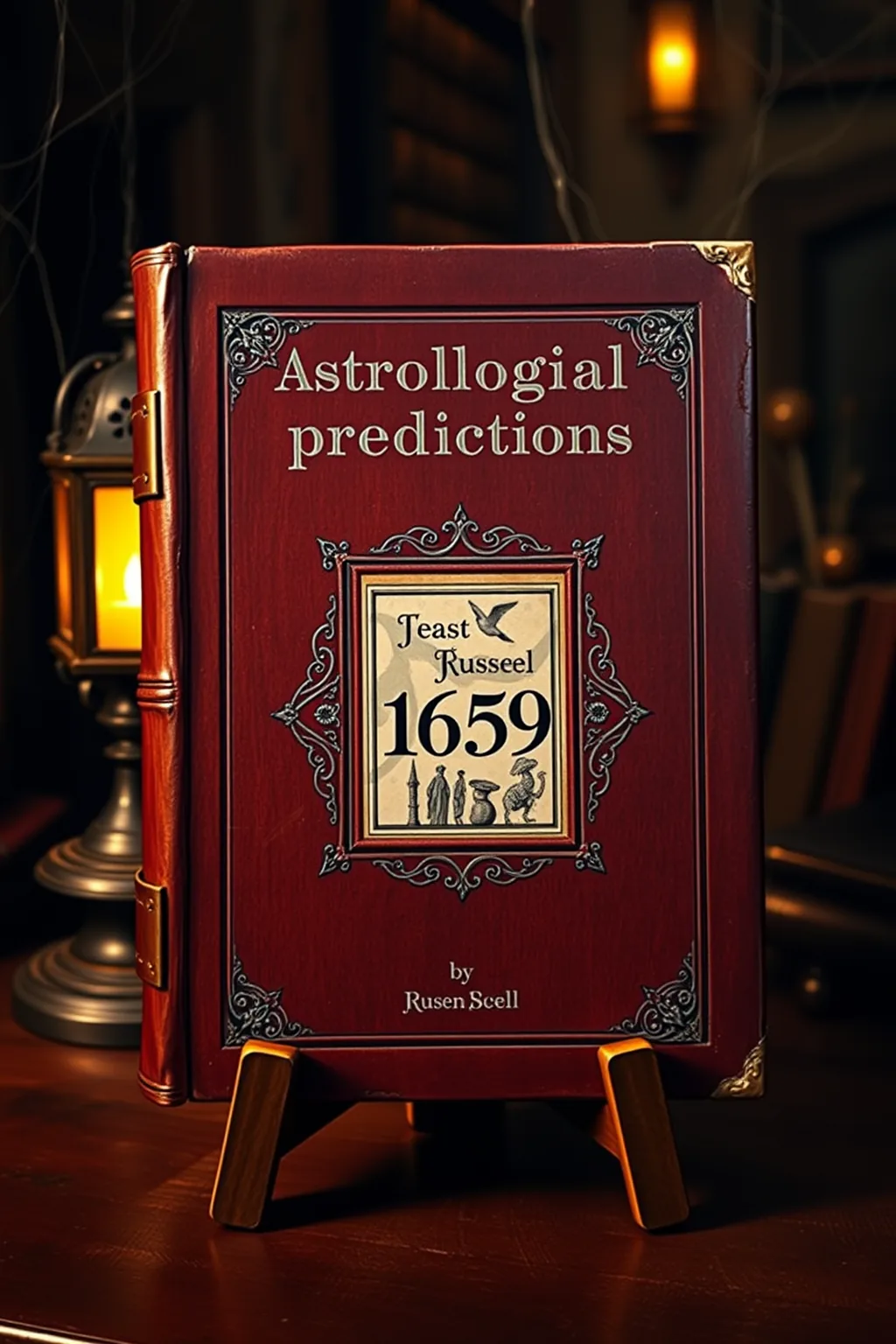
Astrological predictions for the year of our Lord, 1659
 61
61

Astrological predictions for the year of our Lord, 1659


By Cassian Rothmann (Senior Critic, Ancient Wisdom) — John Russell’s "Astrological Predictions for the Year of Our Lord, 1659" is a masterful exposition of 17th-century astrological thought. Russell masterfully synthesizes observational astronomy with occult philosophy, offering predictions that are both historically significant and esoterically resonant. His interpretations of planetary conjunctions and celestial portents reveal a deep understanding of the symbolic language of the cosmos, making this text invaluable for scholars of early modern esotericism and practitioners seeking historical context. The work's strength lies in its unvarnished presentation of a worldview where the celestial dictates the terrestrial, providing a rare window into the minds of those who sought divine order in the stars. A compelling read for anyone fascinated by the history of divination and occult sciences.
📝 Description
61
John Russell published "Astrological Predictions for the Year of Our Lord, 1659" at a time when celestial bodies guided earthly affairs.
This 1659 text by John Russell presents astrological forecasts for the year. Russell, writing from a perspective where the stars held significant meaning, interprets planetary movements and constellations to predict events. The book details celestial messages concerning shifts in power and the relationship between earthly and heavenly realms. Each forecast acts as a coded communication from the cosmos, suggesting unseen influences and the connection between human life and the wider universe. It reflects a historical period deeply invested in astrological knowledge for understanding destiny and seeking guidance. The work invites reflection on humanity's ongoing search for meaning through the interpretation of universal symbols.
This work belongs to the tradition of astrological forecasting prevalent in early modern Europe. Prior to the scientific revolution's full impact, astrology was a recognized discipline, consulted for personal, political, and social guidance. Figures like Russell acted as interpreters of celestial patterns, bridging a perceived gap between divine will and human experience. Such texts reflect a worldview where cosmic events were directly linked to terrestrial occurrences, a common thread in pre-modern esoteric thought.
💡 Why Read This Book?
Embark on a journey into the heart of 17th-century cosmic wisdom. 'Astrological Predictions' offers a direct line to the esoteric worldview of the past, revealing how stars were interpreted as divine guides. Ideal for seekers of historical occult knowledge, students of ancient cosmology, and anyone curious about the profound connection between humanity and the celestial dance. Uncover forgotten prophecies and gain a unique perspective on the enduring human desire to understand our place in the universe.
⭐ Reader Reviews
Honest opinions from readers who have explored this book.
❓ Frequently Asked Questions
What is the primary focus of this book?
The primary focus is on astrological predictions for the year 1659, interpreting celestial movements to forecast earthly events and human destinies within a mystical and prophetic framework.
Who was John Russell?
John Russell was an astrologer and likely a practitioner of esoteric arts during the 17th century, whose work reflects the prevailing cosmological and prophetic beliefs of his era.
Is this book suitable for modern astrological practice?
While not a direct guide to modern techniques, it offers invaluable historical context and insight into the foundational symbolic language and philosophical underpinnings of Western astrology.
What kind of predictions can one expect?
Predictions would have covered various aspects of life, including political events, natural phenomena, societal shifts, and individual fortunes, all interpreted through the lens of celestial influence.
What makes this book 'esoteric'?
Its esoteric nature stems from its belief in hidden cosmic influences, symbolic interpretations of celestial bodies, and its function as a conduit for divine or hidden knowledge not readily accessible.
🔮 Key Themes & Symbolism
Celestial Divination and Prophecy
This theme explores the profound belief in the 17th century that the heavens were a book of divine knowledge, actively communicating future events and cosmic truths. John Russell's work exemplifies this by meticulously charting planetary positions and stellar alignments, interpreting them as direct omens and prophecies. The text examines the symbolic language of the cosmos, where eclipses, conjunctions, and planetary movements held specific, often dire or auspicious, meanings. It highlights the era's worldview, where understanding these celestial signs was paramount for reading through the uncertainties of life, seeking guidance, and anticipating the will of higher powers. This theme underscores the intricate relationship between the terrestrial and the celestial in shaping human destiny.
The Interplay of Astrology and Faith
This theme examines the seamless integration of astrological interpretation with religious and spiritual beliefs prevalent in 1659. Far from being a separate discipline, astrology was often seen as a divinely ordained science, a method by which God communicated His intentions and the natural order of His creation. Russell’s predictions would have been understood within a framework of Christian cosmology, where celestial phenomena served as signs and portents, reinforcing faith or warning of divine displeasure. The text implicitly argues that understanding the stars was a way to understand God's plan, making astrological study a form of spiritual inquiry and a means to align oneself with divine Providence. It reveals how faith and celestial observation were intertwined in the pursuit of wisdom.
Symbolic Language of the Cosmos
This theme focuses on the collection of symbolism employed by John Russell to interpret celestial phenomena. Each planet, constellation, and aspect carries a specific symbolic weight, representing archetypal forces, human virtues and vices, or specific earthly domains. The book acts as a lexicon of this ancient symbolic language, where the Moon might signify the public or the feminine, Mars the force of conflict, and Jupiter the blessings of fortune. Russell’s skill lies in his ability to tie these individual symbols into coherent narratives of prediction. Understanding this symbolic grammar is key to unlocking the deeper meanings within the text, revealing a sophisticated system of cosmic communication that sought to render the ineffable tangible through allegorical representation.
💬 Memorable Quotes
Direct passages from the work, attributed to the author.
“Seek wisdom not only in books, but in the stars above.”
— This emphasizes the holistic approach to knowledge in the era, valuing celestial observation as a primary source of profound understanding alongside terrestrial learning.
“Each star doth whisper secrets of the year to come.”
— This evocative phrase suggests that the cosmos is alive with messages, and skilled interpreters, like Russell, can discern these hidden prophecies and divine insights.
💡 Key Ideas
Editorial paraphrase of the work's core concepts — not direct quotes.
The heavens are a evidence of God's grand design.
This quote highlights the 17th-century view of astrology as a divinely sanctioned science, where celestial movements revealed God's intentions and the structured order of the universe.
When Mars doth cross the Sun, expect great strife.
A classic astrological interpretation, this line symbolizes the perceived direct correlation between planetary influences and earthly events, specifically predicting conflict.
The Moon doth wax and wane, so too do fortunes.
This quote draws a parallel between the natural cycles of celestial bodies and the fluctuating nature of human luck and prosperity, emphasizing cosmic rhythm.
🌙 Esoteric Significance
Tradition
This work is deeply rooted in the Western Hermetic and Neoplatonic traditions, which view the universe as a divinely ordered hierarchy. Astrology, in this context, is not mere prediction but a form of cosmic theology, an attempt to understand the divine mind through the language of celestial mechanics and symbolism. It aligns with the Hermetic principle of 'As Above, So Below,' seeing the macrocosm (heavens) as a reflection and influence on the microcosm (earth). This tradition emphasizes hidden knowledge, spiritual ascent, and the interconnectedness of all things through divine emanations.
Symbolism
The symbolism in Russell's work is rich and layered. Planets represent archetypal forces (e.g., Jupiter for expansion and benevolence, Saturn for restriction and discipline), zodiac signs embody specific qualities and temperaments, and houses denote areas of life. Aspects between planets are seen as dialogues or tensions between these forces. Celestial events like eclipses or comets are often imbued with portents, symbolizing disruption or significant change. The core symbolism lies in the belief that these celestial arrangements are not random but are encoded messages from the divine, offering insight into karmic patterns and the unfolding of destiny.
Modern Relevance
Despite its historical origins, 'Astrological Predictions 1659' offers enduring relevance for modern esoteric practitioners and scholars. It provides a crucial window into the foundational symbolic language and philosophical underpinnings of Western astrology, useful how its principles were conceived before modern scientific interpretations took precedence. For contemporary astrologers, it offers a rich source of historical context, reminding them of the divinatory and philosophical roots of their craft. For seekers, it underscores the perennial human quest for meaning and guidance, demonstrating how past cultures sought to understand their place in the cosmos and derive wisdom from celestial observation.
👥 Who Should Read This Book
This meticulously preserved text is essential for several distinct groups. **Scholars of early modern history and the history of science** will find it an invaluable primary source, offering direct insight into the intellectual and spiritual climate of 17th-century England. **Occult practitioners and historical astrologers** will benefit immensely from understanding the roots of astrological interpretation and the symbolic lexicon of the era. **Spiritual seekers and metaphysicians** interested in the historical relationship between humanity and the cosmos will discover a profound exploration of how our ancestors perceived divine order. Even **curious general readers** with an interest in forgotten knowledge and the evolution of human thought will find the text a fascinating and useful read.
📜 Historical Context
The year 1659 found Europe in a period of significant transition and turmoil. The aftermath of the Thirty Years' War still cast long shadows, and the political landscape was often volatile, marked by dynastic struggles and the rise of new powers. In England, this was a period of Interregnum, a republic established after the execution of Charles I, leading to a climate of uncertainty and fervent intellectual and religious debate. Astrology, far from being relegated to the fringes, was a respected, albeit sometimes controversial, intellectual pursuit, deeply intertwined with philosophy, theology, and early science. Practitioners like John Russell operated within a worldview that saw the cosmos as a living, interconnected system, where celestial events held profound significance for earthly affairs. This was an era where prophecy was taken seriously, and the stars were consulted for guidance in both personal and public matters, reflecting a deep-seated human desire for order and meaning in a complex world.
📔 Journal Prompts
Reflect on a time when you felt a strong connection between celestial events and your personal life. What were the circumstances?
How has the modern scientific understanding of the cosmos changed your perception of astrological symbolism?
If you could ask John Russell one question about his predictions or his methods, what would it be and why?
Consider the 'As Above, So Below' principle. How might a current global event be symbolically reflected in the current celestial configurations?
What personal 'prophecies' or intuitive insights have you received, and how did they manifest in your life?
🗂️ Glossary
Conjunction
In astrology, a conjunction occurs when two or more celestial bodies are located at the same degree of the zodiac, viewed from Earth. It is often considered a potent aspect where the energies of the involved planets merge.
Ascendant (Rising Sign)
The zodiac sign that is rising on the eastern horizon at the moment of birth. It represents the outward persona, the physical appearance, and the initial approach to life.
Aspect
The angular relationship between two or more planets in a birth chart or a predictive chart. Different aspects (e.g., opposition, trine, square) indicate how planetary energies interact.
Portent
An omen or sign that foreshadows a future event, often of a significant or unusual nature. In astrological texts, celestial phenomena were frequently interpreted as portents.
Terrestrial
Relating to or of the Earth. In astrological contexts, it refers to earthly events, human affairs, and the material world, as opposed to celestial or spiritual realms.
This book appears in 2 collections
🔮 Readers Also Liked
Browse all →








From the “Astrology” Collection
View all →





![ERIC ED476541: Animals of the Chinese Zodiac. [Lesson Plan].](/img/thumb/eric-ed476541-animals-of-the-chinese-zodiac-lesson-plan-eric.webp)

More Free Astrology & Cosmology Books
View all →








![Mr. Patridge's [sic] judgement and opinion of this frost. Foretelling how long it is like to continue, according to the rules of astrology. ... 1709](/img/thumb/mr-patridge-s-sic-judgement-and-opinion-of-this-frost-foretelling-how-long-it-is-like-to-continue-according-to-the-rules-of-astrology-1709-patridge-mr.webp)
