Angels Are for Real
 73
73

Angels Are for Real
Judith MacNutt's "Angels Are for Real" attempts to bridge the gap between abstract theological concepts and lived spiritual experience. The strength of the work lies in its accessibility; MacNutt presents complex scriptural passages and diverse anecdotal evidence with a clear, unpretentious voice. She successfully demystifies angelic presence, presenting them not as distant, ethereal beings but as active participants in human affairs, as evidenced by her discussion of angelic encounters throughout biblical history, from Abraham to the disciples. However, the book's reliance on personal testimonies, while compelling for some, may lack the critical rigor for skeptical readers. The exploration of angelic roles, while broad, sometimes feels like an enumeration of biblical verses and stories without a deep dive into comparative angelology or the philosophical underpinnings of belief. Ultimately, "Angels Are for Real" serves as an encouraging primer for those predisposed to believing in angelic intervention, offering solace and affirmation through familiar narratives and relatable accounts.
📝 Description
73
Judith MacNutt's 1994 book examines angelic roles with biblical accounts and personal testimonies.
Angels Are for Real investigates the nature and function of angelic beings as depicted in scripture and historical accounts. The author, Judith MacNutt, presents biblical narratives alongside personal testimonies to illustrate the presence and influence of angels in human lives. The book seeks to clarify the existence and purpose of these celestial entities for a wider readership.
This work is suited for individuals interested in a deeper understanding of spiritual beings and their place within a divine framework. It speaks to believers aiming to reinforce their faith through scriptural support and accounts of angelic actions. Those with an interest in comparative religion, esotericism, or the general subject of angels will find thoughtful perspectives here.
This book engages with a long-standing tradition in religious and mystical thought concerning angelic hierarchies and their functions. From ancient Hebrew texts describing seraphim and cherubim to early Christian writings and later theological interpretations, the concept of angels has been a consistent subject. MacNutt grounds her contemporary observations in these historical and scriptural foundations, placing the book within a discourse that spans millennia and various spiritual traditions.
💡 Why Read This Book?
• Gain a scripturally-grounded perspective on angelic roles, learning about their functions as messengers and protectors as detailed in biblical narratives, a focus not commonly found in contemporary spiritual guides. • Understand the historical continuity of angelic belief, with specific references to ancient Hebrew texts and early Christian writings, providing context beyond modern interpretations. • Discover tangible examples of angelic intervention through curated personal testimonies and biblical accounts, offering encouragement and affirming the possibility of direct celestial interaction.
⭐ Reader Reviews
Honest opinions from readers who have explored this book.
❓ Frequently Asked Questions
What biblical figures are discussed in relation to angelic encounters in 'Angels Are for Real'?
The book references numerous biblical figures who encountered angels, including Abraham, Lot, Hagar, and the disciples of Jesus. It explores the specific contexts of these interactions as described in scripture.
Does 'Angels Are for Real' present angels as purely symbolic figures?
No, the book emphasizes the tangible and active presence of angels, presenting them as distinct celestial beings who serve God and interact with humanity, rather than solely as symbolic representations.
What is the primary purpose of angels according to Judith MacNutt's book?
According to MacNutt, angels serve multiple vital roles including being messengers of God, protectors of individuals, healers, and comforters, acting as integral parts of God's kingdom throughout history.
When was 'Angels Are for Real' first published?
The book 'Angels Are for Real' by Judith MacNutt was first published in February 2012.
Are there personal stories of angelic encounters in the book?
Yes, a significant aspect of the book includes numerous stories of miraculous encounters and personal testimonies of angelic intervention, alongside biblical accounts.
What biblical texts does the author draw upon for information about angels?
The author draws heavily from various parts of the Bible, including Old Testament narratives concerning figures like Abraham and New Testament accounts involving Jesus and his disciples, to support her points about angels.
🔮 Key Themes & Symbolism
Biblical Angelology
This theme centers on the systematic presentation of angels as depicted within the canonical scriptures. The work meticulously examines biblical narratives, identifying the distinct roles angels fulfilled as divine messengers, guardians, and agents of God's will across both the Old and New Testaments. It aims to provide readers with a foundational understanding derived directly from scriptural sources, distinguishing between biblical accounts and later theological or popular interpretations. Specific examples from the lives of figures like Abraham and the apostles are used to illustrate the practical application of angelic ministries.
Personal Encounters and Miracles
Beyond scriptural analysis, a significant theme is the exploration of contemporary and historical personal testimonies of angelic encounters. These accounts serve to demonstrate that angelic presence is not confined to ancient history but remains a vital and active force. The book presents these narratives as evidence of divine care and intervention, offering comfort and encouragement to readers. This theme highlights the experiential aspect of faith, suggesting that direct, miraculous interactions with celestial beings are accessible and verifiable through lived experience.
The Nature of Celestial Beings
This theme addresses the fundamental question of what angels are and their place within the divine hierarchy. MacNutt seeks to clarify these beings, presenting them as created entities with specific functions and purposes ordained by God. The work clarifies their relationship to God and humanity, emphasizing their role as servants of the divine kingdom. By distinguishing angels from purely mythological figures or abstract concepts, the book aims to foster a clearer, more concrete understanding of their existence and spiritual significance.
Angels as Protectors and Comforters
A core aspect of the book focuses on the protective and comforting roles attributed to angels. It explores how these celestial beings have historically served as guardians, shielding individuals from harm and guiding them through difficult circumstances. Furthermore, the work looks at the ways angels offer solace, peace, and reassurance, acting as conduits of divine comfort. This theme aims to instill a sense of security and hope in the reader, underscoring the constant, benevolent presence of angelic assistance available to believers.
💬 Memorable Quotes
Direct passages from the work, attributed to the author.
“Angels have been, and will continue to be, a vital part of God's Kingdom.”
— This foundational statement underscores the enduring and essential nature of angelic involvement in the divine cosmic order, suggesting their continuous relevance across all eras of spiritual history.
“Sometimes their presence is as subtle as a whisper of wind, other times as visible as the sun.”
— This metaphorical description illustrates the varied ways angelic presence can manifest, ranging from imperceptible, gentle influences to overt, undeniable manifestations, emphasizing their adaptable interaction with the physical and spiritual realms.
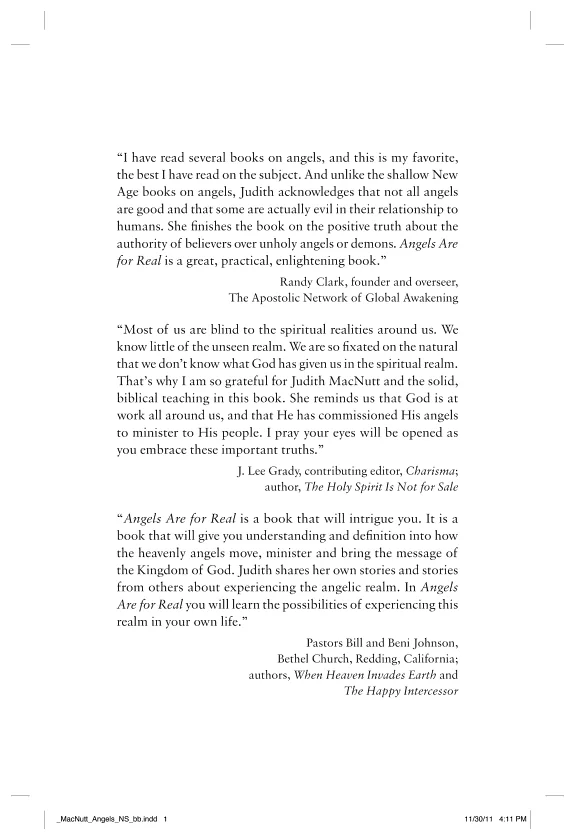
“In this accessible, comprehensive and encouraging guide, Judith MacNutt pulls back the curtain on these intriguing heavenly beings.”
— This blurb-like statement positions the book as an approachable and informative resource that aims to reveal the nature and significance of angels in a clear and reassuring manner for the reader.
“She offers insight and many stories of miraculous encounters, revealing what the Bible says.”
— This highlights the book's methodology: combining scriptural exposition with anecdotal evidence of miraculous events, thereby providing a dual approach to understanding angelic activity and its biblical basis.
💡 Key Ideas
Editorial paraphrase of the work's core concepts — not direct quotes.
Throughout the ages they have been messengers, protectors, healers, comforters and more to the people of God.
This quote summarizes the many-sided functions of angels, highlighting their active and supportive roles in the lives of believers throughout history, serving diverse spiritual and practical needs.
🌙 Esoteric Significance
Tradition
While rooted in mainstream Christian theology, the book touches upon broader esoteric concepts concerning spiritual hierarchies and divine intermediaries. It aligns with traditions that posit a structured celestial realm populated by beings involved in cosmic governance and human spiritual development. Although not explicitly Hermetic or Kabbalistic, its focus on angelic messengers and guardians echoes themes found in Western esoteric traditions that view angels as channels of divine knowledge and power.
Symbolism
The primary symbolism revolves around the concept of the 'angel' itself as a divine emissary. Specific biblical accounts often imbue angelic appearances with symbolic weight; for instance, the 'whisper of wind' symbolizes subtle divine guidance, while a 'visible presence' signifies direct, undeniable divine intervention. The wing motif, often associated with angels, symbolizes their speed, transcendence, and ability to traverse between the material and spiritual realms.
Modern Relevance
Contemporary spiritual seekers, particularly those within Christian contemplative or charismatic movements, may find resonance with MacNutt's approach. Thinkers and practitioners focusing on spiritual warfare, divine protection, or the experiential aspects of faith often draw upon similar scriptural interpretations and anecdotal evidence. The book's accessible style also makes it relevant for comparative religion studies seeking to understand modern manifestations of ancient angelological beliefs within specific faith communities.
👥 Who Should Read This Book
• Individuals seeking to deepen their understanding of Christian angelology based on biblical texts and historical accounts. • Believers who are looking for encouragement and affirmation of angelic presence and intervention in their own lives. • Readers interested in comparative religious studies, specifically exploring the role of celestial beings within a Christian framework.
📜 Historical Context
Published in 2012, "Angels Are for Real" emerged in an era marked by a resurgence of interest in spirituality and the supernatural, often intersecting with traditional religious frameworks. The early 21st century saw a growing market for books exploring angelic phenomena, often bridging conservative Christian theology with more experiential or New Age perspectives. MacNutt's work fits within this milieu, offering a distinctly Christian interpretation grounded in biblical scholarship, differentiating it from more esoteric or occult traditions that also engage with angelic hierarchies. This period also saw continued academic and popular discourse on religious experience, with scholars like Karen Armstrong examining the historical evolution of angelic concepts across cultures, a backdrop against which MacNutt's focused, faith-based approach presents a specific viewpoint.
📔 Journal Prompts
Reflect on the biblical roles of angels as messengers, protectors, healers, and comforters.
Consider the biblical accounts of angelic encounters mentioned in the text.
Explore the concept of angelic presence being 'subtle as a whisper of wind' versus 'visible as the sun'.
Journal about personal experiences or feelings that might be interpreted as subtle angelic guidance.
Identify specific biblical figures who received direct angelic messages and analyze the context.
🗂️ Glossary
Angelic Messengers
Beings described in scripture and tradition as carrying divine messages from God to humanity, facilitating communication between the divine and mortal realms.
Guardian Angels
Angels believed to be assigned to protect and guide specific individuals or groups, offering spiritual and sometimes physical safeguarding.
Celestial Beings
A general term referring to entities originating from or belonging to the heavenly or spiritual realms, often understood as distinct from earthly creatures.
Divine Kingdom
The realm or sphere of God's sovereign rule and authority, understood as encompassing both heavenly and earthly aspects, in which angels play an active role.
Miraculous Encounters
Experiences perceived as extraordinary events attributed to supernatural intervention, often involving direct interaction with divine or celestial entities like angels.
Scriptural Evidence
Information, accounts, or teachings derived directly from the sacred texts of religious traditions, used here to support claims about the nature and actions of angels.
Biblical Angelology
The study and systematic understanding of angels as depicted within the canonical texts of the Bible, including their nature, roles, and interactions.
This book appears in 1 collection
🔮 Readers Also Liked
Browse all →






From the “Angels” Collection
View all →








More Free Sacred Texts & Gnosticism Books
View all →