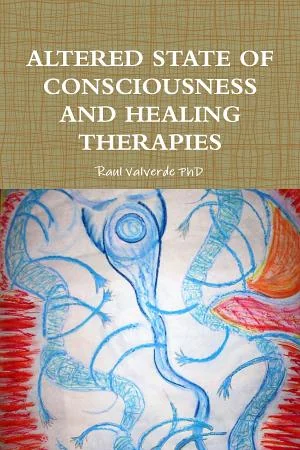
ALTERED STATE OF CONSCIOUSNESS AND HEALING THERAPIES
 78
78

ALTERED STATE OF CONSCIOUSNESS AND HEALING THERAPIES
Raul Valverde's "Altered States of Consciousness and Healing Therapies" attempts to bridge the gap between subjective transpersonal experiences and empirical understanding. The book's strength lies in its ambitious scope, touching upon diverse areas from intuition to neurotechnology within a single volume. Valverde compellingly argues for the utility of altered states in self-discovery, particularly in answering existential questions. However, the work sometimes feels like an overview rather than a deep dive; for instance, the section on neurotechnology, while relevant, could benefit from more detailed case studies or a clearer exposition of the underlying scientific principles. A particularly striking passage discusses channeling not as mere psychic reception, but as a form of accessing collective unconscious archetypes, a concept that challenges simplistic interpretations. Ultimately, the book serves as a useful, if sometimes brief, introduction to a complex field.
📝 Description
78
Raul Valverde PhD's 2019 book examines transpersonal experiences as keys to identity and purpose.
Altered States of Consciousness and Healing Therapies discusses transpersonal experiences, which are states where awareness extends beyond normal space and time. Valverde argues these states are important for understanding who we are and what our purpose is. The book is for people interested in consciousness studies, spirituality, and therapies. It covers topics such as intuition, channeling, neurotechnology, and certain psychotherapy methods. Valverde places this work within the history of consciousness research that grew in the late 20th century. He draws on ideas from the counterculture era and later academic study of altered states. Stanislav Grof's work is an influence.
The text focuses on spirituality, how intuition works, the practice of channeling, and how neurotechnology can change consciousness. It also details Holotropic Breathwork, a therapy method created by Grof. The book aims to connect these areas, showing how expanded awareness can lead to healing and self discovery.
This book sits within traditions that explore consciousness beyond the ordinary. It connects with Western esotericism's interest in altered states, often seen as pathways to spiritual insight or healing. Valverde's engagement with figures like Stanislav Grof and therapies like Holotropic Breathwork bridges scientific inquiry with practices aimed at profound personal transformation. The focus on transpersonal experiences echoes perennial philosophies that posit a universal consciousness or deeper self accessible through specific methods.
💡 Why Read This Book?
• Gain a foundational understanding of transpersonal experiences and their role in self-inquiry, as presented in the book's exploration of consciousness expansion beyond typical time and space limits. • Explore the foundational principles of Holotropic therapy and its relationship to altered states, a concept central to the therapeutic modalities discussed by Raul Valverde PhD. • Understand the nuanced perspectives on channeling and intuition, examining them as potential pathways to profound self-knowledge, a core theme introduced in the book's initial chapters.
⭐ Reader Reviews
Honest opinions from readers who have explored this book.
❓ Frequently Asked Questions
What specific types of altered states of consciousness does the book discuss?
The book covers transpersonal experiences that extend beyond normal time and space, including phenomena related to spirituality, intuition, channeling, and specific therapeutic techniques like Holotropic therapy.
Who is Raul Valverde PhD and what is his background?
Raul Valverde PhD is presented as an author exploring the intersection of consciousness, spirituality, and healing. While specific biographical details are not provided, his work suggests an academic or research-oriented background in these fields.
When was 'Altered States of Consciousness and Healing Therapies' first published?
The book was first published on July 30, 2018, marking its entry into contemporary discussions on consciousness and therapy.
Does the book offer practical techniques for inducing altered states?
While it discusses concepts like Holotropic therapy and neurotechnology, the book primarily focuses on the nature and implications of altered states rather than providing a step-by-step guide for induction.
What is the connection between altered states and healing mentioned in the book?
The book suggests that altered states can facilitate healing by allowing individuals to explore deeper aspects of themselves, potentially leading to resolution of psychological and spiritual issues through transpersonal experiences.
What are the main subjects covered besides altered states?
Key subjects include spirituality, intuition, channeling, neurotechnology, and Holotropic therapy, all examined through the lens of expanded consciousness.
🔮 Key Themes & Symbolism
Transpersonal Experience
The book defines transpersonal experiences as those that transcend the ordinary ego and its boundaries of time and space. These states are presented not as mere psychological anomalies, but as fundamental to understanding the self's deeper nature and cosmic interconnectedness. The exploration looks at how these experiences can provide answers to profound existential questions, moving beyond the material world to touch upon spiritual realities and the essence of being.
Consciousness and Self-Discovery
A central thesis is that altered states of consciousness serve as a gateway to profound self-discovery. By temporarily suspending normal perceptual filters, individuals can access deeper layers of their psyche and connect with a broader reality. This expanded awareness is posited as essential for answering fundamental questions about identity and purpose, suggesting that our true selves are not confined to everyday waking consciousness.
Therapeutic Applications
The work highlights the therapeutic potential inherent in altered states. It examines modalities like Holotropic therapy, which utilizes specific breathing techniques and somatic experiences to induce non-ordinary states for healing and psychological integration. The inclusion of neurotechnology also points to modern approaches that may influence or facilitate these states for beneficial outcomes in mental and emotional well-being.
Intuition and Channeling
Valverde explores intuition and channeling as manifestations of expanded consciousness. These phenomena are presented as faculties that operate beyond rational thought, potentially tapping into higher knowledge or collective unconscious realms. The book encourages viewing these abilities not as supernatural gifts, but as inherent potentials accessible through specific states of awareness, offering pathways to insight and guidance.
💬 Memorable Quotes
Direct passages from the work, attributed to the author.
“Altered states of consciousness cover transpersonal experiences that involve an expansion of consciousness beyond the limits of time and space.”
— This foundational statement defines the core subject matter, framing altered states as a means to transcend ordinary perception and explore a vaster reality beyond conventional physical and temporal constraints.
“Altered states of consciousness allow us to answer the questions of who we really are and why we are here.”
— This highlights the existential and self-discovery aspect of altered states, suggesting they provide access to deeper truths about identity and purpose that are often obscured in everyday consciousness.
“Spirituality, Intuitions, Channeling, Neurotechnology and Holotropic therapy are topics included in this book.”
— This outlines the key areas of exploration, indicating a multidisciplinary approach that bridges esoteric concepts with scientific and therapeutic practices related to consciousness.
“The expansion of consciousness beyond the limits of time and space is a hallmark of transpersonal experience.”
— This reiterates the defining characteristic of the states discussed, emphasizing their non-ordinary nature and their potential to reveal a reality unbound by everyday physical laws.
💡 Key Ideas
Editorial paraphrase of the work's core concepts — not direct quotes.
Understanding our true selves requires exploring states beyond ordinary waking awareness.
This paraphrased concept emphasizes the book's core argument: that authentic self-knowledge is contingent upon venturing into non-ordinary states of consciousness, suggesting limitations in purely rational or ego-bound perspectives.
🌙 Esoteric Significance
Tradition
This work draws heavily from the transpersonal psychology movement, which itself is an outgrowth of depth psychology and integrates concepts from various esoteric traditions, including Gnosticism and Hermeticism, concerning the nature of the soul and its journey. It departs from rigid adherence to any single lineage by incorporating modern scientific concepts like neurotechnology, positioning itself as a bridge between ancient wisdom and contemporary understanding of consciousness.
Symbolism
While not explicitly symbol-heavy, the book implicitly engages with the symbolism of 'expansion' and 'transcendence.' The concept of moving beyond 'time and space' is a symbolic representation of breaking free from the limitations of the material ego and ordinary perception, hinting at archetypal journeys found in Gnostic cosmology or Hermetic quests for higher knowledge. The 'self' is presented as a symbol of a deeper, unified consciousness.
Modern Relevance
Valverde's exploration of altered states and their therapeutic applications finds resonance with contemporary movements in psychedelic-assisted therapy, mindfulness-based interventions, and integrative psychology. Thinkers and practitioners interested in the intersection of neuroscience and subjective experience, such as those in the field of psychedelic research or consciousness hacking, can find foundational concepts within this work that inform modern therapeutic and self-development practices.
👥 Who Should Read This Book
• Individuals exploring transpersonal psychology and the nature of consciousness beyond the ego state, seeking to understand existential questions about self and purpose. • Practitioners of healing modalities, including therapists and counselors interested in incorporating altered states or understanding their clients' experiences, particularly those familiar with or curious about Holotropic therapy. • Students and researchers of esoteric traditions, spirituality, and metaphysics who wish to connect classical concepts of expanded awareness with modern scientific and psychological frameworks.
📜 Historical Context
Published in 2018, Raul Valverde's "Altered States of Consciousness and Healing Therapies" emerged during a period of renewed interest in consciousness studies, building upon decades of research initiated by figures like Stanislav Grof. The late 20th century saw the popularization of concepts like Holotropic Breathwork, developed in the 1970s, and a growing academic engagement with transpersonal psychology, a field championed by figures like William James and later Carl Jung. Valverde's work taps into this legacy, exploring how altered states, facilitated by methods ranging from ancient contemplative practices to modern neurotechnology, can serve as potent tools for psychological and spiritual healing. The book engages with a landscape where psychedelic research was experiencing a resurgence, challenging earlier prohibitions and opening new avenues for therapeutic exploration. Valverde's synthesis aims to connect these diverse strands, offering a framework for understanding consciousness expansion within both esoteric traditions and contemporary scientific inquiry.
📔 Journal Prompts
Transpersonal experiences and their role in expanding consciousness beyond time and space.
The connection between altered states and answering fundamental questions about identity and purpose.
Exploring the therapeutic potential of phenomena like channeling and intuition.
Neurotechnology's influence on consciousness and its integration with healing therapies.
Reflecting on the principles of Holotropic therapy and its effects on the psyche.
🗂️ Glossary
Altered States of Consciousness
Non-ordinary states of awareness that deviate from the typical waking consciousness. These can include states induced by meditation, hypnosis, psychedelics, or specific therapeutic techniques, characterized by changes in perception, cognition, and emotion.
Transpersonal Experience
Experiences that transcend the personal ego and the ordinary boundaries of self, time, and space. Often associated with spiritual, mystical, or profound psychological insights, involving a sense of unity or connection with a larger reality.
Intuition
The capacity to understand or know something immediately, without conscious reasoning. In the context of altered states, it is explored as a faculty that can access deeper knowledge beyond ordinary cognitive processes.
Channeling
A process through which an individual is believed to receive information or messages from a source external to themselves, such as spirits, entities, or a higher consciousness. Often occurs in an altered state of consciousness.
Neurotechnology
The application of scientific knowledge to develop technologies that interact with or influence the nervous system. In this context, it refers to tools or methods that might induce or modulate altered states of consciousness.
Holotropic Therapy
A form of psychotherapy developed by Stanislav and Christina Grof, which uses holotropic breathwork and other methods to induce non-ordinary states of consciousness for therapeutic purposes, aiming at self-exploration and healing.
Ego
In psychology, the part of the mind that mediates between the conscious and the unconscious, and is responsible for reality testing and a sense of personal identity. Transcending the ego is often a goal in altered state explorations.
This book appears in 1 collection
🔮 Readers Also Liked
Browse all →






From the “Altered States of Consciousness” Collection
View all →


![EBOOK COLLECTION ( PART 8) [ CSI][h 33t]](/img/thumb/ebook-collection-part-8-csi-h-33t.webp)
More Free Sacred Texts & Gnosticism Books
View all →