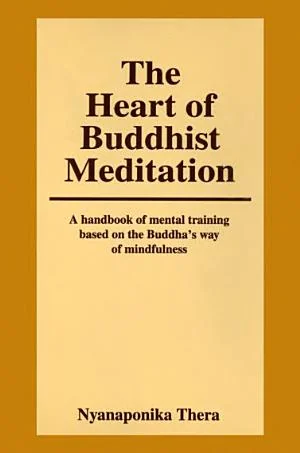
The Heart of Buddhist Meditation
 74
74

The Heart of Buddhist Meditation
Nyanaponika Thera’s "The Heart of Buddhist Meditation" provides a rigorous and unvarnished look at the practice of mindfulness. Unlike many modern interpretations, Thera anchors his exposition firmly in the Pali Canon, particularly the Satipatthana Sutta, a strength that lends the work considerable authority. The clear explanation of 'clear comprehension' (sampajañña) is especially useful, distinguishing mindful awareness from mere passive observation and highlighting its applicability to daily activities. However, the book’s scholarly tone, while commendable for its accuracy, can at times feel dense for the absolute beginner. The inclusion of an introduction by Sylvia Boorstein in later editions offers a welcome bridge, but the core text demands focused attention. Ultimately, this is an indispensable resource for the dedicated student of meditation seeking depth and authenticity.
📝 Description
74
Nyanaponika Thera's 2014 book, The Heart of Buddhist Meditation, explains Theravada meditation's core principles.
This text serves as a guide to the main principles and practices of Buddhist meditation, specifically within the Theravada tradition. It shows the way toward mental clarity and insight through careful observation of the mind and body. The book stresses putting mindfulness to use in daily life, making complex spiritual ideas understandable.
It is meant for people who want a serious, deep understanding of Buddhist meditation, moving beyond simple introductions. It suits practitioners aiming to develop mindfulness (sati) and clear comprehension (sampajañña) as taught in early Buddhist texts. Those interested in the psychological advantages and spiritual depth from these practices will find it useful. The work contrasts with modern popular versions of meditation that may leave out the ethical and philosophical foundations found in the Pali Suttas.
Emerging from the scholarly and monastic circles of early to mid-20th century Sri Lanka, Nyanaponika Thera's work is part of a period marked by renewed attention to the Pali Canon. This era saw figures like Bhikkhu Ñāṇananda and Narada Maha Thera also produce important texts on Buddhist doctrine and practice. The book stands apart from current popularizations of meditation that sometimes neglect the ethical and philosophical underpinnings emphasized in the Pali Suttas.
💡 Why Read This Book?
• Gain a precise understanding of the Four Foundations of Mindfulness (Satipatthana), a core teaching from the Satipatthana Sutta, enabling a structured approach to meditation. • Learn the practical application of 'clear comprehension' (sampajañña), a key concept for integrating mindful awareness into everyday actions beyond formal sitting practice. • Understand the connection between diligent meditation practice and the path to insight, as presented in the foundational Buddhist texts, offering a deeper spiritual perspective.
⭐ Reader Reviews
Honest opinions from readers who have explored this book.
❓ Frequently Asked Questions
When was "The Heart of Buddhist Meditation" first published?
The original publication date for "The Heart of Buddhist Meditation" by Nyanaponika Thera was July 1, 2014. This edition aims to present the classic teachings on Buddhist meditation.
Who is Sylvia Boorstein and what is her role in this book?
Sylvia Boorstein, a noted author and teacher in the Buddhist community, contributed an introduction to a later edition of "The Heart of Buddhist Meditation," offering her perspective on the work's significance.
What are the Four Foundations of Mindfulness mentioned in the book?
The Four Foundations of Mindfulness, as detailed in the book, are mindfulness of the body, mindfulness of feelings, mindfulness of the mind, and mindfulness of mental phenomena (dhammas).
What is 'clear comprehension' in the context of Buddhist meditation?
Clear comprehension, or sampajañña, is a specific type of mindfulness discussed in the book, referring to a state of alert awareness and understanding of one's present actions and mental states.
Is this book suitable for beginners in meditation?
While comprehensive, the book's depth and scholarly approach might be more suited for those with some prior exposure to meditation or a strong desire for in-depth study, rather than absolute beginners seeking only introductory material.
What tradition of Buddhism does this book primarily focus on?
The book primarily focuses on the Theravada tradition of Buddhism, drawing heavily from the Pali Canon and emphasizing the teachings of the early Buddhist scriptures.
🔮 Key Themes & Symbolism
Satipatthana and Sampajañña
The core of the book lies in its detailed exposition of the Satipatthana Sutta, the discourse on the Four Foundations of Mindfulness. Nyanaponika Thera meticulously unpacks each foundation—body, feelings, mind, and dhammas—emphasizing the cultivation of 'clear comprehension' (sampajañña) as the active, discerning quality of mindfulness. This isn't passive observation but an alert, knowing awareness that understands the arising and passing of phenomena, crucial for developing insight.
The Path to Insight (Vipassana)
The work frames meditation not merely as a relaxation technique but as a systematic path toward clear insights into the nature of reality. It explains how sustained practice, guided by mindfulness and clear comprehension, leads to the realization of impermanence (anicca), suffering (dukkha), and non-self (anatta). This understanding is presented as the key to liberation from suffering.
Mindfulness in Daily Life
A significant aspect explored is the integration of mindfulness into everyday activities. The book moves beyond the formal cushion practice to illustrate how clear comprehension can be applied during walking, eating, working, and interacting. This practical dimension makes the teachings accessible and relevant, demonstrating that the meditative state is not confined to specific times but can permeate one's entire existence.
Theravada Buddhist Framework
Rooted firmly in the Theravada tradition, the book draws directly from the Pali Canon, the earliest collection of Buddhist scriptures. It adheres to the orthodox understanding of the Dhamma, presenting a clear, analytical approach to meditation practice. This ensures the teachings are presented with historical and doctrinal integrity, offering a direct link to the Buddha's original instructions.
💬 Memorable Quotes
Direct passages from the work, attributed to the author.
“Mindfulness is the faculty of remembering what one has experienced or heard.”
— This highlights the active, cognitive aspect of mindfulness, emphasizing it as an engaged process of recall and awareness rather than simple passive presence. It suggests mindfulness requires attention and continuity.
“Clear comprehension is the faculty of understanding what is happening.”
— This defines sampajañña as an immediate, discerning awareness of current experiences, both internal and external. It is the active investigation that accompanies mindfulness, ensuring one truly grasps the nature of phenomena.
“The Four Foundations of Mindfulness are the direct path to purification.”
— This emphasizes the foundational role of these practices within the Buddhist path, presenting them as the essential means to cleanse the mind and develop wisdom leading to liberation.
“Meditation is the training of the mind.”
— This concise statement underscores the methodical and developmental nature of meditation practice, framing it as a disciplined endeavor to cultivate specific mental qualities and understanding.
“The practice is to observe things as they are.”
— This captures the essence of Vipassana, the insight meditation, advocating for direct, unbiased observation of reality without distortion or judgment, leading to authentic understanding.
🌙 Esoteric Significance
Tradition
While rooted in the Theravada Buddhist tradition, which is often considered the 'orthodox' or 'original' form of Buddhism, Nyanaponika Thera’s meticulous exposition elevates the practice to an esoteric level through its systematic depth and analytical rigor. It aligns with the broader esoteric pursuit of direct experiential knowledge of reality, moving beyond dogma to the verifiable truths of mind training.
Symbolism
The primary 'symbols' are not decorative but conceptual: the Four Foundations of Mindfulness themselves act as symbolic frameworks for understanding the totality of experience. The 'body' symbolizes the physical realm, 'feelings' the affective, 'mind' the conscious mental states, and 'dhammas' the broader spectrum of mental objects and phenomena. Together, they represent the microcosm of the practitioner's reality.
Modern Relevance
Contemporary mindfulness-based interventions (MBIs) like MBSR and MBCT, while secularized, owe a significant conceptual debt to the detailed practices outlined by Thera and his tradition. Thinkers and teachers within the Insight Meditation Society (IMS) and similar organizations continue to draw directly from the principles of Satipatthana and Vipassana as presented in works like this.
👥 Who Should Read This Book
• Students of Theravada Buddhism: Those seeking an authoritative guide to the core meditative teachings as preserved in the Pali Canon, directly from a respected scholar-monk. • Aspiring meditators focused on insight: Individuals aiming to cultivate Vipassana (insight meditation) and understand the systematic path to liberation, as described in early Buddhist texts. • Scholars of comparative religion: Researchers interested in the historical development and doctrinal underpinnings of Buddhist meditation practices, particularly within the Theravada lineage.
📜 Historical Context
Nyanaponika Thera's "The Heart of Buddhist Meditation," first published in 2014, draws from a rich lineage of Theravada scholarship that saw a resurgence in the 20th century, particularly in Sri Lanka. This period, influenced by figures like Anagarika Dharmapala, fostered a renewed emphasis on the Pali Canon and direct meditative practice. The work emerged within an intellectual milieu where scholars and monastics sought to present the Dhamma with clarity and precision, often in response to colonial influences and the rise of Western interest in Eastern religions. Contemporary scholars and practitioners like Walpola Rahula, also a significant voice from Sri Lanka, were similarly engaged in disseminating Buddhist teachings. Thera's approach, firmly grounded in the Satipatthana Sutta, offered a systematic and analytical method that stood apart from more devotional or syncretic spiritual movements gaining traction elsewhere.
📔 Journal Prompts
The Four Foundations of Mindfulness: How does observing the body differ from observing feelings in your daily experience?
Clear comprehension (sampajañña): Reflect on a recent activity where you lacked clear comprehension and its consequences.
The direct path: How does the concept of a 'direct path' to purification influence your understanding of spiritual practice?
Mindfulness of the mind: Describe a recurring thought pattern you observed using the principles of mindfulness of mind.
The nature of phenomena: Consider an impermanent experience and how observing its arising and passing changes your perception of it.
🗂️ Glossary
Satipatthana
Literally 'Foundations of Mindfulness.' It refers to the four areas of contemplation: the body, feelings, the mind, and mental phenomena (dhammas), as taught in the Satipatthana Sutta.
Sampajañña
Clear comprehension or awareness. It is the discerning quality of mindfulness that understands the nature of present experiences, actions, and mental states.
Sati
Mindfulness or awareness. It is the faculty that prevents the mind from forgetting or becoming oblivious to what is happening in the present moment.
Vipassana
Insight meditation. A core Buddhist practice aimed at developing wisdom and understanding the true nature of reality through careful observation.
Anicca
Impermanence. One of the three marks of existence, referring to the transient nature of all conditioned phenomena.
Dukkha
Suffering or unsatisfactoriness. Another of the three marks of existence, referring to the inherent stress and discontent in conditioned existence.
Anatta
Non-self. The doctrine that there is no permanent, unchanging, independent self or soul in any phenomenon.