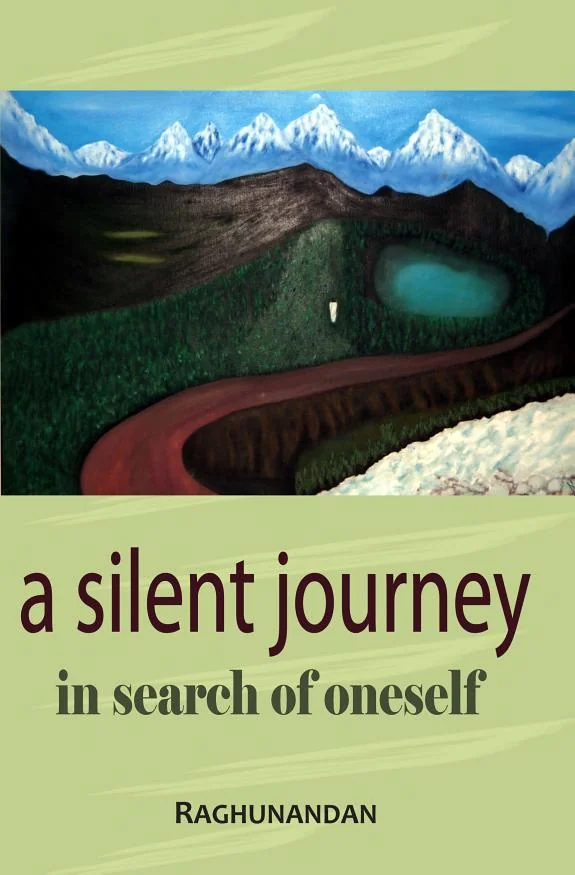
A Silent Journey
 71
71

A Silent Journey
Raghunandan's A Silent Journey offers a candid look at the internal landscape of spiritual seeking. The author rightly identifies that the true obstacles are often not external but deeply rooted within the seeker's own consciousness. A notable strength lies in its direct acknowledgment of the 'spirit of inquiry' and the common, almost instinctual, ways it is suppressed. The book's attempt to map the seeker's path, particularly the difficulties encountered, is commendable. However, the initial chapters, while setting a necessary foundation, could benefit from more concrete examples to illustrate the abstract nature of 'brushing aside' inquiry. The concept of 'subheccha' is well-articulated as the genesis of the journey, but its practical manifestation requires deeper exploration. Overall, the work provides a thoughtful, albeit sometimes general, commentary on the internal dynamics of spiritual development, offering a companion for those who feel the call to self-understanding.
📝 Description
71
Raghunandan's 2008 book, A Silent Journey, addresses the human tendency to ignore inner calls for self-inquiry.
A Silent Journey, published in 2008, acts as a guide for individuals on a spiritual path. It recognizes the common human habit of dismissing inner prompts for self-examination. The book aims to clarify the hidden difficulties and internal barriers that arise during the process of self-discovery. Raghunandan suggests that direct guidance is uncommon, and a written account of these struggles can help sincere seekers.
This work is for those feeling spiritual curiosity but lacking direction. It speaks to people who have begun their search and met obstacles, or who feel alone in seeking meaning. Readers interested in the internal experience of spiritual seeking, especially subtle hesitations and the nature of true spiritual ambition, will find it relevant. It is for the introspective person who understands the need for self-knowledge.
Published in 2008, A Silent Journey situates itself within a continued interest in Eastern philosophies and self-help literature. It draws from traditions like Vedanta and Buddhism, which emphasize inner exploration. Raghunandan's work focuses on the psychological and emotional hurdles faced by the seeker. This theme echoes the writings of 20th-century spiritual figures such as Paramahansa Yogananda and Swami Vivekananda, who also discussed the internal struggles of spiritual practice.
💡 Why Read This Book?
• Gain clarity on the initial stages of spiritual seeking, understanding the concept of 'subheccha' (right desire) as described in the book, which is crucial for initiating self-inquiry. • Learn to identify and navigate the common internal obstacles that arise during the search for oneself, as detailed in the book's narrative of the seeker's challenges. • Understand the role of contemplation ('vicharana') in discerning spiritual truths, a process the book illuminates for those grappling with doubt and mental resistance.
⭐ Reader Reviews
Honest opinions from readers who have explored this book.
❓ Frequently Asked Questions
What is the core message of Raghunandan's 'A Silent Journey'?
The core message is that the spiritual journey begins with an inner 'spirit of inquiry' that is often ignored. The book aims to guide seekers by acknowledging and explaining the internal difficulties they face on the path to self-discovery, serving as a companion through these challenges.
When was 'A Silent Journey' first published?
'A Silent Journey' by Raghunandan was first published on January 1, 2008.
What esoteric concepts does 'A Silent Journey' explore?
The book explores concepts like 'subheccha' (right desire or aspiration) as the starting point for spiritual seeking, and 'vicharana' (contemplation or discursive thought) as a tool for self-inquiry and discerning truth.
Who would benefit most from reading 'A Silent Journey'?
Individuals who feel the initial stirrings of spiritual curiosity but are unsure how to proceed, those who have encountered internal obstacles in their self-discovery, and readers seeking to understand the psychological aspects of spiritual development would find this book beneficial.
Does the book offer practical exercises for spiritual growth?
While the book focuses on explaining the internal landscape and challenges of the spiritual seeker, its narrative approach aims to provide a framework for understanding and navigating these inner difficulties, implicitly guiding the reader's practice.
What is the significance of the title 'A Silent Journey'?
The title suggests that the profound journey of self-discovery is often an internal and quiet process, taking place within one's consciousness rather than through outward displays or loud pronouncements. It emphasizes introspection and personal experience.
🔮 Key Themes & Symbolism
The Ignored Spirit of Inquiry
This theme addresses the initial call towards self-knowledge that individuals often suppress. Raghunandan highlights how societal pressures, mundane distractions, and inherent mental inertia can cause the 'spirit of inquiry' to be dismissed. The book argues that recognizing and nurturing this initial spark, termed 'subheccha', is the crucial first step in any genuine spiritual or self-exploratory endeavor, setting the stage for the deeper internal work that follows.
Obstacles on the Seeker's Path
A central focus is the documentation of the difficulties encountered by those on the path of self-discovery. Unlike external challenges, these are primarily internal – mental resistances, doubts, and the subtle ways the ego deflects true introspection. The book serves as a companion by narrating these common struggles, validating the seeker's experience and offering a sense of shared journey, thereby reducing feelings of isolation.
The Role of Aspiration and Contemplation
The work elaborates on 'subheccha' as the foundational aspiration and 'vicharana' as the active process of contemplation and discernment. It explains how right desire fuels the journey, while thoughtful inquiry helps to navigate illusions and arrive at clearer understanding. This interplay is presented as essential for progressing beyond mere intellectual curiosity to genuine spiritual insight.
The Book as a Spiritual Guide
Positioned as an accessible aid, the book itself is presented as a means to quench spiritual thirst when direct guidance is unavailable. It aims to clarify the often-esoteric nature of spiritual seeking by providing a relatable narrative. This function highlights the enduring value of literature in transmitting wisdom and supporting personal transformation across generations.
💬 Memorable Quotes
Direct passages from the work, attributed to the author.
“The spirit of inquiry knocks at the door of our consciousness many times. But we conveniently brush it aside.”
— This opening statement captures the book's premise: the innate human drive for deeper meaning is often suppressed by habit and distraction, marking the beginning of the internal conflict explored.
“when we do nurture it, only a few of us are fortunate enough to come across a person who can clarify our doubts or quench our spiritual thirst.”
— This highlights the scarcity of direct spiritual teachers and positions the book as a potential substitute, acknowledging the seeker's need for guidance when personal mentors are not readily available.
“if a book is made available, which narrates some of the difficulties the seeker faces during his/her search of oneself, it might be of great help.”
— This articulates the book's core purpose: to serve as a textual companion that maps the challenges of self-discovery, offering solace and direction through shared experience.
“And this book is an attempt in this direction. Explaining how aspiration (subheccha)”
— This clearly states the author's intention to address the foundational element of 'subheccha' – right desire – as the starting point for the spiritual journey detailed within the text.
“The spirit of inquiry knocks at the door of our consciousness many times.”
— Interpretation: This recurring idea emphasizes the persistent nature of the soul's yearning for truth, suggesting that the call to self-awareness is a fundamental aspect of human existence, often present but unheeded.
🌙 Esoteric Significance
Tradition
While not explicitly aligning with a single esoteric lineage, A Silent Journey draws heavily from the Indic traditions, particularly Vedanta and Yoga philosophy, which emphasize self-inquiry ('vicharana') and the nature of consciousness. The concept of 'subheccha' (right aspiration) is a key component in many spiritual paths seeking liberation or self-realization, fitting within a broad non-dualistic framework common in Eastern esotericism.
Symbolism
The primary 'symbol' is the journey itself, representing the internal process of transformation. 'Aspiration' ('subheccha') functions as the guiding star or initial spark, while 'difficulties' symbolize the internal obstacles – the ego, attachments, and mental conditioning – that must be overcome. The 'silence' in the title points towards introspection and the unmanifest nature of true self-knowledge.
Modern Relevance
Contemporary discussions on mental wellness, mindfulness, and the 'spiritual but not religious' movement echo the book's themes. Thinkers exploring the psychology of consciousness and self-development, particularly those influenced by Eastern thought, find resonance in its focus on internal barriers. The book's emphasis on the journey itself remains relevant in an era where instant gratification is common, promoting patience and introspection.
👥 Who Should Read This Book
• Individuals beginning their spiritual or self-discovery journey who feel unsure how to start or are encountering internal resistance. • Seekers who have been on a path for some time but feel stuck or confused by their own mental obstacles and doubts. • Readers interested in the psychological and philosophical underpinnings of spiritual aspiration, particularly those drawn to concepts from Indic traditions like Vedanta.
📜 Historical Context
Published in 2008, A Silent Journey emerged within a landscape rich with spiritual literature, a continuation of the interest sparked by figures like Swami Vivekananda in the late 19th century and Paramahansa Yogananda in the mid-20th century. This period saw a significant cross-pollination of Eastern spiritual concepts into Western self-help and philosophical discourse. While Raghunandan’s work focuses on the internal psychological journey, it exists alongside the burgeoning mindfulness movement and contemporary explorations of consciousness. Unlike more academic treatises on comparative religion or specific yogic lineages, this book adopts a more accessible, narrative-driven approach to the challenges of self-inquiry. Its publication predates the widespread digital saturation of spiritual content, positioning it as a more grounded textual resource for seekers at the time.
📔 Journal Prompts
The 'spirit of inquiry' as a recurring inner call.
Recognizing and naming instances of 'subheccha' in your life.
Describing a personal 'difficulty' on the path of self-discovery.
Reflecting on the role of 'vicharana' in clarifying your understanding.
How the 'search of oneself' manifests in daily life.
🗂️ Glossary
Subheccha
A Sanskrit term often translated as 'right desire', 'good intention', or 'wholesome aspiration'. It signifies the initial, genuine impulse towards spiritual seeking or self-knowledge, distinct from mere curiosity or worldly ambition.
Vicharana
A Sanskrit term referring to contemplation, discursive thought, reasoning, or investigation. In spiritual contexts, it denotes the process of actively examining one's thoughts, beliefs, and the nature of reality to gain deeper understanding.
Spirit of Inquiry
The innate human drive or curiosity that prompts individuals to question the nature of existence, their place in the world, and the deeper meaning of life. It is the foundational impulse for spiritual and philosophical exploration.
Consciousness
The state of being aware of and responsive to one's surroundings; the totality of sensations, thoughts, feelings, and volitions. In spiritual literature, it often refers to the fundamental field of awareness within which all experiences arise.
Seeker
An individual actively engaged in the pursuit of spiritual truth, self-knowledge, or enlightenment. The term implies a journey characterized by earnest inquiry, introspection, and a desire for deeper understanding.
Self-Discovery
The process of gaining a deeper understanding of one's own character, motivations, and true nature. It involves introspection, self-reflection, and often confronting personal limitations and potentials.
Spiritual Thirst
A profound inner longing or yearning for meaning, truth, or connection with the divine or ultimate reality. It is often experienced as a deep dissatisfaction with superficial existence.
This book appears in 1 collection
🔮 Readers Also Liked
Browse all →









From the “Upanishads” Collection
View all →






More Free Occult Philosophy Books
View all →