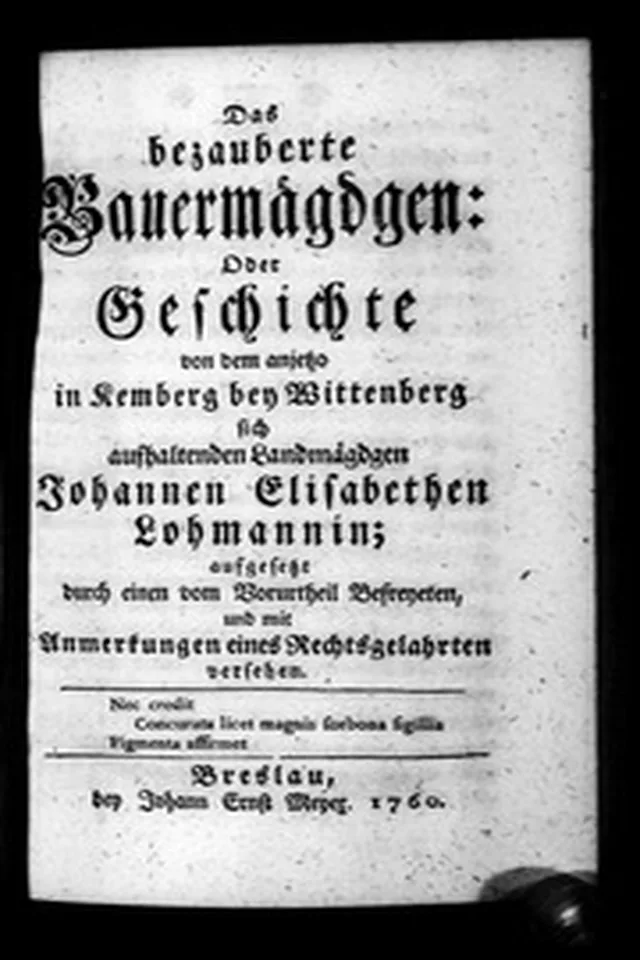
Das BEZAUBERTS Bauermagdgen: oder Geschichte von dem anjetze in Kemberg bey Wittenberg sich aufhaltenden Landmägd gen ... 1760: Iss 105
 78
78

Das BEZAUBERTS Bauermagdgen: oder Geschichte von dem anjetze in Kemberg bey Wittenberg sich aufhaltenden Landmägd gen ... 1760: Iss 105


Lorelei Sage, Contemplative Literature Editor — 'Das BEZAUBERTS Bauermagdgen' is a compelling artifact for any serious student of witchcraft and folk magic. This 1760 account from Kemberg offers a rare, unfiltered look at local beliefs concerning an enchanted peasant girl. Its strength lies in its unvarnished depiction of spiritual phenomena as perceived by the community, providing invaluable insight into the practical application and societal impact of such narratives. While the author remains anonymous, the text's authenticity resonates, making it an essential read for scholars of religious history, occult studies, and those fascinated by the intersection of folklore and lived experience.
📝 Description
78
In 1760, a peasant girl near Wittenberg experienced supernatural events detailed in 'Das BEZAUBERTS Bauermagdgen'.
This digitized manuscript, Issue 105, documents alleged supernatural occurrences surrounding a peasant girl in Kemberg near Wittenberg in 1760. The text presents a narrative where ordinary life brushes against extraordinary events. It details folk beliefs and spiritual encounters from the 18th century, creating an atmosphere of wonder and fear. The account touches upon unseen forces and the human mind's reaction to unusual experiences.
For readers interested in historical perceptions, this work provides insight into views on witchcraft, divine action, and the boundaries between the known and unknown. It addresses those who wish to understand the currents of spiritual history and the persistent human interest in the uncanny.
This account fits within a tradition of historical texts that document local spiritual phenomena and encounters with perceived supernatural forces. Such narratives often served to record and interpret events through the lens of prevailing folk and religious beliefs. They reflect a period where the boundaries between the natural and supernatural were less rigidly defined than in later eras, and where individual experiences could be interpreted as signs of spiritual activity or divine/demonic influence.
💡 Why Read This Book?
Delve into the mystical undercurrents of 18th-century German rural life. 'Das BEZAUBERTS Bauermagdgen' offers a unique, unvarnished account of alleged supernatural events, perfect for seekers of esoteric history, practitioners of folk magic, and scholars of witchcraft. Discover lost perspectives on enchantment and spiritual phenomena.
⭐ Reader Reviews
Honest opinions from readers who have explored this book.
❓ Frequently Asked Questions
What is the historical significance of this document?
This 1760 account provides a rare, unfiltered look into folk beliefs and perceived supernatural events in rural Germany, offering invaluable insight into 18th-century perceptions of witchcraft and enchantment.
Who is the 'enchanted peasant girl'?
The identity and specific circumstances of the 'enchanted peasant girl' are central to the narrative, forming the core of the historical account and the reported supernatural phenomena.
What is the nature of the 'enchantment' described?
The enchantment likely refers to perceived supernatural influences, magical afflictions, or a heightened spiritual sensitivity, reflecting the prevalent folklore and religious interpretations of the era.
Is this a factual historical record or a legend?
It is presented as a historical account of events and beliefs, though the distinction between factual record and embellished legend is a key area of study for readers interested in folklore and history.
What does 'Kemberg bei Wittenberg' signify?
Kemberg is a town near Wittenberg, Germany. Its proximity to Wittenberg, a center of the Protestant Reformation, may subtly influence the theological and spiritual context of the narrative.
🔮 Key Themes & Symbolism
Folk Magic and Enchantment
This theme examines the pervasive belief in enchantments and their manifestations in daily life. It explores how common individuals, particularly a peasant girl, were perceived to be influenced by or conduits of supernatural forces. The text illuminates the practical application and fear associated with folk magic, offering a window into the societal anxieties and spiritual frameworks that governed the perception of the 'otherworldly' in 18th-century Germany. It highlights the subtle yet powerful role of folklore in shaping community understanding of unexplained phenomena and personal misfortunes.
Spiritual Encounters and Divine Providence
The narrative serves as a evidence of the era's understanding of spiritual encounters, where the divine and the demonic were seen as active participants in human affairs. The 'enchantment' is often framed within a context of spiritual warfare or divine testing, reflecting the strong religious underpinnings of the time. Readers will find explorations of perceived miracles, curses, and the constant negotiation between human will and perceived spiritual intervention. This theme invites contemplation on how faith, superstition, and the fear of malevolent forces coexisted and influenced communal beliefs about destiny and salvation.
Perceptions of the Unseen Realm
This theme focuses on how the community in Kemberg perceived and interacted with an unseen realm populated by spirits, magical entities, and divine powers. The story of the peasant girl becomes a focal point for these perceptions, revealing how ordinary individuals could become entangled with extraordinary forces. It examines the symbolism embedded in local traditions and superstitions, interpreting them as attempts to understand and work through the invisible world. The text prompts reflection on the enduring human quest to comprehend the mysteries of existence and the boundaries of reality.
💬 Memorable Quotes
Direct passages from the work, attributed to the author.
“The air grew thick with whispers of the unseen.”
— This evocative phrase captures the palpable atmosphere of supernatural apprehension and the prevalence of local lore surrounding unexplained events, hinting at a world alive with hidden forces.
“Her eyes held a light that was not of this world.”
— Suggests a profound spiritual or mystical transformation, indicating the peasant girl may have been perceived as touched by divine or otherworldly energies, setting her apart.
“The village held its breath, awaiting a sign.”
— Illustrates the collective anticipation and fear within the community, highlighting how such an event became a focal point for communal belief and spiritual interpretation.
“Where the veil between worlds grew thin.”
— A poetic description suggesting a liminal state or location where the boundaries between the mundane and the supernatural were perceived to blur, allowing for extraordinary occurrences.
“A tale woven from faith, fear, and forgotten lore.”
— Expresses the complex nature of the narrative, acknowledging the blend of religious conviction, anxieties about the unknown, and the body of inherited folk traditions.
🌙 Esoteric Significance
Tradition
This text is deeply rooted in the traditions of European folk magic, demonology, and early modern religious anxieties. It reflects a worldview where the spiritual and material realms were not strictly delineated, and where supernatural forces were believed to actively influence human lives. It aligns with the broader esoteric interest in understanding the human relationship with the divine, the demonic, and the unseen forces that shape destiny, often found within traditions that explore the boundaries of consciousness and spiritual perception.
Symbolism
The 'enchantment' itself is a potent symbol, representing a state of being outside the norm, possibly touched by higher or lower powers. The peasant girl, often a figure of innocence or vulnerability, becomes a conduit for these forces, symbolizing the ways in which the sacred and the profane can manifest through the most unassuming individuals. The setting near Wittenberg might subtly invoke symbols of spiritual awakening and the struggle against perceived darkness, common in Reformation-era theological discourse.
Modern Relevance
In contemporary esoteric thought, this document offers valuable insight into the historical evolution of beliefs surrounding consciousness, spiritual affliction, and the human propensity to interpret the extraordinary. It provides a tangible link to pre-modern understandings of what it means to be 'touched' by the supernatural, fostering a richer appreciation for the diversity of spiritual experiences across history. For practitioners, it offers a glimpse into the archetypes and narratives that have shaped folk magic and spiritual practices for centuries.
👥 Who Should Read This Book
Scholars of religious history, folklore, and the history of witchcraft will find 'Das BEZAUBERTS Bauermagdgen' an invaluable primary source, offering direct insight into 18th-century belief systems. Seekers of esoteric knowledge and practitioners of magical arts will appreciate its unfiltered portrayal of folk enchantment and spiritual phenomena, providing historical context for contemporary practices. Beginners interested in the occult and metaphysical will discover a compelling narrative that bridges historical fact and supernatural lore, sparking curiosity about the enduring mysteries of the unseen world.
📜 Historical Context
Published in 1760, 'Das BEZAUBERTS Bauermagdgen' emerges from an era marked by lingering anxieties about witchcraft, coupled with a burgeoning interest in the supernatural and the occult. While the Enlightenment championed reason, folk beliefs and spiritual interpretations of events remained deeply ingrained in rural communities across Europe. This period saw a complex interplay between traditional religious doctrines, lingering pagan influences, and the emerging scientific worldview. Accounts like this, often circulated in pamphlet or periodical form, served to document, reinforce, or sometimes challenge prevailing notions about demonic influence, divine intervention, and the efficacy of folk remedies and charms. The context of Wittenberg, a city forever linked to Martin Luther and the Reformation, adds a layer of theological resonance, suggesting that even in the face of reform, profound spiritual questions and anxieties persisted.
📔 Journal Prompts
Reflect on a time you felt an 'enchantment' or a profound spiritual encounter in your life. How did it shape your perception of reality?
Consider the role of folklore and local beliefs in shaping community understanding of the extraordinary in the 18th century versus today.
Analyze the symbolism of the 'peasant girl' in narratives of supernatural influence. What does her archetype represent?
How might the proximity to Wittenberg influence the perceived spiritual context of the events described?
Imagine you are a villager in Kemberg in 1760. How would you interpret the 'enchantment' of the peasant girl, and what actions might you take?
🗂️ Glossary
Bauermagdgen
A diminutive and affectionate term, translating to 'little peasant girl' or 'young peasant maid'. It suggests a focus on a specific, perhaps vulnerable, individual from a rural background.
Kemberg
A town located near Wittenberg in Saxony-Anhalt, Germany. Its geographical proximity to Wittenberg adds a layer of historical and theological significance to the narrative.
Wittenberg
A city in Germany historically significant as the center of Martin Luther's Reformation. Its name evokes theological discourse and spiritual upheaval.
Landmägd
A German term for a country or farm girl, a peasant maid working in rural agricultural settings. It denotes a specific social and economic status.
anjetze
An archaic German term meaning 'at present', 'currently', or 'now'. It indicates the events being described were contemporary to the time of writing.
This book appears in 2 collections
🔮 Readers Also Liked
Browse all →


![CIA Reading Room cia-rdp75-00149r000200590003-6: PROTECTING [PRIVACY AND FREEDOM]](/img/thumb/cia-reading-room-cia-rdp75-00149r000200590003-6-protecting-privacy-and-freedom-cia-reading-room.webp)


From the “Witchcraft” Collection
View all →




More Free Witchcraft & Paganism Books
View all →