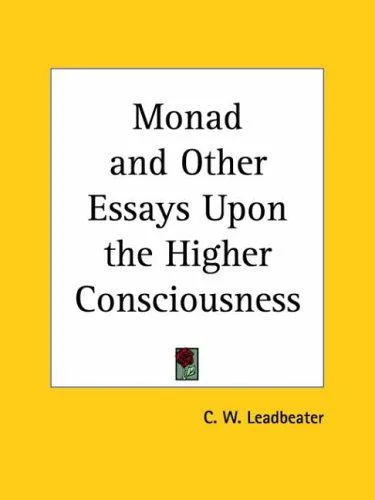
Monad and Other Essays Upon the Higher Consciousness
 75
75

Monad and Other Essays Upon the Higher Consciousness
Charles Leadbeater’s "Monad and Other Essays Upon the Higher Consciousness" offers a dense, intricate exploration of Theosophical doctrines concerning consciousness. The strength of the work lies in its systematic approach to complex metaphysical ideas, particularly its detailed mapping of the planes of existence. Leadbeater’s exposition on the Monad, the immutable spiritual self, provides a conceptual anchor for understanding spiritual evolution. However, the book’s primary limitation is its opacity to the uninitiated; the sheer volume of specialized terminology and the assumption of prior knowledge can create significant barriers. A particularly illustrative passage discusses the distinct vibrations of the mental and astral planes, a concept central to his system but requiring careful parsing. The work is an important document of early 20th-century Theosophy but demands considerable reader effort. It is a scholarly treatise for dedicated students of esoteric thought, rather than an accessible introduction.
📝 Description
75
Charles Webster Leadbeater's 1920 essays, 'Monad and Other Essays Upon the Higher Consciousness,' examine advanced awareness and existence beyond the physical.
This collection of essays by Charles Webster Leadbeater, first published in 1920, addresses advanced states of awareness and subtle planes of existence. It is not a story but a structured explanation of metaphysical ideas. Leadbeater's writing uses specialized terms, showing his deep involvement with Theosophy, and aims to help readers understand consciousness and its potential more broadly. The book is for people already studying esoteric philosophy, especially within Theosophy. It assumes a basic understanding of concepts such as astral and mental planes, and the ego. Those looking for a detailed, though difficult, study of consciousness beyond the physical will find its analyses useful. It is not for casual readers or those new to metaphysical study.
The essays discuss the Monad, seen as the divine spark in each person, and its connection to lower consciousness. Leadbeater describes the different levels of mental and astral bodies, spiritual growth, and the perception of subtle energies. The book presents a systematic exploration of consciousness beyond the physical realm.
Published in 1920, 'Monad and Other Essays' emerged during a period of widespread questioning of materialism and increased interest in spiritualism and occultism following World War I. Leadbeater, a prominent figure in the Theosophical Society, contributed to a milieu where thinkers like Rudolf Steiner were developing spiritual science systems. This work engages with Theosophical concepts during a time of searching for alternative explanations of reality and expanding spiritual understanding.
⭐ Reader Reviews
Honest opinions from readers who have explored this book.
❓ Frequently Asked Questions
What is the "Monad" as described by Charles Leadbeater?
In Leadbeater's "Monad and Other Essays," the Monad represents the eternal, divine spark within each individual. It is the ultimate spiritual principle, distinct from the personality and the ego, serving as the source of consciousness and the driving force behind spiritual evolution.
When was "Monad and Other Essays Upon the Higher Consciousness" first published?
The book "Monad and Other Essays Upon the Higher Consciousness" by Charles Webster Leadbeater was first published in 1920, placing it within the early 20th-century wave of esoteric literature.
What kind of knowledge is assumed for readers of this book?
Readers are expected to have a familiarity with Theosophical concepts, including the existence of astral and mental planes, the nature of reincarnation, and the basic structure of the human subtle bodies, as Leadbeater builds upon these premises extensively.
Does the book offer practical exercises for developing higher consciousness?
While the book focuses on explaining the *nature* and *structure* of higher consciousness, it primarily offers theoretical understanding rather than explicit step-by-step practical exercises. The "exercises" are more in the realm of mental discipline and conceptual assimilation.
Who were some of Leadbeater's contemporaries in the esoteric field?
Charles Leadbeater was active in the Theosophical Society alongside figures like Annie Besant and Helena Blavatsky. Other contemporaries exploring similar themes in different ways included Rudolf Steiner and Aleister Crowley.
🔮 Key Themes & Symbolism
The Nature of the Monad
Leadbeater elaborates on the Monad as the immutable, divine aspect of humanity, the true self residing on the highest planes of existence. This concept is central to understanding the process of spiritual evolution, positing that the lower aspects of consciousness (personality, ego) are vehicles through which the Monad expresses itself and learns. The essays detail the Monad's descent into manifestation and its eventual return, a core tenet in Theosophical cosmology, emphasizing its eternal nature beyond the cycles of birth and death.
Subtle Planes of Existence
A significant portion of the book is dedicated to delineating the various subtle planes, particularly the astral and mental bodies, which Leadbeater describes with intricate detail. He explains their composition, their distinct vibrational frequencies, and their functions in human experience and consciousness. Understanding these planes is presented as crucial for comprehending the mechanics of thought, emotion, and spiritual perception, forming a map for navigating inner realities.
Spiritual Evolution and Attainment
The essays outline a structured path of spiritual growth, moving from the limitations of the physical and lower astral realms towards the realization of higher consciousness. Leadbeater discusses the role of karma, reincarnation, and the development of specific faculties (like clairvoyance) as integral to this evolutionary process. The ultimate aim is the conscious union of the lower self with the Monad, a state of expanded awareness and divine knowledge.
The Higher Consciousness
This theme refers to states of awareness that transcend ordinary, ego-bound perception. Leadbeater presents higher consciousness not as a mystical fantasy but as a demonstrable reality accessible through specific stages of inner development. It involves the activation and integration of faculties that perceive subtler realities, leading to a profound understanding of the interconnectedness of all life and the divine purpose behind existence.
💬 Memorable Quotes
“The Monad is the divine spark in man.”
— This concise statement encapsulates Leadbeater's view of the Monad as the ultimate, sacred essence of an individual, distinct from the temporary personality and ego, serving as the root of all consciousness.
“The astral body vibrates at a much higher rate than the physical.”
— This highlights the fundamental difference between physical and astral matter, emphasizing the subtle nature and energetic qualities of the astral plane, which Leadbeater uses to explain emotions and desires.
“Meditation is the key to unlocking the higher mental faculties.”
— This paraphrased concept reflects Leadbeater's emphasis on the disciplined practice of meditation as the primary method for developing the capacity to perceive and interact with higher planes of consciousness.
“Our thoughts create our reality on the mental plane.”
— This interpretation conveys Leadbeater's teaching that the mental plane is not merely a passive space but an active realm where thought-forms have tangible existence and influence, shaping one's experience.
“Evolution is the unfolding of divine consciousness.”
— This paraphrased concept underscores Leadbeater's belief in a teleological process of spiritual growth, where the entire evolutionary journey is seen as the gradual manifestation of the Monad's inherent divine nature.
🌙 Esoteric Significance
Tradition
This work is firmly rooted in the Theosophical tradition, drawing heavily on the synthesis of Eastern (particularly Indian) and Western esoteric philosophies pioneered by Helena Blavatsky. It elaborates on concepts like the Monad, reincarnation, karma, and the layered nature of consciousness (physical, astral, mental, causal bodies) that are foundational to Theosophy. Leadbeater's contribution lies in his detailed, systematic exposition and his specific interpretations, which, while influential, sometimes diverged or expanded upon earlier Theosophical teachings.
Symbolism
The central symbol is the 'Monad,' representing the divine spark or threefold flame of Will, Love, and Intelligence within each being, often symbolized in occult traditions as a point within a circle or a triangle. Another key symbolic concept is the 'subtle bodies' (astral, mental), which function as vehicles for consciousness, often depicted as layered energetic fields or sheaths around the physical form. The 'planes' themselves—physical, astral, mental—act as symbolic landscapes of consciousness, each with its own laws and inhabitants.
Modern Relevance
Leadbeater's detailed descriptions of consciousness and subtle anatomy continue to influence modern esoteric practitioners, particularly within Theosophy-derived movements and some New Age circles. Thinkers and practitioners exploring energy healing, astral projection, and consciousness studies may reference his models. While sometimes seen as dated, his work provides a foundational vocabulary and conceptual framework for understanding non-physical realities that still informs contemporary discussions on consciousness and spirituality.
👥 Who Should Read This Book
["• Students of Theosophy seeking a deeper understanding of Charles Leadbeater's specific teachings on the Monad and consciousness.", '• Metaphysical researchers interested in the historical development of esoteric thought in the early 20th century and its conceptual frameworks.', '• Individuals exploring the nature of consciousness beyond the physical realm who appreciate detailed, systematic philosophical and psychological models.']
📜 Historical Context
Published in 1920, "Monad and Other Essays Upon the Higher Consciousness" arrived during a period of intense spiritual seeking in the aftermath of World War I. The Theosophical Society, co-founded by Helena Blavatsky in 1875, was a dominant force, and Charles Webster Leadbeater was one of its most prolific and influential writers. His work emerged within a broader occult revival alongside figures like Annie Besant, who championed the Society's teachings. This era saw significant interest in psychic phenomena, spiritualism, and alternative philosophies as people grappled with the perceived failures of materialism. Leadbeater's detailed mapping of subtle realms and consciousness contrasted with emerging psychological theories, such as those of Carl Jung, who also explored archetypes and the collective unconscious, albeit from a different theoretical standpoint. Leadbeater’s writings were widely disseminated but also faced scrutiny and controversy within and outside the Theosophical movement.
📔 Journal Prompts
The Monad's perceived connection to your waking consciousness.
Distinguishing between astral and mental plane experiences.
Identifying the energetic qualities of the astral body.
Leadbeater's concept of spiritual evolution.
The role of thought-forms on the mental plane.
🗂️ Glossary
Monad
The eternal, divine, and unchanging spiritual principle or spark within each individual, considered the true Self and the source of consciousness.
Astral Body
The subtle vehicle of emotion and desire, composed of finer matter than the physical body, which is active during sleep and in the astral plane.
Mental Body
The subtle vehicle of thought and intellect, composed of mental matter, responsible for cognitive processes and residing on the mental plane.
Higher Consciousness
States of awareness that transcend ordinary egoic perception, involving direct perception of subtle realities and a deeper understanding of universal principles.
Subtle Planes
Levels of existence or consciousness beyond the physical, such as the astral plane and the mental plane, each with its own distinct characteristics and inhabitants.
Spiritual Evolution
The process by which the individual consciousness (often seen as the Monad working through its vehicles) progresses through successive lifetimes and experiences towards greater wisdom, awareness, and divine realization.
Thought-form
An entity or construct created on the mental plane by the power of thought, which can have a temporary existence and influence.