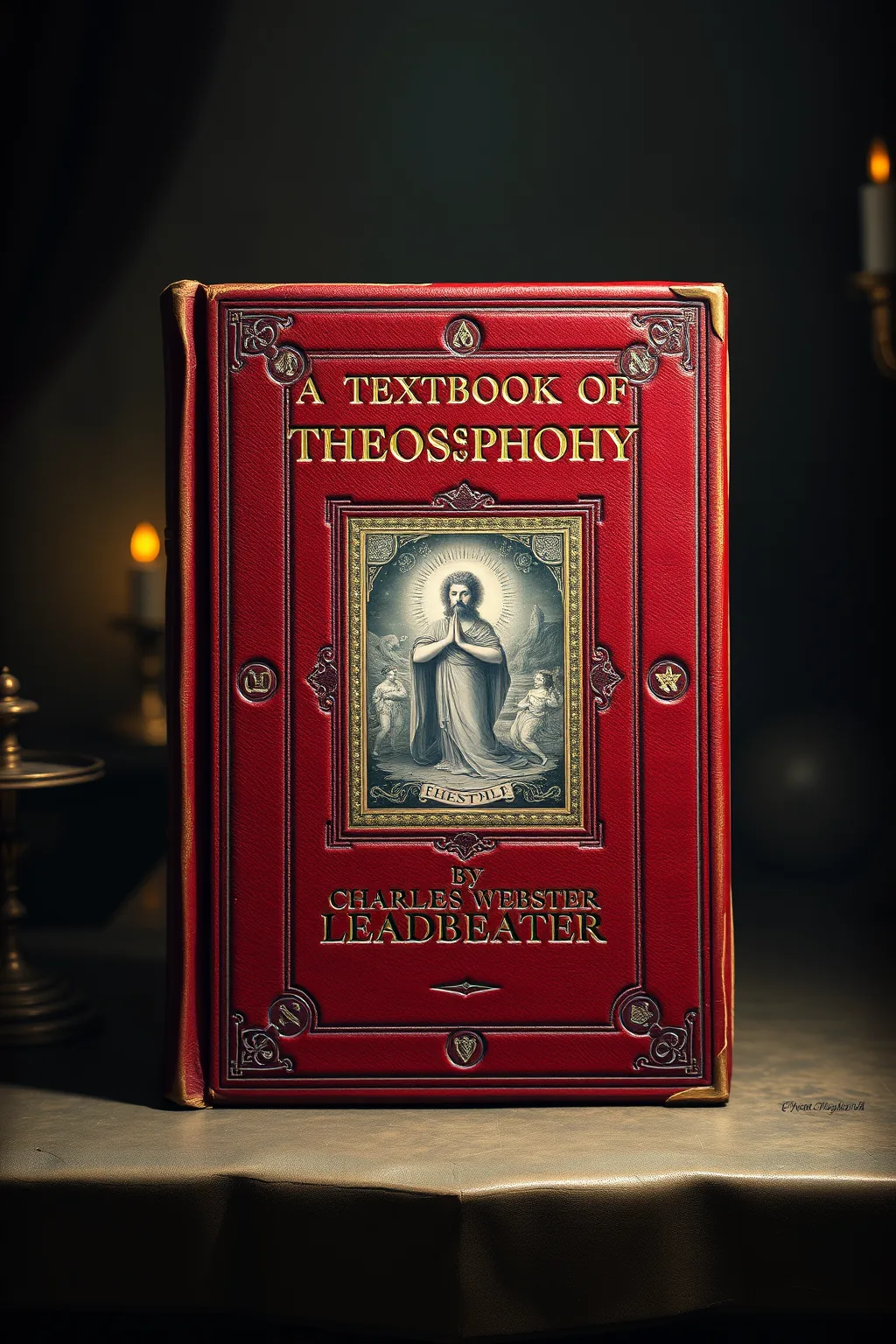
A Textbook of Theosophy
 71
71

A Textbook of Theosophy
Charles Webster Leadbeater's "A Textbook of Theosophy" functions as a meticulously organized primer, a stark contrast to the more sprawling and sometimes cryptic nature of Blavatsky's foundational texts. Its strength lies in its systematic approach, breaking down complex Theosophical cosmology into digestible components. The section detailing the different human 'bodies' – physical, astral, mental, and causal – provides a clear, if dense, framework for understanding spiritual anatomy. However, the book's clarity can sometimes border on dogmatism. Leadbeater presents his interpretations with an air of absolute certainty, which, while reassuring to some, may alienate readers seeking more room for personal exploration. For instance, his detailed descriptions of the Devachanic plane, while vivid, are offered as established fact rather than speculative interpretation. Ultimately, "A Textbook of Theosophy" is an indispensable reference for serious students of Theosophy, offering unparalleled systematic exposition, though its authoritative tone warrants critical engagement.
📝 Description
71
Charles Webster Leadbeater's 1912 "A Textbook of Theosophy" explains the core doctrines of the Theosophical Society.
Published in 1912, "A Textbook of Theosophy" by Charles Webster Leadbeater aims to present the fundamental teachings of Theosophy in a structured way. It serves as an entry point for readers new to the writings of Helena Blavatsky, offering explanations of concepts related to human nature, the cosmos, and the guiding spiritual forces behind evolution.
The book is written for students of esoteric philosophy, particularly those interested in the Theosophical Society's doctrines. It provides a step-by-step introduction to ideas such as karma, reincarnation, the different planes of existence, and the development of consciousness. Readers interested in comparative religion, the history of spiritualism, or occult studies from the early 20th century will find relevant material within its pages.
This work emerged during a period of Western fascination with spiritualism and Eastern philosophies. Theosophy, as a movement, sought to synthesize Western occult traditions with Eastern religions, often presenting itself as a universal wisdom. Leadbeater's book was part of this effort, contributing to the debates and discussions that characterized esoteric thought in the early 20th century.
💡 Why Read This Book?
• Gain a structured understanding of Theosophical cosmology, including the distinct human 'bodies' (physical, astral, mental, causal) as detailed in the text, offering a unique framework for self-study. • Grasp the mechanics of karma and reincarnation as presented by Leadbeater, moving beyond common interpretations to explore their role in spiritual evolution across vast cycles. • Familiarize yourself with the concept of the 'planes of existence,' a core Theosophical doctrine, providing insight into the multi-dimensional nature of reality as envisioned by the movement.
⭐ Reader Reviews
Honest opinions from readers who have explored this book.
❓ Frequently Asked Questions
What is the primary purpose of "A Textbook of Theosophy"?
The book serves as a comprehensive and systematic introduction to the core principles and doctrines of Theosophy, designed to clarify complex spiritual and philosophical concepts for students of the movement.
Who was C. W. Leadbeater and what is his significance in Theosophy?
Charles Webster Leadbeater was a prominent, albeit controversial, figure within the early Theosophical Society. He was a prolific writer and lecturer, known for his detailed expositions on Theosophical subjects, particularly clairvoyant investigations.
Does this book discuss the concept of karma?
Yes, "A Textbook of Theosophy" extensively explores the law of karma, explaining it as a fundamental principle of universal justice and the driving force behind reincarnation and spiritual evolution.
What are the 'planes of existence' mentioned in the book?
The book details various planes of existence beyond the physical, such as the astral, mental, and causal planes, describing them as different states of consciousness and environments through which consciousness evolves.
Is "A Textbook of Theosophy" suitable for absolute beginners?
While it aims for clarity, the subject matter is dense. It's best suited for those with some interest in esoteric philosophy or comparative religion, offering a more structured path than some of Blavatsky's original works.
When was "A Textbook of Theosophy" originally published?
The first publication date for "A Textbook of Theosophy" by C. W. Leadbeater was in 1912.
🔮 Key Themes & Symbolism
The Human Constitution
Leadbeater meticulously breaks down the complex idea of the human being, moving beyond the physical form to describe the subtle bodies: the etheric, astral, and mental bodies. He explains how these vehicles of consciousness function, interact with the physical world, and are involved in the process of reincarnation. The concept of the causal body, as the permanent aspect of the personality, is central to understanding the soul's journey through successive lives. This detailed exploration offers a framework for understanding the multi-layered nature of existence and personal evolution.
Karma and Reincarnation
Central to Theosophical doctrine, karma is presented not as fatalistic punishment but as the law of cause and effect governing spiritual progress. The book elaborates on how actions, thoughts, and intentions in one life inevitably shape the conditions and experiences of future lives. Reincarnation is depicted as the necessary mechanism through which the soul learns and evolves, progressing through the stages of human evolution across vast periods, guided by these karmic principles. This perspective offers a cosmic rationale for life's inequalities and challenges.
The Planes of Existence
The text introduces the concept of a cosmos composed of various 'planes' or dimensions, each with its own laws and inhabitants. Leadbeater describes the physical, astral, mental, and higher spiritual planes, detailing the nature of consciousness and experience on each. This framework helps to contextualize phenomena such as clairvoyance, death, and the afterlife, portraying them as transitions between these different levels of reality. Understanding these planes is crucial for comprehending the Theosophical model of the universe and spiritual development.
Spiritual Hierarchy and Evolution
Leadbeater expounds on the Theosophical belief in a guiding spiritual hierarchy, often referred to as the Masters or Mahatmas, who oversee humanity's evolutionary process. The book suggests that evolution is not a random occurrence but a directed, purposeful unfolding guided by these advanced beings. It outlines stages of evolution for both the individual and the planet, emphasizing the potential for humanity to ascend to higher states of being through understanding and applying universal laws.
💬 Memorable Quotes
Direct passages from the work, attributed to the author.
“The whole of evolution is a gradual unfolding of the divine plan.”
— This statement captures the Theosophical view of existence as a purposeful, directed process, rather than a chaotic or accidental phenomenon. It implies a cosmic intelligence and order guiding all life towards higher states of being.
“Karma is the unerring law of cause and effect.”
— This concisely defines karma within the Theosophical framework, emphasizing its impersonal and precise nature. It suggests that every action has a predictable consequence, forming the basis of moral responsibility and spiritual growth.
“Man is not a single entity, but a complex being composed of many vehicles.”
— This highlights a core Theosophical concept: the layered nature of human existence. It points to the existence of subtle bodies (astral, mental, etc.) in addition to the physical, which are essential for understanding consciousness and reincarnation.
“The planes are distinct states of consciousness.”
— This interpretation simplifies the complex idea of different cosmic realms. It emphasizes that these 'planes' are not just physical locations but fundamentally different ways of experiencing reality, tied to the evolution of consciousness.
“The spiritual evolution of man is guided by a higher intelligence.”
— This interpretation points to the belief in a spiritual hierarchy or Masters who actively participate in and direct the evolutionary journey of humanity, suggesting a benevolent cosmic oversight.
🌙 Esoteric Significance
Tradition
This work is firmly rooted in the Theosophical tradition, which itself draws heavily from Hermeticism, Neoplatonism, Buddhism, and Hinduism. Leadbeater's text attempts to present a coherent, rationalized system of this synthesized wisdom, focusing on the evolutionary path of consciousness. It departs from purely philosophical or religious treatments by incorporating empirical (albeit subjective) clairvoyant observation as a method of inquiry, characteristic of Leadbeater's specific approach within Theosophy.
Symbolism
The book frequently employs symbols integral to Theosophy. The 'Seven Rays,' representing divine energies influencing evolution, are a key concept, often symbolized by colors or numbers. The 'Tree of Life,' though more central to Kabbalah, finds echoes in the hierarchical structure of the cosmos and spiritual evolution described. The cyclical nature of time, often symbolized by the Ouroboros or the wheel, underpins the discussion of reincarnation and planetary chains, illustrating the grand, repeating patterns of cosmic and human development.
Modern Relevance
Leadbeater's systematic approach to the subtle bodies and planes of existence continues to influence New Age spirituality and modern esoteric thought. Concepts like energy fields, chakras (though not heavily detailed here, they are implied in the body system), and the multi-dimensional nature of reality echo in contemporary practices of energy healing, consciousness studies, and spiritual psychology. Thinkers and practitioners in fields ranging from transpersonal psychology to various forms of modern occultism often engage with or react to the foundational ideas presented in texts like this.
👥 Who Should Read This Book
• Students of Theosophy: Those seeking a structured, systematic explanation of the core doctrines of the Theosophical Society, including karma, reincarnation, and the nature of consciousness. • Explorers of Esoteric Philosophy: Individuals interested in comparative religion, occultism, and spiritualism who wish to understand a major 20th-century esoteric movement's foundational texts. • Researchers of Spiritual Movements: Academics or practitioners studying the history of Western esotericism and the impact of Theosophy on subsequent spiritual and New Age thought.
📜 Historical Context
Published in 1912, "A Textbook of Theosophy" emerged during a period of fervent spiritual seeking in the West, fueled by movements like Spiritualism and Theosophy itself. Helena Blavatsky's earlier works had introduced a complex synthesis of Eastern religions and Western esotericism, creating a significant intellectual and spiritual current. Charles Webster Leadbeater, a prominent Theosophist, aimed to systematize these teachings, making them more accessible. This era also saw figures like Annie Besant leading the Theosophical Society, expanding its reach. Leadbeater's work, while influential, was not without its critics; his detailed clairvoyant accounts and interpretations often sparked debate, even within Theosophical circles. Theosophy's attempt to present a 'universal wisdom' stood in contrast to both orthodox religious doctrines and the burgeoning scientific materialism of the time, attracting a diverse following seeking answers beyond conventional paradigms.
📔 Journal Prompts
The Man of the Monad's vehicles: How does the description of astral and mental bodies inform your understanding of emotions and thoughts?
Reflecting on karma: Consider a situation where cause and effect seem evident, connecting it to the principles outlined.
The nature of the planes: How might consciousness experience the astral plane distinctively from the physical?
Spiritual evolution: What personal steps could align with the concept of guided cosmic progress?
The causal body's role: How does the idea of a permanent personality vehicle affect your view of personal identity?
🗂️ Glossary
Theosophy
A spiritual philosophy founded in the late 19th century, seeking to synthesize Western occult traditions with Eastern religions, positing a universal wisdom underlying all faiths and sciences.
Astral Body
In Theosophy, a subtle body composed of finer matter than the physical, associated with emotions, desires, and experiences during sleep or after physical death.
Mental Body
The vehicle of thought and intellect in Theosophical cosmology, responsible for abstract reasoning, conceptualization, and the formation of ideas.
Causal Body
The permanent, higher body or soul-aspect that carries the karmic record and the essence of the individual consciousness through successive reincarnations.
Karma
The universal law of cause and effect, where actions, intentions, and thoughts in one life determine the circumstances and experiences of future lives.
Reincarnation
The process by which the soul or consciousness repeatedly takes birth in a physical body to learn lessons and evolve spiritually over multiple lifetimes.
Planes of Existence
Different levels or dimensions of reality, each characterized by specific types of matter and states of consciousness, through which beings evolve.