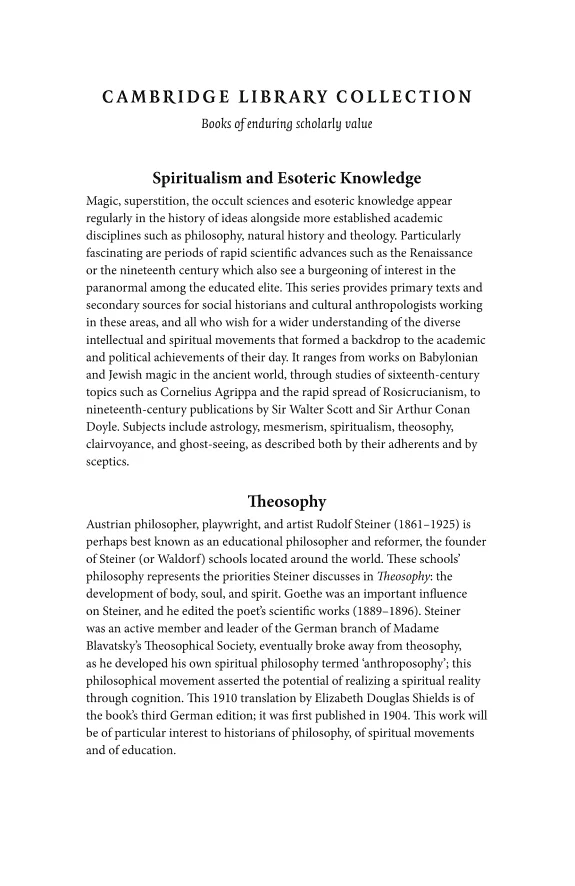
Theosophy
 71
71

Theosophy
Rudolf Steiner's "Theosophy" is an ambitious, if dense, attempt to systematize a spiritual cosmology. Its strength lies in the sheer intellectual architecture Steiner erects; he presents a universe governed by spiritual laws as rigorous as any physical science. The detailed descriptions of human evolution, planetary schemes, and the subtle bodies are meticulously crafted. However, the work's primary limitation is its often inaccessible prose and the sheer volume of specialized terminology, which demands significant reader commitment. Steiner's exposition of the etheric body, for instance, provides a unique conceptual tool for understanding life forces, yet requires careful study to grasp fully. The book's authority rests on Steiner's own claimed spiritual perceptions, which, while presented systematically, remain outside empirical verification. For dedicated students of esoteric thought, it offers a comprehensive, albeit challenging, roadmap of the spiritual worlds.
📝 Description
71
Rudolf Steiner's Theosophy, published in full in 1996, details his spiritual science known as Anthroposophy.
This book systematically outlines Rudolf Steiner's spiritual science, Anthroposophy. It details his cosmology, his views on human evolution, and the nature of consciousness. Steiner aimed to create a rigorous, scientific method for studying the supersensible realms. The work maps these invisible worlds and the processes of spiritual perception.
It is written for dedicated students of esoteric philosophy ready for in-depth conceptual work. The text is especially relevant for those tracing the origins of Anthroposophy and its separation from the earlier Theosophical Society. Readers interested in a structured intellectual framework for reincarnation, karma, and the long development of human consciousness will find considerable material. This is not an introductory text but a serious study of spiritual realities.
Rudolf Steiner's Theosophy arose from his work within the Theosophical Society, founded by Helena Blavatsky. Steiner led the German section until 1912, departing due to disagreements over spiritual authority and succession. His "Theosophy," published from 1904 and later compiled, articulates his distinct spiritual knowledge. This work separated from Blavatsky's "The Secret Doctrine" and the broader society's doctrines, which Steiner felt were becoming too materialistic.
💡 Why Read This Book?
• Understand the distinct evolutionary path of human consciousness as described by Rudolf Steiner, moving beyond general spiritual concepts to specific epochs like the Old Saturn and Old Sun periods. • Grasp the intricate mechanics of reincarnation and karma as presented in Steiner's "Theosophy," detailing how these forces shape individual destiny and collective progress through specific life cycles. • Explore the concept of the "etheric body" and its role in life processes, a unique contribution to esoteric anatomy that offers a different perspective on biology and vitality.
⭐ Reader Reviews
Honest opinions from readers who have explored this book.
❓ Frequently Asked Questions
What is the primary difference between Steiner's "Theosophy" and Blavatsky's teachings?
Steiner's "Theosophy" emphasizes a scientific, verifiable approach to spiritual knowledge, building upon but also diverging from Helena Blavatsky's foundational works. Steiner introduced concepts like the etheric body and distinct evolutionary stages like Old Saturn, offering a more detailed cosmology and path of development.
When was Rudolf Steiner's "Theosophy" first published as a complete work?
While parts were published earlier, "Theosophy" by Rudolf Steiner was compiled and published as a complete book in 1904, with later editions reflecting its ongoing development and dissemination.
Does "Theosophy" by Rudolf Steiner discuss reincarnation and karma?
Yes, the book provides an extensive explanation of reincarnation and karma, presenting them not as mere beliefs but as fundamental laws governing human evolution and destiny within Steiner's spiritual scientific framework.
What are the 'subtle bodies' mentioned in Steiner's "Theosophy"?
Steiner describes several subtle bodies that constitute the human being beyond the physical: the etheric body (life forces), the astral body (consciousness, feeling), and the 'I' or ego (spirit). The book details their nature and development.
Is this book suitable for beginners in esotericism?
While foundational, "Theosophy" is a dense work requiring sustained study. Beginners might find it more accessible after an introductory text on Anthroposophy or Steiner's general philosophy, as it delves deeply into complex spiritual scientific concepts.
What historical event led to Steiner's departure from the Theosophical Society?
Steiner departed the Theosophical Society in 1912 due to significant disagreements, particularly concerning leadership succession and spiritual authority, which led him to establish his own spiritual path, Anthroposophy.
🔮 Key Themes & Symbolism
Cosmic and Human Evolution
The work meticulously details a grand evolutionary scheme for both the cosmos and humanity. Steiner outlines distinct planetary stages, such as Old Saturn, Old Sun, and the current Earth period, describing how consciousness and form have developed through these phases. This evolutionary perspective extends to humanity's spiritual development, tracing the emergence of individual consciousness, memory, and the capacities for moral judgment across vast cosmic epochs. It posits that current human faculties are the result of immense, slow-moving spiritual processes.
The Fourfold Human Constitution
Steiner presents the human being as a complex entity composed of four distinct sheaths or bodies: the physical body, the etheric or life body, the astral body (seat of soul-life and consciousness), and the 'I' or ego (the core of individuality and spirit). "Theosophy" elaborates on the nature and function of each, explaining how they interact and develop. This model is crucial for understanding Steiner's views on health, disease, death, and the processes of spiritual transformation and reincarnation.
Spiritual Perception and Hierarchies
The book addresses the development of spiritual perception, or clairvoyance, as a natural, albeit latent, human capacity that can be cultivated through disciplined spiritual training. Steiner describes the existence of various spiritual hierarchies (e.g., Seraphim, Cherubim, Thrones) that guide cosmic and human evolution. "Theosophy" aims to make these invisible realms and beings accessible to conscious understanding, presenting them as integral parts of a living, intelligent universe rather than abstract concepts.
Reincarnation and Karma
Central to Steiner's "Theosophy" is the doctrine of reincarnation and karma, explained as a universal law of cause and effect. The book elucidates how past actions and experiences influence present lives and future incarnations, shaping individual destinies and the collective evolution of humanity. This perspective offers a framework for understanding suffering, personal growth, and the purpose of earthly existence as a continuous process of learning and spiritual refinement.
💬 Memorable Quotes
Direct passages from the work, attributed to the author.
“Theosophy is a path of knowledge that seeks to lead the spiritual in man to the spiritual in the universe.”
— This statement captures Steiner's core aim: to establish a 'spiritual science' that connects human inner life with the objective spiritual realities of the cosmos, validating esoteric study through rigorous, albeit supersensible, investigation.
“The human being is a fourfold being: physical body, etheric body, astral body, and the 'I'.”
— This foundational concept outlines Steiner's model of human constitution. It suggests that true human nature extends beyond the visible physical form, encompassing vital, sentient, and spiritual aspects that are essential for understanding life, death, and evolution.
“Evolution proceeds through a series of planetary incarnations.”
— This idea highlights the vast cosmic scope of Steiner's cosmology. It frames Earth's existence as one phase in a much larger cycle of planetary evolution, during which humanity and consciousness undergo successive transformations.
“Karma is the law of moral retribution and spiritual development.”
— This interpretation of karma emphasizes its dual function: not merely punishment for past deeds, but an essential mechanism for learning, growth, and spiritual advancement across lifetimes, guiding individuals towards self-realization.
“Spiritual perception can be cultivated through specific training and discipline.”
— This assertion positions spiritual awareness not as an exclusive gift, but as an achievable faculty. It implies that through dedicated inner work and study, individuals can develop the capacity to perceive the supersensible realms described in theosophy.
🌙 Esoteric Significance
Tradition
Steiner's "Theosophy" operates within the broader Western Esoteric Tradition, specifically building upon and reinterpreting the foundations laid by the Theosophical Society. While drawing from Hermetic, Gnostic, and Kabbalistic ideas, Steiner aimed to create a distinct spiritual science, Anthroposophy. He departed from Blavatsky's more exoterically presented doctrines by emphasizing a path of verifiable inner development and a detailed cosmology rooted in specific evolutionary stages and spiritual hierarchies.
Symbolism
Key symbols in "Theosophy" include the concept of the 'Tree of Life' reimagined through planetary evolution, representing cosmic genesis and development. The 'serpent' often symbolizes evolutionary forces, both positive and negative, while the 'cross' represents the intersection of the spiritual and material, particularly in human consciousness. Steiner also uses astronomical and alchemical motifs to depict stages of human and planetary development.
Modern Relevance
Contemporary thinkers and practitioners in fields like Waldorf education, biodynamic agriculture, and anthroposophical medicine draw directly from the principles outlined in "Theosophy." Its detailed cosmology and understanding of human development continue to inform spiritual seekers interested in a structured, scientific approach to the unseen worlds, influencing modern esoteric movements and alternative spiritual philosophies.
👥 Who Should Read This Book
• Students of Rudolf Steiner's philosophy seeking a foundational text for Anthroposophy, particularly those interested in his specific cosmology and evolutionary theories. • Researchers of Western Esotericism and comparative religion, to understand the historical development of the Theosophical movement and its offshoots. • Individuals interested in a systematic, non-dogmatic exploration of reincarnation, karma, and the nature of consciousness beyond materialistic explanations.
📜 Historical Context
Rudolf Steiner's "Theosophy," first published in full in 1904, emerged during a period of intense spiritual and philosophical ferment in Europe. The Theosophical Society, founded by Helena Blavatsky in 1875, had popularized Eastern esoteric concepts in the West, creating fertile ground for such works. However, Steiner's departure from the Society in 1912, partly due to internal schisms and his developing distinct spiritual teachings, marked a crucial divergence. His "Theosophy" presented a more systematized, anthroposophical interpretation of spiritual realities, differing from Blavatsky's "The Secret Doctrine." While figures like Annie Besant continued to lead the main Theosophical Society, Steiner forged his own path. His work engaged with contemporary scientific materialism by offering a spiritual counter-science, seeking to provide a rigorous, observable basis for the supersensible, a stark contrast to the more mystical or purely philosophical approaches prevalent at the time.
📔 Journal Prompts
The concept of the etheric body as described in "Theosophy."
The evolutionary journey of humanity through Old Saturn and Old Sun.
The relationship between karma and individual destiny.
The development of spiritual perception as a human faculty.
The roles of the different spiritual hierarchies in cosmic evolution.
🗂️ Glossary
Etheric Body
In Steiner's cosmology, the 'life body' or etheric body is the vehicle of life forces, responsible for growth, reproduction, and health. It is considered more subtle than the physical body and is the first non-physical layer of the human constitution.
Astral Body
The seat of consciousness, feelings, desires, and instincts. In Steiner's system, the astral body is responsible for subjective experience and is the vehicle through which the 'I' (ego) interacts with the world.
The 'I' (Ego)
The core of individual spiritual identity and consciousness. The 'I' is considered the highest principle in the human being, responsible for self-awareness, moral judgment, and spiritual development across lifetimes.
Old Saturn
The first stage in Rudolf Steiner's seven-stage planetary evolution cycle. During Old Saturn, rudimentary forms of substance and consciousness began to develop, laying the groundwork for subsequent stages.
Old Sun
The second stage of planetary evolution in Steiner's cosmology. Old Sun represents a phase where life forces became more distinct, and the beginnings of sentient consciousness emerged, preceding the Earth stage.
Spiritual Hierarchies
Orders of spiritual beings (e.g., Seraphim, Cherubim, Thrones, Archangels, Angels) that guide the evolution of the cosmos and humanity according to Steiner's teachings. Each hierarchy has specific roles in the spiritual governance of existence.
Karma
The law of cause and effect governing moral and spiritual development. In Steiner's view, karma is not simply retribution but a dynamic process that shapes individual destiny and facilitates soul growth through successive incarnations.