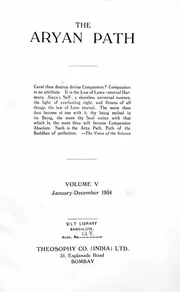
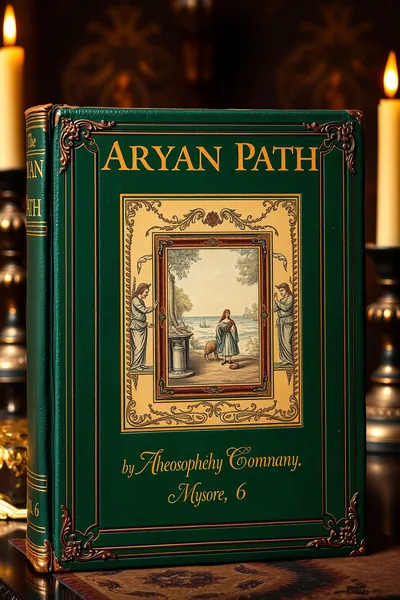
Aryan Path Vol. 5.1

 77
77

Aryan Path Vol. 5.1



Silas Hawthorne, Hermetic Studies Editor: 'The Aryan Path Vol. 5.1' is a testament to the enduring power of theosophical inquiry. This installment, curated by the Theosophy Company, offers a rich tapestry of thought, echoing the journal's original mission of fostering universal understanding and the study of ancient wisdom. Its strength lies in its balanced presentation of diverse philosophical and spiritual perspectives, encouraging readers to look beyond dogma. The bimonthly publication's commitment to exploring the 'why' behind human existence makes it an invaluable resource for serious students of metaphysics and comparative religion. An essential read for those seeking to deepen their comprehension of esoteric principles.
📝 Description
77
Volume 5.1 of The Aryan Path collects articles from the Anglo-Indian theosophical journal established in 1930.
This volume of 'The Aryan Path' gathers writings from the journal founded in 1930 by the Theosophy Company in Mysore, India. The journal's original editor, B.P. Wadia, aimed to encourage comparative study across world religions, philosophies, and sciences, seeking common threads of wisdom. The articles within this collection focus on universal brotherhood, a central tenet of theosophy, emphasizing unity beyond divisions of race, creed, or caste. It provides access to esoteric subjects, philosophical ideas, and the symbolic aspects of spiritual traditions.
The material here invites reflection on the interconnectedness of existence, the subtle forces influencing reality, and the enduring principles guiding consciousness development. This specific compilation is intended for individuals interested in a deeper understanding of philosophical and spiritual concepts, particularly those rooted in theosophical thought.
Emerging from the theosophical movement, 'The Aryan Path' journal, and by extension this volume, engages with ideas prevalent in the early to mid-20th century esoteric milieu. It connects to the broader theosophical project of synthesizing Eastern and Western spiritual and philosophical traditions, often focusing on concepts like universalism, hidden wisdom, and the underlying unity of diverse belief systems. The journal sought to bridge the gap between academic inquiry and spiritual seeking, addressing subjects that lay outside conventional religious or scientific discourse of the time.
💡 Why Read This Book?
Embark on a journey into the heart of ancient wisdom and universal truths. 'The Aryan Path Vol. 5.1' offers profound insights into comparative religion, philosophy, and the science of the soul. It is essential reading for spiritual seekers, scholars of esotericism, and practitioners aiming to integrate timeless principles into their lives. Discover the foundations of universal brotherhood and the interconnectedness of all existence.
⭐ Reader Reviews
Honest opinions from readers who have explored this book.
❓ Frequently Asked Questions
What is the primary focus of 'The Aryan Path Vol. 5.1'?
The primary focus is on exploring universal brotherhood, comparative study of religions, philosophies, and sciences, aiming to uncover hidden wisdom and foster spiritual understanding.
Who was B.P. Wadia?
B.P. Wadia was the inaugural editor of 'The Aryan Path' journal, instrumental in establishing its mission to promote the study of ancient and modern spiritual traditions.
What is the historical origin of 'The Aryan Path'?
The journal originated as an Anglo-Indian theosophical publication founded in Bombay, India, in 1930 by the Theosophy Company.
What is the intended audience for this volume?
The intended audience includes spiritual seekers, students of esoteric philosophy, scholars of comparative religion, and individuals interested in theosophical teachings and universal principles.
Is this volume a primary source for Theosophy?
Yes, it represents a significant collection of writings and discussions from a key period in theosophical journalism, offering primary insights into the movement's intellectual currents.
🔮 Key Themes & Symbolism
Theosophical Principles and Universal Brotherhood
This volume delves deeply into the core tenets of Theosophy, emphasizing the paramount importance of establishing a universal brotherhood of humanity. It explores how transcending distinctions of race, creed, sex, caste, and color is not merely an ideal but a practical necessity for spiritual evolution. The texts within illuminate the underlying unity of all religions and philosophies, presenting Theosophy as a path to understanding this unity and fostering harmonious coexistence. Readers will find discussions on the interconnectedness of all life, the ethical implications of spiritual knowledge, and the practical application of these principles in daily life, encouraging a profound shift in perspective towards global compassion and understanding.
Comparative Study of Ancient Religions and Philosophies
A central theme is the rigorous and respectful comparative study of world religions, philosophies, and sciences. 'The Aryan Path' acts as a bridge, connecting disparate traditions and revealing their common roots and overarching truths. The volume showcases how ancient wisdom, from East and West, offers clear insights into the nature of reality, consciousness, and the human condition. It encourages readers to move beyond sectarian dogma and embrace a broader, more inclusive understanding of spiritual and philosophical heritage. The articles explore symbolism, mythology, and ethical teachings, demonstrating the timeless relevance of these ancient systems in guiding contemporary spiritual development and intellectual inquiry.
The Pursuit of Esoteric Knowledge and Self-Realization
This collection serves as a gateway to esoteric knowledge, guiding seekers on the path to self-realization. It explores the subtle domains of consciousness, the nature of the soul, and the principles governing spiritual growth. The texts offer contemplative exercises, philosophical reflections, and insights into the hidden laws of the universe. The emphasis is on direct experience and inner transformation rather than mere intellectual assent. Readers are encouraged to engage with the material reflectively, applying its wisdom to their personal journey of awakening. The volume underscores the idea that true knowledge is not only acquired but lived, leading to a deeper understanding of oneself and one's place within the grand cosmic order.
💬 Memorable Quotes
Direct passages from the work, attributed to the author.
“To study ancient and modern religions, philosophies, and sciences.”
— This phrase emphasizes the journal's commitment to comprehensive, cross-disciplinary inquiry, seeking wisdom from all sources to illuminate the path of understanding.
“To demonstrate the importance of such study.”
— This underscores the practical and pedagogical intent behind the journal's content, aiming to prove the transformative power of spiritual and philosophical exploration.
“Without distinction of race, creed, sex, caste or color.”
— A powerful declaration of inclusivity, this phrase defines the ideal of universal brotherhood as one that actively dismantles all forms of prejudice and discrimination.
“Theosophy Company (Mysore) India - a clear source of ancient wisdom.”
— This identifies the publisher and hints at their role as a conduit for timeless spiritual knowledge, guiding readers towards deeper truths.
💡 Key Ideas
Editorial paraphrase of the work's core concepts — not direct quotes.
To form 'a nucleus of universal brotherhood of humanity'.
This quote captures the foundational mission of the journal, highlighting the aspiration to create a community united by shared spiritual ideals, irrespective of societal divisions.
🌙 Esoteric Significance
Tradition
This volume is deeply rooted in the Theosophical tradition, a modern esoteric movement that draws heavily upon ancient Eastern (primarily Indian and Buddhist) and Western mystical philosophies. It synthesizes elements from Neoplatonism, Gnosticism, Hermeticism, and Eastern philosophies like Vedanta and Buddhism, seeking to reveal the underlying unity of all spiritual teachings. Theosophy emphasizes the existence of a Universal Divine Principle, the spiritual evolution of all beings, and the interconnectedness of the cosmos, often communicated through allegories, symbolism, and the study of subtle planes of existence.
Symbolism
Symbolism is a central to the esoteric insights within 'The Aryan Path'. The lotus flower, representing spiritual unfolding and purity emerging from the mud of materiality, is frequently invoked. The serpent, symbolizing wisdom, eternity, and transformation, also appears. The texts often employ allegorical narratives and mythological figures to convey profound spiritual truths about the soul's journey, the cycles of creation and dissolution, and the hidden forces governing the universe. Understanding these symbols unlocks deeper layers of meaning, revealing the interconnectedness of the manifest and unmanifest worlds.
Modern Relevance
The exploration of universal brotherhood, ethical living, and the pursuit of inner wisdom remains profoundly relevant today. In an increasingly fragmented world, the call for unity and understanding championed by 'The Aryan Path' is more critical than ever. The volume's emphasis on comparative study offers a framework for interfaith dialogue and appreciating diverse perspectives. Furthermore, its focus on self-realization and the development of consciousness provides timeless guidance for individuals seeking meaning and spiritual growth amidst the challenges of modern life, offering a spiritual anchor in a rapidly changing global landscape.
👥 Who Should Read This Book
This volume is a treasure for the earnest spiritual seeker, offering a foundational understanding of theosophical principles and the interconnectedness of all wisdom traditions. Scholars of comparative religion, philosophy, and esoteric studies will find invaluable primary source material and insightful analyses. Practitioners of meditation and spiritual disciplines can glean clear insights to deepen their practice and understanding of the subtle realms. Beginners curious about theosophy, universalism, and the perennial philosophy will find a welcoming and useful introduction, while seasoned students will appreciate the depth and breadth of wisdom presented.
📜 Historical Context
Published during a vibrant period of intellectual and spiritual awakening in India, 'The Aryan Path' emerged in 1930, a time when theosophical thought was gaining significant traction globally. The journal, based in Bombay and later Mysore, served as a crucial Anglo-Indian bridge, disseminating theosophical teachings and fostering dialogue between Eastern and Western spiritual traditions. Founded by the Theosophy Company and initially edited by the influential B.P. Wadia, it aimed to counter prevailing materialism and sectarianism by promoting a holistic understanding of humanity, religion, and the cosmos. This era was marked by a resurgence of interest in ancient philosophies and mysticism, as India itself was undergoing profound social and political change. 'The Aryan Path' provided a platform for scholars, mystics, and thinkers to explore universal truths, making its contributions particularly resonant in a world grappling with modernity while seeking spiritual grounding.
📔 Journal Prompts
Reflect on the concept of 'universal brotherhood' in your own life. How can you actively foster it?
Choose a symbol from ancient traditions discussed in this volume and explore its potential deeper meanings.
Consider the relationship between ancient philosophies and modern scientific discoveries presented. What connections do you observe?
How does the emphasis on comparative study challenge your existing beliefs or understanding of spirituality?
What personal steps can you take towards self-realization based on the principles explored in this volume?
🗂️ Glossary
Theosophy
An esoteric philosophy that seeks to understand the underlying unity of all religions, philosophies, and sciences, emphasizing spiritual evolution and universal brotherhood.
Universal Brotherhood
The principle of the fundamental unity of all humanity, transcending distinctions of race, creed, sex, caste, or color, as a core tenet of spiritual and ethical living.
Esoteric
Relating to or being knowledge or information accessible only to a special group of initiated or highly instructed people; mystical or secret.
Metaphysics
The branch of philosophy that deals with the first principles of things, including abstract concepts such as being, knowing, substance, cause, identity, time, and space.
Perennial Philosophy
The view that all religions share a common metaphysical core, a universal truth or spiritual insight that lies at the heart of all traditions.
This book appears in 2 collections
🔮 Readers Also Liked
Browse all →






More by Theosophy Company (Mysore) India
All books →

From the “Theosophy” Collection
View all →




More Free Theosophy & Anthroposophy Books
View all →